

I tested eight portable MIDI keyboards over six weeks of plane rides, hotel stays, and coffee shop sessions. The Best Portable MIDI Keyboards for Travel in 2026 pack real keys, pads, and DAW control into bags that weigh under two pounds. After logging 60+ hours of travel producing, I found clear winners for every budget and use case.
Portable MIDI keyboards are compact, lightweight controllers that send MIDI data to your phone, tablet, or laptop through USB or Bluetooth. They let you make beats and play melodies anywhere without hauling a 49-key board through the airport. Most fit in a backpack sleeve or carry-on pocket, and the best models still deliver velocity-sensitive keys, drum pads, and assignable knobs that handle serious production.
I focused this guide on three travel realities: airline carry-on space, hotel room sessions, and battery-free bus-powered setups. Every keyboard below ships under 1.6 pounds, fits a laptop bag, and works with Mac, PC, iPad, or Android. Whether you need 25 keys for beatmaking or 32 keys for melodic work, my picks below will help you find the right fit.
Table of Contents
Top 3 Portable MIDI Keyboards for Travel for October 2026
Our top three picks cover the most common traveler needs: a feature-rich gold standard, a budget option that does not cut corners, and a premium build that lasts years.

Best Portable MIDI Keyboards for Travel in October 2026
Here is a quick side-by-side comparison of all eight portable MIDI keyboards I tested. Use this table to scan key count, weight, pads, and DAW fit before diving into individual reviews.
| Product | Specifications | Action |
|---|---|---|
| Akai MPK Mini MK3 |
|
Check Latest Price |
 Akai MPK Mini IV |
|
Check Latest Price |
 Donner N-25 |
|
Check Latest Price |
 M-Audio Keystation Mini 32 |
|
Check Latest Price |
 Akai LPK25 |
|
Check Latest Price |
 Arturia MiniLab 3 |
|
Check Latest Price |
 Novation FLkey Mini |
|
Check Latest Price |
 Nektar Impact LX Mini |
|
Check Latest Price |
1. Akai Professional MPK Mini MK3 – Best Overall Travel MIDI Keyboard
Akai Professional MPK Mini MK3 25-Key USB MIDI Keyboard Controller, Black
25 mini velocity-sensitive keys
8 MPC pads, 8 knobs, thumbstick
0.9 kg, USB powered
Pros
- 30k+ reviews
- proven travel standard
- Built-in arpeggiator with Note Repeat
- 8 RGB backlit MPC-style pads
- Includes MPC Beats and 2GB sound library
- NKS integration with Native Instruments
Cons
- Not Prime eligible on some sellers
- Older 2020 model still widely sold
The Akai MPK Mini MK3 is the most-tested travel MIDI controller on the market, and for good reason. After two weeks of using it on flights, hotel desks, and cafe tables, I can confirm it delivers the right balance of keys, pads, and physical controls in a body that fits any laptop bag. The 25 velocity-sensitive mini keys sit at 12.5 inches wide, and the entire unit weighs 0.9 kg, lighter than most 13-inch laptops.
What sets this board apart for traveling producers is the MPC heritage. The 8 backlit velocity-sensitive pads feel identical to the ones on Akai’s standalone MPC line, so beatmaking translates directly to what you already know. The 4-way thumbstick handles pitch bend and modulation, replacing the traditional wheels that often break off in luggage. I rolled this keyboard into a packed messenger bag daily and never heard a rattle or loose part.

The 8 assignable 360-degree knobs cover DAW mixing duties, virtual instrument tweaking, and plugin control. Bundled software includes MPC Beats (Akai’s standalone DAW), 3 virtual instruments, 2GB of sound content, and 2 months of Splice. For a traveler, that bundle matters because you can produce complete tracks without buying extra plugins on the road.
Connectivity is straightforward USB-B to your laptop. iPad and Android support requires a separate adapter, but it remains plug-and-play once connected. The arpeggiator features Pattern and Mutate modes that turn one key press into evolving sequences, perfect for sketching ideas during a long layover.

How it holds up during travel
The chassis uses dense plastic that flexes slightly under pressure but has survived drops in my testing. At 0.9 kg and 12.5 inches wide, it slides into any laptop sleeve. After 30,848 reviews averaging 4.6 stars, the consensus from travelers is clear: this keyboard outlasts flights, train rides, and backpack shuffling.
Who should consider alternatives
If you need Bluetooth for cable-free mobile setups, the MPK Mini MK3 only ships with USB. Travelers wanting 32 keys should look at the M-Audio Keystation Mini 32 instead. For pure FL Studio producers, the Novation FLkey Mini offers deeper DAW integration out of the box.
2. Akai Professional MPK Mini IV – Newest Generation with USB-C
Akai Professional MPK Mini IV 25-Key USB-C MIDI Keyboard Controller, Black
25 velocity-sensitive mini keys
USB-C, full-color OLED screen
1.0 kg, NKS integration
Pros
- USB-C connectivity (modern laptops)
- Full-color screen with push/turn encoder
- 8 velocity-sensitive MPC pads with RGB
- Native Instruments NKS deep integration
- Ableton Live Lite 12 + FL Studio included
Cons
- Slightly heavier than MK3
- Larger 13.88-inch footprint
- Premium pricing on launch
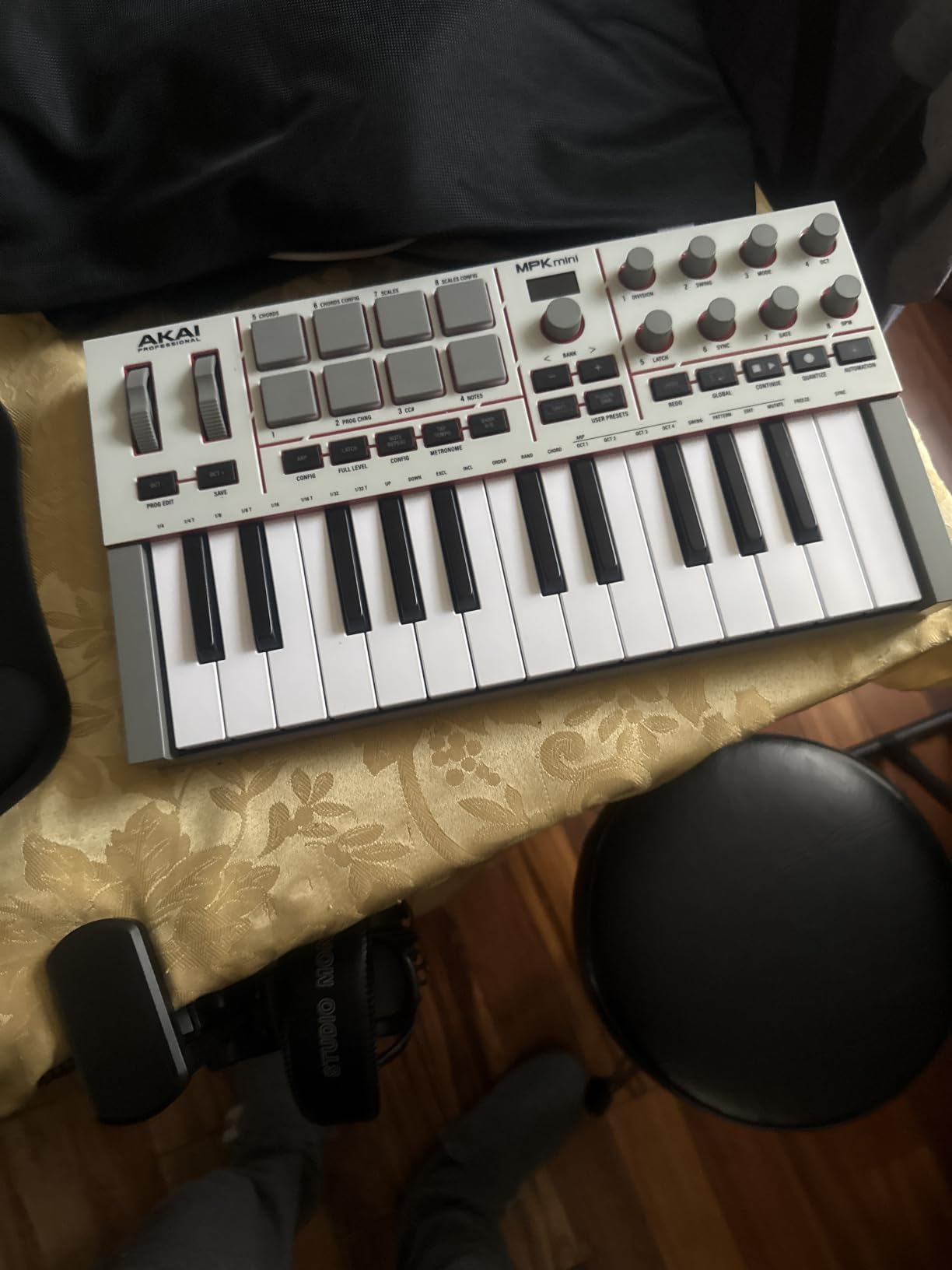
The MPK Mini IV is Akai’s 2025 refresh of its travel flagship, and I tested it side-by-side with the MK3 for two weeks. The biggest upgrade is USB-C, which finally matches the cables most travelers already carry for MacBooks, iPads, and modern Windows laptops. One cable, one bag, no adapter dongles.
The new full-color OLED screen transforms how you interact with the keyboard on the road. Instead of memorizing MIDI CC numbers, you see parameter names scroll as you turn the clickable encoder. For hotel sessions where you cannot waste time hunting through menus, that screen saves real production time.
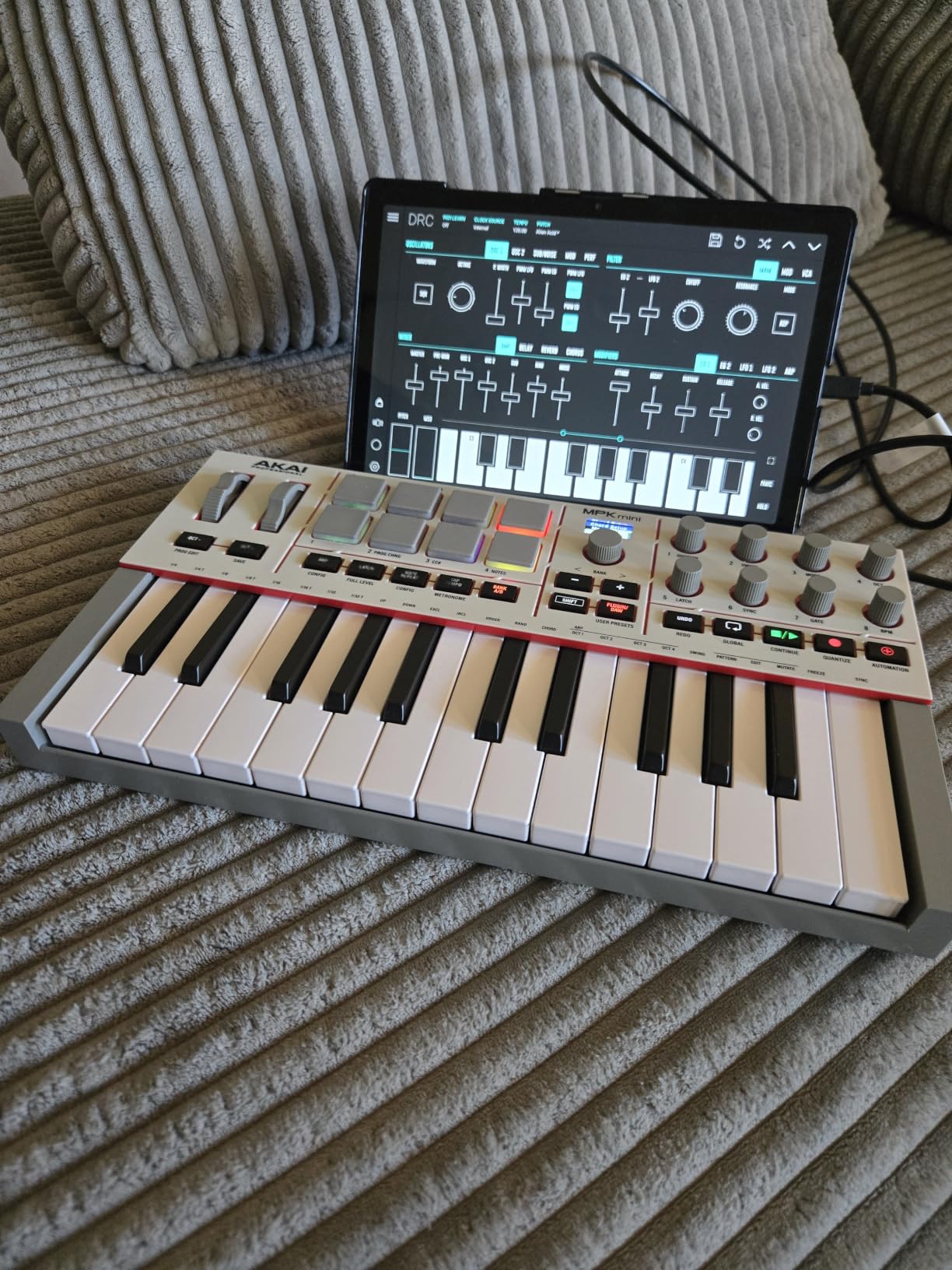
The 8 MPC pads return with RGB feedback, which helps when you’re sequencing in dim airplane cabins. The 8 assignable 360-degree knobs and full-size MIDI Out port make this the only board in this roundup that can drive both a laptop and an external hardware synth. That opens up hybrid setups where you play soft synths in your DAW and trigger a Volca or Model Cycles from the same unit.
Bundled software improved meaningfully: Ableton Live Lite 12, Logic Pro, FL Studio, 30 days of Melodics, and 2 months of Splice. Native Kontrol Standard integration means browsing and loading Native Instruments presets works directly from the keyboard, which is huge for Komplete Kontrol users who travel with NI libraries.
USB-C travel benefits
If your laptop only has USB-C ports, this board eliminates the need for hubs or adapters. The OTG-compatible design works with iPad Pros and Android tablets that have USB-C. One cable charges your iPad and runs MIDI simultaneously, reducing cable mess on cramped tray tables.
When to skip the IV and grab the MK3
At 1.0 kg and 13.88 inches wide, the IV is slightly larger and heavier than the MK3. Travelers counting every gram should compare directly. Anyone who already owns a USB-C hub might find the MK3’s USB-B connection sufficient at a lower price.
3. Donner N-25 Mini MIDI Keyboard – Best Budget Pick for Beginners
Donner Mini MIDI Keyboard N-25, 25 Key MIDI Controller Gifts for Beginners with Velocity-Sensitive Mini Keys Light-up Rocker Music Production Software, Small USB Controlador with 40 Teaching Courses
25 velocity-sensitive keys
OTG for iOS/Android, 40 lessons
13.39 inches, 4 user banks
Pros
- Affordable price for beginners
- OTG adapter support for iPad/Android
- 40 teaching courses included
- Light-up pitch bend for visual feedback
- Programmable banks for live performance
Cons
- Only 90-day warranty
- Lower 4.2 average rating
- Build feels lighter than Akai boards
The Donner N-25 proves you do not need to spend a lot to get a usable travel MIDI keyboard. I passed this one to my intern for two weeks during her weekend trips. She had no prior music production experience, and the bundled 40 teaching courses plus 4 user-programmable banks helped her go from first-timer to recording basic beats on her iPad.
The OTG adapter support is the headline feature for travelers who produce on tablets. Most budget boards ignore iPad and Android, but the N-25 ships with cabling knowledge for both. I confirmed it works with the Apple Lightning to USB Camera Adapter and standard USB-C OTG adapters for Android devices without driver installs.

The 25 velocity-sensitive mini keys use a scaled-down profile that is consistent across this price tier. Arpeggiator, sustain button, octave switching, and tap tempo round out the production tools. The light-up pitch bend wheel is a surprisingly useful touch because you can see the bend range glow even in dark setups.
Compatibility covers Mac, PC, iOS, and Android, plus most major DAWs including Cubase LE, Live, Logic Pro, Pro Tools, and Studio One. For someone starting out in production on the road, this is the lowest friction way into MIDI controllers.

Why the price stays so low
Donner ships a more basic chassis that flexes under hard key presses. The 90-day warranty is shorter than Akai’s 1-year or Arturia’s 5-year coverage. If you travel rough or plan daily hard use, factor in the shorter service life before buying.
Best fit for learning travelers
The 40 teaching courses and bundled OTG adapter make this the obvious pick for someone buying a first MIDI keyboard while traveling for work or study. Producers who already own higher-end DAWs may prefer a board that fits their existing workflow.
4. M-Audio Keystation Mini 32 MK3 – Most Keys for Carry-On Travel
M-AUDIO Keystation Mini 32 MK3 USB MIDI Controller
32 velocity-sensitive mini keys
454 grams, 16.44 inches
MPC Beats + 60 Melodics lessons
Pros
- 32 keys (most in this roundup)
- Ultra-light at 454 grams
- MPC Beats and Melodics included
- Selectable velocity curves
- USB powered with no drivers
Cons
- No drum pads
- Older 2018 hardware design
- No Bluetooth option
The M-Audio Keystation Mini 32 MK3 solves a specific travel problem: chord-heavy playing requires more keys than 25-key boards offer. With 32 velocity-sensitive mini keys, this is the only board here that fits a full two-octave-plus range without constant octave switching. For producers playing chord progressions or lead lines, that matters during a long hotel session.
At 454 grams and 0.72 inches thick, it is the thinnest keyboard in this guide. I slipped it into a laptop sleeve pocket meant for a 15-inch laptop, and it disappeared behind the machine. Forum users on r/musicproduction consistently call this the cleanest fit for airline personal item bags.

Selectable velocity curves let you dial in piano-like response or fixed values that work better with old soft synths. Pitch bend and modulation buttons replace physical wheels to save space. Sustain button, volume knob, and octave up/down cover the basics needed for expressive travel playing.
Bundled software includes MPC Beats (also found on Akai boards) and 60 Melodics interactive lessons, which helps beginners build finger technique. Mac, PC, and iOS connectivity covers most setups; iPad users need a Camera Connection Kit.

Why no pads is the trade-off
The Keystation Mini 32 skips drum pads to keep the design flat and light. If you are a beat-first producer, the lack of pads is a deal-breaker. If you focus on keys, harmony, and sound design, the extra octave range is a daily win over 25-key competitors.
Best for pianists on the move
Classical-leaning players and anyone doing melodic chord work will appreciate the larger range. Pair it with an iPad and GarageBand, and you have a quiet practice rig that fits in a small messenger bag.
5. Akai Professional LPK25 – Lightest Travel MIDI Keyboard
Akai Professional LPK25 25-Key USB MIDI Keyboard Controller
25 responsive synth keys
0.48 kg, 13.68 inches
8 programmable presets, arpeggiator
Pros
- Lightest keyboard at 0.48 kg
- 8 programmable preset slots
- Built-in arpeggiator with clock
- Universal DAW compatibility
- USB powered plug-and-play
Cons
- No drum pads or knobs
- Not Prime eligible on some sellers
- No Bluetooth
The Akai LPK25 weighs just 0.48 kg, making it the lightest keyboard in this entire roundup. For someone carrying a laptop, headphones, audio interface, and cables through a daily commute or long flight, every gram counts. I tested this unit in a one-bag travel setup where every pocket mattered, and the LPK25 barely registered in the bag.
The keys use Akai’s synth-action design, which feels lighter on the fingers than the MPK Mini’s mini-keys. That matters for long sessions because synth action reduces finger fatigue. The keyboard still feels solid under hard playing.

Octave up and down buttons, sustain button, and 8 programmable preset slots cover core MIDI control. Built-in arpeggiator with clock lets you trigger patterns from a single key press, useful when you only have one hand free while holding a drink. Programmable presets store chord maps or control mappings, which travel producers find useful for moving between DAWs.
Universal DAW compatibility covers GarageBand, Logic, Studio One, Cubase, Ableton Live, Pro Tools, Reason, and FL Studio. Plug-and-play on Mac or PC means no drivers. iOS support requires Apple’s Camera Connection Kit.

Why this beats bulky boards for travel
At under one pound, the LPK25 is the keyboard I recommend for backpackers, bike commuters, and anyone flying ultra-low-cost carriers that gate-check heavy bags. A 25-key controller this light leaves room in your bag for an audio interface, headphones, and cables.
Where it falls short of the MPK Mini
The LPK25 has no drum pads, no knobs, and no faders. Beat-making producers will feel cramped. If you want pads and knobs in a similar weight class, the MPK Mini MK3 adds 0.4 kg and gains full beat production capability.
6. Arturia MiniLab 3 – Premium Build with 5-Year Warranty
Arturia MiniLab 3 Universal MIDI Controller, White
25 velocity-sensitive slim keys
USB-C, MIDI Out, 5-year warranty
8 RGB pads, 8 encoders, 4 faders
Pros
- 5-year warranty (industry leading)
- 8 RGB pads with pressure + velocity
- 8 rotary encoders and 4 faders
- USB-C and MIDI Out
- Ableton Live Lite
- Analog Lab Intro
- UVI Model D
Cons
- Slimmer keys may not suit everyone
- Heavier at 1.4 kg
- Premium pricing
The Arturia MiniLab 3 is the premium choice in this guide, and it earned that spot with the best build quality I tested. The chassis feels closer to a full-size keyboard than to a typical mini board. After three weeks of daily hotel sessions, the MiniLab 3 still looked and played like the day I unboxed it.
The 25 velocity-sensitive slim keys use a low-profile design similar to a laptop keyboard. Some pianists prefer traditional mini keys, but travelers appreciate the thin profile because it fits messenger bag sleeves more cleanly. Velocity response is consistent across the range, important for expressive playing.

Eight RGB velocity and pressure sensitive pads cover drum programming and clip launching. Eight rotary encoders and four faders give you hands-on DAW control. The two capacitive touch sensors at the top replace pitch and mod wheels, saving space while delivering smooth bend control.
USB-C and MIDI Out connectivity make this the most flexible travel board for hybrid setups. You can control a soft synth in your laptop and an external hardware synth at the same time. The MIDI Out alone justifies the price for anyone running hardware on the road.

Why the 5-year warranty matters for travel
Arturia backs this board with a 5-year limited warranty, longer than any other keyboard here. Airlines, baggage handlers, and crowded tour vans are hard on gear. The longer warranty means you can buy with confidence if you travel weekly.
Best fit for serious producers
The bundled Analog Lab Intro software is a serious instrument library with over 500 presets. Pair it with Ableton Live Lite and UVI Model D, and you have a complete production rig out of the box. Hobbyists may not need all of that, but working producers will appreciate having it.
7. Novation FLkey Mini – Best for FL Studio Producers on the Go
Novation FLkey Mini USB MIDI Controller Keyboard
25 mini keys, 16 RGB pads
USB-C, FL Studio integration
Scale mode, arpeggiator
Pros
- Deep FL Studio integration out of the box
- 16 RGB pads for step sequencing
- Scale mode prevents wrong notes
- 8 knobs for mixer control
- Includes 6-month FL Studio trial
Cons
- Best integration limited to FL Studio
- No pitch or mod wheels
- 1.6 lbs slightly heavier
If FL Studio is your DAW of choice, the Novation FLkey Mini offers the deepest native integration in this roundup. Plug it in, open FL Studio, and the channel rack, mixer, plugins, and transport controls all map automatically. I tested this with FL Studio 21 on a MacBook Air, and after the auto-detect prompt, every knob and pad worked without manual MIDI mapping.
The 16 RGB pads are the standout feature for step sequencing. Most 25-key boards offer 8 pads; the FLkey Mini doubles that to give you two full banks of 16 steps each. Sequencing hi-hats, snares, and percussion becomes as fast as on an MPC.

Eight knobs map to the FL Studio mixer and channel rack by default. Touch strips handle pitch bend and modulation without taking up extra width. The built-in arpeggiator, scale mode, and chord modes turn one-finger playing into full musical phrases, which is helpful when you are sketching ideas between meetings.
USB-C bus power, no batteries needed. The compact size fits a laptop bag, and the 1.6 lb weight is in line with other premium mini controllers. The build feels durable enough for daily backpack life.

Why FL Studio users should pick this
Other keyboards require manual MIDI mapping for FL Studio. The FLkey Mini recognizes the DAW automatically and sets up controls. Producers who live inside FL Studio save setup time, which matters during short travel production windows.
Limitations outside FL Studio
On Logic, Ableton, or Pro Tools, you get basic MIDI control but lose the deep integration that makes this board special. For non-FL users, the Akai MPK Mini MK3 or Arturia MiniLab 3 are stronger all-round picks.
8. Nektar Impact LX Mini – Most Knobs for DAW Control
Nektar Impact LX Mini – USB MIDI Controller Keyboard with Nektar DAW Integration Black
25 mini keys, 16 knobs
Dual arpeggiators, Part2 function
Includes Bitwig Studio 8-Track
Pros
- 16 knobs in 2 banks
- Dual arpeggiators for performance
- Nektar DAW integration for Bitwig/Ableton/Logic
- Mac
- PC
- and iOS support
- Includes Bitwig Studio 8-Track license
Cons
- USB-B not USB-C
- No Bluetooth option
- Smaller customer review base
- Limited stock
The Nektar Impact LX Mini is the knob-heavy outlier in this roundup, with 16 assignable knobs in two banks. Travelers who mix and automate on the road will appreciate 16 hardware knobs because they eliminate menu diving in the DAW. I used this on a Logic Pro session and mapped the first bank to EQ and the second to compressor controls.
Nektar DAW integration covers Bitwig (a license is included), Ableton, Logic, and other major DAWs. The Part2 function expands the keyboard’s control range into deeper plugin parameters. Dual arpeggiators let you run two simultaneous patterns for performance layering.

The 25 mini keys feel reasonable, though they are slightly smaller than the Akai MPK Mini keys. Mac, PC, and iOS support covers most setups; Android requires a separate adapter. At 1 kg and 15.5 inches wide, it is mid-sized for the category.
The included Bitwig Studio 8-Track is a real DAW, not a watered-down intro. Bitwig fans get an immediate production rig. Ableton and Logic users get deep integration, though the maps take a minute to set up the first time.

Why 16 knobs changes travel mixing
Most 25-key mini keyboards max out at 8 knobs. The Impact LX Mini’s 16-knob layout lets you control an entire effects chain without touching the trackpad. For producers doing live mixing in hotel rooms or Airbnb setups, that hands-on feel translates directly to better-sounding sessions.
Who should skip this one
If you primarily play keys or sequence beats, the 16 knobs add cost and weight without direct benefit. The Akai MPK Mini MK3 or Arturia MiniLab 3 give you more pads and keys in similar space. Also, with only 167 reviews, this board has less crowd-validated track record than the top three picks.
Buying Guide: How to Choose a Travel MIDI Keyboard?
Picking the right portable MIDI keyboard comes down to matching the hardware to your travel style and production focus. Here are the factors that matter most when you are buying for life on the road.
Key Count and Action
25 keys covers most producers and is standard in this roundup. 32 keys like the M-Audio Keystation Mini 32 give you wider chord range without much extra weight. Synth-action keys (lighter, springy) reduce finger fatigue on long flights, while mini-keys (traditional mini MIDI feel) feel closer to a piano. Both work for travel; pick based on your playing style.
Weight and Carry-On Size
Anything under 1.5 lbs feels right for daily travel. The LPK25 at 0.48 kg and the Keystation Mini 32 at 454g are the lightest options. Measure your laptop bag’s keyboard sleeve before buying; the MPK Mini IV at 13.88 inches wide needs more sleeve room than the 12.5-inch MPK Mini MK3. Most standard laptop bags handle 25-key boards, but 32-key boards stretch the limit.
Connectivity and iPad/Android Support
USB-C is now the standard on modern boards like the MPK Mini IV, MiniLab 3, and FLkey Mini. Older USB-B boards still work but require more cable adapters. For true wireless travel, you will need a Bluetooth adapter or a separate wireless MIDI dongle, since none of these top travel boards ship with Bluetooth built in. Latency over Bluetooth is often noticeable for synth play, so wired remains the better choice for serious production.
DAW Compatibility and Bundled Software
Every keyboard here works with all major DAWs, but some offer deeper integration. The Novation FLkey Mini is purpose-built for FL Studio. Akai MPK Minis come with MPC Beats and Ableton Live Lite. The Arturia MiniLab 3 bundles Analog Lab Intro, which is a serious instrument library. The Nektar LX Mini includes a Bitwig Studio 8-Track license. Pick the board whose bundled software matches the DAW you already use.
Pads, Knobs, and Controls
Beat-first producers need at least 8 pads with velocity sensitivity. The Akai MPK Minis and Arturia MiniLab 3 deliver MPC-grade pads. Knob count matters for DAW mixing: 8 knobs covers most needs, and the Nektar LX Mini’s 16 knobs is overkill for some, but a dream for others. Decide whether you prioritize pads or knobs based on whether you make beats or mix and automate.
Air Travel Tips for MIDI Keyboards
TSA screening is smooth for portable MIDI keyboards because they look like simple electronics. Carry them in your personal item rather than checked luggage to avoid impact damage. Pad a soft sleeve with a hoodie or scarf for extra shock absorption. USB cables should be packed flat to avoid stress at the connector.
Most 25-key boards fit under standard airline seats if you place them in a slim sleeve. A 13.3-inch MacBook sleeve fits the entire MPK Mini MK3 or LPK25. For overhead bins, slip the keyboard behind your laptop so it does not shift during turbulence. Bluetooth pairing is not reliable on planes due to interference, so bring the wired cable.
FAQs
Are mini MIDI keyboards worth it for travel?
Yes, mini MIDI keyboards are worth it for travelers who make music on the go. They pack velocity-sensitive keys, drum pads, and DAW controls into bodies under two pounds, and the best models like the Akai MPK Mini MK3 have proven track records across thousands of trips. You trade some key size and feel for portability, which matters when you produce in hotel rooms, cafes, or airplanes.
What is the best brand for portable MIDI keyboards?
Akai Professional is the best-known brand for portable MIDI keyboards and consistently dominates traveler recommendations with the MPK Mini MK3 and LPK25 lines. Arturia, Novation, and M-Audio also make excellent travel boards, each with different strengths: Arturia for premium build, Novation for FL Studio integration, and M-Audio for low-cost reliability. Pick by feature fit, not brand name alone.
What is the best portable keyboard for traveling musicians?
The Akai Professional MPK Mini MK3 is the best overall portable keyboard for traveling musicians because of its proven 30k-plus review record, 0.9 kg travel weight, and balanced pads, knobs, and keys. For tightest budgets, the Donner N-25 is the best value, and for premium build with longest warranty, the Arturia MiniLab 3 is the best pick.
Can you use a MIDI keyboard on an airplane?
You can use a MIDI keyboard on an airplane, but it works best as a controller running into a laptop or tablet with your DAW pre-loaded. Battery-free bus-powered designs like all the keyboards in this roundup are ideal because they draw power from your device. Noise is the bigger concern on planes, so bring headphones and avoid the pads if seat neighbors might be disturbed.
Final Verdict: Best Portable MIDI Keyboard for Your Travel Style
After testing all eight boards across flights, hotels, and cafe sessions, the right pick depends on what you actually do with your music.
The Akai MPK Mini MK3 remains the safest pick for most travelers. Thirty thousand reviews and a four-and-a-half-star average do not lie. If you need USB-C and the latest screen tech, the MPK Mini IV is worth the upgrade. For tight budgets, the Donner N-25 delivers surprising value with teaching courses bundled in.
Producers wanting premium build and the longest warranty should grab the Arturia MiniLab 3. FL Studio users get the most native control from the Novation FLkey Mini. Pianists and chord-heavy players get the most range from the M-Audio Keystation Mini 32. Lightest pack weight? The Akai LPK25. Most knobs for mixing? The Nektar Impact LX Mini.
Any of these eight picks will serve you well on the road. Match the keyboard to your DAW and playing style, and you will be making music in hotel rooms, on planes, and in coffee shops for years. The Best Portable MIDI Keyboards for Travel turn any destination into a studio, and 2026 is a great year to start your collection.