
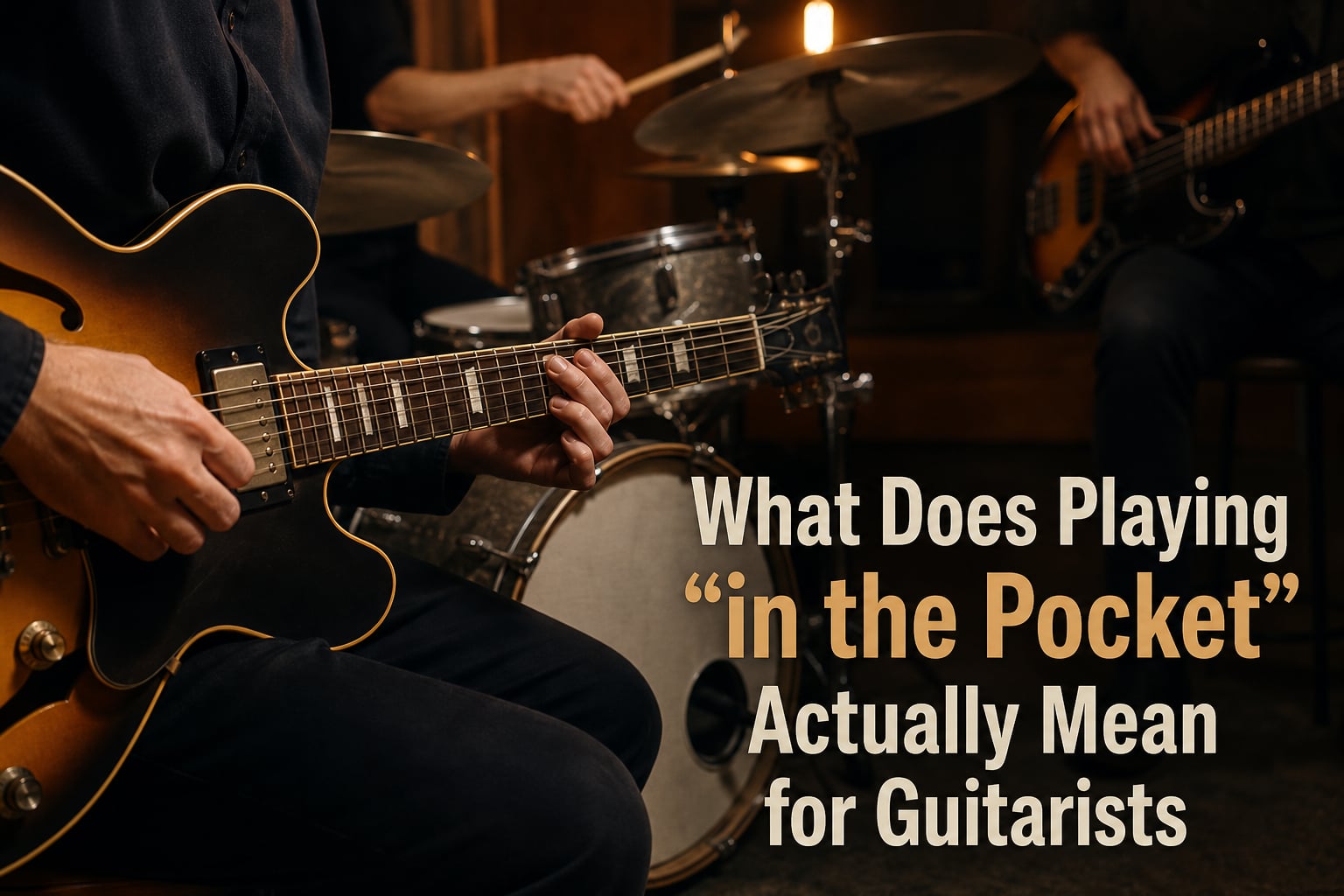
Playing in the pocket guitar means locking your notes, rests, and accents to the rhythmic feel of a song so they support the band rather than float beside it. In music slang, it means hitting notes at just the perfect time to groove with the drums, bass, and pulse—even when the part itself is simple.
It is not a trick lick or a special chord voicing. It is the listener’s sense that the guitarist belongs inside the beat, making the rhythm feel settled, alive, and easy to move to.
For guitarists, that changes how you approach nearly everything: when a chord starts, how long it rings, where a fill ends, and when silence is the better choice. This guide breaks down the feel, the timing choices behind it, and a practical routine for developing it whether you have a band or only a metronome.
Quick answer: A guitarist is in the pocket when their rhythm agrees with the song’s shared pulse and makes the rhythm section feel more connected. Accurate tempo helps, but the real test is whether the part locks in with the kick, snare, bass, and the song’s intended feel.
Table of Contents
Playing in the pocket guitar means sharing the beat instead of merely counting it
A metronome can tell you whether you are near the beat, but pocket is a relationship among players. A guitarist can land every chord at the correct tempo and still sound stiff if the attack, release, or accent fights what the drummer and bassist are doing.
Think of a four-on-the-floor rhythm part. If the kick is firm, the bass is repeating an even figure, and your muted chord arrives with the same confident pulse, the part feels locked in; if you hurry the chord or let it spill into the next event, the shared rhythm gets blurry.
That is why a two-note riff with good timing can feel stronger than a difficult phrase with uneven placement. Musicians in guitar and rhythm discussions often come back to this point: technical correctness does not automatically create groove, while a simple phrase played with conviction can be captivating.
Pocket sounds connected rather than crowded
You usually hear pocket as a lack of friction. The guitar does not have to copy the bass or drums, but its rhythm seems to answer them naturally: a clipped chord may reinforce the snare, a low note may meet the kick, and a rest may leave room for a bass pickup.
Out-of-pocket playing often sounds like little disagreements. The tempo may not collapse, yet a rushed upstroke, an early fill, or a chord that rings too long can make the band feel less settled.
Groove is the repeating rhythm and pocket is the way players sit inside it
Groove is the overall rhythmic pattern that makes a song move: the drum beat, bass motion, repeated chord rhythm, and accents working together. Pocket is the convincing placement and feel each musician brings to that pattern.
Put another way, a song can have a groove on paper before anyone plays it. The pocket appears when people give that groove a shared time feel, including the tiny choices of attack, note length, swing, and space.
On top, behind, and ahead of the beat are intentional placement choices
“On top of the beat” means placing an attack right at the center of the shared pulse. This is often the clearest starting point for a guitarist, especially when learning a new rhythm part or supporting a straight pop or funk pattern.
“Ahead of the beat” means placing an attack a little early without speeding up the song. A controlled push can create urgency, but it only works when it is a group feel or a deliberate contrast; repeated accidental rushing is not push.
“Behind the beat,” often called laying back, means letting an attack arrive a little after the center while the tempo stays stable. In soul, R&B, blues, and some jazz, a relaxed guitar part can sit behind a firm drum pulse and create a deep, unhurried feel.
Warning: Do not try to manufacture a late feel by slowing down each bar. Playing behind the beat means a consistent, small placement choice against a steady pulse, not losing tempo or missing the downbeat.
These positions are not fixed milliseconds that apply to every song. The drummer’s cymbal pattern, the bass attack, the room, the genre, and the arrangement all change the useful amount of space, so your ears matter more than a visual grid.
Guitarists find the pocket by listening first to the kick, snare, and bass
The kick usually tells you where the weight of the groove sits, the snare often defines the backbeat, and the bass joins both harmony and rhythm. Before deciding what guitar rhythm to play, listen for which of those events your part should reinforce and which it should leave alone.
In a sparse funk section, a muted chord can answer the snare while the bass owns the downbeat. In a ballad, a sustained chord may belong after the vocal phrase rather than directly on the kick; pocket is not always short and percussive.
Guitarists control pocket with note length as much as note placement
A guitar chord has two timing events: when it begins and when it stops. Fretting-hand muting, palm muting, and releasing pressure turn those endings into rhythmic information, which is why a tight sixteen-note part can sound precise even with only two or three chord shapes.
Try playing the same chord on every backbeat, first letting it ring for a full beat and then stopping it almost immediately. The harmony is unchanged, but the second version leaves more space for the kick and bass, and it may fit a funk groove far better.
Accents matter too. If a drummer emphasizes beat two and beat four, a guitarist who accents unrelated strokes can weaken the feel even while strumming in time. You do not need identical accents, but you do need to know where the band’s weight is.
Guitarists support pocket by treating rests as part of the part
Silence is not empty time waiting for the next chord. A rest can expose a snare hit, make a bass note speak, or make a short guitar answer feel stronger because it has a clean edge.
When a rhythm part feels busy, remove one stroke before adding another. The result is often clearer because every remaining attack has a job.
Guitarists build pocket through a five-step practice routine
Practice works best when it moves from a plain pulse to a musical context. Start slowly enough that you can hear your note endings and accents, then record short examples so you can judge the result rather than relying only on the feeling in your hands.
Step 1: Start by making one chord agree with a slow click
Set a metronome to 60 BPM and choose one comfortable chord. Strike it exactly on each click for sixteen bars, listening for a single clean attack rather than trying to add style.
Next, play only on beats two and four. Keep the chord short, count the empty beats out loud, and listen for whether your hand makes the click disappear or creates a separate, competing sound.
Play four bars with a ringing chord, then four bars with a clipped chord.
Keep the fretting hand relaxed enough to stop the chord cleanly.
Repeat with a different chord while preserving the same release length.
Step 2: Hear subdivisions before you add them to the guitar
Keep the click at 60 BPM and speak “one-and-two-and-three-and-four-and” for eighth notes. Then say “one-e-and-a” for sixteenth notes while lightly tapping your foot on quarter notes; if the words wobble, a busy strum pattern will wobble too.
Once the subdivisions feel even, play a muted scratch on every sixteenth note. Accent only the chosen strokes, such as the “and” after beat two, while the other strokes remain quiet and even.
This builds a reliable internal grid without making the performance sound machine-like. The point is to make your subdivisions dependable enough that you can choose a loose or swung feel on purpose.
Step 3: Lock a short riff to a drum loop or a stripped backing track
Choose a simple two-bar riff and use a drum part with a clear kick and snare. First clap the guitar rhythm while naming the drum event you are hearing, then play the riff with no fills for several repeats.
Listen to the bass if one is available. If the bass enters just before beat one, do not cover that pickup with an unnecessary guitar attack; let the parts interlock instead of competing for the same space.
Tip: Record thirty seconds, then listen without playing along. Ask one narrow question: do the chord attacks agree with the snare and kick, or do they repeatedly arrive early or late? A short recording is more revealing than an hour of guessing.
Step 4: Practice the pocket without a drummer by removing clicks
Start with the metronome on every quarter note at 70 BPM, then change it so it clicks only on beats two and four. This makes you carry the downbeats and reveals whether your backbeat placement is steady.
For a tougher version, let the click represent only beat one of each bar. Count the remaining beats internally, play a simple chord rhythm, and return to the full click if your tempo drifts; the goal is feedback, not proving that you can survive without it.
You can also make a basic loop of a kick on one and three and a snare on two and four, then mute the loop for one bar at a time. Keep strumming through the silence and check whether the returning drums meet you in the same place.
Step 5: Bring the same feel into fills and improvised lines
Many players hold a solid rhythm until a fill arrives, then rush because the fingers are busy. Make the fill smaller: play two notes on the final eighth notes of the bar, then land decisively on the next chord instead of trying to fill every opening.
For improvised lines, practice leaving a full beat of rest after each short phrase. That rest lets you hear the drummer, prevents a stream of notes from hiding weak timing, and makes it easier to finish a phrase in sync with the form.
Increase the tempo only after the relaxed version feels repeatable. Fast playing in the pocket comes from keeping the same relationship to the pulse as the tempo rises, not from forcing more notes into each bar.
Pocket changes by genre, but the shared pulse remains the same job
Funk guitar often relies on short, muted attacks and carefully chosen sixteenth-note accents. Study how a small chord fragment can answer the drums, then practice making unaccented strokes nearly invisible so the accents carry the rhythm.
Soul and R&B guitar may leave more air between attacks and sit a touch behind a firm backbeat. Listen for sustained chords that arrive after a vocal thought, then compare that spacious role with a percussion-like funk part.
Jazz guitar may use swing subdivisions and conversational comping, so a chord can respond to a soloist rather than repeat a fixed strum. The pocket still depends on shared time: listen to the ride pattern and bass line before placing a comping answer.
Blues can flex the beat while staying grounded in the form. A concise answer between vocal lines will often feel better than a continuous rhythm part, especially when the bassist and drummer already state the groove clearly.
Great pocket players teach economy, conviction, and listening
Listen to recordings featuring James Jamerson for the way bass can make a Motown track move, and to B.B. King for the weight and space in concise phrases. Victor Wooten’s widely repeated idea—if the groove is strong enough, many note choices can work—points guitarists back to time feel before flash.
Do not copy a player’s exact timing from a single bar and call it a rule. Instead, notice what happens to the guitar when the drums get busier, when a vocalist enters, and when the arrangement needs a rest.
Common guitar habits pull a part out of the pocket even when the notes are right
The first habit is overplaying. Adding a stroke to every subdivision can bury the rhythm section, while a smaller part often makes the whole band sound larger and more locked in.
The second is treating every early note as excitement and every late note as soul. Push and lay-back only work when they are deliberate and consistent; random timing changes read as uncertainty.
The third is ignoring note length. Guitarists often focus on the attack and forget that a ringing chord can collide with a bass note, a snare, or the next harmony; practice stopping notes as carefully as starting them.
The fourth is using a metronome as the final test. A click is excellent feedback, but pocket also needs listening, reaction, and the ability to keep a steady feel when the drummer adds fills or the bass changes its phrasing.
Try this at rehearsal: Play one verse with half as many guitar attacks as usual. If the drums and bass suddenly sound clearer, keep the reduced part and make your remaining accents more intentional.
FAQs
What does ‘play in the pocket’ mean?
To play in the pocket means to lock your timing, note length, and accents to the rhythmic feel of the music and the other players. For guitarists, it means hitting notes at just the right moment so the part supports the drums and bass instead of competing with them.
What does ‘in the pocket’ mean in slang?
In music slang, in the pocket means a player or band has a convincing shared groove. The performance feels settled and connected because the musicians agree on the pulse, even if they are not all playing the same rhythm.
What does ‘in the pocket’ mean for bass guitar?
For bass guitar, being in the pocket means creating a dependable rhythmic and harmonic link with the drummer, especially the kick and snare. A guitarist can support that pocket by leaving room for bass pickups, matching useful accents, and controlling chord length.
Why do drummers say ‘in the pocket’?
Drummers use in the pocket because drums establish much of a song’s pulse and backbeat. When the band locks to that pulse with steady timing, appropriate space, and a shared feel, the whole groove feels stronger and easier to follow.
Playing in the pocket guitar comes from listening, choosing, and repeating
Playing in the pocket guitar is not about making every note land in a sterile place. It is about hearing the shared pulse, choosing whether to sit on it, push it, or relax behind it, and giving every attack and rest a role in the groove.
Start with one chord at a slow tempo, make its beginning and ending clean, and listen to how it meets the kick and snare. Then carry that same care into a short riff, a fill, and eventually your improvised lines.
When the band sounds better with fewer notes from you, that is useful information rather than a limitation. Keep the part that makes everyone else feel more locked in, because that is the pocket doing its job.