
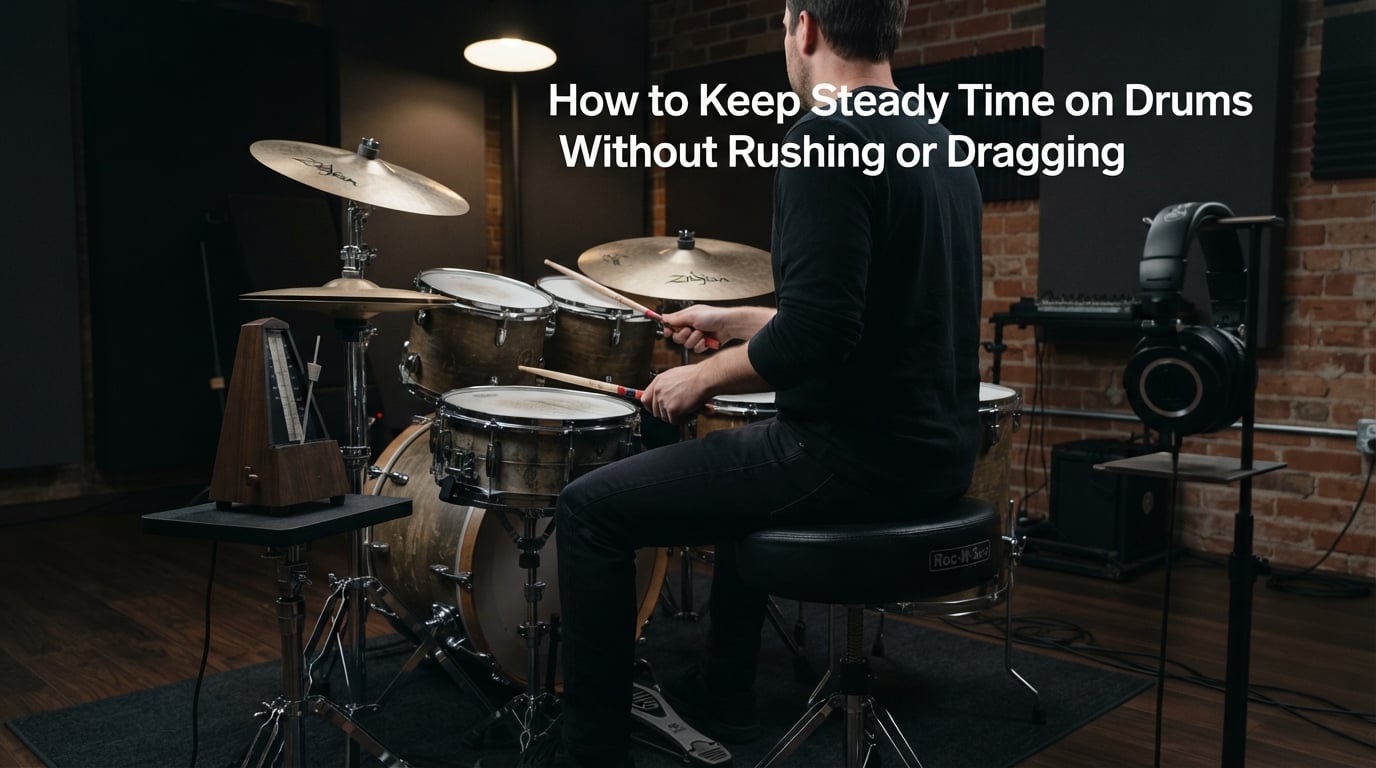
To keep steady time on drums, hear the pulse before you play, divide that pulse into reliable subdivisions, and check your feel against a click or recording. Rushing means you unintentionally speed up the tempo; dragging means you unintentionally slow it down. Both pull the groove away from the agreed pulse, even when every drum part is technically correct.
Learning how to keep steady time on drums without rushing or dragging is less about forcing yourself to be stiff and more about building repeatable awareness. Hear the beat, feel where your limbs land, and notice the moments that make tempo drift: fills, loud sections, fatigue, nerves, and a bandmate changing energy.
Quick answer: Start every timing session with simple quarter notes at a comfortable tempo. Add spoken counts, then eighth notes, triplets, and sixteenth notes before you attempt fills or fast grooves.
Table of Contents
Rushing is speeding up and dragging is slowing down without meaning to
Rushing drums often feels exciting in the moment. A chorus arrives, your right hand gets tense, and the tempo creeps forward one small push at a time until the rest of the band has to chase you.
Dragging drums produces the opposite feeling: the groove sags, transitions feel late, and a song can lose its forward motion. It is common when a pattern is difficult, when your limbs are not coordinated yet, or when you relax so much that the pulse loses shape.
Neither mistake is the same as deliberately playing a little ahead of or behind the beat. A player may place notes slightly forward or laid-back while the underlying tempo stays stable; rushing and dragging change that underlying tempo itself.
Rushing usually follows excitement, effort, or a fill
Listen for the point where your groove gets denser or louder. If the click seems to fall behind you after a fill, a crash, or a fast bass-drum burst, you are probably rushing rather than simply playing with a forward feel.
Your body can reveal it too. Raised shoulders, a clenched jaw, a foot stomping harder than needed, and shallow breathing are signs that you are trying to push the music.
Dragging usually follows uncertainty or a heavy pattern
If the click seems to pull away in front of you, check the notes after a transition rather than only the transition itself. Many drummers land a fill on time but hesitate for a fraction of a beat before restarting the main groove.
Dragging can also happen when you wait for another musician to tell you where beat one is. Listen closely, but still carry a clear internal pulse through rests, held notes, and sparse sections.
Listen for the gap: Do not judge time only by whether you hear the click. Ask whether your notes cover the click cleanly, arrive consistently before it, or arrive consistently after it. A recording makes this much easier to hear.
Keep steady time on drums without rushing or dragging by practicing the pulse in layers
The fastest route to steadier drum time keeping is to make simple time feel deliberate before adding complexity. Use this sequence in order; every step gives you a different way to hear and measure the same tempo.
1. Find the quarter-note pulse before playing a groove
Set a metronome to a tempo where you can relax, such as 60 BPM, and play one note on the hi-hat or ride with every click. Keep your stick height modest and let the note ring rather than trying to hit through the beat.
Count “one, two, three, four” aloud for at least 16 bars. Your voice exposes weak beat placement quickly: if the spoken count becomes hurried, the hands usually follow.
Play quarter notes for 16 bars.
Rest for four bars while counting aloud.
Return for 16 bars without searching for the click.
Repeat at 50, 60, and 70 BPM.
The rest is not empty space. Continue hearing the pulse during it, then compare your return note to the click without correcting early or late by force.
2. Count subdivisions so the space between clicks stays even
A steady beat drums exercise becomes more demanding when the click remains the same but your internal division changes. Start with quarter notes, then count “one and two and three and four and” for eighth notes, “one-trip-let” for triplets, and “one e and a” for sixteenth notes.
Say the full subdivision while playing it softly on one surface. The goal is not speed; it is equal distance between each syllable and each note.
At 60 BPM, play eighth notes for eight bars.
Play triplets for eight bars without changing the quarter-note pulse.
Play sixteenth notes for eight bars at a volume you can control.
Return to quarters for eight bars and hear whether the tempo still feels settled.
This subdivision practice strengthens the internal clock drumming depends on. When you know exactly where the smaller notes sit, a quarter-note click feels less like an outside instruction and more like confirmation of a pulse already running in your head.
3. Put the click on fewer beats to test your internal clock
Playing every note with a click can hide a weak pulse because the click supplies constant rescue points. After you can play a simple groove cleanly with quarter-note clicks, set the metronome to half the tempo so one click represents beats two and four.
For a groove at 80 BPM, set the metronome at 40 BPM and treat each click as the snare backbeat. Keep counting all four beats aloud, especially during fills.
Later, let one click represent beat one of each bar. This is challenging at first, so use a basic rock groove and short fills; a missed barline tells you to return to more frequent clicks, not that you have failed.
Practice rule: Change only one difficulty at a time. If you reduce the click frequency, do not also add a new foot pattern, a fast tempo, and a complex fill.
4. Use the metronome as feedback instead of something to chase
Click track drumming works best when you listen for one blended event: your note and the click together. If you can hear two separate attacks, do not lunge toward the next click; keep the pattern going and notice whether your placement is consistently early or late.
Chasing produces a zigzag tempo, where a rushed note is followed by a dragged correction. Let the click reveal a tendency over several bars, then reduce the pattern until you can place notes evenly again.
Try one minute of a basic groove with the click, followed by one minute with the click muted if your metronome has that function. When it returns, treat its position as information and identify whether drift happened during a fill, an accent, or a change in limb coordination.
5. Record short takes and listen away from the drum kit
You will not always know in real time whether you are rushing drums or dragging drums. Record a two-minute take of one groove with a click, then listen once without playing and mark the exact sections where the notes separate from the click.
On the second listen, focus on a single voice: hi-hat, snare, bass drum, or cymbal. A busy mix can make a timing problem sound like a vague mess, while isolating one limb often shows which note is pulling the tempo.
Do not record an entire practice session and hope for a general verdict. Short, repeatable takes let you compare attempt one to attempt two after one small adjustment, such as a softer right foot or a simpler fill.
6. Keep fills inside the same subdivision as the groove
Fills are a frequent source of drum tempo inconsistency because they ask the brain to count a new pattern while the song keeps moving. Before playing a fill at the kit, speak its subdivision over a steady foot tap: for example, “one e and a two e and a” for sixteenth-note movement.
Then play the fill on the snare only while the bass drum keeps quarter notes. That bass drum is your anchor, and it makes an early last note or late return to beat one much easier to hear.
When you bring the fill back into the groove, leave its volume lower than you think it needs to be. Many players rush because they physically attack a fill, not because they cannot count it.
7. Play along with recordings without becoming dependent on them
Playing with recordings teaches you how stable time feels inside real music. Pick a song with a clear drum part, listen through once, and identify the count-in, the verse-to-chorus transition, and any places where the arrangement gets quieter or more intense.
On the first pass, play only quarter notes on a pad or closed hi-hat. On the second pass, add the full groove, and on the third pass leave out one chosen section so you must continue counting through it before rejoining.
Drumless tracks are useful too, but do not let the backing track make all of the timing decisions for you. Alternate between playing with music, playing with a click, and playing alone so your sense of pulse has to work in each setting.
Relaxed posture and breathing make steady time easier to hold
Timing is physical. If you slump, brace your legs, or hold your breath at a difficult passage, your motions become less even and the urge to rush grows stronger.
Set the throne at a height where both feet can move without locking the knees, sit balanced rather than leaning toward the toms, and let your shoulders drop before the count-in. These small checks give your hands and feet room to repeat the same motion.
Breathe through difficult bars instead of bracing for them
Take a quiet breath before a fill or entrance and keep exhaling through the phrase. This is not a trick for replacing practice; it reduces the tension that makes notes bunch together when pressure rises.
Forum discussions repeatedly describe anxiety as a trigger for rushing, particularly when playing with other musicians. If nerves make you speed up, lower the tempo, simplify the part, and practice entering after several bars of rest until the body stops treating that entrance as an emergency.
Warning: Do not solve every early note by playing softer or every late note by playing louder. Volume can hide a placement issue for a moment, but the pulse improves when you can count and relax through the source of the error.
Listening to the band tells you whether the tempo problem is yours or shared
A band can drift as a group, so do not assume the drummer is always the only person responsible. Record rehearsals when possible, then compare the drums with a stable reference such as a click used only for review or a clearly timed recorded version of the song.
If your quarter-note pulse stays consistent while another player anticipates entrances, the problem may be ensemble coordination. If the tempo changes whenever you play a fill or push a chorus, start with your own part before asking anyone else to adjust.
Leave space and listen for the downbeat before correcting anyone
When another player gets ahead or behind, do not immediately force a dramatic correction. Keep a simple, audible pulse and give the group several beats to settle around it; abrupt tempo corrections often create a second problem.
During rehearsal, agree on one section to loop and identify the exact event that causes movement: a guitar entrance, a vocal pickup, a bass fill, or the drum fill. Specific language is kinder and more useful than telling someone to “stay in time.”
Practice without a click so the internal clock works on its own
A metronome is a measuring tool, not a crutch unless it is the only time setting you ever do. To develop drum tempo maintenance without it, establish a tempo with four click bars, mute the click for eight bars, then restore it for four bars and compare.
Start with a two-bar muted gap if eight bars is too long. The point is to predict where the click will return, not to prove that you can survive a difficult setting immediately.
A short daily routine builds accuracy more reliably than occasional marathons
Spend five minutes on quarter notes and spoken counting, five minutes on subdivisions, five minutes on a groove with reduced clicks, and five minutes recording one transition. Twenty focused minutes gives you a clear record of what improved and what still needs work.
Use more time on the slow tempos that expose uneven motion. Fast tempos can feel easier because the notes are close together; a controlled 50 or 60 BPM test leaves nowhere for uncertain subdivision to hide.
The 80 20 idea means concentrating on the few problems that move your time most
There is no single, universally defined 80 20 rule in drumming. As a practice idea, it means a small number of trouble spots—often fills, entrances, and weak subdivisions—can account for most of your audible tempo drift.
Find those spots from your recordings and repeat them in context. Ten accurate repetitions of a two-beat fill that used to rush will help more than repeatedly playing a whole song without noticing what changed.
FAQs
How to keep time while drumming?
Keep time by hearing and counting the quarter-note pulse, practicing subdivisions with a metronome, recording short takes, and gradually reducing how often the click sounds. Start with a simple groove and add difficulty one element at a time.
What is the 80 20 rule in drumming?
There is no universal 80 20 rule in drumming. As a practice approach, it means focusing most of your attention on the small set of issues, such as fills and entrances, that cause most timing errors.
How to stop dragging while drumming?
Stop dragging by keeping a spoken subdivision running, practicing slow tempos with a click, and recording the moment after fills or transitions. If you land a fill on time but restart the groove late, simplify the fill and keep quarter notes with one foot.
What is drummers syndrome?
Drummers syndrome is an informal phrase sometimes used for timing problems such as rushing or dragging. It is not a medical diagnosis; steady practice with counting, listening, recording, and a metronome can address the timing habits it describes.
Steady time comes from clear counting, calm movement, and honest feedback
How to keep steady time on drums without rushing or dragging comes down to a simple loop: hear the pulse, play a manageable part, check what actually happened, and repeat. A click can show you the truth, but the lasting skill is carrying that pulse through silence, fills, nerves, and a full band.
Start your next 2026 practice session with slow quarter notes and a spoken count. When those feel calm and even, build one layer at a time; patient work is what makes a steady groove feel natural when the music gets loud.