
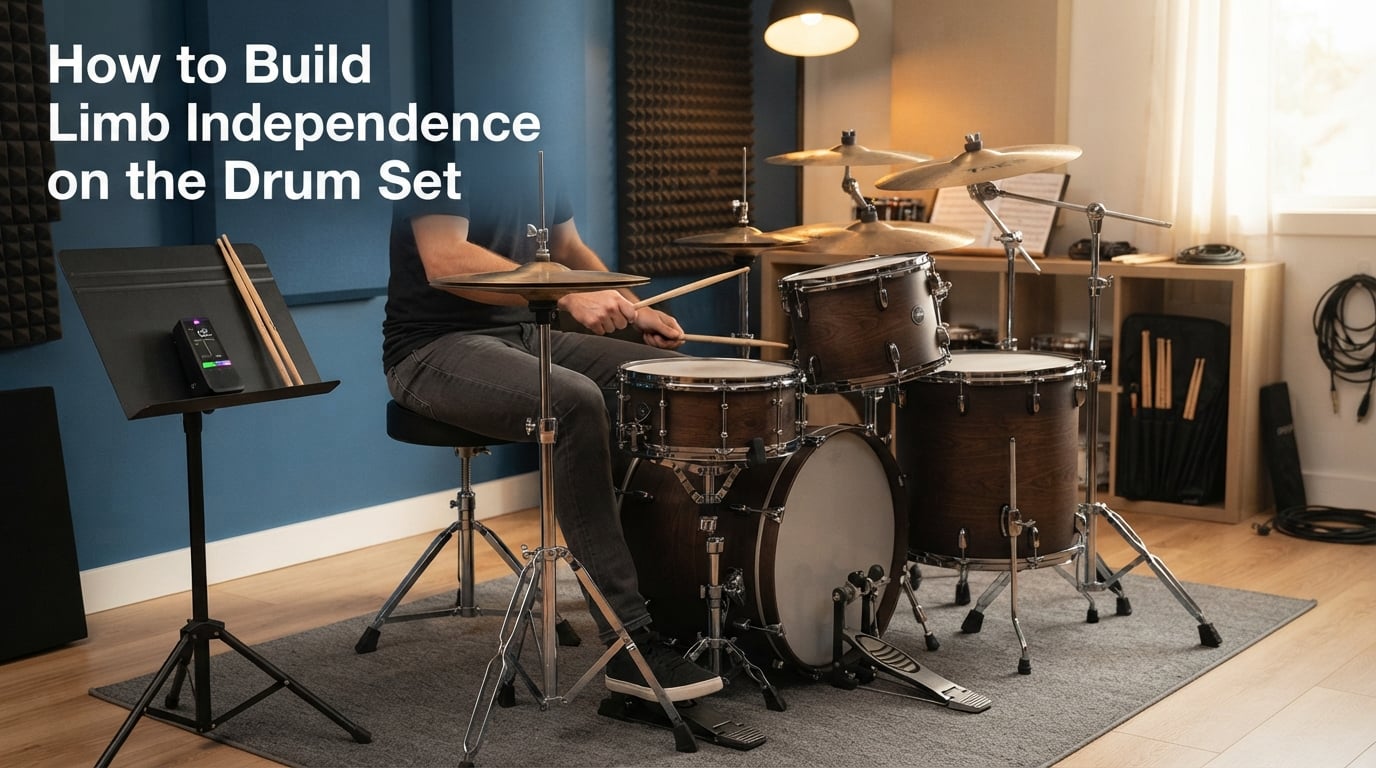
When I first sat behind a drum set, I thought playing with all four limbs would feel natural within a few weeks. It did not. My right hand wanted to copy my right foot. My left hand froze the moment my left foot moved. If you have ever felt like your brain is short-circuiting every time you try to get your hands and feet working separately, you are in the right place.
Learning how to build limb independence on the drum set is the single biggest hurdle every drummer faces, and it is also the skill that separates beginners from players who can hold down a groove without thinking. The good news is that your brain can rewire itself to handle four different rhythms at once. It just needs the right approach.
In this guide, I will walk you through what limb independence actually is, the practice fundamentals that make everything click, five specific exercises you can start today, a realistic timeline for improvement, and the common mistakes that stall progress for months. Whether you have a full kit or just a practice pad, you will have a clear roadmap by the end.
Table of Contents
What Is Limb Independence on the Drum Set?
Limb independence is the ability to make your hands and feet perform different rhythms simultaneously on the drum set without one limb interfering with another. Your right hand might play steady eighth notes on the hi-hat while your left hand hits the snare on beats 2 and 4, your right foot drives quarter notes on the bass drum, and your left foot taps the hi-hat on the off-beats. All four limbs, four different jobs, all at the same time.
Here is something that took me years to understand: true independence is a bit of a misnomer. Experienced drummers on forums like r/drums consistently point out that nobody achieves perfect, free-floating independence in all four limbs. What we actually develop is interdependence, a set of practiced patterns and muscle memories that give the illusion of total freedom. Your brain learns to group movements into chunks that can run on autopilot, freeing up your conscious mind for creativity and improvisation.
So why does this feel so impossible at first? Your brain is not naturally wired to send four independent motor commands at once. When you try to move your left foot independently, your nervous system tends to recruit nearby muscles and drag your left hand along for the ride. This is called motor overflow, and it is completely normal. Through slow, deliberate repetition, you train your brain to create separate neural pathways for each limb. That rewiring takes time, but it absolutely happens at any age.
Practice Fundamentals: Setting Up for Success
Before you touch a single exercise, you need a practice methodology. Without it, you will reinforce bad habits and plateau quickly. These five fundamentals come from drum instructors, forum consensus, and my own years of trial and error.
Start at Turtle Speed
The number one piece of advice from experienced drummers is to slow everything down to an almost painfully slow tempo. I am talking about speeds where you feel slightly ridiculous because it seems too easy. At slow tempos, your brain has enough time to process what each limb is doing and build the correct neural connections. Play fast and you are just practicing mistakes at high volume.
Ditch the Metronome at First
This surprises a lot of people, but multiple instructors recommend starting without a metronome when learning a brand-new coordination pattern. A metronome adds time pressure, and time pressure is the enemy of new motor learning. Get the pattern physically comfortable first. Once your limbs know where to go, bring the metronome in at a slow tempo like 60 BPM and lock things down rhythmically.
Visualize Before You Play
Spend thirty seconds before each practice session mentally rehearsing the pattern. Picture your right hand on the hi-hat, your left hand on the snare, your right foot on the kick pedal. Hear the rhythm in your head and imagine each limb moving. Studies on motor learning show that mental rehearsal activates many of the same neural pathways as physical practice, giving you a head start before you even pick up your sticks.
Break It Into Limb Pairs
Do not try to put all four limbs together immediately. Practice just hands. Then just feet. Then right hand with right foot. Then left hand with left foot. Then right hand with left foot. Build up combinations two at a time until each pairing feels comfortable. Only then layer in the third and fourth limbs. This pair-and-build approach is what forum drummers credit most for their breakthroughs.
The 80/20 Rule of Drumming Practice
The 80/20 rule in drumming means that 80 percent of your progress comes from 20 percent of your effort, specifically the slow, focused, repetitive work on fundamentals. Twenty minutes of concentrated, mistake-free practice at a slow tempo will take you further than two hours of sloppy, full-speed jamming. Quality over quantity, every single time.
How to Build Limb Independence on the Drum Set?: Core Exercises
These five exercises progress from simple to complex. Work through them in order and do not move to the next one until the current one feels easy at a comfortable tempo. Each exercise builds on the coordination skills from the previous one.
Exercise 1: The Unison Foundation
This is where everyone starts. Play quarter notes with all four limbs hitting at the same time. Right hand on the hi-hat, left hand on the snare, right foot on the bass drum, left foot on the hi-hat pedal. Count out loud: one, two, three, four. Everything lands together on each beat.
Once that feels solid, keep your right hand on quarter notes and shift your right foot to play on beats 1 and 3 only. Your hand plays four notes per measure while your foot plays two. This tiny split is your first taste of limbs doing different jobs. It should feel easy, and that is the point. You are building the foundation.
Exercise 2: Split Paradiddles
The single paradiddle sticking is right, left, right, right, left, right, left, left. Play this on the snare with your hands alone until it is smooth. Now add a bass drum quarter note pulse underneath, playing the kick on every beat. The challenge is keeping the bass drum steady while your hands move through the paradiddle pattern.
Here is a simplified notation to visualize it:
Hands (snare): R L R R | L R L L | R L R R | L R L L
Feet (kick): X . . . | X . . . | X . . . | X . . .
Count: 1 e + a | 2 e + a | 3 e + a | 4 e + a
When that works, move the bass drum to the off-beats, landing on the and of each beat. Now your feet are syncopated while your hands play straight paradiddles. This is where the brain starts really working.
Exercise 3: Stacking Quarters with Moving Hands
Play steady quarter notes on the bass drum, one for every beat. Keep those feet locked. Now with your hands, play eighth notes on the hi-hat while your left hand plays the snare on beats 2 and 4. This is the basic rock groove, and it is a independence exercise disguised as a beat.
The key is keeping the bass drum rock-steady no matter what your hands do. Once you have this groove solid, start moving your right hand around the kit. Play the hi-hat for one measure, then the ride cymbal the next, then the floor tom. Your feet should not change at all. The ability to move your hands freely while your feet stay fixed is a core independence skill.
Exercise 4: The Up-Beat Kick Groove
This exercise forces your bass drum to play syncopated patterns while your hands maintain a steady groove. Set up a basic rock pattern: right hand playing eighth notes on the hi-hat, left hand on snare for beats 2 and 4. Now add bass drum hits on the and of beat 1 and the and of beat 3.
Notation:
Hi-hat: X x X x | X x X x | X x X x | X x X x (eighth notes)
Snare: . . X . | . . X . | . . X . | . . X . (beats 2 and 4)
Kick: . x . . | . x . . | . x . . | . x . . (and of 1, and of 3)
That bass drum on the upbeat fights against every instinct your body has. Take it painfully slow. If you feel your hi-hat hand rushing or your snare hand missing, you are trying to play too fast. Drop the tempo by 20 BPM and try again.
Exercise 5: Linear Drumming Patterns
Linear drumming means no two limbs ever hit at the exact same time. This is the ultimate independence test because every note requires a separate, sequential motor command. Start with a simple four-note sequence: right hand on the snare, right foot on the kick, left hand on the hi-hat, left foot on the hi-hat pedal. Repeat that sequence as sixteenth notes.
The pattern looks like: R K L F, R K L F, R K L F, R K L F, where R is right hand, K is kick, L is left hand, and F is left foot. No overlapping. No simultaneous hits. Every limb fires one at a time in sequence. This will feel incredibly awkward at first, and that awkwardness is exactly the neural rewiring you want.
Once the sequence is smooth, change the order. Try R L K F, or L R F K. Each new ordering forces your brain to build fresh coordination pathways. Linear patterns are addictive once they click, and they sound incredibly impressive.
Progression Timeline: When Will You See Results?
One of the biggest content gaps I noticed across every drumming resource is that nobody tells you how long this takes. So here is a realistic progression timeline based on daily practice of 20 to 30 focused minutes.
In the first week, expect frustration. Everything will feel awkward, and your limbs will fight each other constantly. This is normal. You are building the initial neural pathways, and the brain resists new motor patterns at first. Push through.
By weeks two to three, the pair-based exercises (hands only, feet only, two-limb combinations) should start feeling comfortable. You will have moments where a pattern suddenly clicks and you can do it without staring at your hands. Celebrate those moments.
From weeks four to eight, you should be able to hold a basic rock groove with a syncopated bass drum pattern while moving your hands around the kit. This is the stage where playing starts feeling like actual drumming rather than a coordination puzzle.
After three to six months of consistent daily practice, most drummers can handle intermediate independence patterns like linear sequences, split paradiddles with varied feet, and basic polyrhythmic ideas. You will not be a master, but you will have a solid foundation that makes learning new grooves much faster.
Daily Practice Structure
A productive 30-minute session looks like this: five minutes warming up with single strokes and double strokes on a practice pad, ten minutes on one specific independence exercise at slow tempo, ten minutes applying that exercise in a musical context (try playing it along with a song), and five minutes of free play where you experiment and have fun. That last part matters, because enjoying yourself keeps you coming back.
Practicing Without a Drum Set
You do not need a full kit to develop limb independence. A practice pad and a pair of sticks cover your hands. For your feet, tap on the floor or use a pillow under your foot to simulate a pedal. You can also tap your feet on the ground while playing hand patterns on a pad. Many drummers report that this kind of off-kit practice actually accelerates learning because it removes the distraction of sound and forces you to focus purely on coordination. Electronic drum kits and practice pedals are also great if you have limited space.
Common Mistakes to Avoid
I made every one of these mistakes, and they cost me months of progress. Here is what to watch out for.
Mistake 1: Speeding Up Too Soon
The temptation to play fast is overwhelming, especially when you hear how a pattern is supposed to sound at full speed. But playing a coordination exercise faster than your brain can process just wires in mistakes. If you cannot play a pattern perfectly three times in a row at your current tempo, you are not ready to go faster.
Mistake 2: Practicing Errors Into Muscle Memory
When you stumble through a pattern and keep going without fixing the mistake, you are teaching your nervous system the wrong version. Stop the moment you make an error. Slow down. Play it correctly. Then repeat the correct version at least five times before moving on. Unlearning a bad habit takes ten times longer than learning it right the first time.
Mistake 3: Skipping Fundamentals for Flashy Patterns
Linear drumming and polyrhythms are exciting, but if your basic rock groove falls apart when you add a syncopated kick, you are not ready. Build a strong foundation with simple exercises before chasing complex ones. Every advanced pattern is built on the same coordination skills you develop in the first few exercises.
Mistake 4: Never Recording Yourself
You cannot fix what you cannot hear. Record a 30-second clip of yourself playing an exercise and listen back. You will catch timing issues, uneven dynamics, and limbs that drift out of sync that you never noticed while playing. Your phone’s voice memo app is all you need.
FAQs
How to make your limbs work independently in drums?
Start by practicing each limb separately, then combine them two at a time. Play hands alone, then feet alone, then right hand with right foot, and so on. Build combinations gradually at a very slow tempo, adding one limb at a time only when the current combination feels automatic.
Is limb independence hard?
Yes, limb independence is one of the hardest skills for new drummers because the human brain is not naturally wired to send four independent motor commands at once. However, with consistent daily practice of 20 to 30 minutes, most drummers see meaningful progress within a few weeks and solid coordination within three to six months.
What is interdependence in drumming?
Interdependence is the more accurate term for what drummers call limb independence. Rather than each limb operating in complete isolation, drummers learn practiced patterns and muscle memories that allow limbs to work together fluidly. The limbs are dependent on each other within a learned framework, creating the illusion of total independence.
How do drummers get limb independence?
Drummers develop limb independence through slow, repetitive practice of coordination exercises. The process involves starting at very slow tempos without a metronome, breaking patterns into two-limb combinations, visualizing each pattern before playing it, and gradually layering limbs until all four work together. Consistent daily practice is more effective than long, infrequent sessions.
What is the 80 20 rule in drumming?
The 80/20 rule in drumming means that 80 percent of your progress comes from 20 percent of your effort, specifically the slow, focused, repetitive work on fundamentals. Twenty minutes of concentrated, mistake-free practice at a slow tempo delivers more improvement than hours of sloppy, full-speed playing.
Is 27 too late to learn drums?
No, 27 is not too late to learn drums. Neuroplasticity, the brain’s ability to form new neural connections, continues throughout adulthood. While children may pick up motor skills faster, adults often have better focus, discipline, and practice habits. Many drummers start in their 30s, 40s, and beyond and develop strong limb independence through consistent practice.
Wrapping Up
Building limb independence on the drum set is not about talent or natural coordination. It is about consistent, deliberate, slow practice that rewires your brain to handle four rhythms at once. Start with the fundamentals, work through the exercises in order, track your progress, and avoid the common mistakes that derail so many drummers.
Pick one exercise from this guide and commit to practicing it for ten minutes today. Tomorrow, do it again. In a few weeks, you will feel the difference, and in a few months, you will wonder why it ever felt so hard. Your four limbs are capable of far more than you think. Now go practice.