
I remember the first time I tried to practice drums in a second-floor apartment. Within ten minutes, my neighbor was knocking on the door asking if someone was doing construction work. That moment sent me on a years-long journey to figure out how to keep improving as a drummer without making enemies of everyone in my building.
If you are reading this, you are probably in the same boat. Maybe you live in an apartment with thin walls. Maybe you work late and can only practice at midnight. Or maybe you simply do not have the budget or space for a full acoustic drum kit right now. The good news is that none of that has to stop you from becoming a better drummer.
Learning how to practice drums quietly without a full kit is not some watered-down compromise. Some of the fastest progress I have ever made came from months of focused practice pad work, metronome training, and coordination exercises done at low volume. Pros like Vinnie Colaiuta spent serious time practicing on a pillow, and that did not exactly hold him back.
In this guide, I will walk you through every quiet practice method that actually works. We will cover practice pads, electronic kits, drum mutes, brushes, finger drumming, VR drums, and budget-friendly DIY tricks. I will also share real solutions from the drumming community on Reddit and forums, because drummers helping drummers is where the best advice comes from.
You do not need to spend thousands of dollars or soundproof an entire room to get meaningful practice time. Let us break down exactly what you need, what to focus on, and how to build real skills without a full acoustic kit.
Table of Contents
How to Practice Drums Quietly Without a Full Kit?: The Core Methods
Here is the short answer: you can practice drums quietly using a practice pad for stick technique, an electronic drum kit for full-kit simulation, drum mutes or low volume cymbals on an acoustic set, brushes and rods on real surfaces, and technology tools like finger drumming pads or VR drums. Each method targets a different part of your drumming development, and most drummers combine several of them.
If you want a quick roadmap, here are the core quiet practice methods ranked by accessibility:
Practice pad and sticks — the cheapest, most portable option, and the single best tool for building hand technique and rudiments.
Electronic drum kit — gives you a full kit experience with headphones, though it requires a higher budget.
Drum mutes and low volume cymbals — turns down the volume on an acoustic kit you may already own.
Brushes and rods — quieter alternatives to standard sticks for playing on real surfaces like books, pillows, or electronic pads.
Finger drumming and pad controllers — builds rhythm and coordination using a MIDI pad and your hands.
VR drums and air drumming — emerging tech options that simulate a full kit without any physical drums.
Now let us look at each method in detail, starting with the one tool every drummer should own.
Practice Pads: The Foundation of Quiet Drumming
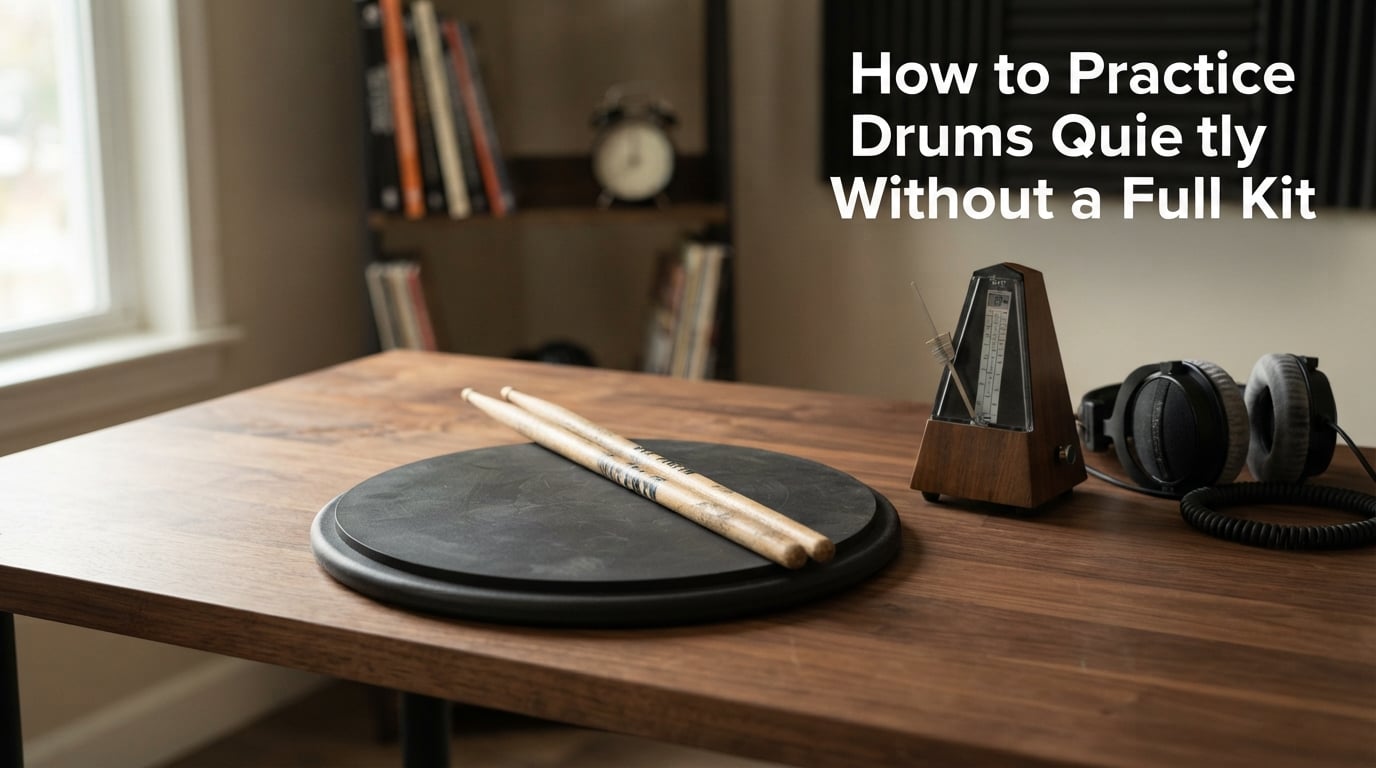
A practice pad is a quiet, portable surface designed to replicate the bounce and feel of a drumhead. It is the single most important tool for any drummer practicing without a full kit, and almost every drummer on Reddit will tell you the same thing: a practice pad is the go-to for daily practice.
Practice pads come in several varieties, and the surface material matters a lot. Rubber pads (like the classic Remo Practice Pad) offer a realistic bounce and are nearly silent. Silicone pads are even quieter and have a softer feel that some drummers prefer for long sessions. Tunable mesh pads replicate an actual drumhead and are popular for players who want a more realistic rebound.
Here is what I recommend when choosing a practice pad:
Get a pad around 6 to 8 inches for travel, or 10 to 12 inches for home practice where you want a bigger target.
Look for a gum or silicone surface if quietness is your top priority, or a rubber surface if you want better stick rebound.
Consider a double-sided pad — one side rubber, one side softer — so you can switch between realistic bounce and near-total silence.
Pair it with a good pair of sticks, like Vic Firth 5A, which is the standard for general practice.
A practice pad costs very little compared to any other practice option, and it will do more for your hands than any other investment. I spent my first year of drumming with nothing but a pad, a pair of sticks, and a metronome app on my phone. That foundation carried over directly when I finally sat behind a real kit.
If you want more versatility, consider a practice pad kit — a stand-mounted set of two or three pads arranged like a drum kit. This lets you practice moving around surfaces and build the muscle memory for kit ergonomics without making noise. Some kits even include a bass drum pad you can trigger with your foot pedal.
Building Real Technique With Rudiments
If you only practice one thing on your practice pad, make it rudiments. Rudiments are the building blocks of all drumming — they are the scales of percussion, and mastering them translates directly to the kit.
The 40 standard Percussive Arts Society rudiments cover everything from basic strokes to complex hybrid patterns. But you do not need to learn all 40 to see real improvement. Focus on these core rudiments first:
Single strokes (R L R L) — the foundation of speed and evenness between hands.
Double strokes (R R L L) — builds the bounce control you need for rolls and fast passages.
Paradiddles (R L R R L R L L) — trains hand-to-hand transitions and is used constantly in beats and fills.
Flams — develops stick control and the ability to play grace notes.
Ratamacues and flamadiddles — more advanced rudiments that build coordination and dynamics.
The key to effective rudiment practice is consistency, not duration. Twenty focused minutes a day on a practice pad will beat two hours of unfocused flailing every time. Start slowly with a metronome — painfully slowly — and only increase the tempo when your strokes are perfectly even between both hands.
One drill that transformed my own playing: practice each rudiment for one minute at a comfortable tempo, then bump the metronome up 5 BPM and do it again. Repeat until your strokes start to fall apart, then back off 10 BPM and finish there. This pushes your ceiling up gradually without reinforcing sloppy technique.
Rudiment practice on a pad builds muscle memory that transfers instantly to a real kit. When you finally sit behind drums, your hands will already know what to do. This is why so many experienced drummers say the pad is where real technique is built.
Electronic Drum Kits for Silent Practice
If you want the full drumming experience without the noise, an electronic drum kit is the answer. Electronic kits use rubber or mesh pads connected to triggers that send signals to a sound module. You hear everything through headphones, so the only acoustic noise is the light tap of sticks on rubber and the thump of your foot pedal.
Mesh-head electronic kits are significantly quieter than rubber-pad kits because mesh absorbs more of the stick impact. A kit like the Yamaha DTX series or Roland V-Drums with mesh heads lets you practice everything — grooves, fills, dynamics, and coordination — at any hour without anyone hearing you.
The biggest advantages of electronic kits for quiet practice:
Headphone output means you hear a full studio-quality drum kit while the room stays nearly silent.
Built-in metronomes and coaching features help you track your timing progress.
Aux input lets you play along with songs through your headphones.
You practice actual kit ergonomics — moving between surfaces, using a hi-hat and bass drum pedal, and sitting at proper kit height.
Here is the catch that nobody on the competitor sites addresses well enough: the bass drum pedal. Even with an electronic kit, the physical motion of a beater hitting a pad produces a low-frequency thud that travels straight through floors. Drummers on Reddit and the r/edrums community report this as their number one complaint for apartment practice.
To solve pedal vibration, try these approaches:
Place a thick yoga mat or interlocking foam tiles under the entire kit, especially under the kick tower.
Build a pedal riser using a piece of MDF on top of tennis balls or isolation pads — this decouples the pedal from the floor.
Use a kick practice pad with a soft beater instead of a hard plastic beater to reduce impact noise.
If you are on a tight budget, stuffing a folded blanket inside a pillowcase and placing it under the pedal absorbs a surprising amount of vibration.
Electronic kits range from entry-level options under a few hundred dollars to professional setups that cost thousands. For quiet practice specifically, a mesh-head kit in the mid-range will give you the best balance of feel, features, and noise reduction.
Low Volume Cymbals and Drum Mutes
If you already own an acoustic kit but need to make it quieter, you have two solid options: low volume cymbals and drum mutes. These let you play real drums and cymbals at a fraction of their normal volume.
Low volume cymbals are purpose-built cymbals with thousands of small holes punched through them. They produce the same tone and feel as regular cymbals but at roughly 20% of the volume. Brands like Zildjian (with their L80 series) and Sabian make low volume cymbals that are popular among apartment drummers. They are quiet enough to play in a shared living space while still giving you the acoustic feedback and physical response of real metal.
Drum mutes are rubber or neoprene pads that sit on top of your drumheads and cymbals. They dampen the sound dramatically — cutting volume by 70% or more. A full mute set covers your snare, toms, bass drum, and cymbals. Mutes are cheaper than low volume cymbals and work with your existing kit, but they do change the feel and rebound of the drums.
The drumming community has a popular budget alternative that costs almost nothing: stuff towels or pillows inside your drums. Multiple drummers on Reddit confirm that laying a towel over the snare head and draping one inside each tom dramatically reduces volume while preserving some of the natural tone. It is not elegant, but it is free, and for many apartment drummers, it works well enough.
You can also replace your acoustic heads with mesh drum heads. Mesh heads produce almost no sound on their own, and many drummers pair them with triggers connected to a module — effectively converting their acoustic kit into a custom electronic kit. As one Reddit drummer put it: “They don’t make sound.” This is a more involved modification, but it gives you the look and ergonomics of a full acoustic kit with total silence.
Brushes and Rods: Quieter Stick Alternatives
Sometimes the answer to quiet practice is not a different surface — it is different sticks. Brushes and rods are alternatives to standard drumsticks that produce significantly less volume on any surface you play.
Brushes are thin wire or nylon fans that spread the impact of each stroke across many tiny contact points. They produce a soft, swishing sound that is a fraction of a normal stick hit. Jazz drummers use brushes for their acoustic qualities, but they are equally useful for quiet practice on a practice pad, book, tabletop, or even a cushion.
Rods (sometimes called rutes) are bundles of thin wooden or bamboo dowls held together at the grip. They sit between brushes and full sticks in terms of volume. Rods give you more attack and definition than brushes but are much quieter than 5A sticks. Many drummers use rods for practice on practice pads or for playing along with acoustic tracks at low volume.
Using brushes or rods on a practice pad gives you a different feel and dynamics workout while keeping things nearly silent. They are also excellent for practicing brush technique itself, which is a whole skill set that many rock and pop drummers overlook until they need it.
Developing Timing With Metronome Practice
Here is a truth that took me too long to accept: you can have perfect hand technique and still be a bad drummer if your timing is off. Timing is the skill that separates people who play drums from people who are drummers, and it is something you can develop entirely without a full kit.
A metronome is your best friend for quiet practice. You can use a free phone app, a dedicated hardware metronome, or the metronome built into an electronic kit module. The goal is to train your internal clock so that you can hold a steady tempo without rushing or dragging.
Here is a progression I recommend for metronome practice on a practice pad:
Week 1-2: Play single strokes at 60 BPM, matching every click. Focus on landing exactly on the beat, not slightly ahead or behind.
Week 3-4: Play paradiddles at 70-80 BPM, ensuring the accented notes land dead-center on the click.
Week 5-6: Remove beats from the metronome. Set it to click only on beats 1 and 3, then only on beat 1. This forces you to subdivide the missing beats internally.
Week 7-8: Play along to drumless tracks at varying tempos. This simulates playing with a band and tests whether your timing holds up under musical pressure.
Another powerful exercise is limb independence practice. You do not need drums to start developing three-way coordination. Tap your left foot on quarter notes (like a hi-hat pedal), tap your right foot on the beat (like a kick drum), and play a rudiment on your practice pad with your hands. This builds the independence that real drumming demands, and you can do it sitting on your couch.
Timing practice is the one area where a full kit is not necessary at all. Some of the tightest drummers I know built their internal clock entirely on a pad with a metronome before they ever sat behind a real set.
Technology Tools for Silent Drumming
Technology has opened up entirely new ways to practice drums without a kit, and most of the competitors writing about this topic barely scratch the surface here. Let me walk you through the options that are actually worth your time.
Finger drumming with a pad controller is one of the fastest-growing practice methods. A MIDI pad controller — like an Akai MPX, Novation Launchpad, or Maschine — connects to your computer or phone. You use your fingers to trigger drum sounds through software. This builds rhythm, timing, and pattern-creation skills, and it is completely silent through headphones. Apps like Melodics turn finger drumming into a guided practice experience with structured lessons and progress tracking.
Aerodrums is a motion-capture drumming system that uses a camera and illuminated sticks to track your movements in the air. You sit with sticks and play the air, and the software translates your motions into drum sounds through your headphones. There are no physical drums at all — just you, sticks, a camera, and a computer. It sounds gimmicky, but drummers who have tried it report that it genuinely helps with kit ergonomics and spatial awareness.
VR drumming games and apps take the concept even further. With a VR headset and motion controllers, you can play a fully simulated drum kit in a virtual environment. Games like Drummer Talent and similar VR rhythm apps give you the visual feedback of a full kit and can build coordination skills. The physical feedback is obviously limited, but for practicing patterns and building rhythmic vocabulary, it is a legitimate option.
DrumPants and similar wearable sensors let you trigger drum sounds by tapping on your legs, chest, or any surface. They are less mainstream but appeal to drummers who want to practice rhythms anywhere — on a bus, at a desk, or during a lunch break.
None of these technology tools will replace the feel of a real drum. But they all contribute to your overall musicianship: rhythm, timing, coordination, and vocabulary. For a drummer with no kit access, they are valuable additions to a practice routine.
Soundproofing and Neighbor-Friendly Tips
Even with the quietest practice methods, sound management matters when you share walls with neighbors. The two problems to solve are airborne noise (the sound traveling through the air) and structure-borne vibration (low-frequency energy traveling through floors and walls).
Airborne noise is relatively easy to manage. A practice pad, electronic kit, or mesh-headed acoustic kit produces so little airborne sound that a closed door and a normal apartment wall will usually contain it. If your walls are particularly thin, hanging heavy curtains, acoustic panels, or even a bookshelf full of books against the shared wall will help absorb and block sound.
Structure-borne vibration is the real challenge, especially from bass drum pedals. This is the problem that forum drummers complain about most, and it is the one that gets people in trouble with neighbors. Here is what actually works:
Decouple your kit from the floor with a thick rug, foam tiles, or a dedicated drum mat. Never set your kick pedal directly on a hard floor in an apartment.
Build a tennis ball riser — a platform of wood resting on tennis balls that isolates the kit from the floor. Reddit DIY threads on r/drums have detailed build guides, and drummers swear by them for cutting bass drum vibration.
Stuff foam inside the kick drum shell if you are using mutes or mesh heads on an acoustic kit. This absorbs internal resonance that otherwise radiates through the shell.
Talk to your neighbors. Seriously. A quick conversation explaining that you drum and asking what hours are acceptable goes a long way. Most people are fine with daytime practice if they know what to expect and when it will end.
Smart scheduling is just as important as soundproofing. I found that practicing between 10 AM and 8 PM kept me on good terms with every neighbor I ever had. Late-night practice is where most complaints originate, and no amount of soundproofing will fully solve a bass drum pedal at midnight in a building with wooden floors.
If you are truly stuck — thin floors, sensitive neighbors, no space — consider renting a rehearsal room by the hour. Many cities have shared music spaces where you can book a soundproofed room with a full kit for 15 to 25 dollars an hour. It is not as convenient as practicing at home, but it gives you real kit time when you need it.
The 80/20 Rule in Drumming
The 80/20 rule — also known as the Pareto Principle — states that 80% of your results come from 20% of your efforts. In drumming, this means that a small number of fundamental skills produce the vast majority of your improvement as a player.
When you are practicing without a full kit, the 80/20 rule is your best friend. You cannot practice everything, so you need to focus on the 20% that moves the needle most. Here is what that 20% looks like for quiet practice:
Rudiments on a practice pad build the hand technique that underlies every beat and fill you will ever play.
Metronome timing develops the internal clock that makes you a musician, not just a noise-maker.
Limb independence exercises — tapping feet while playing hands — build the coordination that real drumming demands.
Listening to music actively — dissecting songs, counting along, and identifying patterns — builds vocabulary and musical understanding.
If you spend 80% of your quiet practice time on these four areas, you will improve faster than someone who spends hours noodling on a full kit without focus. The 80/20 rule is not about doing less work. It is about doing the right work.
I applied this principle during a year when I had no kit access at all. I did 30 minutes of pad work and 15 minutes of coordination exercises daily, and I actively listened to music every day. When I finally got back behind a kit, my playing had improved more than it had in the previous two years of unfocused practice.
Common Beginner Mistakes to Avoid
When you start practicing drums without a full kit, it is easy to develop bad habits that are hard to unlearn later. Here are the most common mistakes I see beginners make, and how to avoid them:
1. Gripping the sticks too tight. This is the number one mistake. A death grip kills your rebound, fatigues your hands, and prevents you from developing speed. Hold the stick firmly enough to control it but loosely enough that it can bounce naturally off the practice pad. Use the fulcrum technique — pinch between your thumb and index finger or middle finger — and let the stick breathe.
2. Practicing without a metronome. Playing rudiments at whatever speed feels comfortable reinforces bad timing. Always use a metronome, even when you are just warming up. If you develop an internal rush or drag, it will haunt you when you get on a real kit.
3. Practicing only what feels good. It is natural to gravitate toward rudiments and patterns you already do well. But improvement comes from practicing what you are bad at. Spend the first ten minutes of every session on your weakest rudiment at a slow tempo.
4. Ignoring posture and setup. Sitting slouched over a practice pad on your lap builds bad ergonomics. Sit up straight, set the pad at a comfortable height on a table or stand, and practice with the same posture you would use behind a drum kit.
5. Rushing to play full beats before mastering the basics. Everyone wants to play along to their favorite songs on day one. But without solid rudiments and timing, you are just building sloppy patterns. Trust the process — pad work first, songs later.
Choosing Your Quiet Practice Setup
Now that you know all the methods, how do you decide what to actually buy or use? It depends on your budget, your living situation, and your goals. Let me break this down into clear scenarios.
Scenario 1: Absolute beginner, tight budget, apartment living. Start with a practice pad, a pair of Vic Firth 5A sticks, and a free metronome app. Total cost is minimal, and this setup will keep you busy for months. Focus on rudiments, timing, and coordination exercises. This is honestly all many drummers need for their first year.
Scenario 2: Intermediate drummer, some budget, wants full-kit feel. Invest in a mesh-head electronic drum kit. Look at entry-level options from Yamaha (like the DTX series), Roland (V-Drums), or Alesis. Pair it with good closed-back headphones. Budget for a thick rug or foam tiles under the kit to handle pedal vibration. This gives you the most realistic practice experience at home without noise complaints.
Scenario 3: Already own an acoustic kit, need to make it quieter. Go with low volume cymbals and a set of drum mutes. If you want total silence, swap your heads for mesh heads and consider adding triggers connected to a module. This converts your existing kit into a quiet electronic-style setup while keeping the hardware and ergonomics you already have.
Scenario 4: No space, travel frequently, or want to practice anywhere. A practice pad plus a finger drumming setup with a small MIDI pad controller is your best bet. You can practice hand technique on the pad and rhythm and coordination through finger drumming apps. Both fit in a backpack.
Scenario 5: Want to explore technology-forward options. Look into Aerodrums or a VR drumming setup if you have the space for motion tracking but no room for a physical kit. These are not replacements for real drumming, but they offer a genuinely useful practice experience for rhythm and coordination.
Here is the progression I recommend for most beginners: start with a practice pad and sticks, spend 3 to 6 months building fundamentals, then add an electronic kit when you are ready for full-kit practice. This staged approach keeps costs manageable and ensures you build the right habits before adding complexity.
One more thing to consider: online drum lessons. Many platforms now offer structured video courses that are designed for practice pad work and electronic kit practice. Having a guided curriculum keeps you from wasting practice time deciding what to work on, and it ensures you are covering the fundamentals in the right order.
FAQs
Is there a way to practice drums silently?
Yes. A practice pad with rubber or silicone surface is nearly silent and lets you practice all hand technique and rudiments. Electronic drum kits with mesh heads let you play a full kit through headphones with almost no acoustic noise. Mesh drum heads on an acoustic kit produce almost no sound at all, and finger drumming on a MIDI pad controller is completely silent through headphones.
How do I practice drumming without a drum kit?
You can practice drumming without a kit by using a practice pad for rudiments and hand technique, doing limb independence exercises by tapping your hands and feet, practicing timing with a metronome, using finger drumming on a MIDI pad controller, and actively listening to music to build rhythmic vocabulary. These methods build the core skills that transfer directly to a full kit when you get access to one.
How can I make drums quieter for practice?
To make drums quieter, use drum mutes (rubber or neoprene pads that sit on drumheads and cymbals), switch to low volume cymbals with holes punched through them, replace acoustic heads with mesh heads, stuff towels or pillows inside drums as a free DIY mute, use brushes or rods instead of standard sticks, or invest in an electronic drum kit that outputs through headphones.
What is the 80/20 rule in drumming?
The 80/20 rule in drumming means that 80% of your improvement comes from 20% of your practice activities. For most drummers, that high-impact 20% consists of rudiments on a practice pad, metronome-based timing practice, limb independence exercises, and active listening to music. Focusing your quiet practice time on these fundamentals produces faster improvement than spending hours playing full songs without structure.
Conclusion
You now have a complete playbook for how to practice drums quietly without a full kit. Whether you are working with a 15-dollar practice pad or a full mesh-head electronic setup, the principles are the same: focus on rudiments, develop your timing with a metronome, build limb independence, and practice consistently rather than in long unfocused bursts.
The 80/20 rule tells us that a small amount of focused, quiet practice will take you further than you might think. Start with a pad and sticks today, and add tools as your budget and space allow. Your future self behind a real kit will thank you for the foundation you built in silence.