
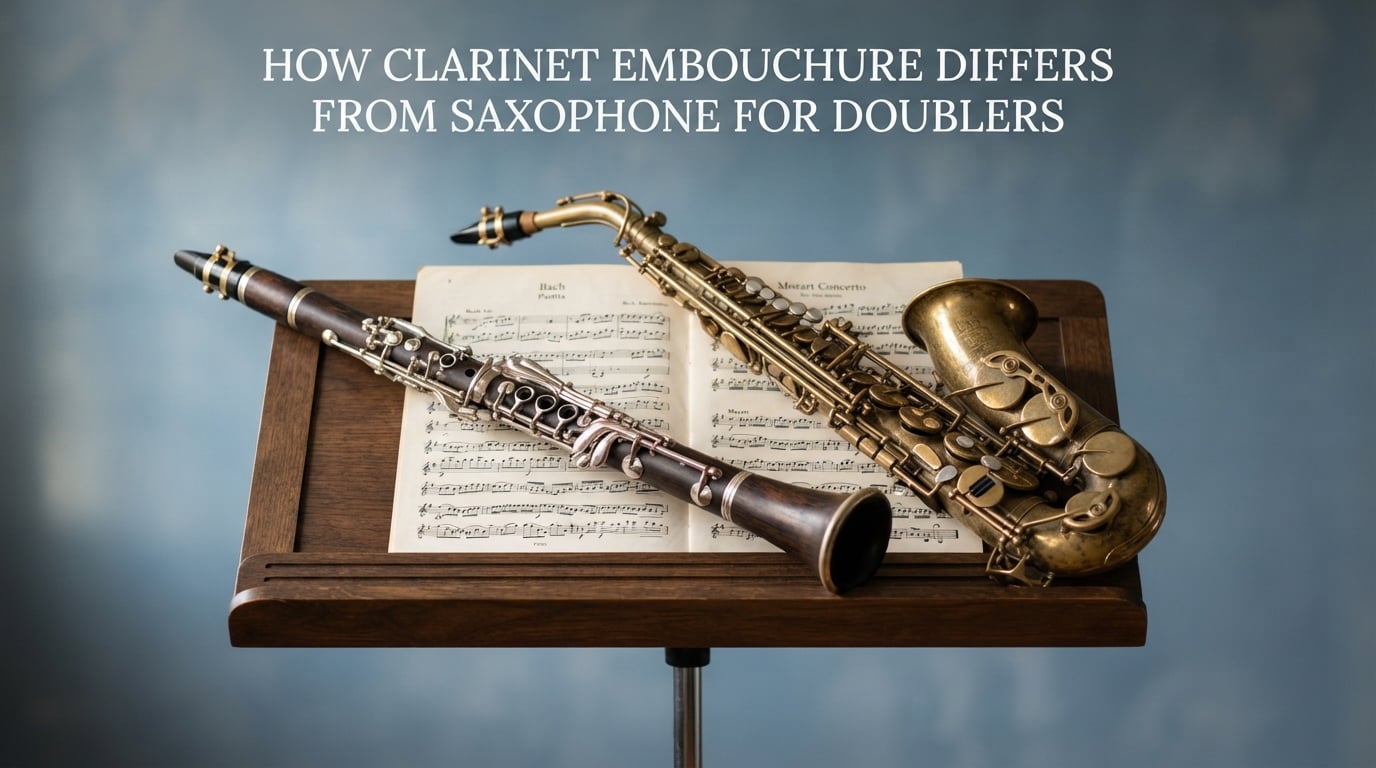
If you play both clarinet and saxophone, you already know that switching between them is not as simple as picking up the other horn. The way your lips, jaw, and tongue interact with each mouthpiece changes in subtle but important ways. Understanding how clarinet embouchure differs from saxophone for doublers can save you months of frustration, squeaky notes, and tone that just does not sound right.
Our team has worked with woodwind doublers in jazz bands, orchestras, and pit ensembles for years. We have seen the same patterns repeat: saxophonists who sound tubby on clarinet, clarinetists who sound pinched on saxophone, and players convinced they need a “tighter” embouchure on one instrument versus the other. Most of these problems trace back to a few specific mechanical differences that nobody explained clearly.
This guide breaks down exactly what changes when you move from clarinet to saxophone and back. We will cover mouthpiece angle, voicing, tongue position, articulation, posture, and the common mistakes doublers make on each instrument. You will also find transition exercises that no competitor covers, plus the mental approach that separates smooth doublers from those who struggle.
Whether you are a saxophone player picking up clarinet for a jazz gig or a clarinetist doubling on sax in a show band, the details below will help you build reliable technique on both instruments without one ruining the other.
Table of Contents
How Clarinet Embouchure Differs From Saxophone for Doublers?: The Core Differences
The clarinet and saxophone embouchures share the same basic goal: forming an airtight seal around the mouthpiece and reed so the reed vibrates freely. But the specific way you achieve that seal differs in mouthpiece angle, the amount of lip tension, tongue position, and how much mouthpiece you take in. These differences are driven mostly by the size and shape of each mouthpiece, not by some mysterious requirement for one instrument to be played “tighter” than the other.
Here are the key differences every doubler needs to understand:
Mouthpiece angle: Clarinet sits at roughly 30 degrees from vertical (steeper, closer to your body), while saxophone sits at roughly 45 degrees (flatter, more outward).
Voicing: The tongue position and oral cavity shape differ significantly between the two, affecting pitch and tone color more than lip pressure does.
Lip contact: Saxophone uses a more rounded, drawstring-like seal around the mouthpiece, while clarinet uses firmer, more linear pressure from the lower lip.
Mouthpiece amount: Clarinet requires less mouthpiece in the mouth than saxophone due to the smaller facing and tip opening.
Jaw pressure: The myth that clarinet needs dramatically more jaw pressure is overstated. The real difference is in where and how the pressure is applied.
Many doublers focus obsessively on lip tightness when the actual problem lives in their voicing. We will address each of these areas in detail below.
Mouthpiece Angle: The 30 vs 45 Degree Rule
The single most visible difference between clarinet and saxophone is the angle at which the instrument meets your face. Clarinet is held steeply, at roughly 30 degrees from vertical. The mouthpiece comes almost straight down into your mouth. Saxophone sits much flatter, at roughly 45 degrees, with the mouthpiece entering your mouth at a wider, more horizontal angle.
This angle difference is not cosmetic. It directly affects how your lower lip contacts the reed and how your jaw aligns with the mouthpiece. On clarinet, the steeper angle means your lower lip supports the reed from below with relatively firm, direct pressure. On saxophone, the flatter angle means your lip wraps around the mouthpiece differently, requiring a more rounded, flexible seal.
Think about it this way: if you hold a pencil straight down against your lip versus at a 45-degree angle, the contact point and the way your lip tissue deforms around it change completely. The same principle applies to a mouthpiece and reed.
When saxophonists pick up clarinet, they often keep the saxophone angle in their muscle memory. The mouthpiece enters their mouth at too flat an angle, which causes the reed to close off and produces a thin, pinched sound. When clarinetists pick up saxophone, the opposite happens: they tend to hold the neck too steeply, which chokes the larger reed and produces a stuffy, resistant tone.
The fix is awareness. Before you play a single note, check the instrument angle in a mirror. Get the geometry right first, then focus on what your lips are doing.
Embouchure Formation: Similarities and Key Differences
Both clarinet and saxophone use the lower lip curled over the bottom teeth as a cushion for the reed. Both require the corners of the mouth to seal around the mouthpiece. Both depend on steady, controlled air support from the diaphragm. At a fundamental level, the mechanics are closely related.
But the execution differs in important ways. Experienced doublers often describe the saxophone embouchure as a drawstring bag: the lips close evenly around the mouthpiece from all sides, creating a rounded, flexible seal. The clarinet embouchure, by contrast, feels more like pressing two straight lines together: the lower lip provides firm, focused support against the reed while the upper teeth rest on the mouthpiece with consistent downward pressure.
The lower lip behaves differently on each instrument. On clarinet, the bottom lip needs to be firm and focused, providing a stable platform for the smaller reed to vibrate against. On saxophone, the lip should be more relaxed and mobile, allowing the larger reed to vibrate with a wider amplitude. This is why saxophonists who keep too much lip tension when they switch to clarinet may actually be fine on sax but then sound tubby and flat on clarinet, they are not adjusting their lip focus.
How much mouthpiece you take in also differs. Clarinet mouthpieces are smaller with a shorter facing, so you take in less mouthpiece overall. Saxophone mouthpieces are larger with a longer facing curve, so you take in more. If you take in the same amount on both instruments, you will choke the clarinet reed or fail to engage the full facing on the saxophone.
A practical test: play a long tone, then slowly slide the mouthpiece slightly in and out of your mouth while sustaining the note. The spot where the tone opens up freely with the least effort is your correct position. Do this on both instruments separately, because the answer will be different for each.
The Loose vs Tight Embouchure Myth
If you spend any time in woodwind forums or band rooms, you will hear some version of this advice: “Play clarinet with a tight embouchure and saxophone with a loose embouchure.” This oversimplification causes more problems than it solves, and it is worth debunking directly.
The myth persists because there is a grain of truth buried in it. Clarinet does require more focused, firm lower lip pressure relative to its small reed. Saxophone does benefit from a more relaxed, flexible lip relative to its large reed. But framing this as “tight versus loose” leads players to clamp down on clarinet, which chokes the reed and produces a thin, nasal tone. It also leads players to go slack on saxophone, which produces a pitchy, unfocused sound.
The reality is that both instruments require a balanced embouchure. The differences are not about tension level but about the type of pressure and where it is directed. Clarinet needs firm, focused support from the lower lip against a small, hard reed. Saxophone needs an even, flexible seal around a large, more responsive reed.
Experienced doublers and teachers like Bret Pimentel have pointed out that the tightness difference is largely a proxy for voicing. When your tongue is in the right position for each instrument, the lip tension largely takes care of itself. The players who struggle most are the ones trying to control everything with their lips while ignoring what their tongue and oral cavity are doing.
The next time someone tells you to “tighten up” on clarinet, ask them what they mean. If they are talking about lip clamping, they are giving you bad advice. If they are talking about focusing the lower lip and raising the tongue arch, they are describing voicing without using the word.
Voicing and Tongue Position: The Real Challenge
If there is one area that separates smooth doublers from struggling ones, it is voicing. Voicing refers to the shape of your oral cavity, the position of your tongue, and the direction of your airstream. These factors have a bigger impact on your tone and pitch than lip pressure ever will.
On clarinet, the tongue sits relatively high and forward in the mouth. The oral cavity is smaller and more focused, which helps produce the bright, focused tone the instrument is known for. The airstream feels directed and fast, like blowing through a small straw. Many teachers describe clarinet voicing as “cold air,” the kind of fast, focused air you would use to blow out a candle across the room.
On saxophone, the tongue sits lower and more relaxed. The oral cavity is more open, which allows the larger reed to vibrate with the wider amplitude that gives saxophone its warm, broad tone. The airstream feels warmer and rounder, like the “warm air” you would use to fog up a mirror. This lower tongue position is why saxophone sounds fuller and darker than clarinet even with similar lip setups.
This voicing difference is the root cause of the most common doubler complaints. Saxophonists playing clarinet with saxophone voicing produce a flat, tubby, dark tone because their tongue is too low and their oral cavity is too open. Clarinetists playing saxophone with clarinet voicing produce a thin, pinched, bright tone because their tongue is too high and constricts the larger reed’s vibration.
The most effective voicing exercise for doublers is the mouthpiece pitch test. Play the mouthpiece and reed alone, without the instrument attached. On clarinet mouthpiece, a well-voiced concert C (one octave above middle C) is the target pitch. On alto saxophone mouthpiece, a concert A is typical. On tenor mouthpiece, a concert G. These pitches correspond to correct tongue and air positions for each instrument.
If your mouthpiece pitch is flat, your tongue is too low. If it is sharp, your tongue is too high or you are biting. Practice matching the target pitch on each mouthpiece separately, then switch back and forth. This builds the voicing memory that makes doubling feel effortless.
Articulation Adjustments When Switching Instruments
Tonguing feels different on clarinet and saxophone, and the difference is tied to the voicing and mouthpiece characteristics we just covered. Because the clarinet reed is smaller and the mouthpiece tip opening is narrower, the reed responds faster to articulation. Your tongue touches a smaller surface and releases quickly, producing the crisp, clean articulation that clarinet playing demands.
On saxophone, the larger reed and wider tip opening mean the reed has more mass and travels a greater distance. The tongue touches a wider surface area and the release feels slightly slower and broader. This is why saxophone articulation tends to sound rounder and more legato compared to the pointed clarity of clarinet tonguing.
When switching instruments, adjust your tonguing to match the reed size. Clarinetists moving to saxophone often tongue too lightly and quickly, producing a thin articulation that does not speak fully. Saxophonists moving to clarinet often tongue too heavily, producing a sluggish response and sometimes causing the reed to close off entirely.
A simple drill: practice single tonguing on a single note at a slow tempo, then gradually increase speed. Notice where the articulation starts to break down on each instrument. The point of failure will be different, and adjusting your tongue stroke to match the reed will improve clarity at faster tempos.
Posture Considerations for Doublers
Posture plays a bigger role in embouchure than most players realize. The angle of your head, the position of your shoulders, and the height of your instrument all affect how your lips and jaw engage the mouthpiece. Because clarinet and saxophone are held so differently, your body position needs to adjust when you switch.
Clarinet is supported primarily by the right thumb and the lower lip. It hangs at a steep angle from your mouth, and your head sits relatively centered over your body. Your right elbow should be away from your side to support the instrument weight, and your shoulders should be relaxed and level. If your head tilts forward or your neck tenses, the steep clarinet angle becomes even steeper, choking the reed.
Saxophone is supported by a neckstrap, which changes the equation entirely. The neckstrap carries most of the weight, allowing your jaw and lips to be more relaxed. Your head tilts slightly forward to meet the mouthpiece, and the instrument hangs outward from your body at roughly 45 degrees. A well-adjusted neckstrap brings the mouthpiece to you, so you do not have to reach for it with your neck.
The biggest posture mistake for doublers is using the same head angle for both instruments. Clarinet players who lean forward into the saxophone mouthpiece end up with too much jaw pressure on the reed. Saxophone players who hold their head too vertically for clarinet end up with too little support and a weak, airy tone. Let each instrument dictate your head position, not the other way around.
Check your posture in a mirror on both instruments. Your spine should be tall, your shoulders relaxed, and your head balanced. The instrument comes to your face, not your face to the instrument. This principle applies equally to both clarinet and saxophone, but the execution looks different for each.
Common Mistakes Saxophonists Make on Clarinet
Saxophonists who pick up clarinet tend to share a predictable set of problems. Recognizing these patterns early can save you from building bad habits that take months to undo.
Flat, tubby tone. This is the number one complaint. Saxophonists bring their low-tongue voicing to the clarinet, opening the oral cavity too much and darkening the tone past the point of clarity. The fix is raising the tongue arch and thinking “cold, fast air” to focus the sound.
Squeaking on low notes. When saxophone voicing meets the clarinet register key system, the chalumeau register often breaks. Low notes require a relaxed but well-supported embouchure with the tongue in the right position. Too much oral cavity openness, combined with the smaller reed, causes the reed to jump to an overtone instead of speaking the fundamental.
Difficulty crossing the break. The transition from chalumeau to clarion register is one of the hardest things for saxophonists. The clarinet overblows a twelfth, not an octave like saxophone, so the embouchure and voicing shift is more dramatic. Players who do not adjust their voicing will get a thin, cracked sound or nothing at all when they press the register key.
Too flat an instrument angle. Saxophonists often hold the clarinet at too shallow an angle, which changes the lower lip contact and weakens the seal. Check yourself in a mirror and aim for roughly 30 degrees from vertical.
Common Mistakes Clarinetists Make on Saxophone
Clarinetists crossing to saxophone face a different set of challenges. The large mouthpiece and wide tip opening feel unfamiliar, and the habits that serve clarinet well can work against you on saxophone.
Pinched, bright tone. Clarinetists bring their high-tongue voicing to the saxophone, constricting the oral cavity and producing a thin, nasal sound. The fix is dropping the tongue arch and opening the throat, thinking “warm, round air” to let the larger reed vibrate freely.
Difficulty with low notes. The saxophone’s low register needs a relaxed, open voicing to speak. Clarinetists who keep their tongue high and oral cavity tight will struggle to get the low notes to respond, and they may compensate by loosening the embouchure too much, which causes pitch problems.
Over-tightening the embouchure. Clarinetists are used to firm lip pressure against a hard reed. On saxophone, that same pressure chokes the larger, softer reed and kills the resonance. The lip needs to be firm enough for a seal but flexible enough to let the reed move.
Holding the neck too steeply. Clarinetists sometimes hold the saxophone neck at too vertical an angle, mimicking their clarinet position. This changes the mouthpiece entry angle and makes the embouchure feel wrong even when the lip position is otherwise correct. Let the neckstrap and the natural saxophone angle do the work.
Transition Exercises for Smooth Instrument Switching
No competitor we analyzed provides specific exercises for transitioning between clarinet and saxophone. This is one of the highest-value things you can practice as a doubler, so we want to give you concrete drills you can use today.
Exercise 1: Mouthpiece Pitch Alternation. Start with your clarinet mouthpiece alone. Find the target pitch (concert C, one octave above middle C) and hold it for four counts. Set it down, pick up your saxophone mouthpiece, and find its target pitch (concert A for alto, G for tenor). Hold for four counts. Alternate between the two mouthpieces, ten rounds each. This builds separate voicing memory for each instrument faster than anything else.
Exercise 2: Same Note, Different Instrument. Pick a note that exists in the same register on both instruments, like concert B-flat. Play it on clarinet, then immediately pick up the saxophone and play the same concert pitch. Listen to the tone color and notice what your tongue and lips are doing on each. The goal is not to make them sound the same but to feel the difference clearly and reproduce it on command.
Exercise 3: The Five-Minute Switch. Set a timer for five minutes. Play a simple melody or scale exercise on clarinet for one minute, then switch to saxophone for one minute, then back to clarinet. Repeat until five minutes are up. This simulates real doubling situations where you have seconds, not minutes, to switch instruments. The rapid alternation forces your embouchure and voicing to adapt quickly.
Exercise 4: Register Key Drill. On clarinet, practice slow slurs across the break (throat tones to clarion register) with careful attention to voicing changes. On saxophone, practice octave slurs with attention to how little the embouchure should change. The contrast between how much the clarinet embouchure shifts across registers versus how little the saxophone embouchure shifts is one of the most important sensations a doubler can internalize.
Do these exercises consistently for two weeks and you will notice a significant improvement in how quickly and smoothly you can switch between instruments. The key is frequency over duration. Ten minutes daily beats an hour once a week.
The Mental Side of Doubling
No competitor addresses the cognitive aspects of switching instruments, but this is often the hidden barrier that holds doublers back. Your brain stores separate motor programs for clarinet and saxophone, and the skill of doubling is largely about accessing the right program at the right time.
Beginner doublers often try to consciously think through every adjustment when they switch instruments. This is slow and error-prone. The goal is to build automatic, separate muscle memory for each instrument so the switch happens without conscious effort. This takes time, typically three to six months of regular practice on both instruments before the motor programs separate cleanly.
One mental trick that works well: give each instrument a character or personality. Your clarinet embouchure feels focused, precise, and bright. Your saxophone embouchure feels open, warm, and broad. When you pick up each instrument, take a moment to mentally “switch on” that character before you play a note. This simple visualization primes your brain to access the correct motor program.
Players who have one embouchure ruin the other are usually trying to use a single motor program for both instruments. The solution is not to stop doubling but to practice each instrument enough that the programs separate. Players on forums who report success with doubling almost universally cite consistent, regular practice on both as the key factor.
Be patient with yourself. Doubling is a skill that compounds over time. The first few months feel awkward because your brain has not yet built distinct pathways. Once the pathways form, switching becomes as natural as switching between walking and running.
Equipment Considerations for Doublers
While embouchure technique is the main focus of this guide, your equipment choices can make doubling easier or harder. A few smart decisions go a long way.
Mouthpiece selection. Choose mouthpieces that complement each other rather than fighting your embouchure. A medium-facing clarinet mouthpiece (such as a Vandoren M13 or M30 series) pairs well with a medium-facing saxophone mouthpiece (such as a Vandoren AL3 for alto or a Meyer 5 for alto). Avoid extremes: a very open saxophone mouthpiece combined with a very closed clarinet mouthpiece will exaggerate the differences and make switching harder.
Reed strength. Many doublers use slightly different reed strengths on each instrument, and that is fine. What matters is consistency within each setup. Find a reed strength that works for each mouthpiece and stick with it while you build embouchure memory. Changing reed strengths frequently will confuse your lips and slow your progress.
Neckstrap for saxophone. A good neckstrap is non-negotiable for doublers. It carries the saxophone weight so your embouchure does not have to. A padded or harness-style strap reduces neck tension, which directly improves your embouchure by keeping the surrounding muscles relaxed. If your neck hurts after a doubling gig, your strap needs upgrading.
Consistent setups. Once you find equipment that works, resist the urge to change it constantly. Doublers benefit from stable, predictable setups because the goal is to make the instruments feel familiar. Every mouthpiece or reed change forces your embouchure to readjust, which sets back your progress on building reliable switching ability.
FAQs
Are saxophone and clarinet embouchures the same?
No, saxophone and clarinet embouchures are not the same, though they share the same basic mechanics of forming a seal around the mouthpiece and reed. The main differences are mouthpiece angle (roughly 30 degrees for clarinet versus 45 degrees for saxophone), the amount of mouthpiece taken in, and the voicing or tongue position. Saxophone uses a more rounded, flexible seal while clarinet uses firmer, more focused lower lip pressure.
Is clarinet and saxophone blowing technique the same?
No, the blowing technique differs primarily in voicing. Clarinet requires a higher tongue position and more focused, fast air (often described as cold air), while saxophone uses a lower tongue position and warmer, more open air stream. These voicing differences affect tone color, pitch stability, and response far more than lip pressure does. Players who use the same blowing technique on both instruments will produce a tubby clarinet tone or a pinched saxophone tone.
Are clarinet and saxophone mouthpieces the same?
No, clarinet and saxophone mouthpieces are completely different in size, shape, and facing. Clarinet mouthpieces are smaller with a narrower tip opening and shorter facing curve. Saxophone mouthpieces are larger with a wider tip opening and longer facing. Because of these differences, you take in less mouthpiece on clarinet and more on saxophone, and the embouchure and voicing must adapt accordingly.
Which instrument is harder to play, clarinet or saxophone?
Clarinet is generally considered harder to play well than saxophone, particularly for doublers. The clarinet overblows a twelfth rather than an octave, making register transitions more demanding. The smaller mouthpiece requires more precise voicing and embouchure control, and crossing the break between registers is a well-known technical hurdle. Saxophone is more forgiving for beginners because the larger mouthpiece and octave-key register system make tone production and register changes easier to manage.
Conclusion
Understanding how clarinet embouchure differs from saxophone for doublers comes down to four core areas: mouthpiece angle, lip formation, voicing, and articulation. The instruments share the same basic goal of sealing the mouthpiece and reed, but they differ in the details of how you achieve that seal.
The biggest takeaway is this: focus on voicing, not lip tension. The loose versus tight myth has held back countless doublers who clamped down on clarinet and went slack on saxophone when the real issue was tongue position and air direction all along. Master the mouthpiece pitch exercise on both instruments and you will build the voicing memory that makes switching feel automatic.
Use the transition exercises in this guide consistently. Give yourself three to six months to develop separate motor programs for each instrument. Practice in front of a mirror to check your angles. And remember that every smooth doubler started exactly where you are now.
The reward for putting in this work is the ability to pick up either instrument and sound like you belong on it. That versatility opens doors in jazz bands, orchestras, pit orchestras, and teaching studios. Keep practicing, trust the process, and enjoy becoming a complete woodwind doubler.