
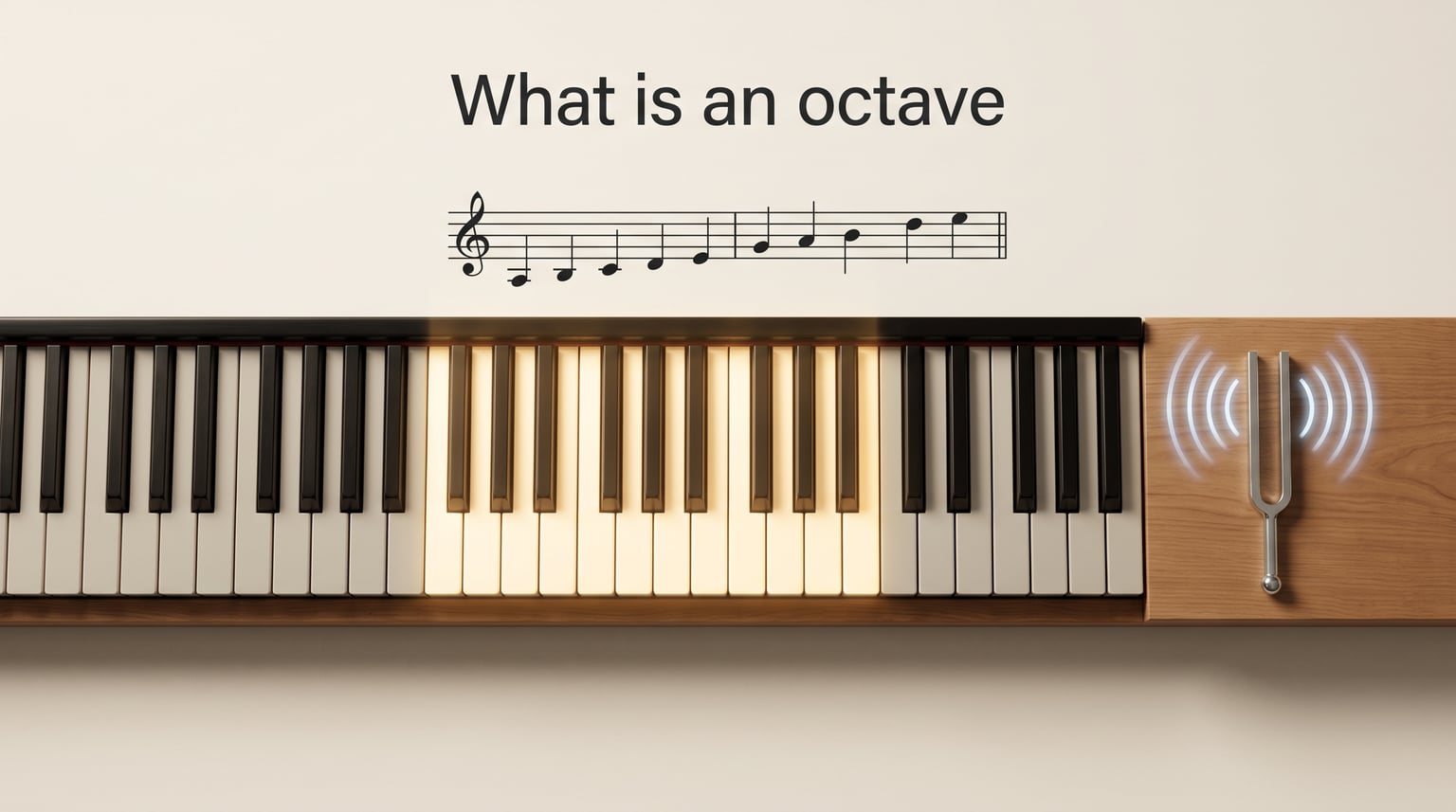
An octave is the interval between two musical notes where the higher note vibrates at exactly twice the frequency of the lower one, a 2:1 ratio that creates the strongest sense of pitch similarity our ears can detect. The word comes from the Latin octavus, meaning “eighth,” because a standard scale spans eight diatonic steps before the pattern repeats.
In this 2026 guide, I will walk you through what an octave is in plain language, how the frequency ratio works, why octaves sound so similar, and how to spot them on a piano, guitar, or even your own voice. By the end, you’ll understand the concept clearly enough to explain it to a complete beginner.
Whether you are picking up an instrument for the first time, studying music theory, or just trying to follow a conversation about pitch and range, the octave is the single most important interval to grasp. Nearly every scale, chord, and melody in Western music is built on it.
Table of Contents
What Is an Octave? A Clear Definition
An octave is the musical interval between one note and the next note with the same letter name at double or half the frequency. If you play a C on a piano and then play the very next C above or below it, that distance is exactly one octave.
The term comes from the Latin word octavus, meaning “eighth,” because in a diatonic scale, eight notes separate the starting pitch from its repeat. However, an octave actually contains twelve semitones when measured on a chromatic scale, which is the source of one of the most common beginner questions I hear.
Three quick things make an octave unique among intervals:
It is the interval with the simplest frequency ratio in music, exactly 2:1.
It is the only interval our ears perceive as the “same” pitch at a different register.
It forms the foundation of every Western musical scale, from ancient chant to modern pop.
For a definition that competes directly with the ones cited in Google’s AI Overview, here is the tightest version: an octave is the interval between two musical notes where the higher note has exactly twice the frequency of the lower note, spanning eight diatonic steps and creating a sense of the same pitch at a higher or lower register.
The 2:1 Frequency Ratio Explained
Every musical note is created by a vibration measured in hertz (Hz), which counts how many times a sound wave cycles per second. When the higher note in an octave vibrates at exactly twice the rate of the lower note, the ratio is 2:1, and that relationship is what defines the interval.
For example, the note A4, the A above middle C on a piano tuned to standard concert pitch, vibrates at 440 Hz. The A one octave above, called A5, vibrates at 880 Hz. The A one octave below A4, called A3, vibrates at 220 Hz. Each octave either doubles or halves the frequency, no matter which direction you move.
This doubling pattern holds for every pitch:
Middle C (C4) vibrates at roughly 261.63 Hz.
C5, one octave higher, vibrates at roughly 523.25 Hz.
C3, one octave lower, vibrates at roughly 130.81 Hz.
C2, two octaves below middle C, vibrates at roughly 65.41 Hz.
I find this idea clicks when people see the numbers. The pitch isn’t just “higher” in a vague sense. The air is physically vibrating at twice the speed, and our ears register that as the same musical letter at a new register. The 2:1 ratio is not a musical convention invented by composers. It is a physical fact about how sound waves interact.
This is also why octaves feature in nearly every tuning system humans have invented, from ancient Greek tetrachords to modern equal temperament. Even cultures that divide the octave differently, into 22 steps in Indian classical music or 24 in Arabic maqam, still treat the octave itself as the basic repeating unit.
Why Octaves Sound the Same?: Octave Equivalence
Octave equivalence is the psychoacoustic phenomenon where our brains treat two notes an octave apart as essentially the “same” pitch at different heights. When you sing a note and someone echoes it an octave higher, it feels like agreement rather than a different melody.
This happens because of how the human ear processes sound. The cochlea, the spiral-shaped organ in your inner ear, has hair cells tuned to specific frequency ranges. The pattern of cells activated by a 440 Hz tone overlaps with the cells activated by 880 Hz, so the brain recognizes them as belonging to the same pitch class.
Musicologist Bobby McFerrin demonstrated this in a famous 2009 performance at the World Science Festival. When he gestured at an audience to keep singing a rising tone, the crowd instinctively snapped to the next octave up. People without any music theory training still treat octaves as the “same” note. That instinct is built into our hearing.
Researchers believe octave equivalence is wired into the auditory system itself, not learned. Studies on infants show they treat notes an octave apart as similar long before they encounter scales or formal music. Even some non-human species, including macaque monkeys, show similar responses, which suggests the underlying mechanism is biological rather than cultural.
Is an Octave 7 or 8 Notes? Understanding the Count
An octave spans eight diatonic notes or twelve semitones, depending on which scale you measure with. Both answers are correct, and the confusion comes from mixing the two systems.
The diatonic scale, the basic seven-note scale used in Western music, has eight pitches counting both endpoints. Play C, D, E, F, G, A, B, and the next C. That is one octave, with seven notes in between the two Cs.
The chromatic scale divides that same span into twelve equal semitones. Between each pair of adjacent white keys on a piano, there are often black keys that fill in the gaps. Counting every key, white and black, the chromatic scale gives you twelve pitches per octave.
Here is the quick breakdown that clears up the confusion for most learners:
7 distinct letter names (A, B, C, D, E, F, G) plus the repeated starting note = 8 diatonic notes.
12 semitones when you include all five black keys between the white keys in a full octave.
The “oct” in octave refers to the eighth step in the diatonic count, not the total count of unique pitches.
Both counting methods describe the same physical span, just with different subdivisions.
This is one of the most frequently asked questions on music theory forums, and the answer is almost always the same: it depends on whether you are counting letter names or half-steps. Musicians use whichever system fits the conversation.
How to Find Octaves on a Piano?
To find an octave on a piano, locate any note and then count up seven white keys until you reach the next note with the same letter name. On a full 88-key piano, middle C is C4, and the next C to the right is C5, exactly one octave higher.
Here is a simple step-by-step method I share with my beginner students:
Place your right thumb on middle C, the white key just left of the group of two black keys near the center of the keyboard.
Count seven white keys to the right: C, D, E, F, G, A, B, and the next C.
That eighth white key is C5, exactly one octave above middle C.
Repeat in the opposite direction to find the octave below, which is C3.
Play both Cs together and listen for that “same but higher” sound that defines the interval.
The distance between those two Cs is roughly the width of your outstretched hand if you are an adult, which is why pianists often talk about “hand octaves” when describing chord shapes. On a guitar, the same interval spans twelve frets on a single string, or six frets if you shift up to the next string in standard tuning.
Once you can spot the pattern on one note, you can find octaves everywhere. The black-key groups on a piano, two together, then three together, repeat at every octave, so the keyboard is essentially the same seven-note pattern copied up and down the instrument.
Octave Notation: Understanding C4 and A440
Scientific pitch notation, the modern system used by musicians and audio engineers, labels each octave with a number. Middle C is C4, the A above it is A4 at 440 Hz, and each octave above or below increments or decrements that number.
This notation solves a problem that older naming systems couldn’t: telling two Cs apart. If a composer writes “C,” older systems couldn’t say whether they meant the low C below the staff or the high C two lines above it. Scientific pitch notation removes the guesswork by attaching a number to every C, every A, and so on.
A few reference points help anchor the system:
A0 is the lowest A on a full 88-key piano, at 27.5 Hz.
C4 is middle C, around 261.63 Hz.
A4 is the international tuning standard at 440 Hz.
C8 is the highest key on a standard piano, at roughly 4186 Hz.
This notation is also how audio software, synthesizers, and digital audio workstations organize their sounds. If you see a sample labeled “Cello C3,” you know it was recorded at the C one octave below middle C, around 130.81 Hz.
Octaves in Famous Music and Songs
Octaves shape the sound of almost every song you know, even when you don’t notice them. In “Somewhere Over the Rainbow,” the opening melody leaps an octave between “Some” and “where,” giving the song its iconic floating quality.
Vocalists use octaves to extend their range. Mariah Carey is often cited for hitting notes across roughly five octaves, and many classical singers cover similar ground by switching between chest voice and head voice at octave boundaries. When someone says a singer’s “voice dropped an octave,” they mean the singer reached a new lower register at half the previous frequency.
You also hear octaves constantly in basslines. In funk, disco, and EDM, the bass guitar often plays the same melodic line one octave below the synth or keyboard, doubling the groove and filling out the low end of the frequency spectrum. Jazz pianists like McCoy Tyner made octave-based left-hand patterns a signature sound in the 1960s.
Famous examples worth listening to for octave movement:
“Somewhere Over the Rainbow” by Judy Garland: octave leap in the opening word.
“Take On Me” by A-Ha: the chorus climbs into a high octave that defines the song.
“Billie Jean” by Michael Jackson: bassline doubles the melody an octave below.
Moonlight Sonata by Beethoven: triplet ostinato spans multiple octaves in the right hand.
Beyond Music: Octave in Poetry, Voice, and Physics
The word octave shows up outside music in a few interesting places. In poetry, an octave refers to the first eight lines of a Petrarchan sonnet, ending at the volta where the poem turns. It comes from the same Latin root as the musical term, since both involve a span of eight.
In audio engineering and physics, an octave also describes a doubling or halving of frequency, often used when measuring filters, speaker responses, and noise. A third-octave filter, for example, splits audio into bands that each cover one-third of an octave. The math is the same as in music: a band from 100 Hz to 200 Hz is one octave wide, just as 200 Hz to 400 Hz is.
Even everyday speech uses the idea loosely. When someone says their “voice dropped an octave,” they usually mean it settled into a noticeably lower register, which in musical terms would be a fall of about an octave or so. The phrase has slipped into common usage because the underlying concept, a clear drop in pitch level, is something everyone recognizes instinctively.
Octaves and Equal Temperament: A Quick Note on Tuning
Modern Western music uses a system called twelve-tone equal temperament, which divides each octave into twelve equal semitones. This means every semitone represents the same frequency ratio, the twelfth root of two, applied twelve times to span one full octave.
Equal temperament lets a piano play in every key without retuning, but it is a compromise. Older systems like just intonation placed certain intervals, especially fifths and thirds, at mathematically simpler ratios, which made them sound purer but only worked in a few keys. The octave itself stays fixed at 2:1 in every tuning system, which is one reason it serves as the anchor for all the others.
FAQs
Is an octave 7 or 8 notes?
An octave spans eight diatonic notes counting both endpoints, or seven notes between the two repeated pitches. When measured by semitones, the same span contains twelve equal chromatic steps. The name comes from the eighth diatonic step, not from the total count of unique pitches.
How many notes are in one octave?
One octave contains eight diatonic notes or twelve semitones depending on how you count. The diatonic scale has seven distinct letter names plus the repeated starting note. The chromatic scale divides that same distance into twelve equal half-steps, including the five black keys on a piano.
Why do octaves sound the same?
Octaves sound the same because of a psychoacoustic phenomenon called octave equivalence. The human ear processes frequencies logarithmically, so doubling the frequency activates overlapping regions of the cochlea. The brain then interprets notes an octave apart as the same pitch class at a higher or lower register.
What does it mean if someone’s voice drops an octave?
When someone’s voice drops an octave, they are singing or speaking at half the frequency of where they were before. In practical terms, the vocal cords vibrate at a slower rate and the sound settles into a noticeably lower register. Singers often shift down an octave to reach deeper notes outside their chest voice range.
How many octaves can a human hear?
Healthy young humans can typically hear across about ten octaves, from roughly 20 Hz to 20,000 Hz. A standard 88-key piano spans about seven and a quarter octaves. Most trained singers comfortably cover three to four octaves, while exceptional vocalists like Mariah Carey have been credited with five or more.
What is octave equivalence?
Octave equivalence is the principle that notes one octave apart are perceived as the same pitch at different heights. It is the foundation of Western music theory and the reason scales repeat after eight diatonic steps. The concept is built into how the human ear and brain process frequency.
What is the frequency ratio of an octave?
The frequency ratio of an octave is exactly 2:1. If a lower note vibrates at 440 Hz, the note one octave above it vibrates at 880 Hz, and the note one octave below vibrates at 220 Hz. This doubling or halving pattern is the defining feature of the interval.
Who has an 8 octave voice?
No verified singer has a true eight-octave vocal range. The claim is sometimes attached to artists like Mariah Carey or Tim Storms, but most credible assessments place trained singers at three to four octaves. The human hearing range spans about ten octaves, but the human singing range is far narrower.
Final Thoughts on Understanding Octaves
An octave is the simplest and most powerful interval in music, the bridge between two notes where the higher one vibrates at twice the frequency of the lower one. Once you understand the 2:1 ratio, the eight-note diatonic count, and the idea of octave equivalence, every scale, chord, and melody in Western music starts to make more sense.
If you want to take this further in 2026, try playing octaves on a piano or guitar and listen for that “same but higher” feeling. It is one of those concepts that becomes obvious the moment you hear it for yourself.