
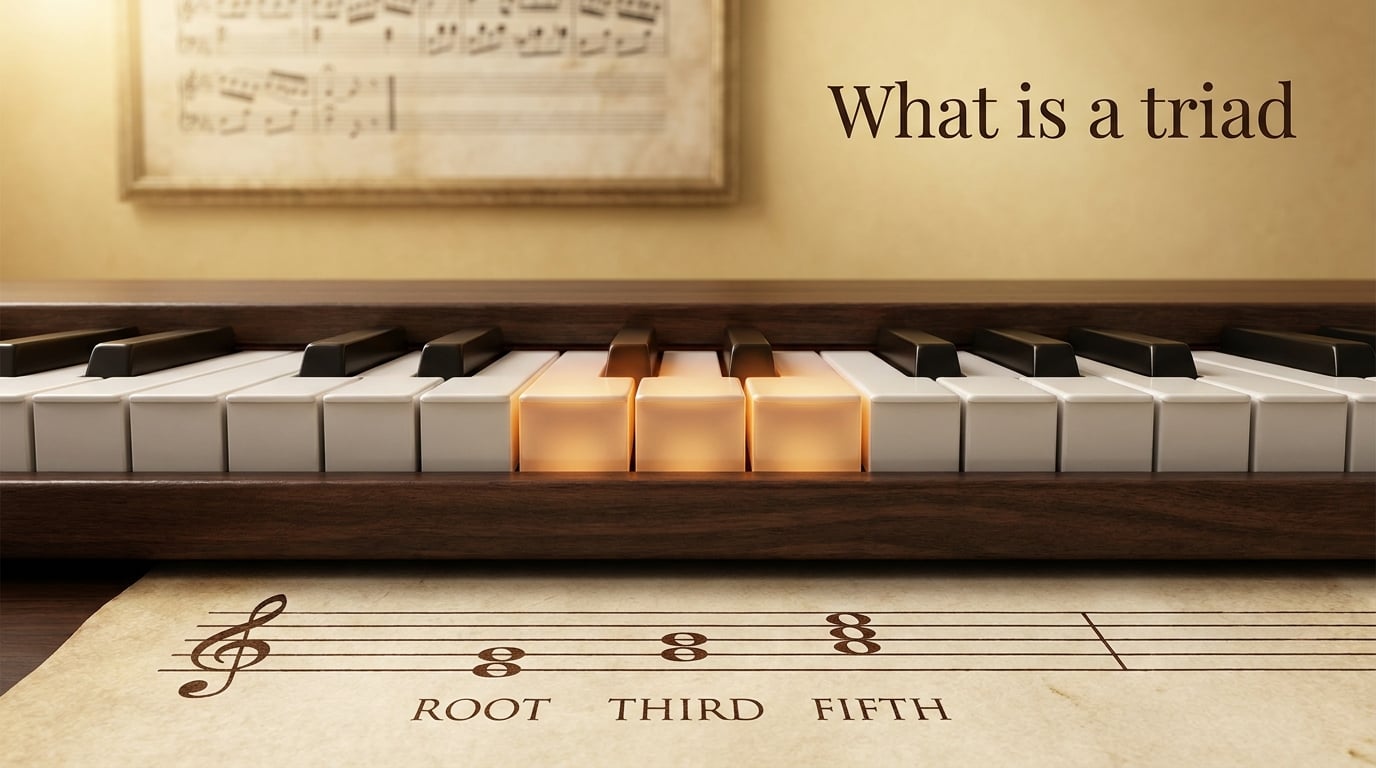
If you’ve ever played a guitar chord, pressed three keys on a piano, or sung in harmony, you’ve already worked with triads — even if you didn’t know it. A triad is the most fundamental chord structure in Western music: exactly three notes, arranged in a specific way, that together create a sound with a distinct emotional character.
Understanding what a triad is and how it works unlocks nearly everything else in music theory. Chord progressions, key signatures, harmonic tension and release — all of it traces back to this simple three-note structure.
This guide covers the definition of a triad, the three components that make one up, all four triad types with their interval formulas and note examples, and how to build any triad from scratch. Whether you’re a beginner trying to understand your first chord book or an intermediate player who wants to understand the theory behind what you’re already playing, this is your starting point.
Table of Contents
What Is a Triad in Music?
A triad in music is a chord made of three notes that are stacked in consecutive intervals of a third. You start with any note, add a note a third above it, and then add another note a third above that — and you have a triad.
That stacking method is what makes a triad different from just any random collection of three notes. Music theorists call this “tertian harmony” — harmony built from thirds. It’s the structural foundation of nearly every chord you’ve heard in classical, jazz, pop, rock, blues, and folk music going back several hundred years.
In everyday language, people often use “chord” and “triad” interchangeably. Technically, a chord is any combination of three or more notes played together, while a triad specifically refers to a three-note chord built from stacked thirds. But since triads are by far the most common chord type, the terms overlap constantly in practice.
One thing worth knowing: the three notes of a triad don’t have to be played at the same time. They can be played one after another (an arpeggio), spread across different octaves, or voiced in different orders. As long as the chord contains those same three pitch classes, it counts as a triad.
Triads also appear in what are called “inversions” — arrangements where the root isn’t the lowest note. When the third is on the bottom, that’s called first inversion. When the fifth is on the bottom, that’s second inversion. The notes are the same; only the order changes. Inversions give composers and arrangers flexibility to create smoother voice leading and different bass lines without changing the underlying harmony.
The concept of a triad has been at the center of Western music theory since at least the 16th century. Music theorist Lorenz Christoph Mizler formalized a related definition in 1739, describing a chord as the simultaneous sounding of tones. The triad as we define it today — root, third, fifth — became the core building block of the common practice period (roughly 1600 to 1900) and remained central to popular music right through the 20th century and into 2026.
The Three Notes Inside Every Triad: Root, Third, and Fifth
Every triad has exactly three components, each with a specific name and role. Understanding what each note contributes to the triad makes it much easier to hear why different triads sound the way they do.
The Root
The root is the note that names the triad. If you’re playing an F major chord, F is the root. The root is typically the lowest note when a chord is in its “root position,” and it acts as the harmonic foundation that the other two notes are built upon.
The root doesn’t always have to be the lowest-sounding note in a chord — that’s what inversions are for — but it’s always the note we name the chord after. When a musician says “play a B-flat chord,” they’re telling you that B-flat is the root.
The Third
The third is the note positioned a third above the root. It’s the single most important note for determining the emotional quality of the triad.
A major third sits 4 semitones (half steps) above the root. A minor third sits 3 semitones above the root. That one-semitone difference is what separates a bright, uplifting major chord from a darker, more introspective minor chord. When beginning musicians ask “why does that chord sound happy and this one sounds sad?” the answer almost always comes down to whether the third is major or minor.
Semitones are just the smallest interval in Western music — one fret on a guitar, one key to the next on a piano. Counting four semitones up from C lands you on E (major third). Counting three semitones up from C lands you on E-flat (minor third). One note’s difference, enormous emotional impact.
The Fifth
The fifth is the note positioned a fifth above the root, or a third above the third. In most triads, this is called a perfect fifth — sitting 7 semitones above the root — and it adds fullness, resonance, and stability to the chord sound.
The perfect fifth is one of the most acoustically consonant intervals in music, meaning it sounds naturally stable and agreeable to the ear. This is related to the physics of sound: the overtone series naturally produces a fifth above any fundamental tone. That physical relationship is part of why major and minor triads feel so settled and complete.
In diminished and augmented triads, the fifth is altered. The diminished fifth sits 6 semitones above the root (one semitone lower than perfect), creating an unstable, tense sound. The augmented fifth sits 8 semitones above the root (one semitone higher than perfect), creating a floating, ambiguous quality.
The Four Types of Triads
The four types of triads are major, minor, diminished, and augmented. Each type has a specific interval formula that creates its distinct sound. Once you know the formula, you can build any triad type starting from any note.
Major Triad
A major triad is built from a root, a major third (4 semitones above the root), and a perfect fifth (7 semitones above the root).
Formula: Root + 4 semitones + 7 semitones (from root)
Example: C major = C, E, G
Sound: Bright, stable, uplifting, resolved
The major triad is the most common chord in Western music. When a guitarist strums a “C chord” or a pianist plays “G major,” they’re playing a major triad. The sound is often described as happy or bright, but it’s really more accurate to say it sounds stable — settled and resolved, with no inherent tension pulling it anywhere.
Think of the opening chord of a hymn, the final chord of almost any pop song, or the basic sound of acoustic guitar strumming. That resting, complete feeling is the major triad doing its job.
Other major triad examples: G major (G, B, D), D major (D, F#, A), A major (A, C#, E), F major (F, A, C).
Minor Triad
A minor triad is built from a root, a minor third (3 semitones above the root), and a perfect fifth (7 semitones above the root).
Formula: Root + 3 semitones + 7 semitones (from root)
Example: A minor = A, C, E
Sound: Dark, melancholic, introspective, expressive
The minor triad differs from the major triad by exactly one note: the third is lowered by one semitone. That single change produces a dramatically different emotional quality. Minor triads are used constantly in rock, classical, jazz, and blues to convey sadness, seriousness, or emotional depth.
A minor is often the first minor chord guitarists learn, and its contrast with A major (which has a C# instead of C) is a perfect example of how one semitone changes everything about the sound of a chord.
Notice that the fifth is still a perfect fifth (7 semitones) in both major and minor triads — only the third changes between these two types. Other minor triad examples: E minor (E, G, B), D minor (D, F, A), B minor (B, D, F#).
Diminished Triad
A diminished triad is built from a root, a minor third (3 semitones above the root), and a diminished fifth (6 semitones above the root).
Formula: Root + 3 semitones + 6 semitones (from root)
Example: B diminished = B, D, F
Sound: Tense, unstable, dissonant, anxious
The diminished triad has both a minor third and a diminished fifth (also called a tritone), giving it a compressed, unsettled quality. There’s nothing in this chord that feels resolved — both the third and the fifth are “narrowed” compared to the major triad’s template.
This instability is actually musically useful. In the key of C major, the B diminished triad (B, D, F) is the seventh-scale-degree chord, and it naturally wants to resolve upward to the C major triad. Composers from Bach to Beethoven used this tension-and-release relationship as one of the main engines of harmonic movement.
You’ll hear diminished triads in horror film scores, dramatic classical passages, and jazz progressions where the composer wants a sharp jolt of harmonic anxiety. The tritone (B to F in B diminished) is an especially tense interval — historically it was called “diabolus in musica” (the devil in music) because of its unsettling sound.
Augmented Triad
An augmented triad is built from a root, a major third (4 semitones above the root), and an augmented fifth (8 semitones above the root).
Formula: Root + 4 semitones + 8 semitones (from root)
Example: C augmented = C, E, G#
Sound: Mysterious, floating, ambiguous, unresolved
The augmented triad is the rarest of the four types in common use. It has a major third like a major chord, but the fifth is raised by one semitone — creating a chord that feels like it’s hovering, unsure of where it belongs. Unlike the diminished triad which pulls urgently toward resolution, the augmented triad simply floats with an eerie, suspended quality.
Romantic composers like Franz Liszt and Richard Wagner favored augmented triads for moments of dreaminess, mystery, or harmonic ambiguity. In jazz, the augmented triad appears as part of whole-tone scale harmonies and dominant chords with a raised fifth.
One interesting property: the augmented triad is symmetrical. Each interval within it is identical (two major thirds stacked), which means a C augmented triad (C, E, G#) shares all the same notes as an E augmented triad (E, G#, C) and a G# augmented triad (G#, C, E) — just in different inversions.
How to Build a Triad Step by Step?
Building any triad comes down to knowing the interval formula for the type you want, then counting semitones up from your chosen root note. Here is the process:
Step 1: Choose your root note. This is the note that names the triad.
Step 2: Find the third. Count up from the root: 4 semitones for a major third, 3 semitones for a minor third.
Step 3: Find the fifth. Count up from the root: 7 semitones for a perfect fifth, 6 semitones for a diminished fifth, 8 semitones for an augmented fifth.
Let’s walk through a D minor triad as an example. The root is D. A minor third above D is 3 semitones: D → D# → E → F, so the third is F. A perfect fifth above D is 7 semitones: D → D# → E → F → F# → G → G# → A, so the fifth is A. D minor = D, F, A.
Now a G major triad. The root is G. A major third above G is 4 semitones: G → G# → A → A# → B, so the third is B. A perfect fifth above G is 7 semitones: G → G# → A → A# → B → C → C# → D, so the fifth is D. G major = G, B, D.
You can also build triads directly from a scale without counting semitones every time. In a major scale, the 1st, 3rd, and 5th scale degrees always form a major triad. Flat the 3rd by a semitone and you have the minor version. This scale-based method is how most musicians actually think about chords in practice once they know their scales.
Is a triad always built on the 1st, 3rd, and 5th? Yes — triads are always constructed from the root (scale degree 1), the third (scale degree 3), and the fifth (scale degree 5). What changes between the four types is the quality of those intervals: whether the third is major or minor, and whether the fifth is perfect, diminished, or augmented.
Diatonic Triads: Building Chords From a Scale
When you build a triad on each note of a major scale using only the notes in that scale, you get seven triads called diatonic triads. These are the “native” chords of any key, and they form the backbone of chord progressions in nearly all tonal music.
Here are the diatonic triads in C major (C, D, E, F, G, A, B):
I — C major (C, E, G)
II — D minor (D, F, A)
III — E minor (E, G, B)
IV — F major (F, A, C)
V — G major (G, B, D)
VI — A minor (A, C, E)
VII — B diminished (B, D, F)
The pattern is: major, minor, minor, major, major, minor, diminished. This exact sequence appears in every major key — the specific note names change but the quality of each chord position stays the same. That means if you know the diatonic pattern, you know the chord options in any key once you know the key’s root note.
The I, IV, and V chords are called the primary triads. They’re the most harmonically stable and frequently used chords in any key. The I-IV-V progression (in C major: C, F, G) forms the backbone of blues, rock, country, and folk music. An enormous percentage of all songs ever written use only these three chords.
The II, III, and VI chords are the secondary triads — still diatonic (all their notes come from the key’s scale), but less central. They provide harmonic color and allow for more complex progressions. The VI chord (A minor in C major) is often called the “relative minor” — it shares the same notes as the C major scale but gives the music a darker, minor-key feeling when it’s treated as a home base.
The VII chord (B diminished in C major) is the most unstable diatonic triad and appears less often in root position. It shows up frequently as a passing chord or in harmonic sequences where its tension creates forward momentum.
Why Triads Are the Foundation of Western Harmony?
Most music resources explain what triads are but skip over the more interesting question: why did three-note chords built in thirds become the cornerstone of an entire musical tradition?
Part of the answer is physics. When any note sounds, it produces a series of overtones — faint frequencies that vibrate at exact multiples of the fundamental pitch. The most prominent overtones in that series are the octave, the perfect fifth, and the major third. In other words, the notes inside a major triad are literally present in the sound of a single note. The major triad isn’t an arbitrary invention — it’s something the ear already “hears” embedded in every tone we produce.
This physical relationship makes major and minor triads the most acoustically consonant (stable-sounding) three-note combinations available in 12-tone Western tuning. They feel resolved and complete because they align with how sound naturally behaves. Diminished and augmented triads deviate from this natural template, which is exactly why they sound tense and unstable — and why composers have used them to create harmonic tension for centuries.
For musicians learning theory in 2026, understanding triads is a genuine shortcut to everything else. Seventh chords are just triads with one more note added. Extended chords (9ths, 11ths, 13ths) are triads stacked further. Even complex jazz voicings and modern pop production is built on top of the same major, minor, diminished, and augmented foundations. Once you understand the four triad types and how they function within a key, the rest of music theory becomes much easier to decode.
Frequently Asked Questions
What is a triad in music?
A triad in music is a chord made of exactly three notes built by stacking two consecutive intervals of a third. Every triad has a root (the naming note), a third (which determines the chord’s emotional quality), and a fifth (which adds fullness and stability). Triads are the most common and fundamental chord type in Western music.
What is an example of a triad in music?
A C major triad is one of the most common examples: the notes C, E, and G played together. C is the root, E is a major third above C (4 semitones), and G is a perfect fifth above C (7 semitones). Another example is A minor: the notes A, C, and E, where A is the root, C is a minor third (3 semitones up), and E is a perfect fifth (7 semitones up).
What are the 4 types of triads?
The four types of triads are: (1) Major triad — root, major third (4 semitones), perfect fifth (7 semitones) — bright and stable sound; (2) Minor triad — root, minor third (3 semitones), perfect fifth (7 semitones) — darker, more melancholic sound; (3) Diminished triad — root, minor third (3 semitones), diminished fifth (6 semitones) — tense and unstable; (4) Augmented triad — root, major third (4 semitones), augmented fifth (8 semitones) — floating and ambiguous.
Is a triad always built on the 1st, 3rd, and 5th?
Yes, a triad is always built on the root (scale degree 1), the third (scale degree 3), and the fifth (scale degree 5). What changes between the four triad types is the quality of those intervals — whether the third is major or minor, and whether the fifth is perfect, diminished, or augmented. The 1-3-5 structure is the defining feature of all triads.
Final Thoughts
What is a triad? It’s a three-note chord — root, third, and fifth — built by stacking intervals of a third, with the quality of those intervals determining whether the result sounds major, minor, diminished, or augmented.
The four triad types give musicians and composers a complete harmonic toolkit for every emotional context. Major triads for brightness and resolution, minor for depth and expression, diminished for tension and urgency, augmented for ambiguity and mystery.
Start with C major (C, E, G) and A minor (A, C, E) if you’re at the keyboard or guitar. Play them back to back, listen to the difference that single semitone in the third makes, and you’ll understand the core of what a triad does better than any amount of reading can convey.