
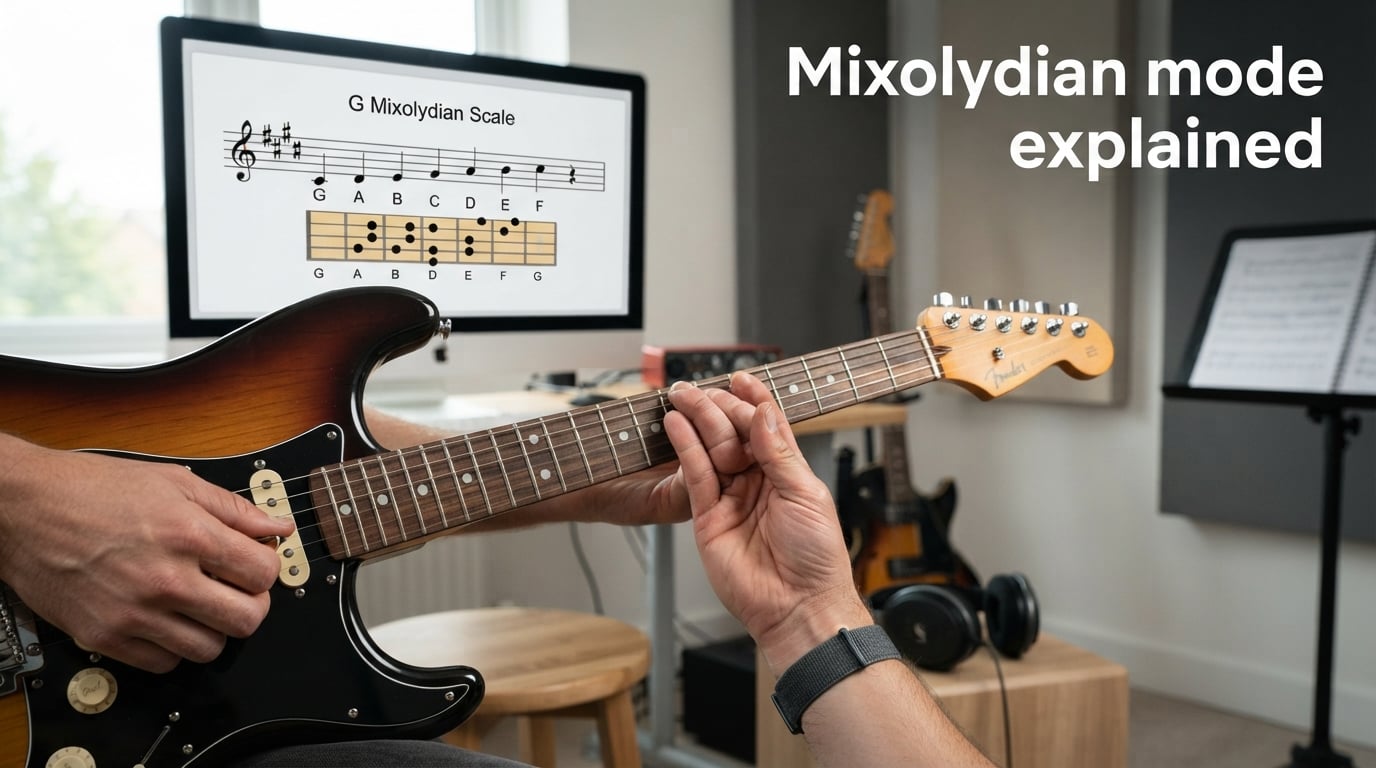
The Mixolydian mode is a major scale with one note changed — the seventh degree drops by a half step — and that single modification is responsible for some of the most recognizable sounds in rock, blues, funk, and jazz. If you’ve heard “Sweet Home Alabama,” “Sympathy for the Devil,” or nearly any James Brown track and felt that driving, bluesy-but-not-quite-minor energy underneath it, you were hearing the Mixolydian mode in action.
Most musicians encounter the Mixolydian mode as part of a list of seven diatonic modes and promptly find it confusing. The interval formulas and Roman numerals stack up fast without much to connect them to actual sounds. That’s the problem this guide is designed to fix.
I spent a long time learning scale shapes before the modes actually made sense to me. The turning point was simple: I put a C major scale and a C Mixolydian scale side by side and noticed the only difference was one note. That comparison took about 30 seconds and cut through more confusion than hours of abstract reading had managed. This guide takes the same approach — grounding every concept in direct comparison and real musical examples.
What follows covers the scale formula, two construction methods, all 12 keys, the characteristic sound, famous songs that use it, genre-specific applications, chord progressions, how it compares to Dorian and major, and a step-by-step practice routine. Everything here applies across instruments, whether you’re working on guitar, piano, bass, or any other melodic instrument.
Table of Contents
Mixolydian Mode Explained: What It Is and Why It Matters?
The Mixolydian mode is a major scale with a flattened seventh degree. Every note from 1 to 6 is identical to a major scale; only the seventh is lowered by one semitone. That single change gives the mode its distinctive combination of brightness and unresolved tension.
Here’s the clearest possible comparison, using C:
C major: C – D – E – F – G – A – B – C
C Mixolydian: C – D – E – F – G – A – B♭ – C
The only difference is that final seventh note. In C major it’s B natural; in C Mixolydian it’s B♭. Play both scales back to back and the shift in character is immediately obvious — the Mixolydian version sounds like it wants to keep moving rather than landing cleanly at home.
Mixolydian is formally defined as the fifth mode of the major scale. This means if you take any major scale and play all its notes starting from the fifth degree, you produce a Mixolydian scale. Start on the fifth note of C major — which is G — and play through to the next G, and you get G Mixolydian: G–A–B–C–D–E–F–G. That F natural, where F# would normally appear in a G major scale, is the flattened seventh.
Both ways of thinking about the mode — “take a major scale and lower the 7th” and “play from the 5th degree of a parent major scale” — are valid and produce the same result. The construction section below covers both methods with examples.
The name Mixolydian comes from ancient Greek music theory, where the term referred to a specific tuning system connected to emotional intensity. The modern definition in Western music theory is different from that ancient Greek context, but the name has persisted across more than a thousand years of music scholarship. More on the history later in this guide.
Musically, Mixolydian matters because it sits at the intersection of major and minor tonality. It sounds bright enough to feel major while the b7 prevents full resolution. This quality makes it ideal for driving, groove-oriented music — the kind that creates momentum without ever quite arriving at a comfortable destination.
The Mixolydian Scale Formula
Every scale is defined by its pattern of whole steps (W) and half steps (H). The Mixolydian mode formula is:
W – W – H – W – W – H – W
Starting from any root note and applying that pattern produces a Mixolydian scale. Using G as the root:
G (root) → A (W) → B (W) → C (H) → D (W) → E (W) → F (H) → G (W)
Result: G – A – B – C – D – E – F – G
Compare this to the major scale formula: W – W – H – W – W – W – H. The last two intervals are flipped. Major ends with W–H; Mixolydian ends with H–W. That swap pushes the seventh degree down by one semitone.
Mixolydian Scale Degrees
Breaking the formula into scale degrees shows exactly where Mixolydian diverges from major:
1 — Root
2 — Major 2nd
3 — Major 3rd
4 — Perfect 4th
5 — Perfect 5th
6 — Major 6th
b7 — Minor 7th (the defining feature)
8 — Octave
Degrees 1 through 6 are identical to a major scale. The b7 is the only point of departure. This is the most important practical takeaway about Mixolydian: if you already know your major scales, you know every Mixolydian scale with one adjustment per key.
Why the b7 Matters So Much
The minor seventh (b7) in Mixolydian aligns directly with the minor seventh in a dominant seventh chord. A dominant 7th chord contains: root, major 3rd, perfect 5th, and minor 7th — exactly scale degrees 1, 3, 5, and b7 of Mixolydian. When you play Mixolydian over a dominant seventh chord, every note in that chord is already present in the scale.
This harmonic alignment explains why Mixolydian works so naturally in blues, rock, and jazz. The dominant seventh chord appears everywhere in those genres, and Mixolydian is the scale built to match it perfectly.
How to Build a Mixolydian Scale: Two Methods
There are two clean, practical ways to construct a Mixolydian scale in any key. Both produce the same notes — the right choice depends on which you find more intuitive.
Method 1 — Lower the 7th of a Major Scale
Take any major scale. Find the 7th degree. Lower it by one half step. That’s your Mixolydian scale.
Example with D major:
Start with D major: D – E – F# – G – A – B – C# – D
Identify the 7th degree: C#
Lower it by a half step: C# becomes C natural
Result — D Mixolydian: D – E – F# – G – A – B – C – D
That C natural is the b7. If you know your major scales, this method takes about two seconds per key. It’s the fastest way to work out Mixolydian in any key on the fly.
Method 2 — Use the Parent Major Scale
Every Mixolydian scale is the fifth mode of a parent major scale. To find the parent scale for any Mixolydian, count up a perfect fourth from the Mixolydian root — or equivalently, count down a perfect fifth.
Example: Building G Mixolydian
G is the 5th note of C major
So G Mixolydian’s parent scale is C major
Play all the notes of C major starting and ending on G: G – A – B – C – D – E – F – G
Result — G Mixolydian: G – A – B – C – D – E – F – G
The F natural (instead of F#) is what gives G Mixolydian its character. If you used F# you’d be playing G major. The parent scale method is especially useful for understanding notation and key signatures.
Quick parent scale reference for common Mixolydian keys:
E Mixolydian → parent: A major
A Mixolydian → parent: D major
D Mixolydian → parent: G major
G Mixolydian → parent: C major
C Mixolydian → parent: F major
F Mixolydian → parent: B♭ major
Use Method 1 for speed and practical application. Use Method 2 when you want to understand how the mode relates to the broader key system or when reading music notation.
The Mixolydian Mode in All 12 Keys
The table below gives the Mixolydian scale for every chromatic root note along with the flattened seventh and the parent major scale. The b7 column shows the one note that differs from the corresponding major scale.
| Root | Mixolydian Scale Notes | b7 (Flattened 7th) | Parent Major Scale |
|---|---|---|---|
| C | C D E F G A B♭ C | B♭ | F major |
| G | G A B C D E F G | F | C major |
| D | D E F# G A B C D | C | G major |
| A | A B C# D E F# G A | G | D major |
| E | E F# G# A B C# D E | D | A major |
| B | B C# D# E F# G# A B | A | E major |
| F# | F# G# A# B C# D# E F# | E | B major |
| D♭ | D♭ E♭ F G♭ A♭ B♭ C♭ D♭ | C♭ | G♭ major |
| A♭ | A♭ B♭ C D♭ E♭ F G♭ A♭ | G♭ | D♭ major |
| E♭ | E♭ F G A♭ B♭ C D♭ E♭ | D♭ | A♭ major |
| B♭ | B♭ C D E♭ F G A♭ B♭ | A♭ | E♭ major |
| F | F G A B♭ C D E♭ F | E♭ | B♭ major |
The pattern to memorize: each Mixolydian scale shares all its notes with the major scale built a perfect fourth above its root. G Mixolydian shares notes with C major. D Mixolydian shares notes with G major. Once you see this relationship, moving between keys becomes systematic rather than something you have to memorize separately for each one.
What Does the Mixolydian Mode Sound Like?
Mixolydian sounds assertive and forward-moving — brighter than minor, but less settled than major. The major third keeps it from sounding dark or melancholy, while the flattened seventh prevents the clean resolution you’d get from a standard major scale cadence.
The most accurate description I’ve come across is that it sounds “confident but unfinished.” It has the brightness of major without the sense of arrival. This quality makes it ideal for music that needs to keep pushing forward — driving rock riffs, locked-in funk grooves, the kind of music that creates momentum rather than resolution.
A common frustration mentioned in music theory communities is that Mixolydian can sound “cheesy” or “too happy” when played without proper context. This is a real challenge, and the solution is in phrasing rather than scale choice. Leaning on the b7 in your melodic lines — landing on it, bending up to it, resolving from it — brings out the characteristic tension. When the b7 is just another passing tone you barely emphasize, the mode starts to sound like an ordinary major scale with a quirk.
The most useful experiment to hear the difference: play a G major scale over a G major chord, then switch to G Mixolydian (same scale but with F natural instead of F#) over a G7 chord. The second combination feels immediately natural in a way the first doesn’t. That “lock-in” sensation when the b7 in the scale matches the b7 in the chord is the core Mixolydian experience. No theoretical explanation captures it as clearly as hearing it directly.
So is the Mixolydian mode happy or sad? Neither, exactly. It sits in between — assertive and energized rather than settled or melancholy. Think of the attitude in early rock and roll, the swagger of classic funk, the intensity of blues improvisation. All of those emotional qualities live in the Mixolydian mode.
Famous Songs That Use the Mixolydian Mode
Song examples are the fastest route to recognizing and internalizing the Mixolydian sound. These tracks are widely cited as clear, accessible examples across different styles.
“Sweet Home Alabama” – Lynyrd Skynyrd: The song moves on a D–C–G chord progression throughout. That C chord while the track sits in D signals D Mixolydian immediately — C natural is the flattened seventh of D major. The riff is one of the most frequently cited Mixolydian examples in classic rock for good reason: the b7 is impossible to miss.
“Sympathy for the Devil” – The Rolling Stones: Built on E Mixolydian, the track’s driving feel comes from the interplay between the E root and the D natural chord (bVII of E). The Stones don’t resolve that tension — the song stays in that charged, unfinished space for its entire runtime.
“Seven Nation Army” – The White Stripes: The riff sits in E Mixolydian and prominently uses the D natural (b7). The song never fully resolves the way a standard major key track would. That stomping, anthemic quality is characteristic of Mixolydian over a driving rhythm.
“I Feel Good (I Got You)” – James Brown: A textbook funk Mixolydian track. The song stays planted on a tonic dominant seventh chord — which is exactly where Mixolydian belongs — and the horn lines and vocal delivery reflect the b7 throughout. This is Mixolydian in its natural funk habitat.
Pokemon Opening Theme: Music theory communities frequently cite this as one of the easiest Mixolydian examples for beginners to recognize. The melody is bright and adventurous but carries that slight tension that keeps it from sounding like a plain major scale — exactly the Mixolydian character at work in a memorable, accessible context.
“Crossroads” – Cream: Eric Clapton’s guitar work on this track, adapted from Robert Johnson, leans heavily into Mixolydian phrasing over the blues chord changes. The way Clapton bends into and around the b7 is worth studying as an example of using the mode expressively rather than mechanically running the scale from bottom to top.
Mixolydian Mode Across Different Genres
Mixolydian appears differently depending on the musical style, and knowing those differences helps you apply it with intention rather than hoping it fits.
Rock and Blues
Rock’s relationship with Mixolydian is foundational. The I–bVII–IV chord progression — for example, G – F – C in G Mixolydian — is one of the defining harmonic moves in classic rock. Bands like AC/DC, Lynyrd Skynyrd, The Rolling Stones, and Creedence Clearwater Revival built significant portions of their catalogs around this progression. The bVII chord is the signal: whenever you hear a major chord that sits a whole step below the tonic in what otherwise sounds like a major-key track, Mixolydian is almost certainly what’s happening.
In blues, Mixolydian fits naturally because the dominant seventh chords that define 12-bar blues are the exact chords the mode was built for. The b7 in the scale matches the b7 in every dominant chord in a standard 12-bar progression. Blues guitarists can reach for Mixolydian phrasing across the entire form without clashing with the harmony — the scale and the chord changes are already aligned.
Funk and Soul
Funk uses Mixolydian in a specific, concentrated way: the groove typically anchors to a I7 chord (a tonic dominant seventh) and stays there for extended stretches without resolving. James Brown’s rhythm section built an entire genre around this concept. The Mixolydian mode is the scale that matches the I7 chord perfectly, which is why it’s so central to funk.
Players like Bootsy Collins and Bernard Edwards of Chic constructed bass lines using Mixolydian-inflected phrasing to create that signature sense of perpetual forward motion. The groove never quite lands — it keeps rolling, powered by the unresolved b7. That restless momentum is one of the defining qualities of funk, and Mixolydian is the harmonic source of it.
Jazz
In jazz, Mixolydian is the standard choice for improvising over the V chord (the dominant) in a ii–V–I progression. When the harmony reaches that dominant seventh chord, jazz musicians typically reach for Mixolydian. This is so standard in jazz pedagogy that the mode is often called the “dominant scale” in that context — the two terms describe the same notes from different theoretical starting points.
Modal jazz, particularly the approach Miles Davis explored in the years following 1959’s Kind of Blue, sometimes uses Mixolydian as a sustained tonal center rather than a passing mode. When a piece lingers on a single dominant seventh chord for an extended section — as happens in modal jazz compositions — Mixolydian becomes the home base rather than a temporary color. This is a significant expansion of how the mode is used compared to functional harmony contexts.
Pop and Video Games
Pop songwriters reach for Mixolydian when they want a sound that’s accessible and bright but avoids the sometimes overly clean quality of straight major. The mode’s slight tension adds character without the darkness of minor. Video game composers have used it extensively for adventure and exploration music — the Pokemon theme being the most widely cited modern example in music theory discussions.
The sense of forward movement and possibility without resolution or darkness makes Mixolydian ideal for background music that needs to keep a listener’s attention engaged without demanding emotional processing. Game soundtracks, film action sequences, and energetic pop tracks all share this need, and Mixolydian delivers it reliably.
Mixolydian Chord Progressions
When you harmonize the Mixolydian scale — building a three-note chord on each scale degree using only notes from the scale — you get a specific set of diatonic chords. In G Mixolydian:
I = G major (G – B – D)
ii = A minor (A – C – E)
iii° = B diminished (B – D – F)
IV = C major (C – E – G)
v = D minor (D – F – A) — lowercase: this chord is minor, not major
vi = E minor (E – G – B)
bVII = F major (F – A – C)
The most important detail in that list is the lowercase v. In standard major keys, the V chord is major (and often a dominant seventh) with strong pull back toward the root — that V–I resolution is one of the foundations of Western harmony. In Mixolydian, the fifth-degree chord is minor. That minor v chord doesn’t push toward resolution the same way, which is a big part of why Mixolydian feels open and unfinished rather than settled.
The signature Mixolydian chord progressions and what makes them work:
I – bVII – IV: The defining Mixolydian loop. In G: G – F – C. The F major chord (bVII) is entirely diatonic to G Mixolydian but foreign to G major — that’s the tell. “Sweet Home Alabama” lives here. This progression repeats without needing to resolve because the minor v isn’t pulling it anywhere.
I7 (tonic dominant seventh): Simply staying on the tonic as a dominant seventh chord. G7 in the key of G Mixolydian. All of funk essentially starts here. The b7 in the chord (F) is already in the scale, so everything clicks into place.
I – bVII: Stripping it to its core. Just that one chord move to the flat seventh establishes the Mixolydian sound immediately. Two chords, instantly recognizable mode.
IV – I: In a Mixolydian context this avoids the strong resolution you’d get from V–I, keeping the progression modal and open. Moving from C to G (in G Mixolydian) feels different from V–I precisely because C is the IV chord, not a dominant chord pushing toward resolution.
The bVII chord is the easiest identifier of Mixolydian in any song. If a track sounds like it’s in a major key but regularly uses a major chord a whole step below the root — and that chord sounds completely natural, not like a borrowing or a surprise — you’re almost certainly in Mixolydian territory.
Mixolydian vs Dorian vs Major: Key Differences
These three modes share significant overlap and get confused regularly, especially by musicians who are learning theory alongside their instrument. Here is the direct comparison:
| Mode | Scale Degrees | 3rd | 7th | Sound Character |
|---|---|---|---|---|
| Major (Ionian) | 1 – 2 – 3 – 4 – 5 – 6 – 7 | Major | Major | Stable, resolved, bright |
| Mixolydian | 1 – 2 – 3 – 4 – 5 – 6 – b7 | Major | Minor | Assertive, bluesy, unresolved |
| Dorian | 1 – 2 – b3 – 4 – 5 – 6 – b7 | Minor | Minor | Minor with warmth, groovy |
Major resolves cleanly. It has a major third and a major seventh, and everything wants to come home to the root. Mixolydian has the same major third (so it sounds bright), but the minor seventh (b7) prevents full resolution and adds tension. Dorian shares the minor seventh with Mixolydian but adds a flatted third (b3), which pulls the whole sound toward minor tonality — though the natural major sixth in Dorian gives it a distinctly warm, hopeful quality compared to other minor modes.
The practical test to distinguish them while listening: focus on the third scale degree. If it sounds bright and major-like, you’re in major or Mixolydian territory. If it sounds darker and minor-like, you’re in Dorian or another minor mode. Once you’ve identified the third, listen for the seventh. If the seventh sounds settled and resolved, it’s major. If it sounds slightly unresolved or bluesy, it’s Mixolydian (major third, minor seventh) or Dorian (minor third, minor seventh).
Mixolydian and Dorian are the most commonly confused pair because both work well over groove-oriented, funk-influenced music. The distinguishing marker is always the third: Mixolydian’s major third makes it brighter and more “rock,” while Dorian’s minor third gives it a darker, more introverted warmth. If a track sounds like a minor groove but still feels optimistic or soulful, it’s likely Dorian. If it sounds like a major groove with a slight rough edge, it’s almost certainly Mixolydian.
How to Practice the Mixolydian Mode?
The most effective practice approach moves from scale knowledge to musical application as quickly as possible. Running scales without harmonic context slows down the process. Here’s a step-by-step routine that works:
Step 1: Start with G Mixolydian. G is accessible on guitar (open strings are helpful) and piano (the only change from G major is F# becomes F natural). Practice the scale ascending and descending — G – A – B – C – D – E – F – G — slowly enough to hear each note clearly. Spend a few minutes just listening to the F natural against the G starting point.
Step 2: Play the scale over a G7 drone. Set up a looping G7 chord using a loop pedal, a backing track, a DAW, or even just ask another musician to hold the chord. Run G Mixolydian over that drone. Listen for the moment the F natural (b7) lands against the chord’s b7 — that is the core Mixolydian sound. This step alone is worth more than memorizing the formula.
Step 3: Practice the I–bVII–IV progression in G. That’s G – F – C. Loop it and improvise simple melodic ideas using G Mixolydian over the changes. At this stage you’re making music, not running exercises, and the mode starts to feel like a musical choice rather than an abstract concept.
Step 4: Learn one riff from the song examples listed above. “Seven Nation Army” has a riff accessible to early-intermediate players. “Sweet Home Alabama” is slightly more involved but deeply satisfying once it sits under your fingers. Playing phrases you already know by ear makes the Mixolydian sound tangible and memorable in a way that scale exercises alone don’t.
Step 5: Mix in the minor pentatonic. Blues and rock guitarists regularly combine Mixolydian with the minor pentatonic in the same key. In G, the G minor pentatonic is G – B♭ – C – D – F. Combined with G Mixolydian, you access both the major third (B natural) and the minor third (B♭) in your improvisation. That combination — reaching for the major third when you want brightness, the minor third when you want grit — is a significant part of what makes blues guitar phrasing so expressive and flexible.
Step 6: Transpose to one new key per week. Once G Mixolydian feels natural, move to D Mixolydian, then A, then E. The theoretical relationship — same pattern as major but with a flattened seventh — stays constant in every key. Only the starting note changes. Transposing systematically this way builds both technical fluency and the ability to hear the mode in whatever key a song happens to be in.
The critical point across all six steps is that chord context is not optional — it’s essential. Mixolydian over silence sounds like a major scale with an odd note. Mixolydian over a dominant seventh chord sounds like it belongs exactly where it is. The mode only fully makes sense when you hear it in its natural harmonic environment.
A Brief History of the Mixolydian Mode
The word Mixolydian comes from ancient Greek. “Mixo” means mixed, and “Lydian” refers to Lydia, a region in what is now western Turkey. Ancient Greek music theory organized pitches into systems called “harmoniai” — roughly equivalent to modal scales — and Mixolydian was one of the named harmoniai. Historical sources, including accounts connected to the philosopher Aristotle and the music theorist Aristoxenus, associated the Mixolydian harmonia with emotional intensity and lamentation. Some ancient texts credit the poet Sappho with the mode’s invention or development.
The ancient Greek Mixolydian, however, used a different pitch structure from what the term describes in modern theory. The name carried into medieval European music through early Christian scholars who preserved and reinterpreted Greek music theory, but the actual pitches shifted over centuries of transmission. By the time the church modes were codified in medieval Europe, Mixolydian had settled into a different position than it occupied in ancient Greece.
During the Renaissance and Enlightenment periods, music theorists consolidated the modal system into the seven-mode framework built on the major scale that we use today, with Mixolydian as the fifth mode. In the 20th century, the blues brought Mixolydian back into the center of popular music. Blues harmony relies on dominant seventh chords and the scale tones that match them — which is Mixolydian territory — and through blues, the mode fed directly into rock, soul, funk, and jazz. The ancient association with intensity and emotional drive still echoes in every rock riff and funk groove built on the mode in 2026.
FAQs
What is the rarest mode in music?
The Locrian mode is generally considered the rarest in practical musical use. It is the seventh mode of the major scale, and its diminished fifth above the root makes it harmonically unstable — the tonic chord itself is a diminished chord, which removes the stable home base that most music depends on. Locrian appears occasionally in metal and experimental genres but is almost never used in mainstream songwriting. By contrast, Mixolydian is one of the most commonly used modes in popular music.
Is Mixolydian happy or sad?
The Mixolydian mode is neither fully happy nor sad. The most accurate description is that it sounds assertive or energized. The major third keeps it bright (like a major scale), while the flattened seventh introduces tension that prevents full resolution. The result is confident and forward-moving rather than settled or melancholy — think the attitude of a classic rock riff or a funk groove that never quite lands. It sits between the clean brightness of major and the introspective quality of minor modes.
How do you practice the Mixolydian mode?
Practice Mixolydian by connecting it to musical context as quickly as possible. First, learn G Mixolydian (G–A–B–C–D–E–F–G) ascending and descending. Second, play the scale over a G7 drone chord so you can hear the b7 lock in against the chord. Third, practice the I–bVII–IV progression (G–F–C) and improvise over it. Fourth, learn one Mixolydian riff from a song you already know — Seven Nation Army is a good starting point. Fifth, try mixing Mixolydian with the minor pentatonic in the same key for expressive blues phrasing. Finally, transpose the scale to one new key each week. Running the scale without chord context delays progress — the mode needs harmonic support to sound like itself.
Is Mixolydian the same as dominant?
Yes, Mixolydian and the dominant scale describe the same set of notes but come from different theoretical traditions. In jazz pedagogy, the dominant scale refers to a major scale with a flattened seventh — which is exactly what Mixolydian is. Jazz musicians often use the term dominant scale because the mode perfectly matches the notes of a dominant seventh chord (root, major 3rd, perfect 5th, minor 7th). Classical and pop/rock theory tends to use the term Mixolydian instead. The two terms are functionally interchangeable; which one you encounter depends on the musical context you are working in.
Final Thoughts
The Mixolydian mode sits at a particularly useful intersection: bright enough to feel major, with just enough tension from the b7 to keep things from landing too comfortably. Once the formula is clear — a major scale with the seventh degree lowered by one half step — you have access to the harmonic language behind classic rock, funk, blues, and jazz in one package.
Getting the Mixolydian mode explained in a way that actually sticks is usually a turning point for musicians who have been frustrated by modes in general. The common trap is learning scale shapes and interval patterns without connecting them to sounds in real songs. The moment you hear that C natural in “Sweet Home Alabama” and understand why it works — why it belongs there and what it’s doing — the entire mode makes practical sense in a way that no formula on a page can fully convey.
In 2026, Mixolydian remains as relevant as it has ever been. It shows up in everything from indie rock to modern R&B production to video game soundtracks. Producers, guitarists, pianists, and songwriters across every style reach for it regularly, often without naming it explicitly. Knowing what it is and how to use it puts you in a much better position to recognize it when you hear it and apply it deliberately when you need it.
Start with G Mixolydian over a G7 chord. Learn one song that uses it. Then let your ears take over. The theory is the map — the music is what you’re actually going to.