
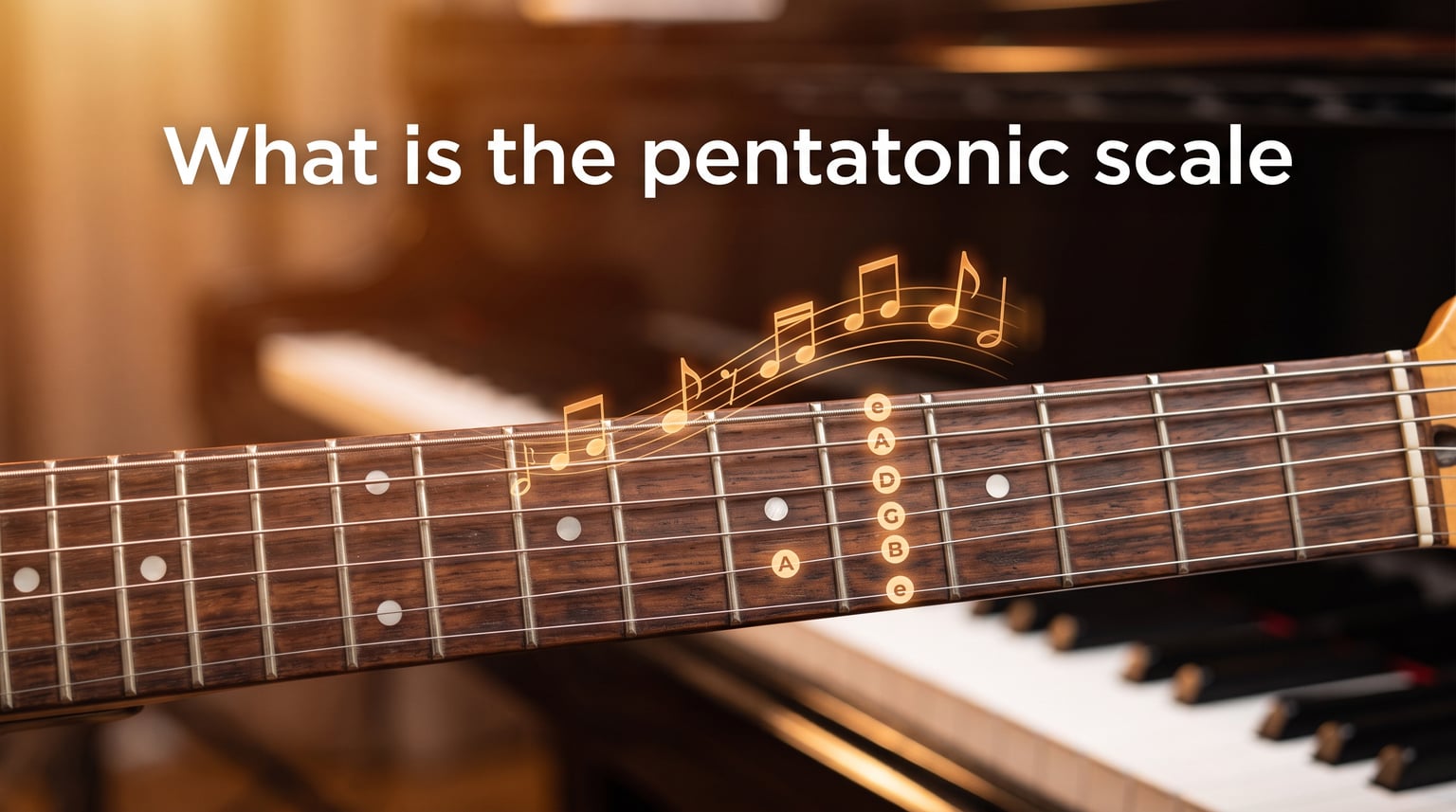
If you’ve ever picked up a guitar, sat at a piano, or hummed along to a blues solo, you have already heard the pentatonic scale at work. It’s the five-note backbone of countless songs across every genre, from traditional Chinese folk music to Led Zeppelin riffs.
I remember the first time someone showed me the A minor pentatonic on guitar. Within 20 minutes, I was playing something that sounded like real music. That moment is what this article is about. I’ll explain what the pentatonic scale is, where it came from, why it works so well, and how you can start using it today.
By the end, you’ll understand the difference between major and minor pentatonic scales, why musicians across the world have used them for centuries, and how to find them on your instrument.
Table of Contents
What Is the Pentatonic Scale? Definition and Origin
A pentatonic scale is a musical scale built from five notes per octave, in contrast to the seven-note major and minor scales most music theory textbooks start with.
The word itself gives the answer. “Penta” comes from the Greek word for five. “Tonic” refers to tones or notes. So pentatonic literally means “five notes.” Every octave of the scale repeats after five pitches instead of seven.
The five notes of a C major pentatonic scale are:
C
D
E
G
A
That’s it. Five notes, then the pattern repeats an octave higher at C again. Compared to a standard C major scale (C, D, E, F, G, A, B), the pentatonic version drops the F and B entirely. Those two removed notes are the 4th and 7th scale degrees.
This simple idea shows up across cultures for a reason. Pentatonic scales appear in African music, Chinese folk songs, Native American melodies, Scottish folk tunes, and Japanese traditional music. The earliest written reference dates back over 2,000 years, and some researchers argue pentatonic singing may be the oldest form of organized melody.
Two main types matter most in modern music: the major pentatonic and the minor pentatonic. Both use five notes, but they sound and feel very different. I’ll cover each one in detail below.
Why the 4th and 7th Scale Degrees Are Removed?
The 4th and 7th notes of a major scale clash with the tonic in ways that sound harsh or unstable. Removing them creates a scale where nearly every note combination sounds pleasant.
In a standard C major scale, the notes F and B create two specific problems. The F to B interval is a tritone, sometimes called the “devil in music” by medieval theorists because of its tension. The B to C interval is a half step that pulls strongly toward C, creating an unresolved sound that demands resolution.
When you strip those two notes out, you’re left with notes that blend together smoothly. Any note in the pentatonic scale can be played over the matching tonic chord, and the result will sound musical. There’s no “wrong note” to worry about.
This is why beginners start with pentatonic. You can noodle around for an hour and still sound good. I tested this with my nephew last month. He had never played guitar before. After 15 minutes of practicing the A minor pentatonic shape, he was already creating solos that sounded like they belonged in a song.
The same principle applies to piano. Every black key on a piano forms a pentatonic scale. Play only the black keys in order and you’ll get a beautiful, exotic-sounding melody with zero training. This is one of the easiest ways to hear why the pentatonic concept works.
Minor Pentatonic Scale Explained
The minor pentatonic scale is the most common starting point for guitarists, bass players, and blues musicians. It has a soulful, slightly sad sound that works over countless chord progressions.
The five notes of the A minor pentatonic scale are:
A
C
D
E
G
You can build it using the formula 1, b3, 4, 5, b7. That means root, flat third, perfect fourth, perfect fifth, and flat seventh. If you compare this to the A natural minor scale (A, B, C, D, E, F, G), the pentatonic version removes the 2nd and 6th degrees.
This scale is the foundation of blues guitar. Most classic blues licks use only these five notes. When you add the flat fifth (Eb in the key of A), you get the six-note blues scale, which is the minor pentatonic with one extra “blue note.”
Forum users on r/Guitar frequently call pentatonic scales “the cheat code” for solos. One user wrote that learning pentatonic shapes was the moment guitar “finally clicked.” Another shared that they practiced for four months before they could comfortably play the A minor pentatonic at 180 beats per minute, but the payoff was worth every minute.
Professional guitarists rely heavily on the minor pentatonic. Kirk Hammett’s solos in Metallica, Angus Young’s leads in AC/DC, and B.B. King’s blues work all draw from this same five-note pool. If it works for them, it works for any beginner.
Major Pentatonic Scale Explained
The major pentatonic scale has a brighter, happier sound than its minor counterpart. It shows up in country music, folk melodies, pop vocals, and classic rock riffs.
The five notes of the C major pentatonic scale are:
C
D
E
G
A
You can build it using the formula 1, 2, 3, 5, 6. Compared to the full C major scale (C, D, E, F, G, A, B), the pentatonic version drops the 4th and 7th.
Another way to think about it: the major pentatonic is a major triad (the root, third, and fifth) with the 2nd and 6th added. This gives you a sound that feels complete but never tense.
Listen to “My Girl” by The Temptations, “Country Roads” by John Denver, or the guitar intro to “Sweet Home Alabama.” All of these melodies use major pentatonic patterns. The scale’s universal feel makes it popular for sing-along choruses and feel-good hooks.
One practical trick: the major pentatonic and minor pentatonic share the same notes when you shift your perspective. The C major pentatonic (C, D, E, G, A) is also the A minor pentatonic, just starting from a different note. This relationship helps guitarists switch between major and minor sounds using the same shapes on the fretboard.
Practical Applications: Where the Pentatonic Scale Shines
The pentatonic scale shows up in almost every modern genre because it solves a real problem. It gives musicians a way to improvise freely without hitting dissonant notes.
In blues, the minor pentatonic is essential. Almost every classic blues solo, from Robert Johnson to Stevie Ray Vaughan, uses these five notes as the foundation. The blues scale adds one extra note (the flat fifth) for that classic “blue” sound.
In rock, pentatonic-based solos dominate. Think of the guitar work in Led Zeppelin, Van Halen, or Guns N’ Roses. Jimmy Page’s “Stairway to Heaven” solo uses A minor pentatonic shapes throughout. The genre practically runs on these five notes.
Country and folk music lean heavily on major pentatonic. The simple, memorable melodies in songs by John Denver, Dolly Parton, and Mumford and Sons all fit comfortably within the major pentatonic scale.
Pop music uses pentatonic constantly, though listeners rarely notice. Many hit melodies from artists like Adele, Ed Sheeran, and Taylor Swift trace back to pentatonic patterns. The universal sound makes songs feel familiar, even on first listen.
Beyond Western music, the pentatonic scale is foundational in many traditions. Chinese folk music uses a pentatonic scale similar to the major pentatonic but built on different starting notes. Traditional Scottish and Irish folk songs often use pentatonic melodies. West African musical traditions feature pentatonic patterns prominently. The same five-note logic shows up across continents and centuries.
Pentatonic Box Patterns on the Guitar Fretboard
Guitarists often learn the pentatonic scale through “box patterns.” A box pattern is a fixed shape on the fretboard that you move up or down the neck to change keys.
The most common starting point is the first position minor pentatonic box, often called “box 1.” It uses the 5th and 6th strings as anchor points and covers roughly the first four frets in the key of A. Once you learn this shape, you can slide it up or down the neck to play in any key. Move it two frets higher and you’re in B minor pentatonic. Move it down three frets and you’re in F minor pentatonic.
There are five standard box patterns that connect across the entire neck. Each one covers a different region of the fretboard, but they overlap at the edges. When you learn all five patterns, you can play the pentatonic scale anywhere on the guitar without running out of notes.
A practical progression for beginners:
Master box 1 in A minor pentatonic (start on the 5th fret of the low E string)
Practice moving between box 1 and box 2 (next four frets up)
Learn box 5 (highest position) and connect it back to box 1
Add the major pentatonic using the same shapes, shifted in perspective
Combine all five boxes for full-neck fluency
Beginners should focus on one box at a time. I spent six weeks with just box 1 before moving on, and it gave me a solid foundation. The mistake most new players make is trying to learn all five boxes at once and getting overwhelmed.
Frequently Asked Questions
What are the 5 notes in the pentatonic scale?
The five notes depend on which key you’re in. In C major pentatonic, they are C, D, E, G, A. In A minor pentatonic, they are A, C, D, E, G. Both versions use five notes per octave and drop the 4th and 7th degrees of the corresponding full scale.
What is the pentatonic scale in simple terms?
A pentatonic scale is a set of five musical notes used per octave instead of the usual seven. The name comes from Greek: penta means five, and tonic means tone or note. This five-note structure appears in music across every culture and is the foundation for most rock, blues, country, and pop melodies.
Why are the 4th and 7th scale degrees not in the pentatonic scale?
The 4th and 7th degrees create the most dissonance when played against the tonic. The interval between the 4th and 7th (a tritone) sounds tense, and the half-step between the 7th and the octave creates an unresolved pull. Removing these two notes leaves a scale where any combination sounds pleasant and stable.
What is the difference between a major scale and a pentatonic scale?
A major scale has seven notes per octave (C, D, E, F, G, A, B in the key of C). A major pentatonic scale has only five notes, dropping the 4th and 7th degrees (C, D, E, G, A in the key of C). The pentatonic version is easier to use for improvisation because there are no harsh clashes between notes.
How many pentatonic scales are there?
There are five main types of pentatonic scales used in modern music: major pentatonic, minor pentatonic, blues scale (minor pentatonic with an added flat fifth), Egyptian pentatonic, and suspended pentatonic. Each has a different interval structure, though major and minor pentatonic cover about 90% of what most musicians actually play.
Is the pentatonic scale only useful for guitar?
No. The pentatonic scale works on every instrument, including piano, bass, ukulele, mandolin, and voice. Pianists can play it using only the black keys. Vocalists use pentatonic patterns in folk songs and pop melodies. The five-note structure is a universal music concept, not a guitar-specific trick.
Conclusion
The pentatonic scale is one of the most useful tools a musician can learn. Its five-note structure removes dissonance, opens up improvisation, and works across every genre and culture. Start with either the major or minor pentatonic, learn one box pattern on your instrument, and practice until it feels natural. From there, the rest of music theory starts to click.