
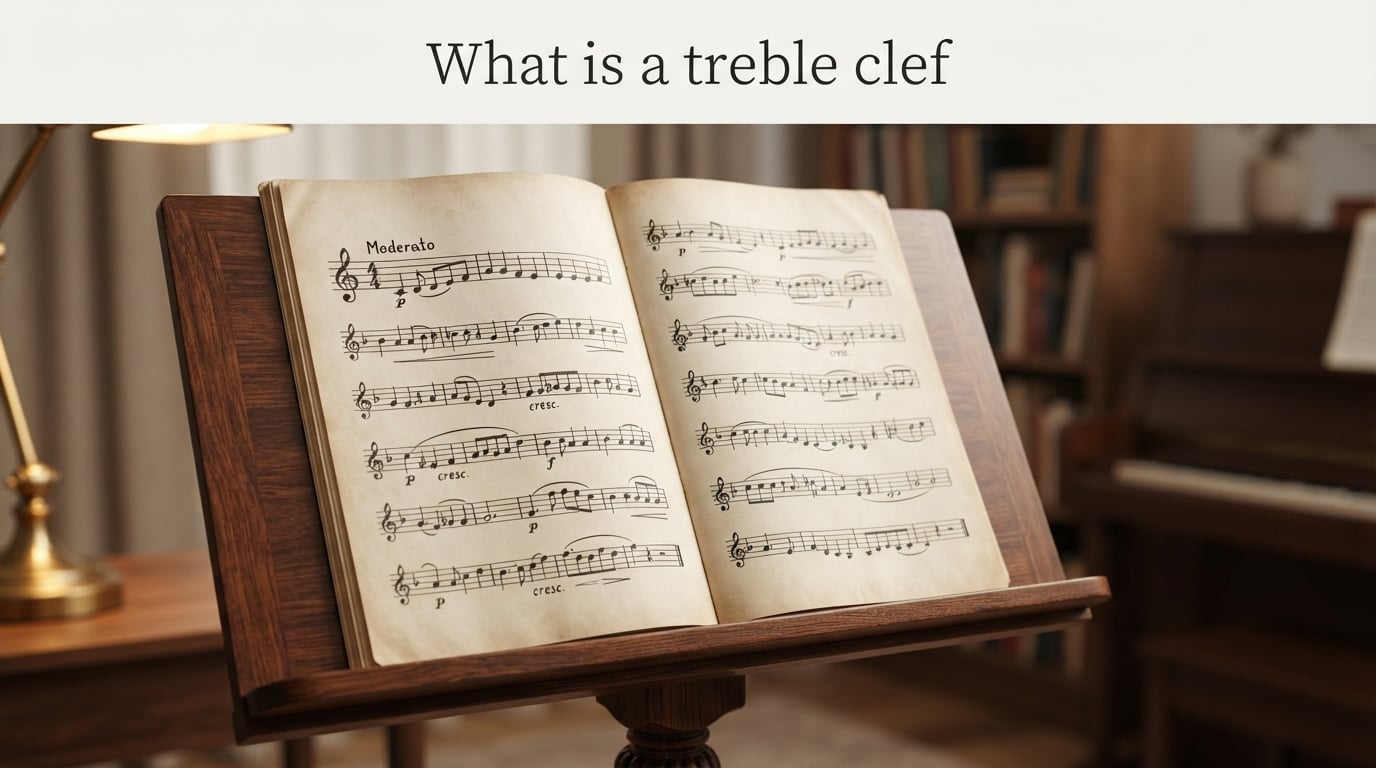
A treble clef is a musical symbol placed at the start of a staff to tell you the notes are written in a higher range, above middle C. You’ll see it at the very beginning of almost every piece of sheet music, and it’s the first thing to recognize when learning to read music.
I’ve taught dozens of beginners over the years, and the treble clef is where everyone starts. Once you understand what it does and how to read it, the rest of music theory becomes much easier. In this guide, I’ll walk you through the definition, the staff, the mnemonics, and the instruments that depend on the treble clef every day.
Table of Contents
What Is a Treble Clef?
The treble clef is a symbol used in Western music notation to indicate the pitch of written notes. It is also known as the G-clef because its signature curl wraps around the second line of the staff, marking that line as the note G4.
The name tells you exactly what the symbol does. It “clefs” or “keys” the staff so every line and space has a specific pitch. Without a clef, the five lines of a staff are just empty horizontal marks. The treble clef turns them into the musical alphabet, starting from G on the second line and going up from there.
You may also see it called the violin clef or the G-clef in older books. All three names refer to the same symbol. The curl itself evolved from a stylized Gothic letter G used in medieval notation, which is why the shape looks like an ornate letter rather than a plain dot or line.
How the Treble Clef Is Written on the Staff?
The treble clef always sits at the far left of a staff, with its inner swirl centered on the second line from the bottom. That swirl is what locks the G note into place, and every other line and space is identified relative to it.
A standard staff has five horizontal lines and four spaces between them. When the treble clef is drawn correctly, the center of the symbol’s curl touches the second line. The line passing through the curl is G, the line above it is B, the next is D, then F, and the top line is A.
If the composer changes clef mid-piece, you may see a treble clef appear in the middle of a line. Beginners often miss this and keep reading in the previous clef. I made this mistake for months when I started violin, so always glance left when the music shifts.
How to Read Notes on the Treble Clef?
Reading treble clef notes follows two simple mnemonics that almost every musician memorizes on day one. The five lines from bottom to top spell EGBDF, and the four spaces from bottom to top spell FACE.
The Five Lines: Every Good Boy Does Fine
The lines of the treble clef, from bottom to top, are E, G, B, D, and F. A common memory trick is the phrase “Every Good Boy Does Fine,” where each word’s first letter matches a line. So the bottom line is E, then G, then B, then D, and the top line is F.
The Four Spaces: FACE
The four spaces between the lines, from bottom to top, are F, A, C, and E. The word FACE spells them out in order. This one is easier to remember because the letters literally spell “face.”
Middle C and Ledger Lines
Middle C sits on a short line just below the staff, called a ledger line. It is the note C4, the C closest to the middle of a piano keyboard, and it’s a key reference point between treble and bass clef.
Ledger lines are short horizontal lines drawn above or below the main staff for notes that fall outside the five lines. Each ledger line above the staff represents the next note in the alphabet. A5 sits on the first ledger line above, C6 on the second, E6 on the third, and so on.
A common beginner mistake is to count spaces from the top down. Always count from the bottom line up. Another one is to forget that spaces and lines alternate, so going from a line to the next space is always a third, not a second.
Which Instruments Use the Treble Clef?
The treble clef is used for higher-pitched instruments and for the right-hand part of piano music. Common treble clef instruments include violin, flute, clarinet, trumpet, saxophone, and guitar. Most vocal scores also use the treble clef for soprano, alto, and tenor voices.
On the piano, the right hand almost always reads treble clef, while the left hand reads bass clef. Singers usually read treble clef because the human singing range sits naturally above middle C. Even instruments like the guitar, which sounds lower than its written notes, are notated in treble clef so the player can read standard music without transposition.
Treble Clef vs Other Clefs
The treble clef is just one of several clefs in Western music. The four most common are treble (G-clef), bass (F-clef), alto (C-clef), and tenor (C-clef).
Here’s a quick comparison of the main clefs:
Treble clef (G-clef): Used for high-pitched notes. Points to G4 on the second line. Most common in violin, flute, and right-hand piano.
Bass clef (F-clef): Used for low-pitched notes. Its two dots surround the F3 line, the second from the top. Common for cello, bass guitar, tuba, and left-hand piano.
Alto clef (C-clef): Centers middle C on the middle line. Used primarily for viola.
Tenor clef (C-clef): Centers middle C on the fourth line. Used for the upper ranges of cello, bassoon, and trombone.
The bass clef is the one most often compared to the treble clef. Bass clef notes are read from the top line down, with the lines spelling GBDFA and the spaces spelling ACEG. It’s essentially the treble clef’s lower-pitched partner, and most pianists learn both at the same time.
Frequently Asked Questions
What’s another name for a treble clef?
The treble clef is also called the G-clef because its stylized curl wraps around the second line of the staff, marking that line as the note G4. Some older books also call it the violin clef.
What are the 4 types of clefs?
The four most common clefs in Western music are the treble clef (G-clef), the bass clef (F-clef), the alto clef (C-clef), and the tenor clef (C-clef). Each one places a different reference note on a specific line of the staff.
What’s the difference between bass clef and treble?
The treble clef points to G4 on the second line and is used for higher-pitched notes. The bass clef points to F3 on the fourth line and is used for lower-pitched notes. They cover opposite ends of the musical range and are often paired in piano music.
What is the difference between treble clef and alto clef?
The treble clef centers on G4 and is used for high-pitched instruments like violin and flute. The alto clef centers on middle C and is used primarily for viola. The alto clef lets viola players read notes without many ledger lines, since the instrument’s range sits in the middle of the staff.
Final Thoughts
The treble clef is the gateway to reading sheet music, and once you understand its purpose, the rest of music theory starts to make sense. Practice reading lines with EGBDF and spaces with FACE, and the notes will become second nature within a few weeks.