
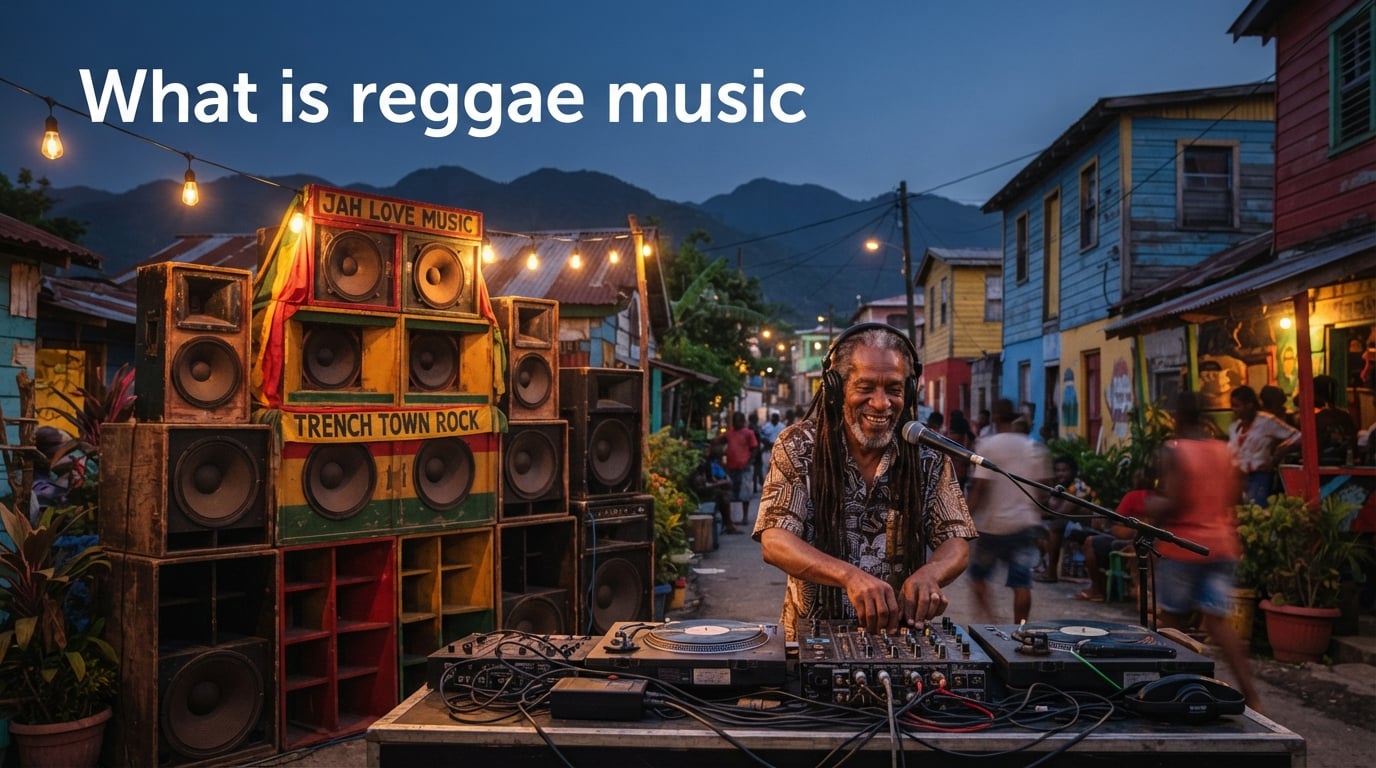
What is reggae music? It is a genre that grew out of Jamaica in the late 1960s and turned the cultural, political, and spiritual struggles of working-class Jamaicans into a sound the entire world could dance to.
In my years of writing about music, few genres have surprised me as much as reggae. I grew up hearing Bob Marley on my dad’s old cassettes, and only later did I realize that every snare hit, every skanking guitar chord, and every bass drop carried a story about resistance, faith, and community.
By the end of this guide, you will understand where reggae came from, what makes it sound the way it does, who shaped it, and why it still matters in 2026. I will also walk you through the terminology fans use, so you can hear the difference between riddim, skank, and one drop the next time a track rolls in.
Table of Contents
What is Reggae Music?
Reggae is a music genre that originated in Jamaica in the late 1960s. It is built on syncopated offbeat guitar chords, a heavy syncopated bassline, and steady drumming that sits between 80 and 110 BPM.
The genre combines African and Caribbean rhythm patterns with American R&B, soul, and jazz harmony. Add a vocal style that ranges from melodic harmonies to rough toasting, and you have a recipe unlike anything else in popular music.
Reggae is also a cultural and spiritual expression. Lyrics often address social inequality, police brutality, love, and Rastafarian faith. The genre became a global voice for the oppressed, and that is part of why I think of reggae as a soundtrack for everyday life, not just a beach playlist.
Where Did Reggae Originate?
Reggae was born in Kingston, Jamaica, in the late 1960s. The story begins in the years after Jamaica gained independence in 1962, when rural Jamaicans migrated in huge numbers to the capital’s overcrowded Trenchtown, Riverton, and Arnett Gardens neighborhoods.
I have walked through Trenchtown, and the streets are tight, loud, and warm. It is easy to see why portable “sound system” rigs became the main source of entertainment. DJs like Duke Reid, King Tubby, and Coxsone Dodd would spin imported American soul and R&B 45s for crowds, and local singers started cutting their own songs to match the demand.
By 1968, the recording industry in Jamaica was booming. Studios like Studio One, Treasure Isle, and Dynamic Sounds pushed out hundreds of singles. The genre crystallized during this era, and Toots Hibbert’s 1968 track “Do the Reggay” is usually credited with giving the new style its name.
The sound systems created both the music and the culture around it. Fans judged DJs by who could throw the loudest, cleanest street party. Producers judged musicians by who could cut the most danceable riddim. That pressure cooker of competition is why reggae arrived fully formed and ready to take on the world.
The Evolution: From Ska to Rocksteady to Reggae
Reggae did not appear out of nowhere. It grew out of an earlier Jamaican sound.
Jamaican music in the 1950s leaned on a folk style called mento, mixed with American R&B and Caribbean calypso. By the early 1960s, producers had cranked the tempo and added bright horn charts to create ska. Ska runs at around 120 BPM, with guitars and horns chopping offbeat chords and a walking bass pushing the rhythm forward.
Around 1966, the music cooled down. Slower tempos, more prominent basslines, and soulful vocals defined a style known as rocksteady. Rocksteady ran at roughly 80 BPM and focused tightly on groove rather than speed. Many of the era’s greatest harmony singers, like Alton Ellis and Delroy Wilson, came out of that window.
By 1968, rocksteady had stretched even slower in some studios and grown heavier in others, splitting into two streams. One became lovers rock, focused on romantic harmony. The other developed into reggae proper, with its deeper bass, more militant lyrics, and powerful Rastafarian themes.
I like to think of it as a temperature dial. Ska was the energetic fast burn, rocksteady was the simmer, and reggae was the deep, smoky, late-night groove. Each stage kept the offbeat guitar and walking bass idea, but slowed everything down and gave the bass room to growl.
Core Musical Characteristics of Reggae
Reggae has a few sonic signatures that you can hear from across a room. Once you know what to listen for, the genre becomes impossible to miss.
Tempo and time signature. Most reggae sits between 80 and 110 BPM, which is roughly half the speed of ska. The meter is 4/4, so four beats per measure, but the accents fall in unexpected places.
Offbeat chord stabs. Rhythm guitar and keyboards play short, muted chords on the upbeats, the “and” between each main beat. This chopping pattern is called the skank, and it is the genre’s most recognizable element.
Prominent bassline. The electric bass is the lead melodic voice in reggae. Producers like Lee “Scratch” Perry and Chris Blackwell pushed bass to the front of the mix, so you feel every note on your chest.
One drop drum pattern. Instead of striking the snare on beats two and four like rock music, reggae drummers often hit only the bass drum and a heavy rim click on beat three. This creates a feeling of falling forward and gives the rhythm its signature lilt.
Horns and keyboards. Saxophones, trumpets, and trombones punch in melodic fills above the groove. Hammond organ, clavinet, and electric piano add warm pads and bubbly accents.
Lead and harmony vocals. From call-and-response harmonies to a single toasting MC, reggae vocals range from soft crooning to aggressive declamation. Singers often sing in Jamaican Patois before switching into English, which gives the music its unmistakable cadence.
When you stack all of this together, you get a sound that is patient, hypnotic, and grounded. The offbeat guitar pulls you forward, the bass directs your feet, and the kick and rim lock the dance floor together.
Key Reggae Terminology Explained
Walking into a reggae conversation can feel like arriving in a different country. Let me translate the most common terms so the rest of the article lands easier.
Riddim — The instrumental backing track. Producers release one riddim, and dozens of singers record different vocals on top. A single riddim can underpin thirty songs.
Skank — The choppy, muted upstroke on guitar or keys that lands on the offbeats.
One drop — The drum pattern that emphasizes beat three, leaving beat one open for the bass to speak.
Dub — A remix style developed by King Tubby that strips out vocals and cranks echo, reverb, and bass. Dub became its own genre.
Toasting — Spoken-word vocals delivered over a riddim, often by a DJ (now called a deejay or toaster). It is the parent of modern rap.
Singjay — A performer who both sings and toasts on the same track.
Once you learn these words, reggae stops sounding like a wall of foreign sounds and starts feeling like a neighborhood you already belong to.
Iconic Reggae Artists
Reggae has no single inventor. Instead, it is a collage of voices, and a few of them tower above the rest.
Bob Marley. To most listeners, Bob Marley is reggae. His band, The Wailers, recorded albums like Catch a Fire and Exodus that introduced the genre to a worldwide audience. Songs such as “One Love,” “No Woman No Cry,” and “Redemption Song” remain cultural staples. Marley died in 1981, but his posthumous compilation Legend has sold tens of millions of copies and still spreads reggae into new homes.
Peter Tosh. A founding Wailer and fierce advocate for legalizing marijuana and equal rights, Tosh’s solo albums like Equal Rights and Legalize It are some of the heaviest records in the genre.
Bunny Wailer. The third original Wailer, Bunny won a Grammy for Time Will Tell: A Drop of Music and kept the spiritual roots of reggae alive with his vocals and devotion to Rastafarian culture.
Jimmy Cliff. Cliff starred in The Harder They Come (1972), the film that brought reggae into international cinemas. Tracks like “Many Rivers to Cross” and “The Harder They Come (You Can Get It If You Really Want)” turned him into one of the most famous reggae voices of the 1970s.
Burning Spear. Winston Rodney’s deep, rootsy voice and steady live band made him a favorite for listeners who love classic roots reggae. His song “Marcus Garvey” is a genre standard.
Key producers and engineers. Lee “Scratch” Perry, King Tubby, and Bunny Lee shaped the sound at the console. Perry’s Black Ark studio turned songs into smoky, psychedelic explorations, while King Tubby’s dub mixing invented an entirely new genre.
These are the names I lean on when friends ask who they should listen to first. Bob Marley for the heart, Peter Tosh for the fight, Jimmy Cliff for the gateway, and Lee “Scratch” Perry if they want to know how the records were built.
Rastafarianism and Spiritual Themes
You cannot fully understand reggae without understanding Rastafarianism. The two are interlocked.
Rastafarianism is a religious and cultural movement that began in Jamaica in the 1930s. Its followers see Haile Selassie I, the former emperor of Ethiopia, as the returned messiah. They believe in the divine destiny of Black people, the importance of community, and returning to a more natural way of life, including a vegetarian diet and the ritual use of ganja.
Reggae artists took these messages and turned them into anthems. The Bible, especially the Book of Psalms and Revelation, shows up in lyrics about Babylon (a metaphor for corrupt Western society) and Zion (a metaphor for an ideal, liberated homeland).
Dreadlocks, the long, uncut hair worn by many Rastas, became a visual signature of reggae performers. Colors like red, gold, and green (the Ethiopian flag) appear in album art, clothing, and stage design.
I find the spiritual side of reggae refreshing because it doesn’t feel preachy. It is woven into the music, sometimes as soft meditation, sometimes as fierce protest. Either way, it gives reggae a depth that beach-party playlists cannot match.
Social Justice and Cultural Impact
Reggae has always carried a message, and that message often pushes back against power.
Lyrics regularly touch on police violence, poverty, and inequality. Bob Marley’s “Get Up Stand Up” opens with “Preman a vexed with you, fix it.” Peter Tosh’s “Equal Rights” demanded legal protection and dignity for all Jamaicans. Steel Pulse, an English reggae band, took on apartheid with songs like “Handsworth Revolution.”
Reggae also became a tool for diplomacy. In 1978, Bob Marley performed at the One Love Peace Concert in Kingston, where he convinced rival political leaders Michael Manley and Edward Seaga to join hands on stage. That moment is still used as a case study in music’s power to heal divisions.
Outside of politics, reggae gave working-class Jamaican communities an artistic outlet and a real industry. Producers and musicians built studios, labels, and pressing plants that employed thousands of people. The genre created careers for vocalists, DJs, and sound system operators.
Reggae was recognized by the United Nations in 2015 when UNESCO added it to the Representative List of the Intangible Cultural Heritage of Humanity. That recognition underlines how a sound that started in Kingston’s dancehalls now belongs to the world.
Global Spread and Regional Reggae Scenes
Reggae did not stay on a small island. As Jamaicans traveled during the 1970s, the music traveled with them.
United Kingdom. British Jamaicans in London, Birmingham, and Bristol built a scene called lovers rock. Artists like Dennis Brown, Maxi Priest, UB40, and Matumbi carried the sound to new audiences. UK reggae eventually fed into jungle, drum and bass, and grime.
Africa. Reggae spread across West Africa and into South Africa in the 1970s and 80s. Lucky Dube became South Africa’s most famous reggae voice. Tiken Jah Fakoly, Alpha Blondy (from Ivory Coast), and Majek Fashek (from Nigeria) built regional fan bases. Tanzanian and Kenyan artists keep growing the scene today.
United States. Hawaiian, Californian, and East Coast scenes picked up reggae in the 1990s. Sublime, Pepper, and Slightly Stoopid popularized a punk-infused reggae-rock. Today, New York and Miami remain hubs for Caribbean-influenced reggae fusion.
Japan and the Pacific. Because of strong diaspora networks and a love for Jamaican music, Japan has hosted packed reggae festival circuits. Tokyo’s Yokohama Reggae Festival and Osaka live houses are still packed every summer.
Wherever reggae lands, it picks up local color. African reggae lyrics often speak to post-colonial struggle. UK lovers rock leans into romance. French reggae mixes in touches of chanson. The core groove survives, but the message keeps shifting.
Modern Reggae in 2026
Reggae in 2026 is anything but a museum piece. A new generation of Jamaican artists has built a movement often called the reggae revival or reggae renaissance.
Chronixx released his debut album Chronology in 2017, and he has become a global ambassador for roots-infused modern reggae.
Protoje continues the tradition with songs that fuse live band arrangements with contemporary production. Albums like In Search of Lost Time show a thoughtful evolution of roots.
Koffee became the youngest female artist to reach number one on the Billboard Reggae chart, and her song “Lockdown” won a Grammy in 2021.
Jesse Royal, Kabaka Pyramid, and Mortimer lead the new school of conscious reggae. They often collaborate on shared riddims, in the classic Jamaican tradition.
Beyond Jamaica, modern artists like Stick Figure (California), HIRIE (California), and The Elovaters (Boston) keep a reggae-rock vibe alive. UK singer-songwriters like JP Cooper blend reggae grooves into pop.
Producers like WondaWurl and Ibo Canlah keep pushing studio boundaries with digital tools while preserving the analog warmth of vintage records. Sound system culture is also growing again, with global events like the Red Bull Culture Clash pitting crews from London, Kingston, and Tokyo against each other.
What I love about modern reggae is that the new artists remember the past without being trapped by it. They sample old riddims, record live one drops, and sing about pressing 21st-century issues. The genre is alive, kicking, and still evolving.
FAQs
Why do they call it reggae?
The name reggae likely comes from the Jamaican slang ‘rege-rege,’ which meant ragged clothing or a quarrel. The term entered the mainstream when Toots Hibbert of Toots and the Maytals released the 1968 song ‘Do the Reggay.’
How do you identify reggae music?
Reggae is identified by its offbeat guitar and keyboard chords called skanking, a heavy syncopated bassline, a steady tempo between 80 and 110 BPM, and lyrics that often address social justice, Rastafarian spirituality, or Jamaican life.
What is reggae music known for?
Reggae is known for giving a voice to the oppressed, spreading Rastafarian faith across the globe, influencing genres like dub, hip-hop, dancehall, and reggaeton, and producing global icons such as Bob Marley.
Who is the biggest reggae singer?
Bob Marley is widely considered the biggest reggae artist in history. His posthumous album Legend has sold tens of millions of copies worldwide, and songs like ‘One Love’ and ‘Redemption Song’ remain global anthems.
What instruments are used in reggae?
Reggae uses electric bass, rhythm and lead guitar, drums, keyboards, horns such as saxophone, trumpet, and trombone, and percussion like congas and bongos. The one drop drum pattern often replaces the traditional backbeat.
What is the difference between ska, rocksteady, and reggae?
Ska is fast at around 120 BPM with bright horns and offbeat guitar, rocksteady slowed to about 80 BPM with strong bass and romantic harmonies, and reggae settled between them at 80 to 110 BPM with heavier bass, slower grooves, and often Rastafarian lyrics.
Final Thoughts: Why Reggae Still Matters
So, what is reggae music? It is the sound Jamaica gave the world when the country needed to be heard. It is heavy bass, offbeat skank, sleepy tempos, and lyrics that refuse to look away from injustice.
Reggae is also a living tradition. In 2026, new artists in Kingston, London, Lagos, Brooklyn, and Tokyo are picking up where Bob Marley, Peter Tosh, and Jimmy Cliff left off. They write songs about migration, climate, identity, and faith, all rooted in the same groove that hit Kingston street parties in 1968.
If you are new to reggae, start with the classics. Press play on Catch a Fire, lean into the bassline on “Duppy Conqueror,” and let the rhythm do the rest. Then dive into Chronixx, Koffee, or Protoje to hear how the genre grows without losing its soul.
Reggae is not a museum piece. It is a soundtrack for people who want to dance, think, and push for a better world at the same time. That is the heart of reggae, and it is why the genre still matters today.