
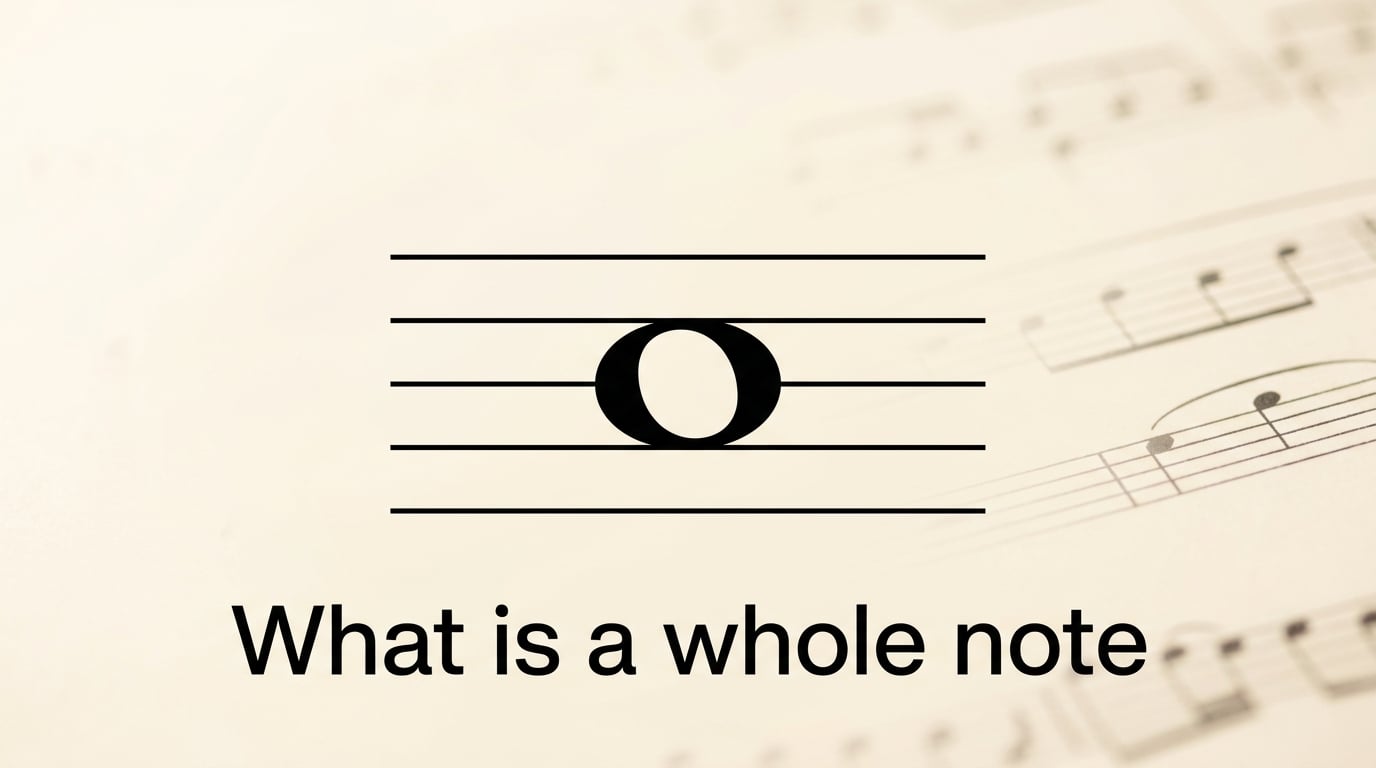
If you have ever stared at a piece of sheet music and wondered what that little hollow oval shape means, you are in the right place. That open circle sitting on the staff is one of the most fundamental symbols in all of Western music notation. It is called a whole note, and understanding it unlocks the foundation of rhythm and timing.
A whole note (American) or semibreve (British) in musical notation is a single note equivalent to or lasting as long as two half notes or four quarter notes. In standard 4/4 time, it fills an entire measure with sound. For beginners learning piano, guitar, or any instrument, this note value is usually the starting point for understanding how rhythm works on the page.
In this guide, our team breaks down everything you need to know about the whole note. We cover what it looks like, how long it lasts, how it changes depending on the time signature, and how to count it when you play. We also clear up the most common misconception that trips up even advanced students.
Table of Contents
What Is a Whole Note?
A whole note is the longest standard note value used in modern music notation. It is written as an open, hollow oval note head with no stem attached. The name comes from the fact that it represents a “whole” measure of sound in 4/4 time, the most common time signature in Western music.
In British and international terminology, this same note is called a semibreve. The two terms refer to exactly the same symbol and the same duration. If you study music theory in the United States, you will hear “whole note.” If you study in the United Kingdom, Australia, or much of Europe, you will hear “semibreve.” Both are correct.
The whole note sits at the top of the standard note value hierarchy. Every other common note value is simply a fraction of it. Two half notes equal one whole note. Four quarter notes equal one whole note. Eight eighth notes equal one whole note. This division-by-two system is the backbone of how rhythm is organized in written music.
Think of the whole note as the pie. A half note is half the pie. A quarter note is a quarter of the pie. Once you grasp this relationship, every other rhythm symbol starts to make sense because they all measure themselves against this one reference point.
What Does a Whole Note Look Like?
A whole note looks like a hollow oval or open circle resting on a line or space of the musical staff. It has no stem, no flags, and no filled-in center. That empty oval shape is the entire symbol.
This makes the whole note easy to spot on a page of music. While quarter notes have a filled-in note head with a stem, and half notes have a hollow note head with a stem, the whole note is just the open oval by itself. If you see a hollow circle with no stem, you are looking at a whole note.
The note head is slightly tilted and elongated, not a perfect circle. Composers and engravers draw it at a gentle angle to match the visual style of all other note heads on the staff. When the whole note sits on a line of the staff, the line passes through the middle of the oval. When it sits in a space, the oval fills that space.
One quick way to tell a whole note apart from a half note at a glance: the half note always has a vertical stem extending up or down from the note head. The whole note never has a stem. If there is no stem, it is a whole note. If there is a stem, it is a half note.
How Many Beats Is a Whole Note?
In 4/4 time, also called common time, a whole note lasts for four beats. That means you hold the note for a full count of “1, 2, 3, 4” at a steady tempo. Since a measure of 4/4 time contains exactly four beats, a single whole note fills the entire measure.
This four-beat duration comes from the note value hierarchy. Remember the pie analogy. A quarter note gets one beat in 4/4 time. A half note gets two beats. The whole note, being twice as long as a half note, gets four beats. The math is simple and consistent.
Here is how the standard hierarchy breaks down in 4/4 time. One whole note equals four beats. One half note equals two beats, so two half notes fill the same space as one whole note. One quarter note equals one beat, so four quarter notes fill the same space. One eighth note equals half a beat, so eight eighth notes fill the same space.
When you see a whole note on a page of music written in 4/4, the instruction is clear. Strike or blow your note and hold it for the entire measure. Do not lift your finger, stop your bow, or release your breath until the measure is complete. The conductor or metronome clicks four times during that single sustained sound.
This is why whole notes are common in slow, sustained passages. Hymns, ballads, and classical adagio sections often feature whole notes because they create a feeling of stillness and breadth. The sound stretches out and fills the room.
Is a Whole Note Always 4 Beats?
No, a whole note is not always four beats. This is the single biggest misconception in beginner music theory, and it trips up students constantly. A whole note is always one whole note in duration relative to other note values. But how many beats it gets depends on the time signature.
Here is the key distinction. A whole note always equals two half notes or four quarter notes in relative value. That never changes. But a “beat” is defined by the bottom number of the time signature, not by the note itself. So the number of beats a whole note receives can shift depending on the meter.
In 4/4 time, the quarter note gets one beat, and the whole note gets four beats. But in 3/4 time, the quarter note still gets one beat, yet there are only three beats per measure. A whole note would need four beats to play in full, but the measure only has three. This is why you almost never see a whole note in 3/4 time. It literally cannot fit in a single bar.
In 2/4 time, the same problem appears. The measure has only two beats, so a whole note cannot fit. In these meters, composers use half notes or dotted half notes instead to fill the available space.
The clearest way to think about it: a whole note fills an entire measure only when the time signature allows it. In 4/4, that means four beats. In other time signatures, a whole note might not fit at all, or it might be written differently. The whole note always maintains its 4-to-1 ratio with the quarter note, but the beat value changes with context.
Advanced tip: in music theory, the whole note defines the “whole” reference in any time signature where the denominator is 4. That is why the bottom number 4 is called “quarter note gets the beat” and the whole note is considered four times that value. The relationship is fixed even when the practical use changes.
Whole Note vs Half Note vs Quarter Note
Understanding the whole note becomes much easier when you compare it side by side with the half note and quarter note. These three note values form the core of rhythmic notation, and their relationships are built on simple division.
A whole note is a hollow oval with no stem. It lasts for four beats in 4/4 time and fills an entire measure. It is the longest standard note value in common use.
A half note is a hollow oval with a stem. It lasts for two beats in 4/4 time. Two half notes take up the same duration as one whole note. Visually, the only difference between a half note and a whole note is the stem.
A quarter note is a filled-in, solid oval with a stem. It lasts for one beat in 4/4 time. Four quarter notes fill the same space as one whole note. The filled-in note head is what distinguishes it from the half note.
Here is the hierarchy in a single chain. One whole note equals two half notes equals four quarter notes equals eight eighth notes equals sixteenth sixteenth notes. Each step down the chain doubles the count while halving the duration. This binary division is what makes Western rhythm notation so logical and predictable.
When you practice reading music, try clapping or counting each value in sequence. Count “1, 2, 3, 4” for the whole note. Count “1, 2” for each half note. Count “1” for each quarter note. Feeling the difference in your body is the fastest way to internalize these relationships.
The visual difference matters just as much as the duration difference. When sight-reading, your eye needs to instantly recognize whether a note is whole, half, or quarter based on its shape alone. Practice spotting the stem and the fill of the note head until it becomes automatic.
The Whole Note Rest (Whole Rest)
Every note value has a matching rest, which tells the musician to stay silent for that same duration. The whole rest is the silence equivalent of the whole note. It lasts for four beats in 4/4 time, filling an entire measure with quiet.
Visually, the whole rest looks like a small black rectangle that hangs down from the fourth line of the staff. It sits under the line, like a hat hanging on a peg. This is different from the half rest, which looks almost identical but sits on top of the third line, like a hat resting on a table.
Here is a memory trick that music teachers have used for generations. The whole rest hangs under the line because it is “heavy” and falls down. The half rest sits on top of the line because it is “lighter” and rests on top. This silly image helps students tell the two apart on sight.
The whole rest has another practical use beyond silence. In many contexts, a whole rest is used to indicate a completely empty measure regardless of the actual time signature. So even in 3/4 time, where a whole note cannot fit, you might see a whole rest used to mean “rest for the entire bar.” This convention is widely accepted in orchestral and band music.
How to Count and Play Whole Notes?
Counting whole notes is straightforward once you understand the beat structure. In 4/4 time, you simply count “1, 2, 3, 4” while holding the note. Each number represents one beat, and you sustain the sound through all four counts without stopping.
Here is a step-by-step method our team recommends for beginners. First, set your metronome to a comfortable tempo, around 60 to 80 beats per minute. Second, play or sing your note on count 1. Third, hold the sound steady through counts 2, 3, and 4 without wavering. Fourth, release the sound cleanly right as count 1 of the next measure arrives.
The hardest part for most beginners is not starting the note. It is keeping the sound even and sustained for the full four beats. On piano, this means holding the key down without releasing pressure. On a wind instrument, it means controlling your breath to last the full measure. On violin, it means drawing the bow in one long, even stroke.
A common mistake is cutting the whole note short. Students often release the note on count 3 or count 4 out of habit from playing shorter values. Train yourself to feel the full four-beat duration by tapping your foot on each beat while you hold the note.
Practice exercise: play a series of whole notes, one per measure, for eight measures. Use a metronome and count out loud. This simple drill builds the muscle memory and internal clock you need to sustain long notes accurately. It sounds boring, but it works.
Whole Notes in Different Time Signatures
The time signature at the start of a piece tells you two things. The top number tells you how many beats are in each measure. The bottom number tells you which note value gets one beat. This combination determines whether a whole note can even appear in the music.
In 4/4 time, the whole note fits perfectly because the measure has four beats and the whole note lasts four beats. One whole note fills the bar completely, with no room for anything else.
In 3/4 time, the measure has only three beats. A whole note needs four beats to sound in full, so it cannot fit. You will never see a standard whole note in a 3/4 measure. Instead, composers use a dotted half note, which lasts three beats and fills the bar.
In 2/4 time, the measure has only two beats. Again, a whole note cannot fit. Composers use a half note or two quarter notes instead.
In 6/8 time, things get more complex. The dotted quarter note gets one beat, and there are six eighth notes per measure. The whole note is rarely used in compound meters like this because the beat structure does not divide evenly into four.
The practical takeaway: whole notes appear most often in 4/4 and sometimes in other simple quadruple meters like 2/2 (cut time). If you are reading music in a different time signature, do not expect to see many whole notes. Their natural home is the four-beat measure.
A Brief History of the Whole Note
The whole note has roots stretching back to the 13th century, when European musicians developed a system called mensural notation. Before this system, music was passed down orally or written with vague symbols that did not specify exact durations. Mensural notation changed that by creating note shapes that represented specific lengths of time.
In this early system, the longest note was called the maxima or larga. Below that came the longa, then the breve, and then the semibreve. The word “breve” means “short” in Latin, which seems contradictory today since the breve is now longer than the semibreve. The naming made sense at the time because the breve was the shortest note in common use during that era.
As music evolved over the centuries, the longer notes like the maxima and longa fell out of regular use. The semibreve, originally a relatively short note, became the longest standard note value in common practice. In American English, it was renamed the “whole note” to reflect its new position at the top of the hierarchy.
The British term “semibreve” preserves the historical name, even though its literal meaning (“half short”) no longer makes sense. This is why the two naming systems differ. American terminology describes the note’s function in the modern system. British terminology preserves its medieval origins.
Today, the whole note remains essentially unchanged from its early notation. That hollow oval shape has survived seven centuries of musical evolution. When you read a whole note on a page of music, you are looking at a symbol with a longer continuous history than almost any other element of written music.
Frequently Asked Questions
Is a whole note always 4 beats?
No, a whole note is not always 4 beats. It always equals two half notes or four quarter notes in relative value, but the number of beats depends on the time signature. In 4/4 time it gets 4 beats, but in other time signatures the beat value changes. The whole note maintains its 4-to-1 ratio with the quarter note regardless of meter.
What does a whole note look like?
A whole note looks like a hollow or open oval note head with no stem attached. It is drawn as a slightly tilted, empty circle sitting on a line or space of the musical staff. Unlike a half note, which also has a hollow center, the whole note has no vertical stem.
Is a whole note the longest note?
The whole note is the longest standard note value in common modern use. However, longer notes do exist in music theory. The breve (or double whole note) lasts twice as long as a whole note, and historically there were even longer values like the longa and maxima. In practical everyday music, the whole note is the longest you will typically encounter.
How many counts is a whole note?
In 4/4 time, a whole note is counted as 4 beats, meaning you count 1, 2, 3, 4 while holding the note for the entire measure. In other time signatures, the count may differ because the beat is defined by the time signature’s bottom number, not the note itself.
Conclusion
The whole note is the cornerstone of rhythmic notation, serving as the reference point against which every other standard note value is measured. It looks like a hollow oval with no stem, lasts for four beats in 4/4 time, and fills an entire measure with sustained sound. Known as the semibreve in British English, it carries a history that stretches back to medieval mensural notation.
Remember the key lesson from this guide: the whole note always maintains its relative value of two half notes or four quarter notes, but its beat count depends on the time signature. This distinction separates students who memorize definitions from musicians who truly understand rhythm. Next time you see that open oval on a page of music, you will know exactly what it means, how long to hold it, and why it works the way it does.