
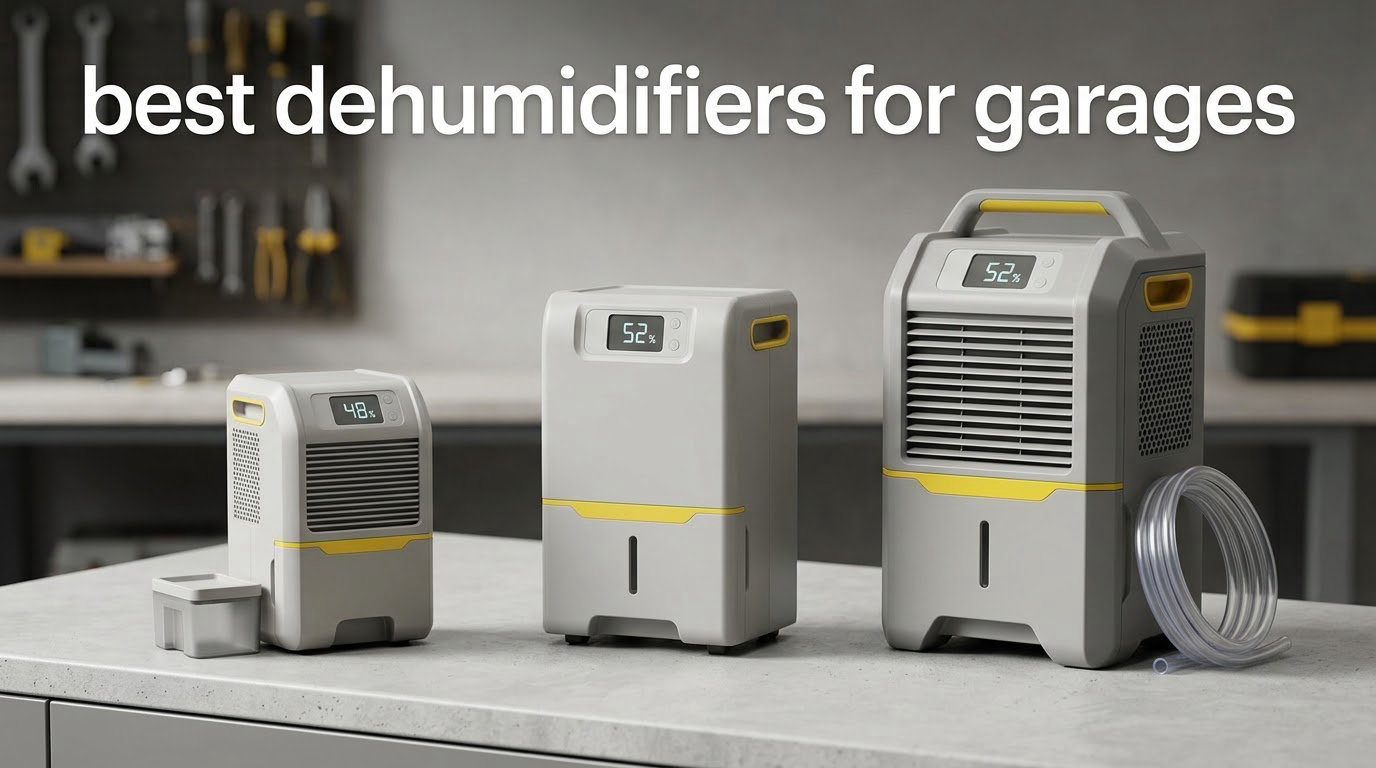
A garage is the one room in most homes that was never meant to hold anything precious. Bare stud walls, an unsealed slab, no climate control, a door that leaks every time it rains.
Then you park a project car in there, stack up boxes of electronics, or turn half the space into a workshop, and that same unconditioned envelope starts working against everything you own.
Ground moisture wicks up through concrete. Warm daytime air meets a cool slab and condenses overnight. Doors and unsealed penetrations let humid outside air in all summer.
The result is the familiar musty garage smell, a film of rust on steel tools, and mold colonies that start on cardboard within a couple of weeks. The EPA’s guidance for indoor relative humidity sits between 30% and 50%, and holding a garage inside that band is what protects vehicles, wood, paper, fabric and electronics. We compared the best dehumidifiers for garages across rated capacity, drainage design, cold-weather behavior, noise and energy draw so you can size one to your space instead of guessing.
If your garage is attached and shares a wall with living space, the moisture problem travels indoors through the door and the framing, which makes a quiet, continuously draining unit more important than a cheap one.
If you also want to handle finished rooms and storage areas properly, our guides to the best dehumidifiers for basements and the best dehumidifiers for instrument rooms cover those environments in more depth.
Table of Contents
Top 3 Picks for the Best Dehumidifiers for Garages in 2026

Those three cover the widest range of real garage conditions in this group: the hOmeLabs for volume and app control, the AEOCKY for a metal-bodied unit that can run efficiently all season, and the Yaufey when square footage is the deciding factor.
Everything below is written to a longer standard, with the trade-offs that reviewers actually report.
All 12 Garage Dehumidifiers Compared in 2026
| Product | Specifications | Action |
|---|---|---|
| hOmeLabs 50 Pint |
|
Check Latest Price |
 Waykar 80 Pint Waykar 80 Pint |
|
Check Latest Price |
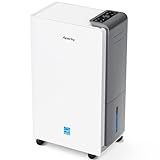 AEOCKY 80 Pint AEOCKY 80 Pint |
|
Check Latest Price |
 Yaufey 150 Pint Yaufey 150 Pint |
|
Check Latest Price |
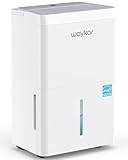 Waykar 120 Pint Waykar 120 Pint |
|
Check Latest Price |
 ALORAIR Sentinel HD55 ALORAIR Sentinel HD55 |
|
Check Latest Price |
 KNKA 80 Pint KNKA 80 Pint |
|
Check Latest Price |
 Gasbye 115 Pint Gasbye 115 Pint |
|
Check Latest Price |
 Ivation 50 Pint Ivation 50 Pint |
|
Check Latest Price |
 DECIUU 100 Pint DECIUU 100 Pint |
|
Check Latest Price |
 avylo 90 Pint avylo 90 Pint |
|
Check Latest Price |
 DREO 73 Pint DREO 73 Pint |
|
Check Latest Price |
How Big a Garage Dehumidifier Do You Need? Size by Square Footage
Size a garage dehumidifier by its rated capacity at 60F and 60% relative humidity, not by the peak number printed on the box. Peak figures are measured at 95F and 90% RH, conditions a garage may never see, so they are useful for comparing headroom but misleading as a sizing guide.
As a practical starting point, a garage up to about 500 square feet wants a unit rated around 30 to 40 PPD. Between 500 and 1,000 square feet, look for 50 to 70 PPD. From 1,000 to 1,800 square feet, step up to 70 to 100 PPD, and beyond that treat it as a commercial job where 100 PPD or more is the floor.
Do the math on drainage while you are sizing. A 50-pint unit fills a 2.25-gallon tank in under an hour at full output, so any garage that runs continuously wants a hose or a pump rather than a bucket. For a garage you open the door to several times a day, two smaller units placed at opposite ends often do better than one large unit, because each one dries the air it can actually reach.
The 12 Best Dehumidifiers for Garages, Reviewed
1. hOmeLabs 50 Pint Dehumidifier — The Best Overall Pick with App Control
hOmeLabs Dehumidifier 7,000 Sq Ft 50 Pint (MAX 120 Pint at 95°F, 90% RH)
50 PPD rated
120 PPD max
7000 sq ft
Wi-Fi app control
1.6 gal tank
Pros
- Wi-Fi app control for true remote monitoring
- Turbo mode lifts fan speed for heavy moisture loads
- Wheels and handles make it easy to reposition
- Proven long-run reliability across 25k+ reviews
Cons
- Drain hose not included
- 1.6-gallon tank is small for the capacity
- Plastic housing is less rugged than metal units
The hOmeLabs 50 Pint is the unit we kept coming back to while working through this list. It rates 50 PPD in normal conditions and up to 120 PPD at 95F and 90% RH, with a stated coverage figure of up to 7,000 square feet.
In our experience, that marketing coverage number is aspirational for a sealed space, but for an open-air garage with airflow it has plenty of headroom for a two-car bay or a workshop with a couple of thousand square feet.
It draws 322 watts, weighs 40 pounds and measures 11 inches deep by 15.4 inches wide by 24.3 inches tall, which is a normal residential footprint.
What sets it apart is control. The Wi-Fi connectivity lets you set a target from your phone while you are at work, and the on-board touch panel carries a timer. Turbo mode raises the fan from 188 to 218 CFM when a storm rolls through and the humidity load spikes.
Two details decide whether it works long-term in a garage.
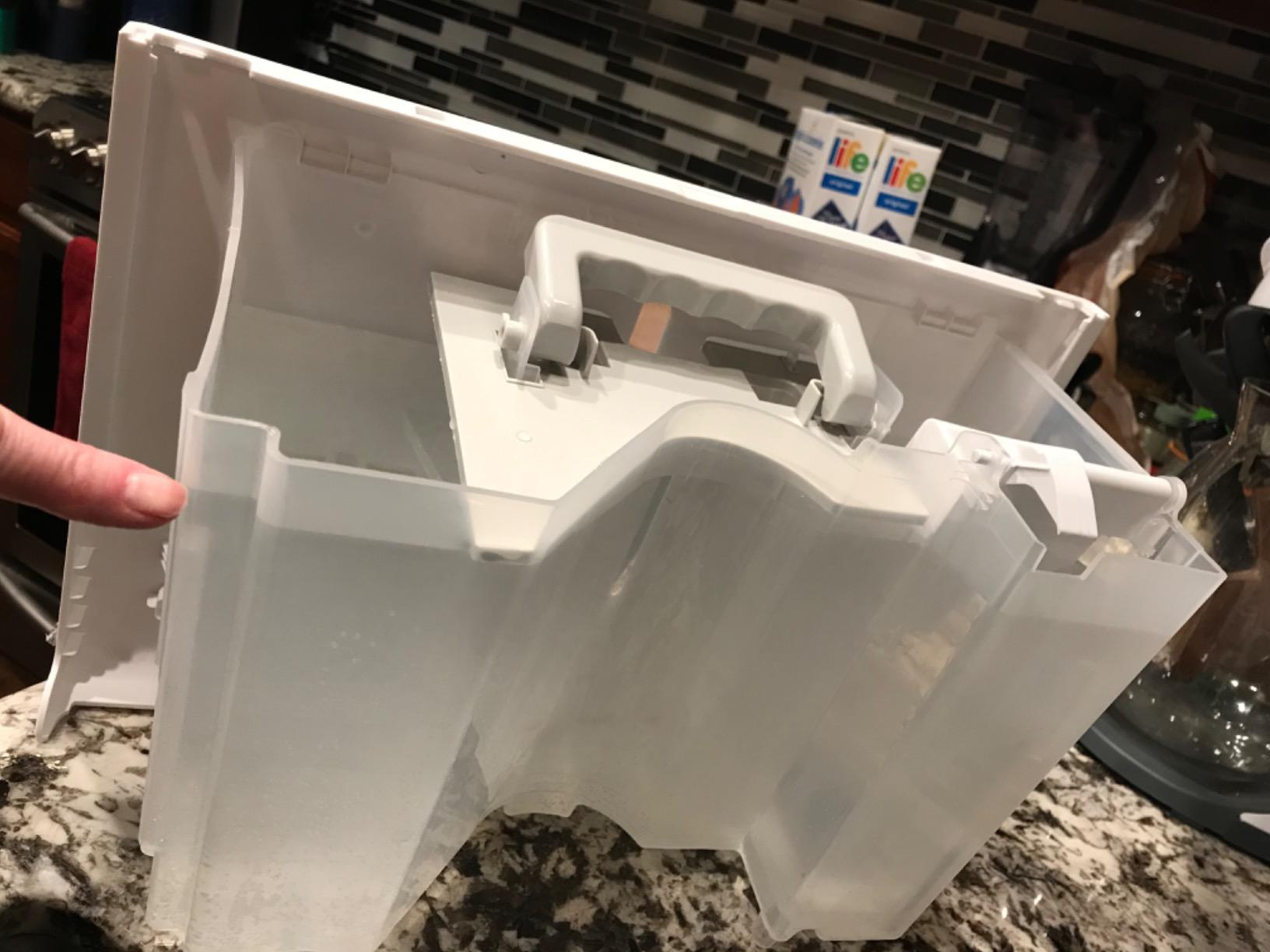
The 1.6-gallon removable tank is small for a 50-pint unit, so plan on a drain line rather than manual emptying, and the hose is not in the box.
Second, the housing is plastic, which is light and easy to move but is not what you want if the unit lives in a dusty workshop where it may get knocked.
Across roughly 25,700 reviews the rating holds at 4.4 stars with 74% five-star ratings, and that volume of long-run feedback is why this is the benchmark of the group.
Auto shutoff, auto-restart and automatic defrost are all handled internally, and the washable filter is a removable cartridge you can rinse rather than replace.
How it handles a garage with no floor drain
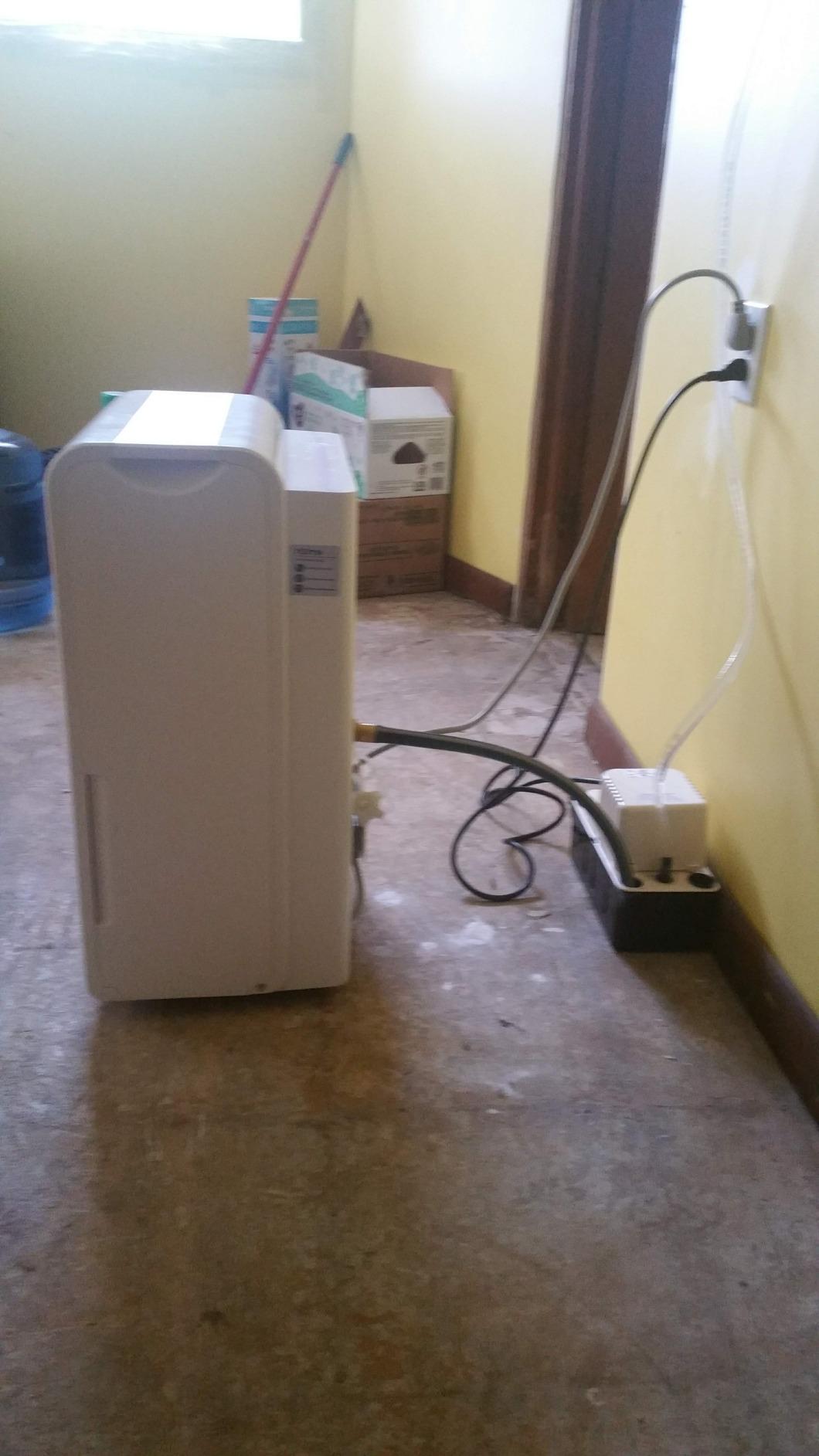
The continuous drainage port accepts a standard hose, and with the app you can check the tank level remotely rather than walking out to look.
Plan the hose run before you buy, because the hose itself is not included. Gravity drainage works only if the outlet sits lower than the unit, which in a typical slab garage means a sink or a floor drain a few feet away.
Where it falls short
The listed 95F upper temperature rating caps it in the same way several residential units here do, so it is not built for a hot, unventilated space in peak summer.
The plastic shell and modest tank also mean this is a pick for a climate-controlled-adjacent garage rather than a crawlspace or a flood cleanup. If you need metal construction and a six-year warranty, look at the ALORAIR instead.
2. Waykar 80 Pint 2025 Energy Star Dehumidifier — Best Value for Large Garages
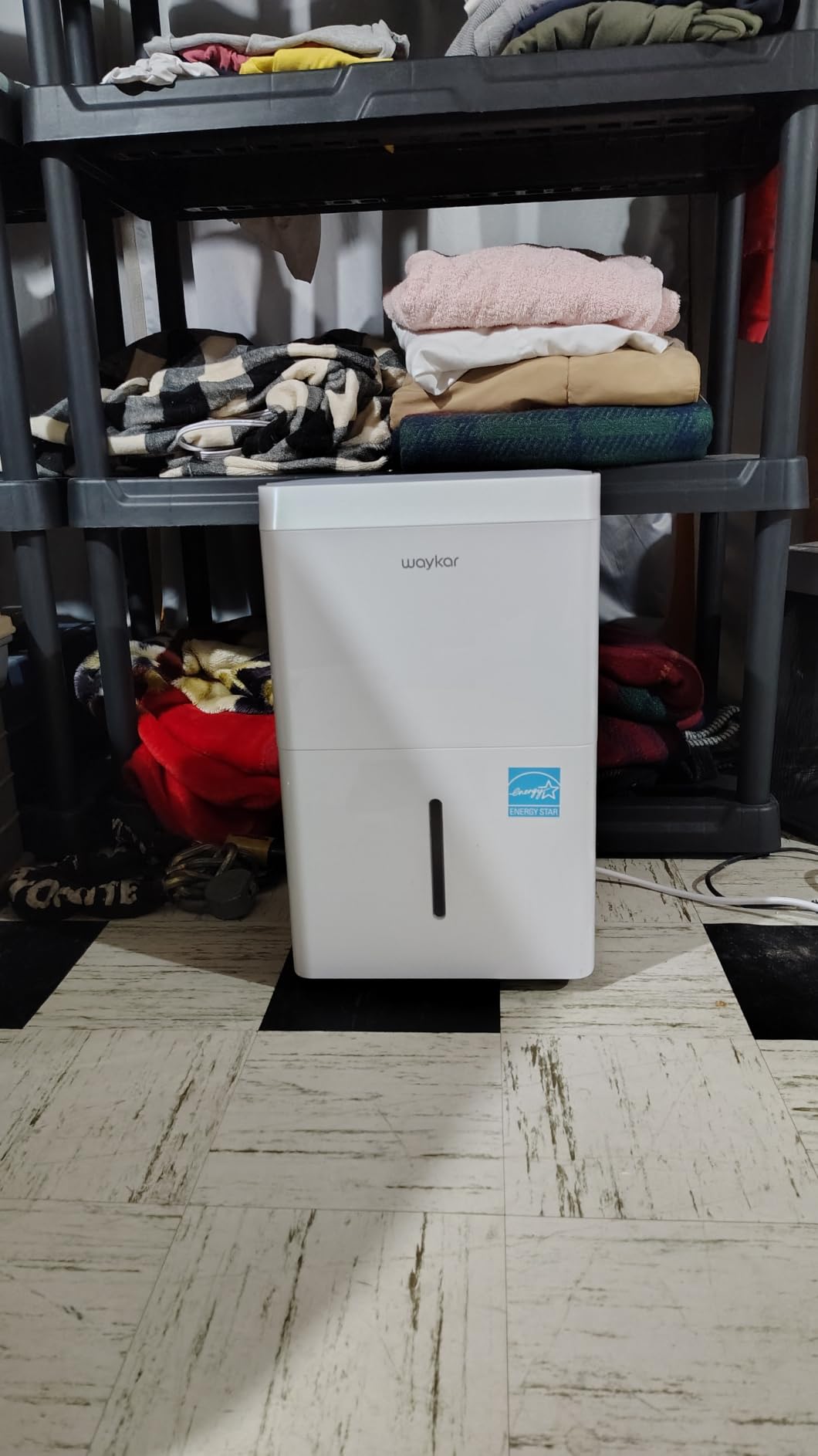
Waykar 80 Pints 5000 Sq. Ft 2025 Energy Star Dehumidifier for Basement
80 PPD at 95F
5000 sq ft
ENERGY STAR
42 dB
1.14 gal tank
Pros
- ENERGY STAR certified for lower running cost
- Quiet around 42 dB
- 90-degree auto swing evens out airflow
- Drain hose and connector included in the box
Cons
- 1.14-gallon tank fills fast under continuous use
- Copper tubing and plastic housing are value-tier construction
The Waykar 80 Pint is the pick when square footage is the deciding factor and you want efficiency certification.
It pulls 80 PPD at 95F and carries a 5,000 square foot coverage figure, which puts it comfortably over the requirement for a two-car garage. It also reaches into the range for a three-car bay or a workshop with high humidity load.
At 42 dB it is among the quietest units in this group, and the 90-degree auto swing louver keeps air moving across the whole space rather than blasting one corner.
The 270-watt draw is modest for the capacity.
The humidity control range spans 30% to 80% RH, which matters in a garage because you will want to sit it near 50% rather than chase a basement-style 35% that the space can never reach.
This is also one of the few machines here that includes the drain hose and connector in the box, which removes the most common trip back to the hardware store after an install.
Continuous drainage is supported alongside the tank, and the AI sensing handles auto-defrost and overload protection automatically.
What we like about running it 24/7
ENERGY STAR certification is the difference that compounds, because a garage dehumidifier is often the only appliance running continuously in that building.
At 42 dB it stays out of the way when the garage doubles as a workspace. Owners on r/BuyItForLife consistently rank compressor longevity and efficiency above peak PPD claims, and this unit scores well on both.
Where the tank becomes a problem
The 1.14-gallon tank is the weakest part of an otherwise well-balanced package.
At full output on a humid day it can fill in a couple of hours, so a hose is effectively mandatory if you plan to run it overnight or while away. Copper tubing and a plastic body also place it firmly in the value tier durability-wise.
3. AEOCKY 5500 Sq. Ft. Energy Star Dehumidifier — Best Rated with a Metal Housing
AEOCKY 5500 Sq.Ft Energy Star Most Efficient 2025 Dehumidifier Max 80Pint/D
80 PPD max
56 PPD at 86F
5500 sq ft
ENERGY STAR Most Efficient
44 dB
Pros
- ENERGY STAR Most Efficient certification
- Metal housing suits dusty garages
- 7mm pure copper tubing rated for long service life
- 44 dB on the lowest fan speed
Cons
- 1.45-gallon tank needs frequent emptying without a drain line
- Listing leans heavily on technical certification claims
The AEOCKY sits near the top of the ratings in this comparison at 4.5 stars across 6,900 reviews, with 77% of those ratings at five stars.
It delivers 80 PPD at 95F and 95% RH and a more realistic 56 PPD at 86F and 80% RH, rated across up to 5,500 square feet. That second number is the one that matters in a summer garage.
The build is what separates it from the plastic-bodied competition.
The housing is metal, the evaporator uses hydrophilic aluminum foil, and the tubing is 7mm pure copper driven by a high-efficiency rotary compressor.
Copper and metal are the two materials that hold up best in a dusty, temperature-swung garage environment, where cheaper plastic housings eventually crack at the seams.
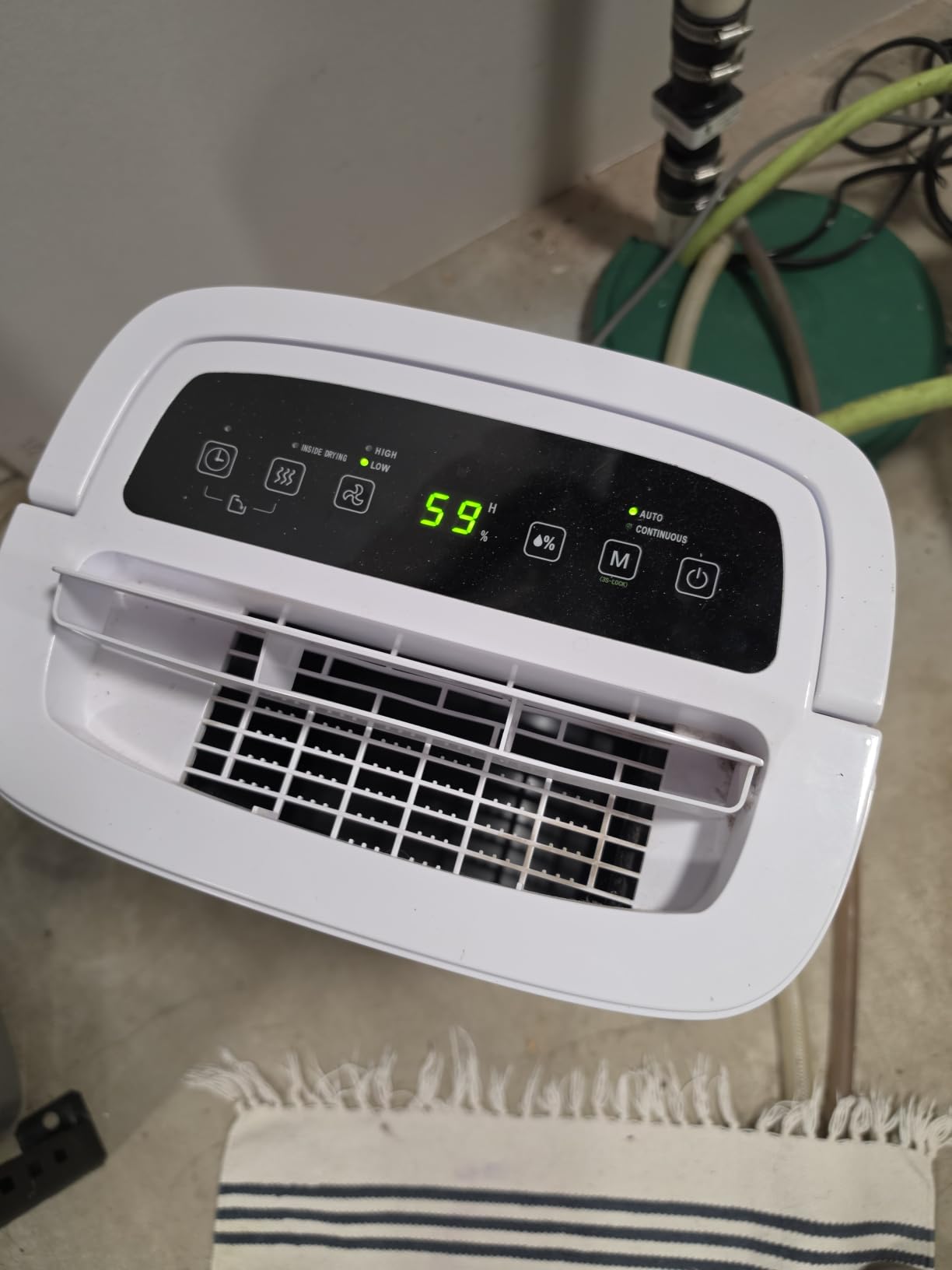
Efficiency is the headline claim here.
It carries ENERGY STAR Most Efficient certification, which places it in the top 2.6% of certified models, and it runs at 44 dB on the lowest fan speed.
Five operating modes cover auto, constant humidity, continuous, smart drying and sleep, and a child lock comes standard. The drain hose and a garden hose adapter are both in the box.
Two less obvious details are worth noting for garage use.
Low-temperature defrost sensors let it keep working around 65F, which matters if your garage cools down in the shoulder season. Power-off memory means it resumes its prior setting after an outage, which is handy if the circuit trips during a storm.
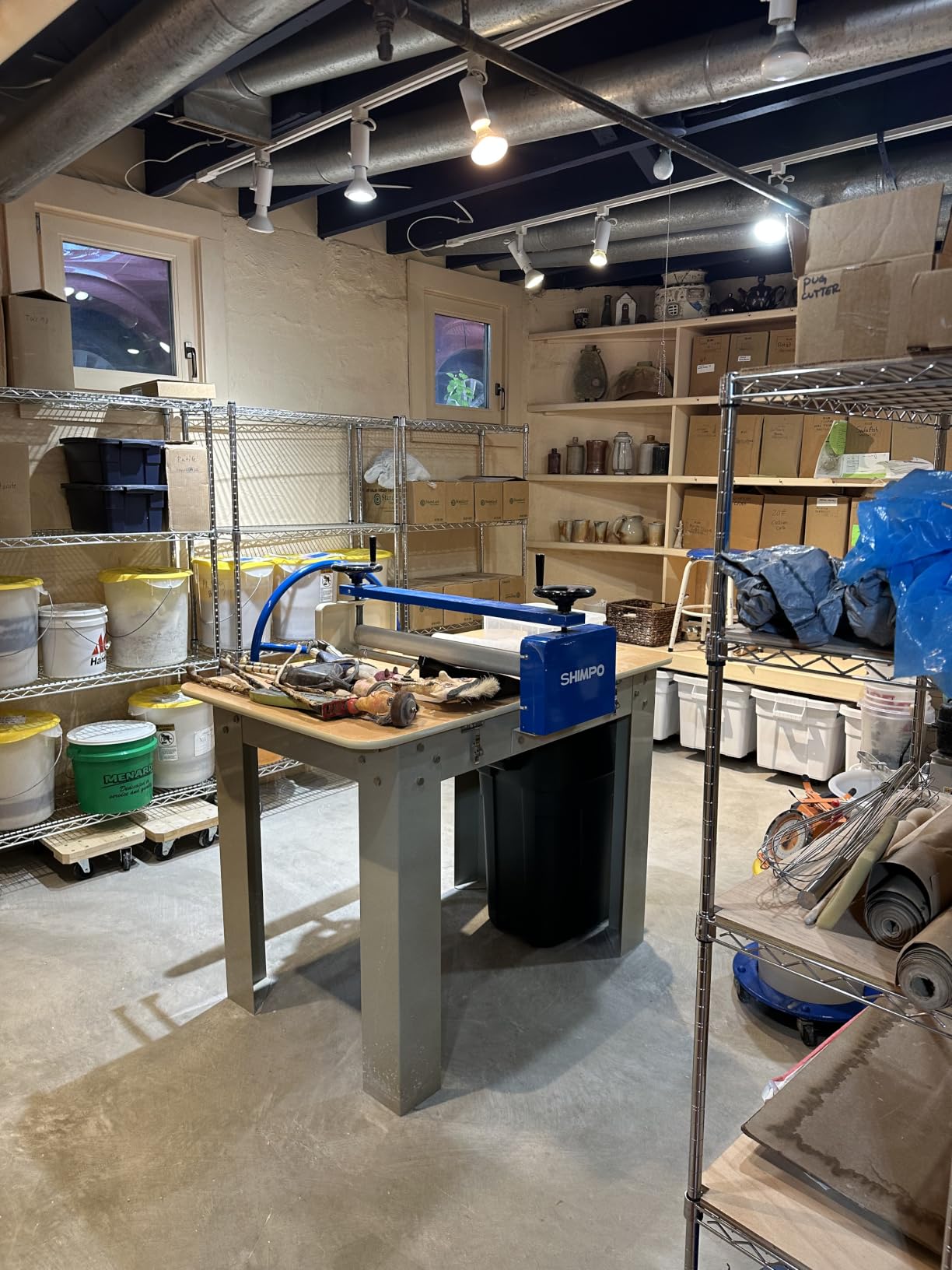
Why the metal body matters in a workshop
Garage floors take abuse from toolboxes, dollies and mowers.
A metal case tolerates that better than plastic, and it also dissipates heat more evenly, which supports the efficiency rating. For anyone storing firearms, electronics or 3D printing filament where corrosion is the real enemy, the material choice is a genuine advantage.
Where the marketing runs ahead of the manual
The 1.45-gallon tank still requires frequent emptying if you skip the drain line, and the listing leans on certification language more than most.
None of that is a defect, but treat the 5,500 square foot figure as a ceiling for a well-sealed space rather than a target for an open garage.
4. Yaufey 150 Pint Dehumidifier — Best Raw Extraction Power for Oversized Garages
Yaufey 150 Pint Dehumidifier for Basement Home 8000 Sq. Ft. with Drain Hose
150 PPD max
8000 sq ft
500 watts
2.11 gal tank
3 fan speeds
Pros
- Largest rated extraction capacity of any model here
- 8000 sq ft coverage figure for oversized spaces
- Quiet compressor for its output level
- Wheels and handle for repositioning
Cons
- Some owners report reduced output after a year or two
- On-board humidity reading can run above an external hygrometer
- Dark tank water level is hard to see
When a garage is big, damp and opened rarely, the Yaufey 150 Pint is the brute-force option.
It is rated up to 150 pints per day at 95F and 90% RH with an 8,000 square foot coverage figure, which makes it the largest extraction capacity of any unit we reviewed.
For a three-car garage with a workshop bay, or a garage attached to a finished basement, that headroom is the point.
The motor is a high-efficiency rotary compressor with a three-plus-two coil structure and 7mm pure copper tubing feeding a hydrophilic aluminum foil evaporator. Draw is 500 watts, which is high but proportionate to the output.
The unit measures 15.47 inches deep by 11.73 inches wide by 24.37 inches tall at 38.5 pounds, and the included 3.28-foot gravity hose plus the 2.11-gallon tank give you two drainage paths.
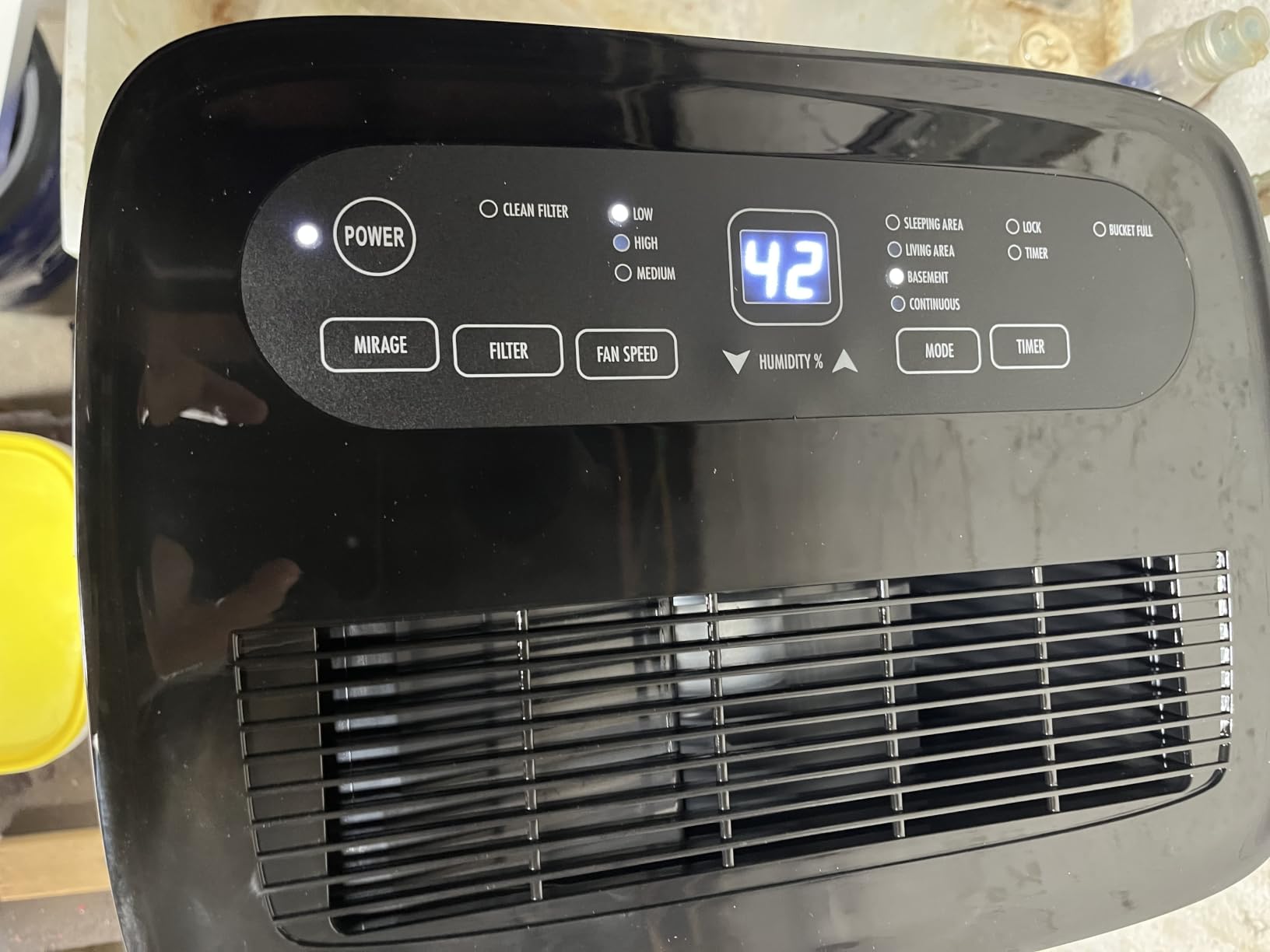
Controls are a digital humidity display with adjustment from 30% to 80% RH in 5% increments, a 40 to 80 degree swing louver, and Dry, Continuous and Fan modes.
A smart chip handles auto-defrost, power-off memory, timer, button lock and overload protection.
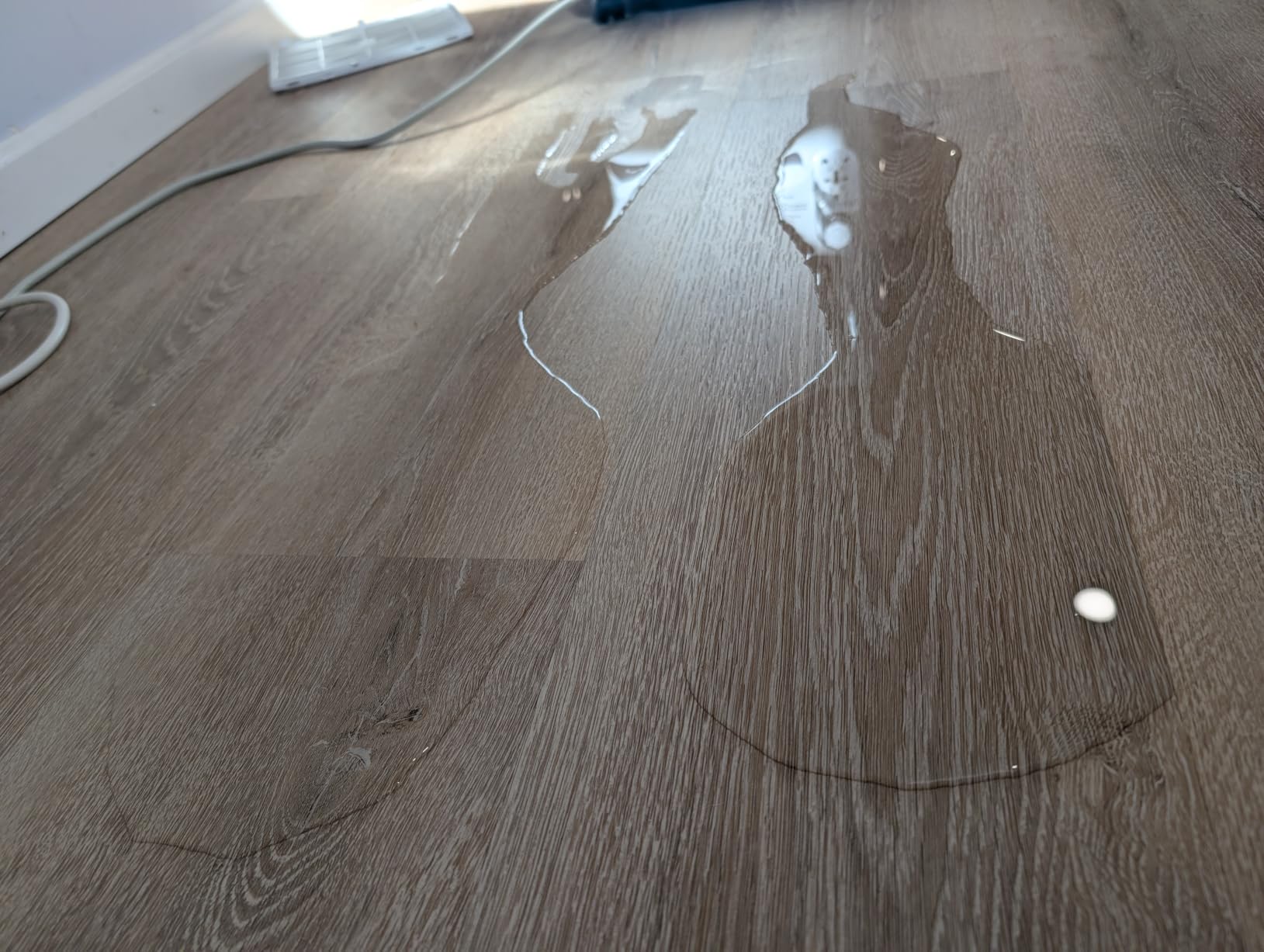
Roughly 6,900 reviews at 4.4 stars with 72% five-star ratings tell a consistent story: buyers like the raw extraction and the quiet compressor for its output.
Owners also point to responsive customer support and simple, intuitive fan and humidity controls.
Durability is the one area to watch.
A minority of long-term owners report reduced water output and refrigerant loss after a year or two, which is the kind of multi-year complaint that a short warranty window will not catch.
The listed upper temperature rating of 89.6F is also among the lowest here, so this is not a unit for a west-facing garage that bakes in July.
When 150 PPD is the right call
Peak capacity matters when the moisture load is genuinely extreme: a slab that wicks constantly, a garage next to a finished basement with a shared wall, or a coastal climate where outside air stays humid for months.
It also gives you the ability to run the compressor hard on a rare soaking weekend and still catch up the next day.
Where it overreaches
For a normal one- or two-car garage, this unit is overkill and you would be paying for capacity you never use while living with a 500-watt draw.
The on-board humidity reading also tends to run above an external hygrometer, so budget for a cheap wall hygrometer if you want to verify the target independently.
5. Waykar 120 Pint Smart Auto Comfort Mode Dehumidifier — Best for Two-Car and Mid-Size Garages
Waykar 6000 Sq.Ft Energy Star Dehumidifier for Basement & Home, 120 Pint/Day with Drain Hose & Tank, Ultra Quiet (40 dB), Smart Auto Comfort Mode
120 PPD
6000 sq ft
40 dB
Auto-defrost to 42F
1.24 gal tank
Pros
- Auto-defrost operates down to 42F for cold garages
- Smart Comfort Mode sets target RH by temperature
- Very quiet at 40 dB
- Included drain hose with AquaStop overflow protection
Cons
- Several owners report failure around the one-year mark
- 1.24-gallon tank is small for a 120-pint unit
- 470-watt draw is high for the class
The Waykar 120 Pint is the unit we would put in a standard two-car attached garage where the door opens daily and the living space is close enough that noise would matter.
It handles 120 PPD at 95F and 90% RH across up to 6,000 square feet, and it is the only unit here with a published auto-defrost rating, down to 42F.
The Smart Comfort Mode is the feature that makes it different. It reads temperature and sets the humidity target on its own: below 65F it aims for 55% RH, between 65F and 77F it targets 50%, and above 77F it pulls to 45%, all within plus or minus 5% accuracy.
That removes the biggest frustration of garage dehumidification, which is that a fixed target either cannot be reached in winter or never challenges summer humidity.
Noise is exceptional at 40 dB on low speed, and the max is documented at 55 dB or below.
Airflow runs at 230 CFM across three fan speeds with a 24-hour timer.
AquaStop provides full-tank shutoff with overflow backoff defense, and a three-minute compressor restart delay protects the unit from short cycling.
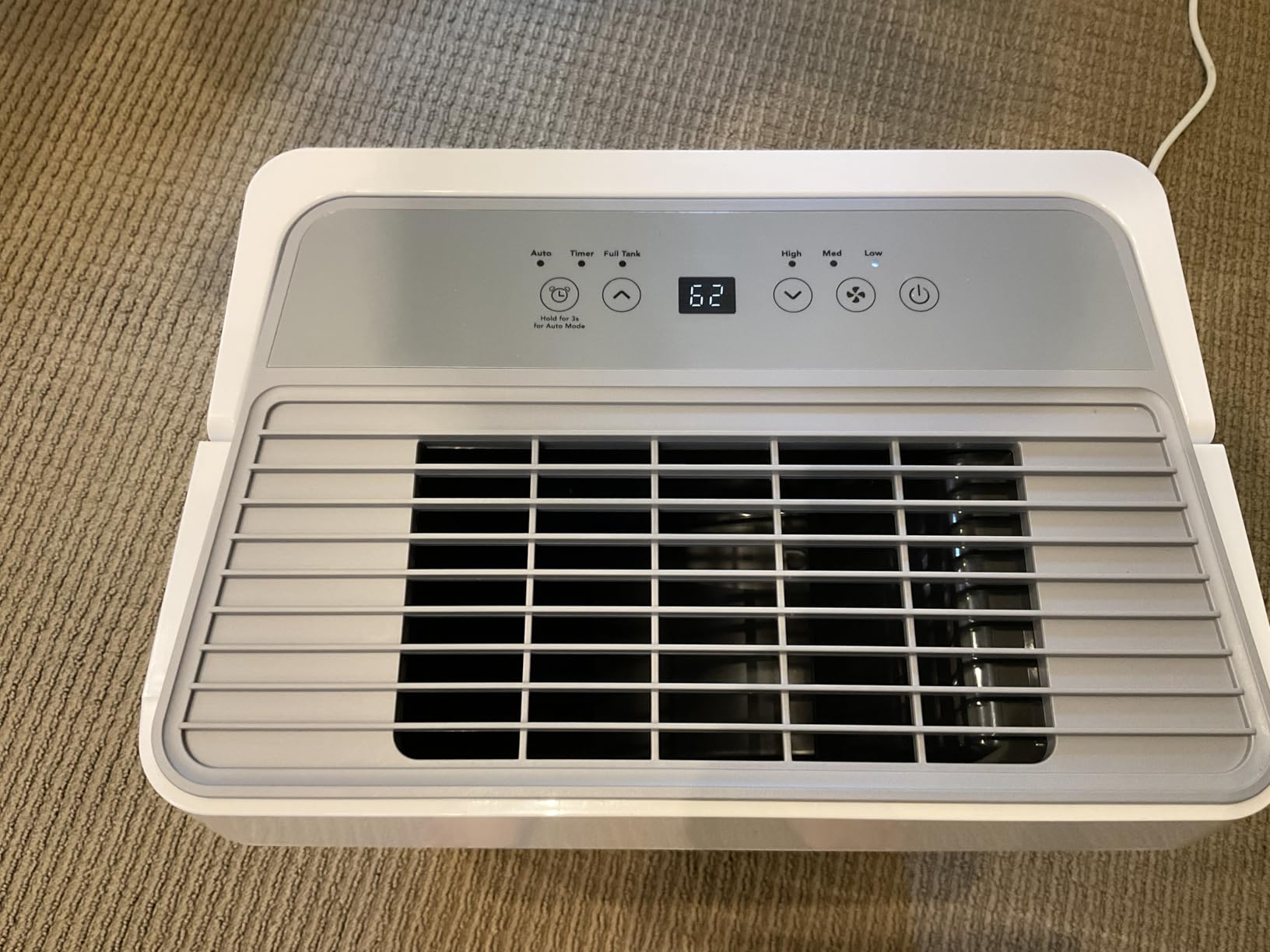
Owners report that damp, musty spaces transform within days, and that it is barely audible in a finished basement.
Support has been quick to replace failed units inside the warranty window, which suggests the brand stands behind the product.
Three things to know.
The 1.24-gallon tank is small relative to the 120-pint capacity, so the included 3.3-foot hose is effectively part of the setup.
The 470-watt draw is high for the size class, so a machine running around the clock will show up on the meter.
And a recurring theme across reviews is failure around the one-year mark, which is worth weighing against the extra-second-year warranty extension.
Why the automatic target beats a manual dial
Garage humidity is seasonal in a way basement humidity is not.
A fixed 50% set point is right in summer, too wet in spring, and impossible to hold in a cold snap. Letting the unit pick its target by temperature is the closest thing here to set-and-forget operation, and it also reduces compressor cycling, which extends life.
Where the small tank bites
If you ever lose the drain line, the practical run time on the internal tank is short at this capacity.
And in a garage with heavy dust, the washable mesh screen will need pulling more often than the manual suggests to keep airflow healthy.
6. ALORAIR Sentinel HD55 — Best Metal-Cased Unit for Crawlspaces and Flooded Spaces
ALORAIR 113 Pints Crawlspace Dehumidifier for Commercial, Sentinel HD55
53 PPD AHAM
113 PPD max
1200 sq ft
Metal cETL case
Tankless drain
Pros
- Metal commercial casing built for unfinished spaces
- Tankless continuous drain means nothing to empty
- 6-year limited warranty on a metal-cased unit
- MERV-1 filter shields internals from dust
Cons
- Owners report evaporator icing that forces defrost shutdowns in cool spaces
- Humidity often plateaus above the set point when cold
- Noticeably louder than plastic residential units
The Sentinel HD55 is the most overtly commercial-grade unit in this group, and it is built differently on purpose.
It is a cETL-listed metal-cased machine rated at 53 PPD AHAM and up to 113 PPD at saturation, with a 1,200 square foot coverage figure.
That AHAM figure is honest in a way most of the peak numbers in this category are not, and it is the number to size against.
There is no internal tank to empty.
Water leaves through a continuous drain, which in a garage or crawlspace means a hose to a sump, a floor drain or an exterior line. A sensor-driven auto-defrost cycle pauses the compressor while the fan keeps moving, and a MERV-1 filter protects the internal components from the dust that kills electronics in a garage.
The upper temperature rating of 104F is among the highest here, and the unit weighs 41.7 pounds with a rugged handle for moving it job to job.
An optional remote control system is available, and the six-year limited warranty comes with two years of full coverage. Rated 1,211 reviews at 4.3 stars with 70% five-star ratings.
Where a metal-cased commercial unit earns its place
If your moisture problem is below the slab, in a crawlspace, or in a garage that took water, plastic housings are the wrong tool.
The metal case handles impact and dampness, the tankless design removes the one failure mode that gets basement units abandoned, and the six-year warranty is longer than any other in this comparison. Several owners report strong moisture removal in basements after flooding.
Where it underperforms in cool conditions
Coil icing is the recurring complaint, and it connects to a cold-garage problem more broadly.
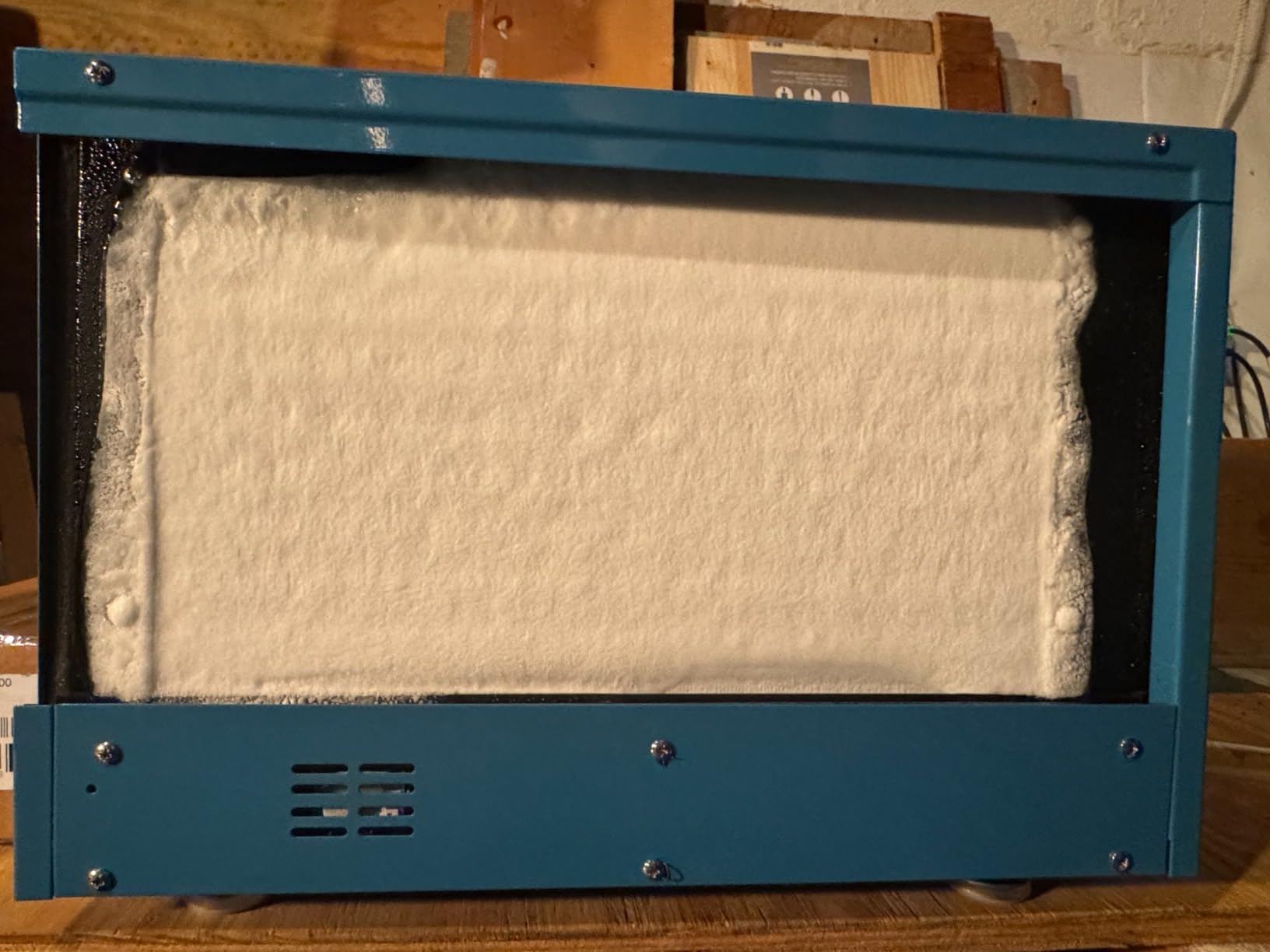
Owners report heavy evaporator icing that forces frequent defrost shutdowns, and achieved humidity that plateaus well above the set point when the space is cool. It is also noticeably louder than residential units, and replacement filters cost more than the machine’s residential rivals.
7. KNKA 5500 Sq. Ft. Energy Star Dehumidifier — Best Budget Pick for Quiet Workshops
KNKA Energy Star 5500 Sq.Ft Dehumidifier for Basement, Max 80 Pint/Day
80 PPD
5500 sq ft
ENERGY STAR
40-45 dB
1.45 gal tank
Pros
- Very quiet at 40-45 dB for overnight running
- Plug-and-play setup with clear controls
- Included 6.56 ft drain hose
- Optional external tank expands capacity
Cons
- 4.1 stars with 14% one-star ratings
- Small 1.45 gal tank and awkward to lift
- Advertised coverage disputed by at least one owner
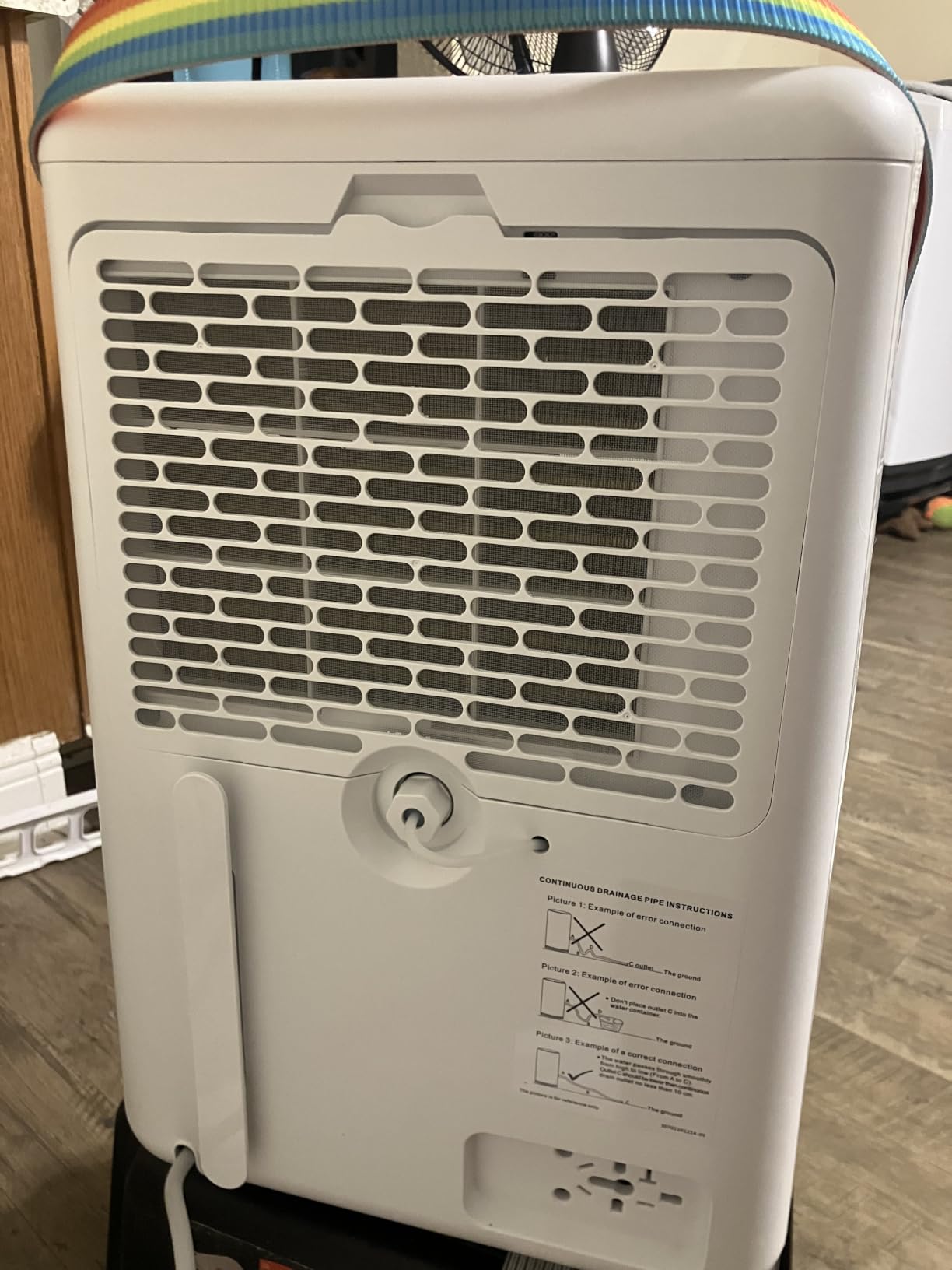
The KNKA is the value pick, and it succeeds on the two things a workshop actually cares about: it is quiet and it is cheap to run.
It rates 80 PPD at 95F and 95% RH, 56 PPD at 86F and 80% RH, and carries a 5,500 square foot coverage figure with ENERGY STAR certified efficiency. Operating noise is 40 to 45 dB with a humidity display you can switch off entirely.
Three modes cover the usual cases.
AUTO defaults to 50% RH, DRY is aimed at clothing and drying racks, and SETTING gives manual control from 30% to 80% RH. A 12-hour timer, child lock, washable reusable filter, 360-degree casters and built-in cord storage round out a long feature list for the money.
Drainage is the reason it earns its place over a cheaper unit.
A 6.56-foot hose is included for continuous drainage, and an optional 2.64-gallon external tank can be added, which is rare at this tier.
What works well in a quiet space
At 40 to 45 dB with the display off, this is among the easiest units here to live with in a space that doubles as an office or a man cave.
Customers also report exceptionally responsive service. For a workshop where you want humidity controlled without background noise, the operating experience is the selling point.
Where the compromises show
Review sentiment is among the weakest in this group at 4.1 stars with 14% one-star ratings.
The internal tank is small and the wrap-around shape is awkward to lift, so owners drain it every few hours. One owner reported the auto tank-full shutoff not working, and another disputed the square footage claim in a space under 1,000 square feet.
The listed 220-volt input is also unusual for a US residential unit.
8. Gasbye 6000 Sq. Ft. Energy Star Dehumidifier — Best Rated Performance and Honest Capacity Figures
Gasbye 6000 Sq.Ft 2026 Energy Star Dehumidifier for Basement Max 115Pints/D
115 PPD max
50 PPD at 65F
ENERGY STAR 2026
45 dB
1.72 gal tank
Pros
- 4.6 stars across 919 reviews
- ENERGY STAR certified for up to 30% better efficiency
- Reinforced 5-tier copper coil built for durability
- 2-year warranty with brand-new replacement units
Cons
- 500-watt draw is among the higher figures here
- Black plastic exterior collects visible dust
- Listing square footage exceeds the rated spec
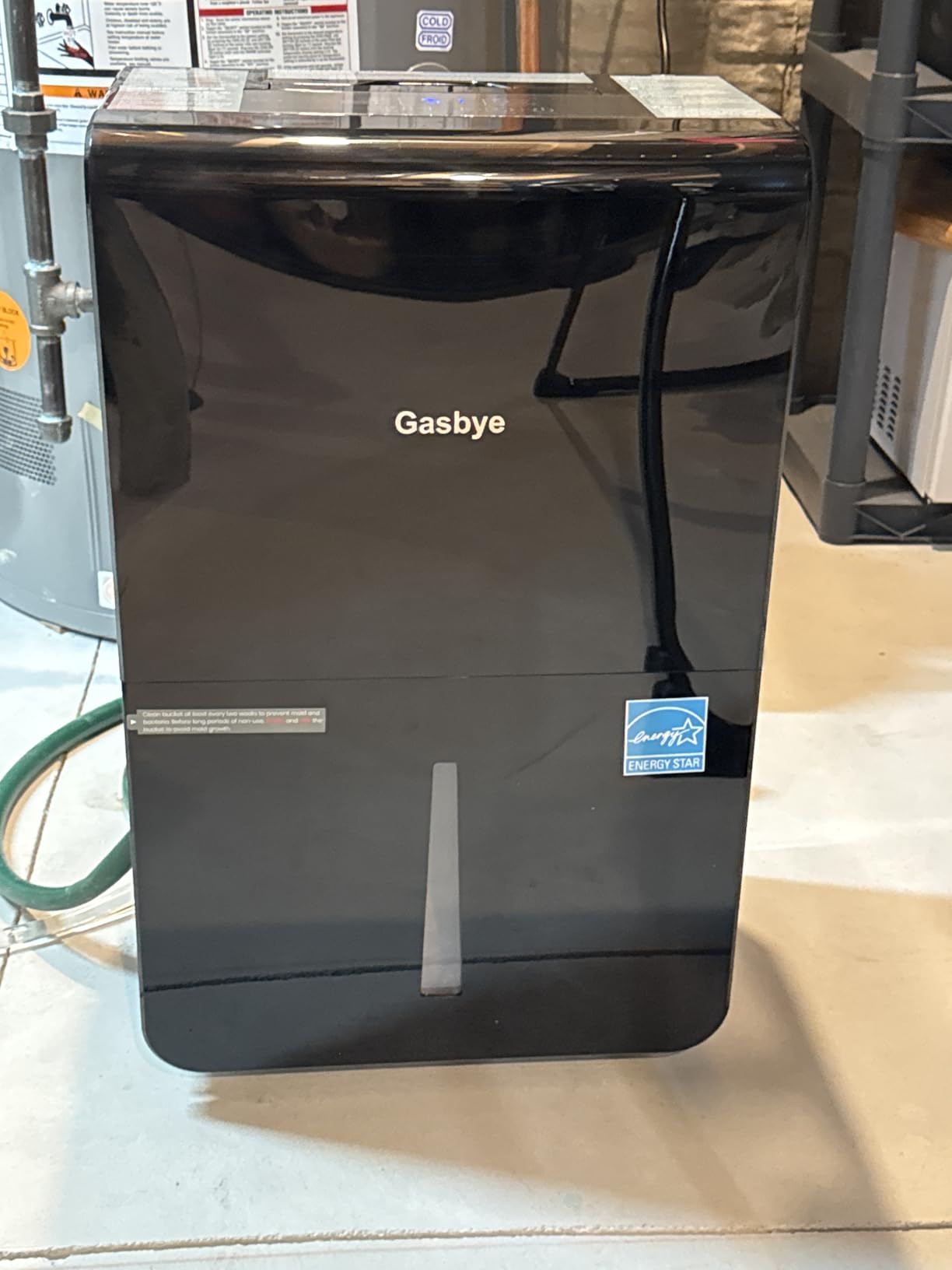
The Gasbye posts a 4.6 star average across 919 reviews, the highest rating of any unit here, with 80% five-star ratings.
What makes that score meaningful is that the capacity claims are conservative rather than inflated.
It lists 115 PPD as a maximum but breaks out the real numbers: 115 PPD at 86F and 80% RH, 73 PPD at 80F and 60% RH, and 50 PPD at 65F and 60% RH.
That third figure is the one that matters most for garage owners, and it is unusual to see a manufacturer publish it.
Most listings give you one headline number measured at conditions you will never see. If you want to plan a summer run in a warm garage, start from 73 PPD, not 115.
It carries ENERGY STAR certification with a stated efficiency improvement of up to 30% over non-certified models, uses reinforced five-tier copper coil tubing, and runs at 45 dB.
Construction weight is 43 pounds at 11 by 15 by 24 inches. Auto shutoff and auto restart use a 3% humidity hysteresis band, and the fan runs briefly after shutdown to cool the coil.
What a conservative rating actually buys you
Buyers emphasize honest, non-inflated performance claims and sturdy construction.
That matters because the coverage numbers on competing boxes are frequently marketing rather than measurement, and if you size off one of those you can end up with a unit that runs nonstop and still never reaches target. The two-year warranty that provides brand-new replacement units rather than refurbished ones is also a real differentiator.
Where it draws attention
The 500-watt draw is among the higher figures in this category, which shows up on a meter if you run it around the clock.
The black plastic exterior shows dust in a garage, and the listing headline claims 6,000 square feet against a rated 4,500 square foot specification, which is the kind of inconsistency to distrust elsewhere.
9. Ivation 50 Pint Dehumidifier with Built-In Pump — Best for Garages with No Floor Drain
Ivation 50 Pint Dehumidifier for Basement w/Pump & Drain Hose, 4,500 Sq Ft
50 PPD at 60F
4500 sq ft
Built-in 16W pump
2.25 gal reservoir
LCD display
Pros
- Built-in pump drains continuously and upward
- 2.25-gallon reservoir is large for its capacity
- Water-level sensor with automatic shutoff
- Auto-restart after power outage
Cons
- Older design with no app control
- 16W wattage figure refers to the pump rather than total draw
- Lowest sales rank of the models here
Across garage forums, the most repeated request by a wide margin is a unit that drains itself without a floor drain nearby.
The Ivation 50 Pint answers that with a built-in 16W pump that pushes water continuously upward, out a basement window or into a sink.
It has a built-in pump as standard rather than an accessory, one of two models in this roundup that does.
The rest of the design is sensible for unattended long-run use.
A 2.25-gallon reservoir with a water-level sensor and automatic shutoff is generous next to most 50-pint units, and a built-in humidity sensor handles set-and-forget operation.
The LCD display shows the humidistat setting, fan speed, timer and filter alerts, so you know when maintenance is due without guessing.
Rated capacity is 50 PPD at 60F and 60% RH over up to 4,500 square feet, with an 80F upper temperature rating and an older manufacture year.
Auto-defrost handles cool rooms and auto-restart covers power outages, and caster wheels make it movable between spaces. The washable reusable filter avoids replacement costs entirely.
Why the pump changes the install
With a pump, drainage direction stops mattering.
You can run a hose up and over a curb, into a utility sink, or to a floor drain above the unit’s base, which removes the most common reason people give up on continuous drainage. That single feature is what keeps the unit running unattended through a work week.
Where it shows its age
This is an older design without Wi-Fi or app control, and the feature set reflects it.
The 16W wattage listing refers to the pump rather than total draw, so do not use it for energy planning. Its sales rank is also the lowest in this comparison, which usually reflects how widely a model is carried rather than how well it performs.
10. DECIUU 5000 Sq. Ft. 100 Pint Smart Dehumidifier — Best Mid-Size for Shops and Gym Rooms
DECIUU 5000 Sq.Ft Dehumidifier, 100 Pint Smart Humidity Control, Drain Hose
100 PPD
70 PPD at 86F
5000 sq ft
ENERGY STAR Most Efficient
300 watts
Pros
- ENERGY STAR Most Efficient certified
- Strong extraction in a compactish 26-inch footprint
- Intelligent humidistat cycles the compressor instead of running nonstop
- Three drainage options including a garden hose
Cons
- 1.45-gallon reservoir is small and the handle can loosen
- Humidity readout bottoms out at 30% and is not perfectly accurate
- Manual warns against extension cords
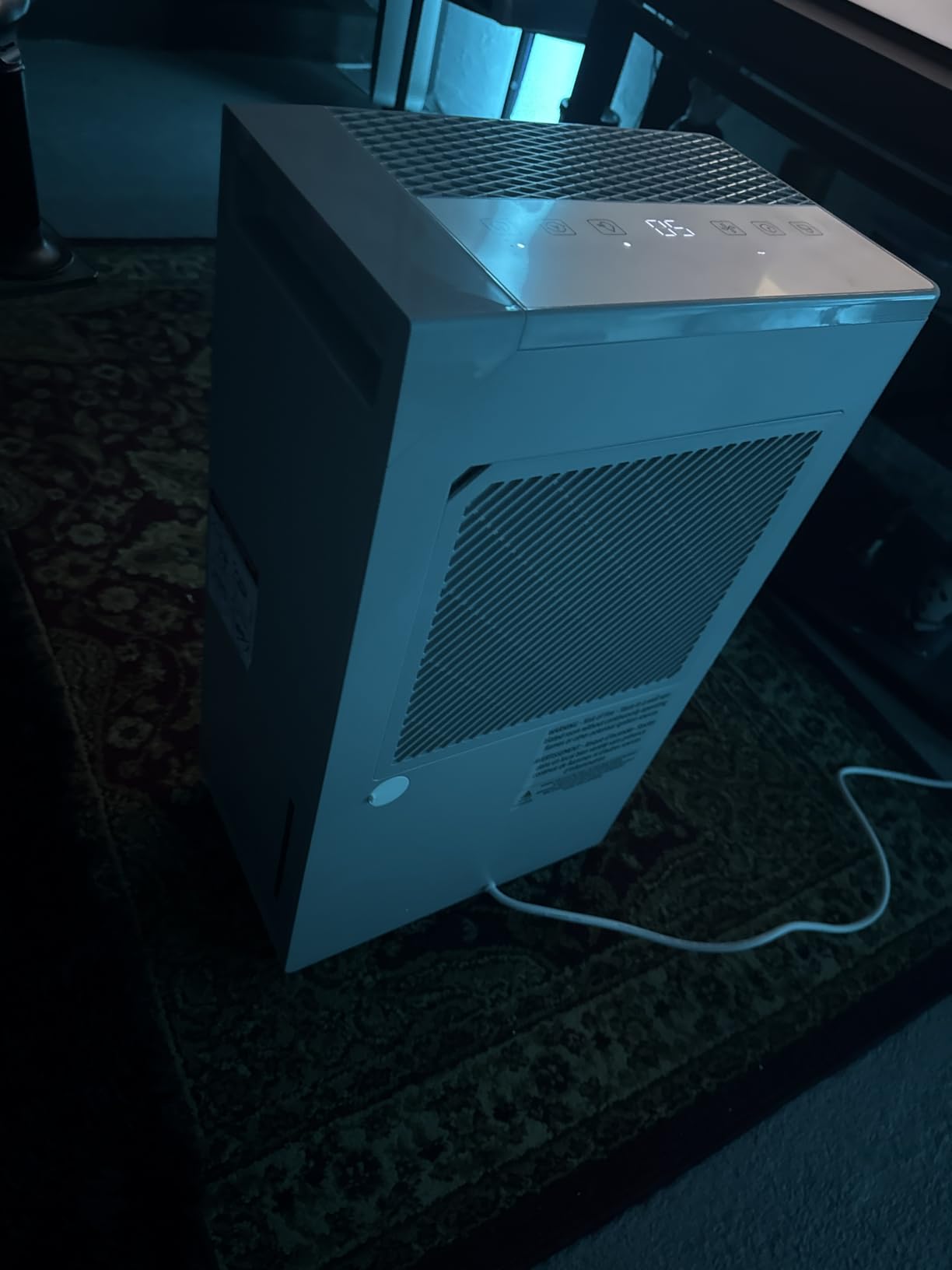
The DECIUU 100 Pint is the balanced choice when a garage is big enough to need real capacity but not so big that a commercial unit is warranted.
It delivers 100 PPD at 95F and 90% RH and a more realistic 70 PPD at 86F and 80% RH across up to 5,000 square feet, drawing 300 watts.
It carries ENERGY STAR Most Efficient certification, and airflow moves at 9,396 cubic feet per hour.
The intelligent humidistat works across a 35% to 80% RH range, which suits a garage well.
A sealed space may never get below 35%, and you do not want to run the compressor chasing a number it cannot hit.
Drainage options are unusually broad for a unit this size: a 5.5-liter tank, an included 6.56-foot drain hose, or a 3/4-inch garden hose connection.
It has 360-degree swivel casters, a hidden handle, a removable washable filter, auto defrost, child lock and a timer. Two-year product protection applies with registration.
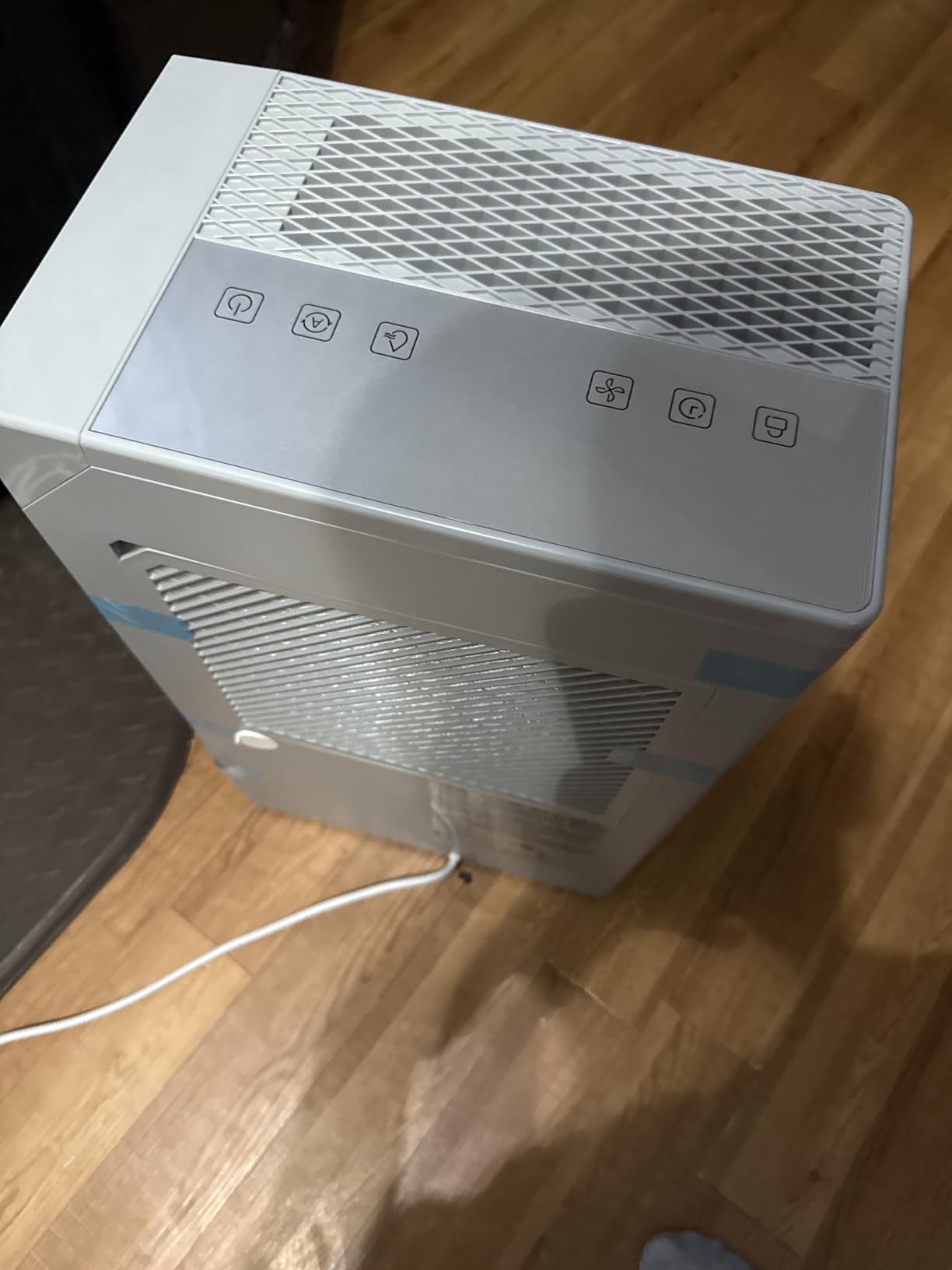
Owners who replaced failing units report significantly better noise levels and humidity holding, and they call out its usefulness in shops and garages as well as basements.
The 423-review base is among the smallest here, so read the long-term reliability picture with appropriate caution.
A few specifics to note.
The 1.45-gallon reservoir is small, and the handle can loosen when you lift it out, so keep the hose connected as the default arrangement.
The humidity readout bottoms out at 30% and is not perfectly accurate against a separate hygrometer. The manual also explicitly warns against extension cords, which limits where you can place it in a garage with limited outlets.
Where 100 PPD sits in a mid-size garage
This is the tier that covers most two-car and three-car bays with a workshop corner, and it does so at 300 watts rather than the 470 to 500 watts the larger units need.
For a converted garage gym or a shop with power tools, moderate draw combined with ENERGY STAR Most Efficient certification makes it an efficient long-run choice.
Where to be cautious
The thin review history is the main risk.
Buy it if you want efficiency and a compact footprint, but if your priority is a proven service record over a decade, the hOmeLabs or Waykar models carry far more long-run evidence.
11. avylo 90 Pint Dehumidifier with Pump and Hose — Best Built-In Pump with Uphill Drainage
avylo Dehumidifier for Basement with Pump and Hose, Max 90 Pints/D, White
90 PPD
Built-in 15 ft pump
2.05 L/kWh
41 dB
2.11 gal tank
Pros
- Built-in pump with a 15-foot lift solves uphill drainage
- ENERGY STAR Most Efficient with a 2.05 L/kWh efficiency rating
- Quiet 41 dB with sound and light disable
- 5-year manufacturer warranty
Cons
- Only 339 reviews
- so the long-term record is thin
- Floor drain pipe for the pump outlet is not included
- Coverage figure is more conservative than rivals at the same capacity
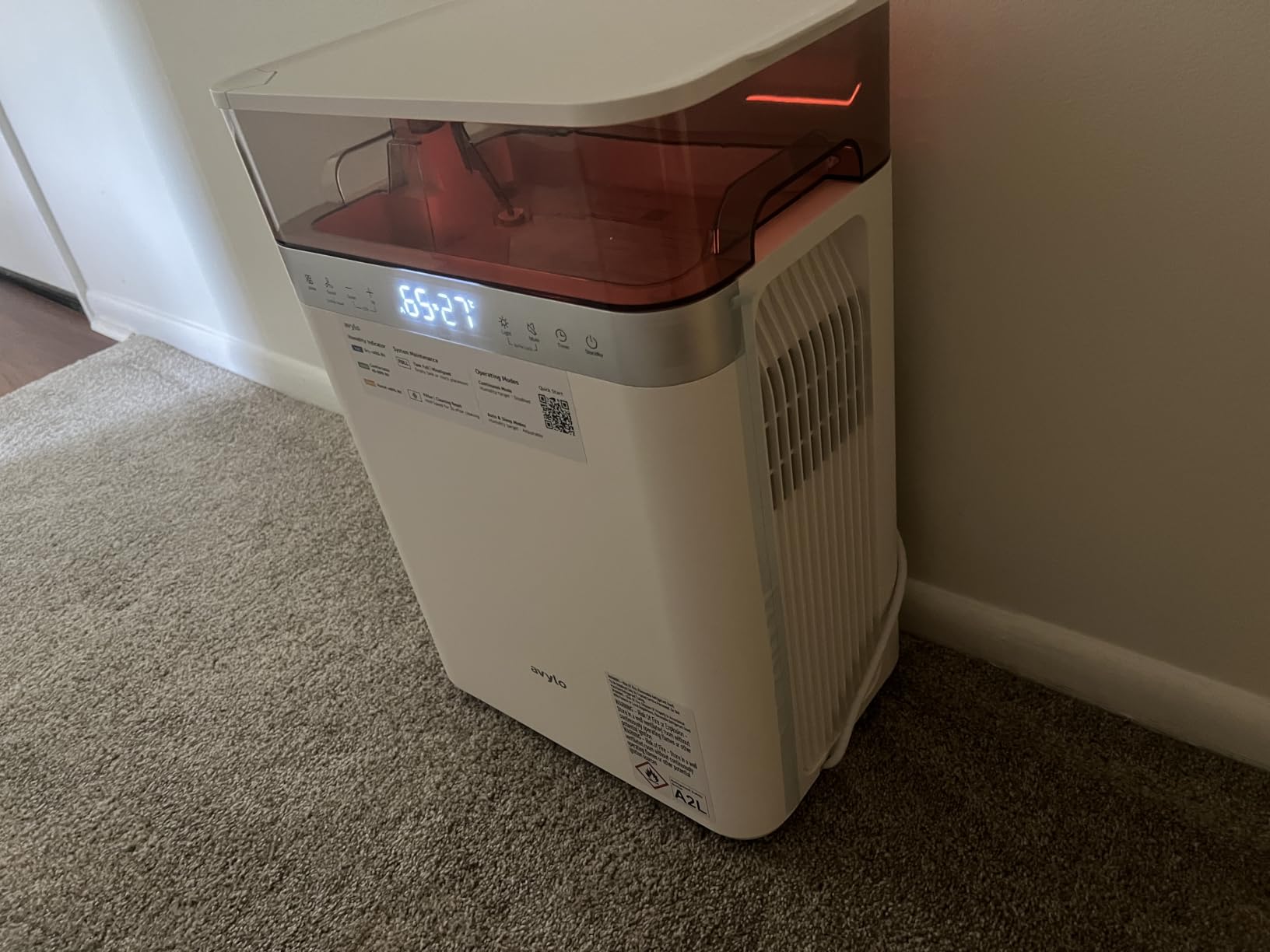
The avylo 90 Pint is the second pumped unit here, and it pushes water harder than the Ivation: a built-in pump with a 15-foot lift, and a 15-foot drain hose included.
If your garage drain is uphill or across the slab, that lift figure is the whole reason to choose it. Rated 90 PPD at 90F and 90% RH across up to 5,000 square feet.
Efficiency is the standout.
It carries ENERGY STAR Most Efficient certification with a stated energy efficiency ratio of 2.05 L/kWh, and it draws only 235 watts, the lowest rated draw among the compressor models in this comparison.
That combination of high capacity and low draw is unusual and it makes a strong long-run cost argument for a garage running 24/7.
Operation is quiet at 41 dB, with a mode that disables both sound and light, plus a 24-hour timer.
The top-mounted 2.11-gallon tank has a full-tank reminder and auto shutoff, and sensors feed an LED display showing live humidity and temperature.
Safety protection covers compressor overheat, overload and leakage. It meets DOE, CEC, FCC, TSCA and UL standards and carries a five-year manufacturer warranty.
Why 235 watts matters in an unconditioned garage
Running cost is the quiet killer of garage dehumidification.
A machine at 500 watts running around the clock adds up to roughly 84 kilowatt-hours a week, and over a humid season that is a real line on the utility bill.
At 235 watts with a 2.05 L/kWh rating, the avylo removes roughly 90 pints a day for a fraction of what the 150-pint units cost to run.
Where the record is thin
With 339 reviews at 4.5 stars and 80% five-star ratings, early sentiment is strongly positive but the long-term durability history simply does not exist yet.
The floor drain pipe for the pump outlet is not included, so budget for that fitting. And the coverage figure is more conservative than competitors claiming the same capacity.
12. DREO Energy Star Smart Dehumidifier — Best for App-Controlled Garages
DREO Energy Star 2025 Smart Dehumidifier for Basement, 1.85 Gal Water Tank
73 PPD
2000 sq ft
ENERGY STAR certified
41 dB
1.85 gal tank
Pros
- App control with real-time energy usage and cost tracking
- Exceptionally quiet at 41 dB
- ENERGY STAR certified using about 30% less energy
- 10-minute automatic rest cycle protects the compressor
Cons
- Side-loading tank requires rotating the unit to empty
- On-panel controls are not backlit
- Humidity readings run 3-4 points high versus a separate hygrometer
The DREO is the smallest garage on the list in square footage terms, rated for up to 2,000 square feet at 73 PPD, which makes it a fit for a one-car garage, a finished storage bay or a man cave rather than a workshop.
It is also the most deliberately styled design in the group, with a silver finish and a color-changing humidity indicator light.
ENERGY STAR certified and using about 30% less energy than standard DOE models, it pairs that with a stated 41 dB operating level.
Owners measuring it directly report around 43 dB on low and 46 dB on high, which is honest for the class. Airflow is 163 CFM across three fan speeds.
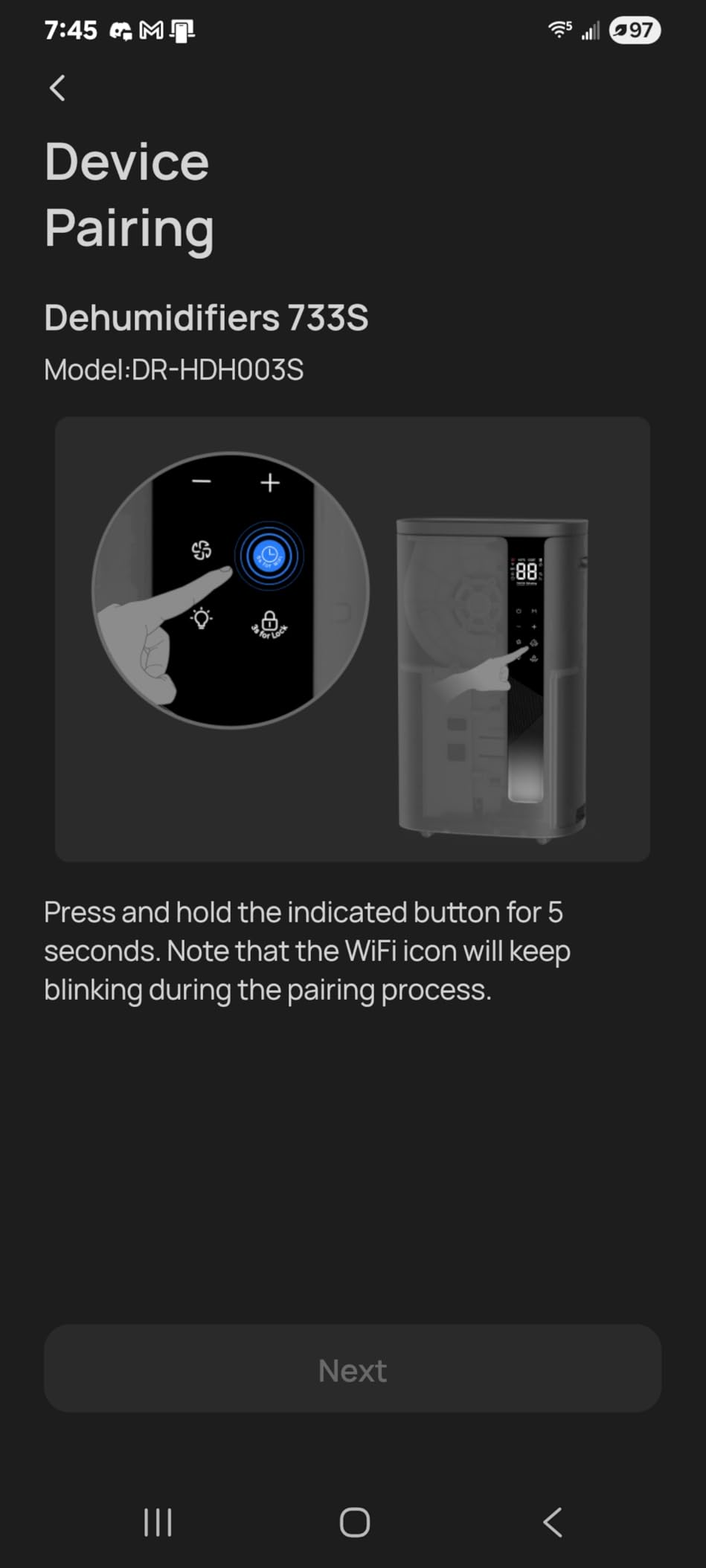
The app is the real draw. It shows real-time energy usage and power cost tracking, so you can see what the unit is drawing rather than estimating it.
Full-tank alerts, auto shutoff, auto defrost, water level detection, child lock and timer all report to the phone.
A 10-minute automatic rest period after shutdown cools the compressor, which is genuinely useful for a unit meant to run unattended. The drain hose is included and the filter is washable.
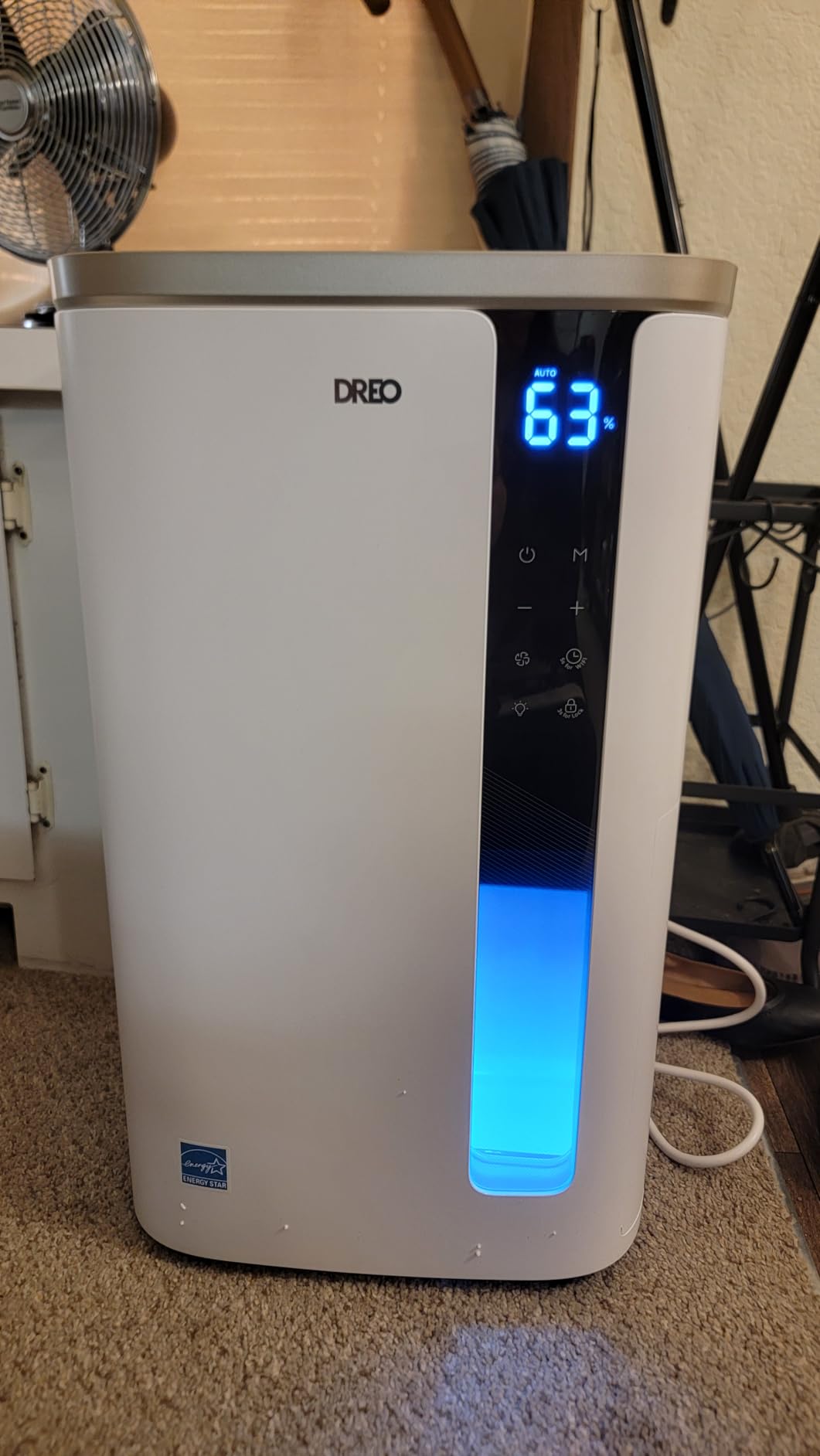
Two practical notes. The 7-liter tank gives up to 15 hours of runtime, but emptying it means rotating the unit roughly 90 degrees because the tank loads from the side.
That is awkward if you plan to rely on the tank without a hose. On-panel controls are not backlit, so the app is the better interface in a dark garage. Owners also report readings running 3 to 4 points high against a separate hygrometer.
At 246 reviews this carries the smallest evidence base in the comparison, and the warranty is a 12-month limited term, among the shortest offered here.
Treat it as the smart-control pick for a smaller space rather than a long-term durability bet.
Where app control earns its keep
If the garage is a second home for your tools or a workshop you use on weekends, remote visibility stops the most common failure mode: a full tank nobody noticed until the compressor had already cycled hard for days.
Cost tracking in the app also lets you verify the energy savings claim on your own bill rather than trusting a certification label.
Where the size limit bites
Two thousand square feet is roughly a one-car garage or a two-car bay that is already reasonably tight.
In an open three-car space, a heavily loaded slab, or a garage that takes in humid air every time the door opens, this unit will run continuously without reaching target. A continuous compressor is the fastest way to wear one out.
How to Choose a Garage Dehumidifier: Nine Criteria That Matter
1. Rated pints per day, not the marketing maximum
Buy on the rated number measured at 60F and 60% RH, and treat the peak figure as headroom rather than a sizing tool.
This roundup shows the spread clearly: the Yaufey advertises 150 PPD while the Gasbye lists 50 PPD at 65F and 60% RH alongside its 115 PPD headline.
The second style of listing is the one you can actually plan a garage around.
2. Continuous drainage: gravity hose or built-in pump
Any garage that runs continuously needs water to leave without you.
A gravity hose works only when the outlet is lower than the unit. If it is not, you need either an uphill run with a pump or a plan to empty the tank.
Two models here have a pump built in, the Ivation and the avylo at 15 feet of lift. Both solve the most common install problem in garage forums: no floor drain.
3. Cold garage: compressor with auto-defrost or desiccant
Every unit in this list is a refrigerant compressor, and compressors stall as the coil approaches freezing. Only the Waykar 120 Pint publishes a specific auto-defrost rating down to 42F, which makes it the one to choose if you intend to run through winter.
The pattern in the reviews is consistent. Cold-storage owners report coil icing and humidity that plateaus above the set point, and users weighing options point out that desiccant units keep working near freezing but draw more power continuously.
A desiccant unit remains the right tool for a sub-freezing unheated garage, a gun safe or a sealed cabinet holding electronics.
Where compressor units typically stop helping below about 53 to 54% RH, desiccant keeps pulling. The tradeoff is power draw and typically a smaller tank, so we would run a desiccant unit on a timer for a cold garage and switch to a compressor for the humid season.
4. Noise level and where the sound lands
Rated noise is measured at the unit, and what matters is what reaches you.
Anything at or below 45 dB is effectively invisible in a detached garage.
For an attached garage, place the unit as far from the interior door as the drainage layout allows rather than just buying a quieter model. The DREO, avylo, AEOCKY and Waykar 80 Pint all land in the 41 to 44 dB range.
5. Energy use and annual running cost
A garage dehumidifier can be the only appliance running continuously in that building, so draw multiplies fast.
The avylo at 235 watts and the Waykar 80 Pint at 270 watts are among the cheapest here to run, while the Yaufey and Gasbye at 500 watts are among the most expensive. Most of the models here carry ENERGY STAR certification in some form, with the AEOCKY, avylo and DECIUU holding Most Efficient status.
6. Filtration and dust
A garage filter is a dust collector, not an odor solution.
In a workshop where you run a table saw or a welder, a washable mesh or MERV screen is more practical than a sealed HEPA-style unit you would buy filters for forever.
The ALORAIR Sentinel HD55 carries a MERV-1 filter specifically to shield its internal components, which matters if you move it between job sites.
7. Housing and component durability
Plastic keeps the unit light and portable, and metal survives knocks, dust and temperature swings.
Copper tubing over aluminum is the other durability differentiator, and the Gasbye, Waykar and AEOCKY all use it.
8. Humidistat accuracy and control range
The control range should start near 35 to 50% RH, because that is where a garage should sit.
Several units here bottom out at 30%, which sets a target the space will never reach and can keep the compressor cycling. Read the sensing location too, and expect a few points of drift: multiple owners across this list report on-board readings running above a separate hygrometer.
9. Warranty length and serviceability
Warranty length tracks manufacturer confidence more than anything else on the spec sheet.
The ALORAIR Sentinel HD55 offers six years with two years of full coverage, the avylo five, the AEOCKY three, the Gasbye two with brand-new replacement units, and the DREO twelve months.
Warranty length also hints at replaceable parts, which matters more than the paperwork when a compressor fails in year three.
Once the unit is chosen, a wider look at whole-home moisture control helps.
Our guides to the best air compressors for home garages and the best upright freezers for garages cover the other two appliances that decide how long a garage stays dry.
Installation, Drainage and Electrical Safety in a Garage
Pick the location before you buy the hose.
Leave clearance on all sides so intake and exhaust air move freely, keep the unit out of direct sunlight near a hot wall, and set it where you can reach the filter without dragging the machine across the floor.
If the garage is attached, place the unit at the far end from the interior door.
Run the drain line downhill to a floor drain, a utility sink or an exterior grade away from the foundation, and secure it so a tug cannot disconnect it.
Where uphill drainage is unavoidable, use one of the two pumped units in this roundup. Test the line with a full tank of water before you walk away.
On the electrical side, run these units on a dedicated 115V circuit with a GFCI-protected receptacle, and do not use extension cords.
Several manuals in this category state that warning explicitly, and it is not a formality in a damp space. If the garage is on a subpanel, confirm the circuit has capacity for a 500-watt continuous load before you install.
Garage Dehumidifier Maintenance Schedule and Common Mistakes
Vacuum or rinse the filter every one to three months, and more often in a dusty workshop, because a clogged filter chokes airflow and drives the coil cold.
Wash the coil itself roughly twice a year with a coil cleaner, and check the drain line for kinks every few weeks if you are running continuously.
Do not store cardboard, paper or fabric directly against the slab, no matter how well the unit performs.
Space things off the floor on pallets or shelving so air can move, and avoid stacking items against the garage door where condensation collects. Placing a cheap hygrometer near eye level gives you an independent reading, which is worth having given how many units here report 3 to 4 points high.
The most common mistakes are sizing too small and running without drainage.
An undersized unit never reaches target, so the compressor runs continuously, the meter climbs and the machine ages early.
A unit with no drain line fills its tank overnight and either stops or overflows. Fix either one and the same machine suddenly feels like a better purchase.
Frequently Asked Questions
What type of dehumidifier is best for a garage?
A high-capacity compressor dehumidifier rated between 30 and 100 PPD, with a digital humidistat, a continuous drain hose or a built-in condensate pump, and auto-defrost if the garage cools in winter. Residential plastic-bodied units suit climate-adjacent garages; metal-cased commercial units suit crawlspaces, flood cleanups and workshops where dust and impact are constant.
Is it a good idea to put a dehumidifier in a garage?
Yes, for any garage that stores vehicles, tools, electronics, paper, wood or firearms. Garages are unsealed and unheated, so they collect ground moisture and condensation that rust steel, grow mold on cardboard within weeks and push musty air into the rest of the home. Holding relative humidity between 30% and 50% prevents all three.
What size dehumidifier do I need for a garage?
Up to about 500 square feet wants a unit rated near 30 to 40 PPD. Between 500 and 1,000 square feet, look for 50 to 70 PPD. From 1,000 to 1,800 square feet, step up to 70 to 100 PPD, and beyond that treat 100 PPD or more as a commercial job. Size on the rated number at 60F and 60% RH, not the peak figure.
What type of dehumidifier is best for an unheated garage?
Choose a compressor unit with a documented auto-defrost rating and a wide humidity control range, and plan to shut it down if the space freezes. Only some models publish a specific low-temperature defrost rating. In a garage that stays above freezing, a standard compressor with auto-defrost and a drain line handles the job well.
What type of dehumidifier is best for a cold garage?
A desiccant dehumidifier is the right choice for a garage that drops below freezing or where you need relative humidity held under the low-50s. Refrigerant compressors stall as the coil approaches freezing and often plateau above the set point in cold conditions. Desiccant units keep extracting but draw more power, so a timer-controlled setup works best.
Do garage dehumidifiers need a pump?
Only if the drainage outlet is not lower than the unit. A gravity hose handles most garages that have a floor drain or a sink nearby. Where the drain runs uphill or across the slab, a built-in pump is the difference between a machine that runs unattended and one you have to empty by hand every few hours.
What humidity level should a garage be at?
Between 30% and 50% relative humidity, which is the EPA’s guidance for indoor spaces and the range that protects vehicles, wood, paper and electronics. Set a compressor unit near 50% in a typical garage, because a sealed garage often cannot reach lower without running continuously.
The Best Dehumidifiers for Garages in 2026
After working through all twelve, the hOmeLabs 50 Pint remains our pick for the best dehumidifier for garage use overall, thanks to Wi-Fi control, a large review history and enough headroom for most two-car spaces.
The AEOCKY 80 Pint takes the metal-housing and efficiency crown, the Waykar 120 Pint wins for a cold two-car garage that needs a documented 42F defrost rating, and the avylo 90 Pint is the one to buy when your drain runs uphill.
Measure your square footage, decide where the water is going, then pick from the reviews above. Set the humidistat near 50% RH, run it on a dedicated GFCI circuit, and check back in a month.