
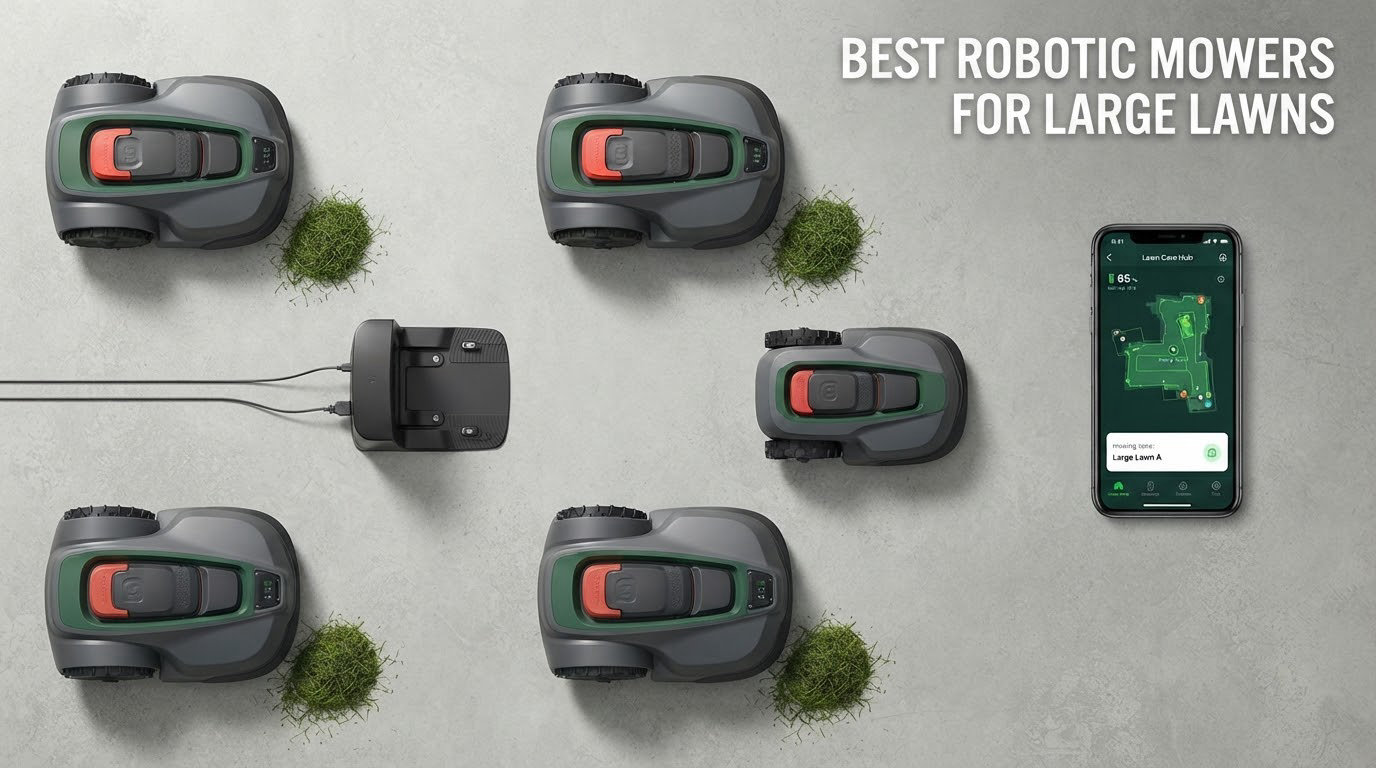
A large lawn starts at roughly half an acre. Beyond that, two numbers decide everything: the square footage of grass you actually have to cut, and the steepest slope on the property. In this guide to the best robotic mowers for large lawns, we size both up, then put ten wire-free and wired machines through their paces so you can match one to your lot.
Most comparison pages assume you already know your mowable square footage. You probably do not, and neither does the person selling you the machine. A quarter-acre of lawn around a house on a two-acre lot is a very different buying decision from an open two-acre field, and the number that matters is grass, not land.
We wrote this documentation-led. Every specification here comes from manufacturer documentation, and every owner comment traces back to aggregated customer review themes rather than to a weekend of testing on one lawn. That approach has limits, and we would rather name them than pretend. What it does give you is a consistent comparison across ten machines that otherwise bury their differences in marketing copy.
If your property is more of a small yard, start with our picks for reel mowers for small lawns instead. If you are still riding a tractor on three acres, our zero-turn mower guide for big properties covers that side of the market.
Table of Contents
Top 3 Picks for Large Lawns in 2026
The Mammotion LUBA 2 AWD 5000HX takes our top slot because it pairs the widest coverage claim in this group with the largest review base we could verify, and the owners running shaded, sloped lots report consistent results. The LUBA 3 AWD 3000 is the smarter answer when trees block the sky, thanks to its three-sensor Tri-Fusion setup. For anyone past three acres, the YARBO is the only machine here rated for genuine multi-acre ground.

Mammotion LUBA 2 AWD 5000HX
- 1.25 acres reception and 1.48 acres max
- 80% slope
- UltraSense AI Vision plus RTK

Mammotion LUBA 3 AWD 3000
- 360 degree LiDAR plus NetRTK plus AI vision
- 500 sqm per hour
- 30 mowing zones
Best Robotic Mowers for Large Lawns (October 2026)
Here is the short version. Coverage figures are manufacturer ratings under ideal conditions, so read them as a ceiling rather than a promise. Slope numbers use mixed units across brands, so the buying guide below explains how to normalise them before you compare.
| Product | Specifications | Action |
|---|---|---|
| Mammotion LUBA 2 AWD 5000HX |
|
Check Latest Price |
 MOVA LiDAX Ultra 3000 AWD MOVA LiDAX Ultra 3000 AWD |
|
Check Latest Price |
| Mammotion LUBA 3 AWD 3000 |
|
Check Latest Price |
 ECOVACS GOAT A3000 LiDAR PRO ECOVACS GOAT A3000 LiDAR PRO |
|
Check Latest Price |
 ECOVACS GOAT A2500 RTK ECOVACS GOAT A2500 RTK |
|
Check Latest Price |
| YARBO Robot Lawn Mower Pro |
|
Check Latest Price |
 Husqvarna 410iQ Husqvarna 410iQ |
|
Check Latest Price |
 Sunseeker X5 AWD Sunseeker X5 AWD |
|
Check Latest Price |
 Lymow One Plus Lymow One Plus |
|
Check Latest Price |
 Husqvarna Automower 430X Husqvarna Automower 430X |
|
Check Latest Price |
One more thing before the individual reviews: how we evaluated. We cross-checked manufacturer specification sheets against the technical detail listings, then weighted the aggregated customer review data for each machine, paying closest attention to failure modes that show up repeatedly rather than one-off complaints. We did not perform hands-on mowing, and we flag products with thin review histories so you can weigh the evidence yourself.
1. Mammotion LUBA 2 AWD 5000HX – Best Overall for Large Sloped Lawns
Mammotion LUBA 2 AWD 5000HX Robot Lawn Mower with 4G, Reception 1.25 Acres, Max. 1.48 Acres, All-Wheel-Drive for 80% Slope, UltraSense AI Vision & RTK Automatic Edge Mapping, 2.2″-4.0″ Cutting Height
1.25 acres
80% slope (38 degrees)
41 lbs
15.7 inch cut
2.2-4.0 inch height
Pros
- Handles steep hills and rough terrain reliably
- Mows under trees when satellite signal drops
- Very quiet in operation
- Accurate edge mapping
- App control with up to 50 mowing areas
Cons
- Narrow cut width means long mow cycles
- Does not mulch or handle fallen leaves
- Razor blades need frequent replacement
- Setup and boundary mapping take real effort
The LUBA 2 AWD 5000HX is the machine I would put on a one-acre-plus property with hills and shade, and the reasoning is simple. It carries the widest coverage rating in this group at 1.25 acres with a maximum of 1.48 acres, climbs 80% slopes, and has the deepest review history of anything here with 481 ratings averaging 4.3.
Owners running shaded, sloped, complicated yards describe the same pattern repeatedly. The mower gets up the bank, keeps cutting under canopy where satellite signal fades, and quietly finishes the property without anyone driving a tractor. Several replaced a paid lawn service with it and treated the difference as money saved rather than time saved.
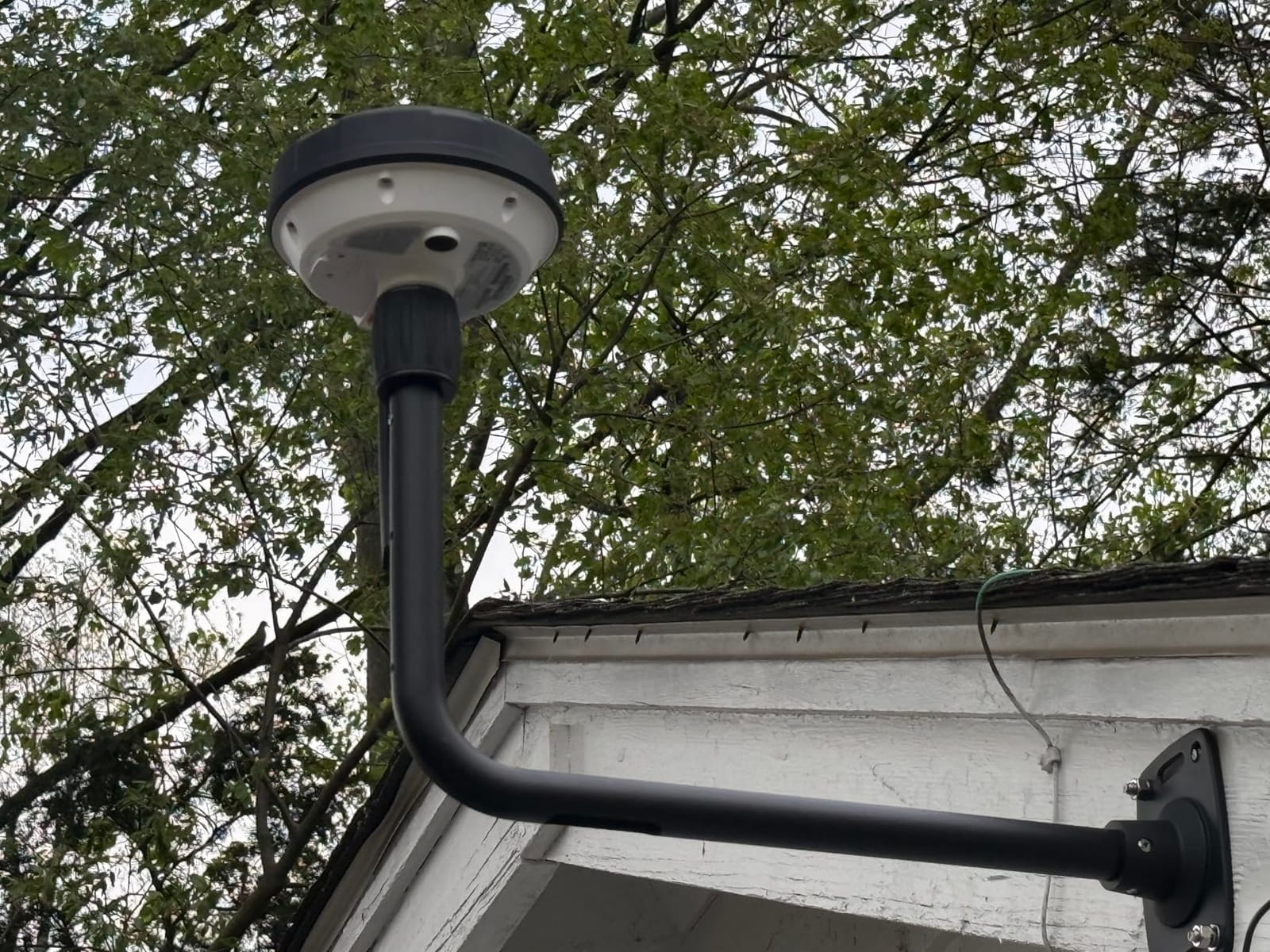
What stands out technically is the combination of a 165 W all-wheel-drive motor with UltraSense AI Vision layered on top of RTK positioning. That pairing is the whole story on a tree-covered lot, because the camera system can keep the machine oriented when the satellite signal cannot. The dual-blade disc runs up to 15.8 inches wide, and a single charge covers up to 13000 sq ft.
The app handles up to 50 mowing areas with no-go zones, and obstacle avoidance recognises more than 200 object types. Connectivity covers 4G, Bluetooth and WiFi, with GPS tracking and a lost mode for theft protection. Cutting height adjusts across 18 positions from 2.2 to 4.0 inches.
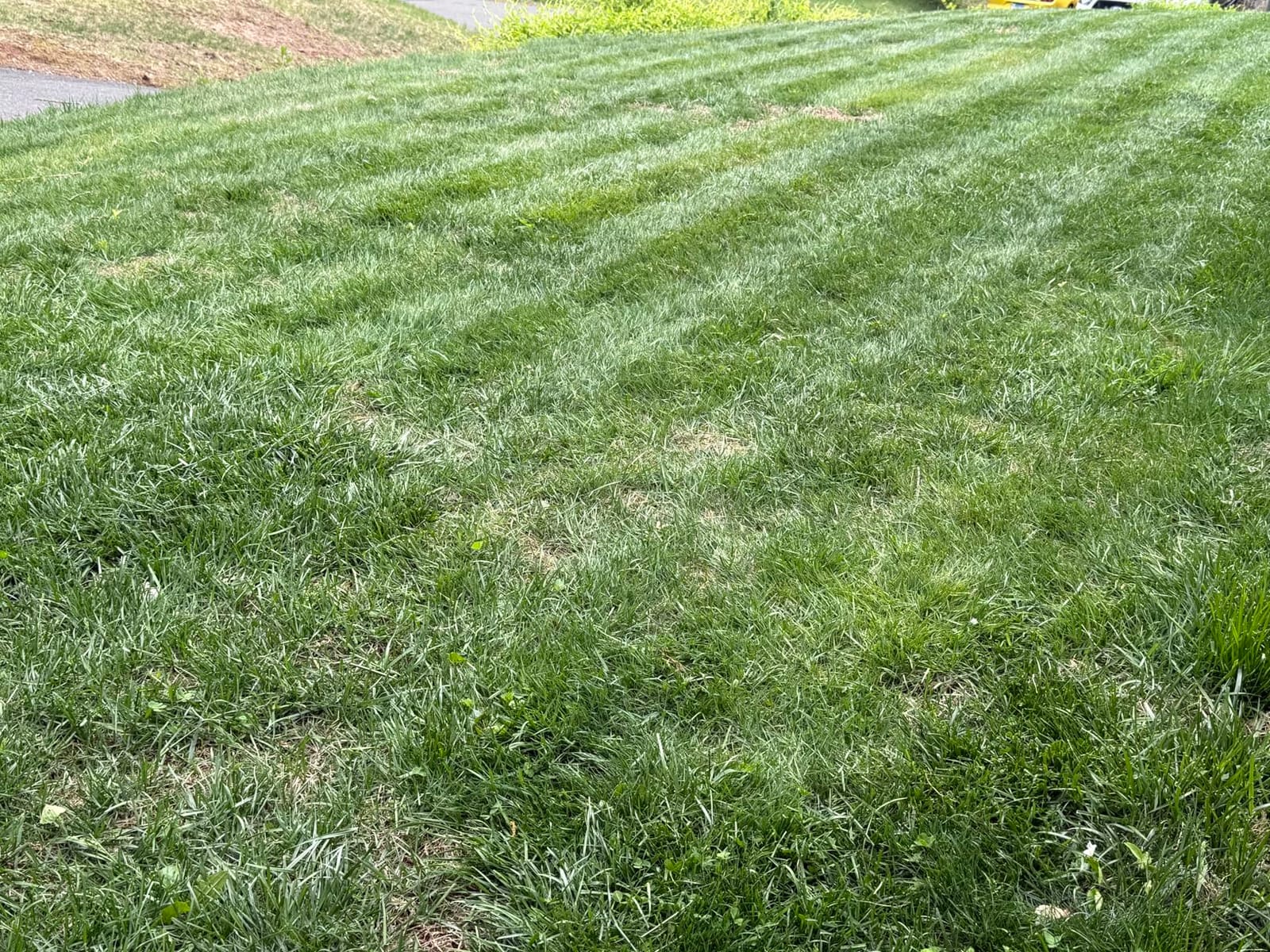
How it handles a one-acre yard with real hills
Here is the honest version of the throughput maths. At 13000 sq ft per charge, a 43560 sq ft acre needs more than three full charge cycles to cover once. In practice that means the mower runs for most of a day, and a busy weekend gets dedicated to it.
Several owners on r/mammotion ask specifically for real-world feedback on large, tree-heavy, uneven properties, and the pattern in those threads is that the machine copes with the terrain but takes its time on the volume. If your lawn is genuinely over an acre, plan on the mower working most days rather than twice a week.
Who should skip the narrow deck
Skip this one if edge-to-edge finish matters more than hours saved. The 15.7 inch deck means visible overlap work along paths and beds, and the razor-style blades need replacing more often than the ones in a conventional deck.
Owners also report that it does not mulch or process fallen leaves well, so leaf season still needs a manual pass. Support response times get called out as slow and script-driven when several issues are open at once, which matters if you are not near a dealer.
2. MOVA LiDAX Ultra 3000 AWD – Best Wire-Free Setup With No Antenna
MOVA LiDAX Ultra 3000 AWD Robot Lawn Mower Wire Free RTK Free for up to 0.75 Acre*Dual Maps, 360° 3D LiDAR & AI Dual Vision Mapping, Robotic Mower with 4G, for 80% Slopes, Cutting Height 1.2”–3.9“
0.75 acre
80% slope
52 lbs
15.8 inch cut
1.2-3.9 inch height
Pros
- No RTK base station or boundary wire
- Handles complex zoned lots with pets and toys
- Crisp even stripes
- Three years of included 4G connectivity
- Wide deck covers substantial ground per charge
Cons
- No gate automation for a fenced-off front lawn
- Front wheels slide downhill on slanted passes
- Needs frequent cleaning and hubcaps fall off
- Leaves uncut strips at the lawn edge
The MOVA LiDAX Ultra 3000 AWD is the pick for anyone who wants a robot mower with nothing to install. No base station, no antenna, no boundary wire. It mapped and mowed on the first run for several owners, which is a genuinely different experience from the RTK crowd.
Navigation is 360-degree 3D LiDAR combined with AI dual vision, giving centimetre-accurate 3D maps without touching a satellite. Four 116 W hub motors with anti-tip suspension and floating cutting discs handle 80% slopes and 2.4 inch obstacles. At 52 pounds it is one of the heavier machines here, so plan how you will move it.
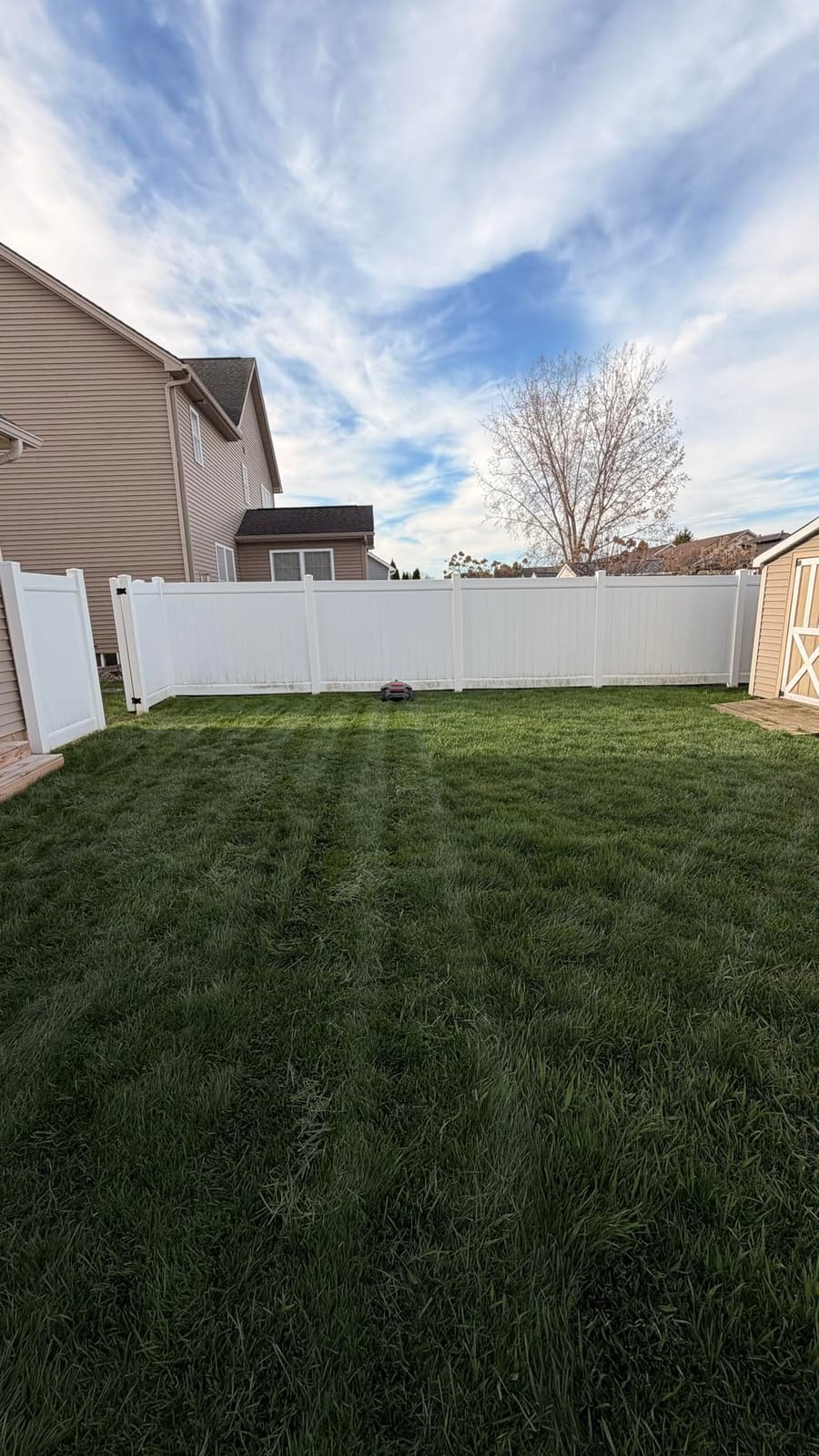
Reviewers consistently praise the cut quality. Several owners compare the stripes to a golf course, and the dual-disc system with 12 blades across a 15.8 inch width is the reason. The battery is 36V 243Wh giving roughly 165 minutes of runtime, and UltraTrim 2.0 edge riding leaves about 1.2 inches of uncut edge, the tightest figure in this group.
Three years of 4G connectivity come included, alongside PIN lock and TrueGuard anti-theft monitoring, and the warranty runs three years. Avoidance covers more than 300 object types, and the app handles dual maps with multi-zone schedules and cutting heights from 1.2 to 3.9 inches.
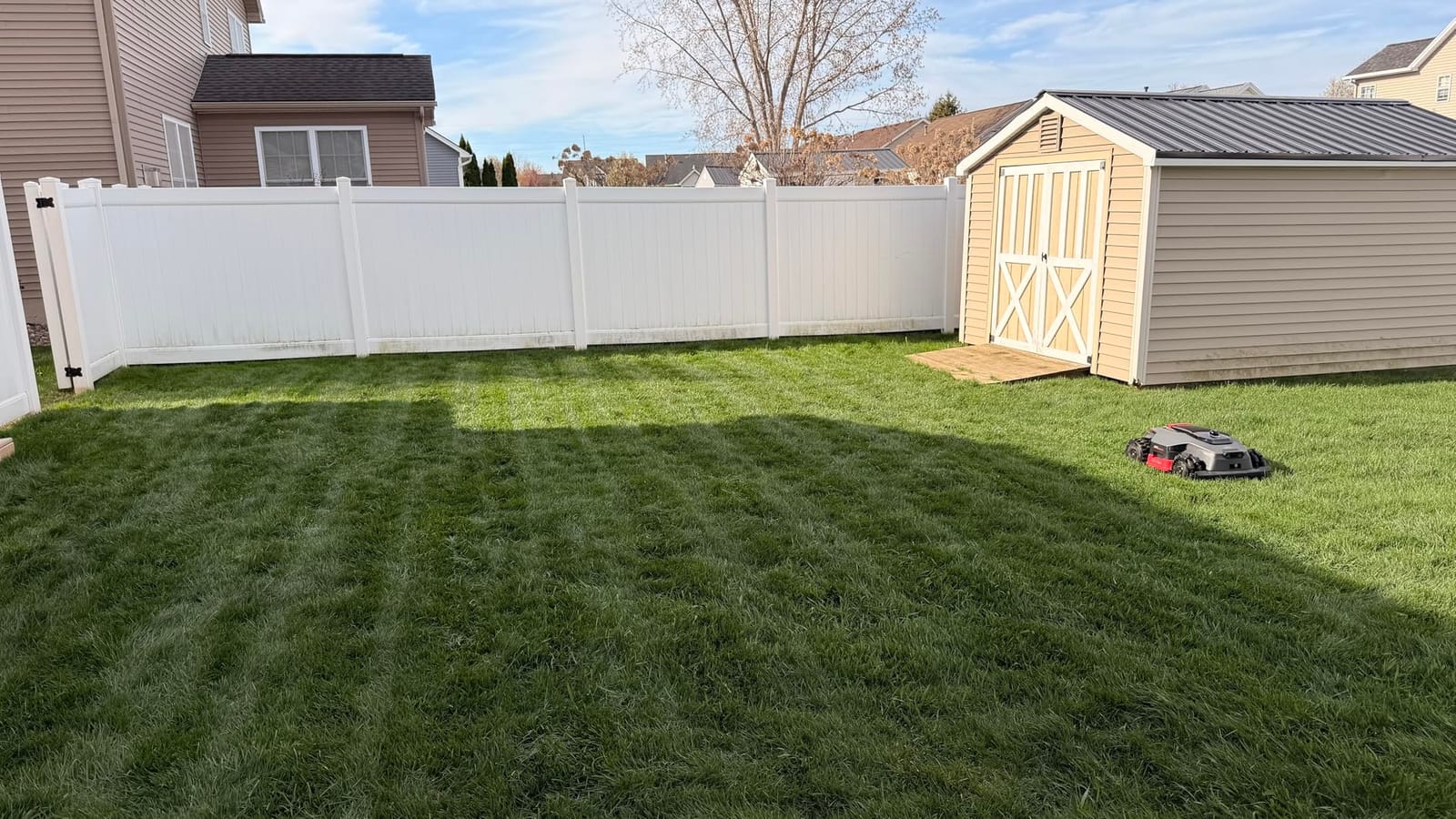
Why the no-antenna design changes setup day
With RTK mowers, setup means finding sky view for a base station or a data centre unit and running the machine along boundaries. Experienced owners on r/roboticLawnmowers consistently prefer spinning-dome LiDAR because it just works, and this machine is squarely in that camp.
On a lawn broken up by buildings, walls and mature trees, having no external reference point to lose is the advantage. The trade-off is that LiDAR mapping is generally the more expensive technology to fit, so the price gap versus entry RTK models is narrower than the spec sheets suggest.
When the front wheels give up on a bank
The recurring complaint is wheel behaviour. On slanted mowing passes the front wheels slide downhill and can tear turf lines, which is exactly the situation a large lawn with hills creates more often than a small one does.
There is no gate automation here, so a front lawn behind a closed gate means carrying the machine or installing a second base. With 25 reviews the listing is young, and the evidence base is thinner than the top pick’s. Edge strips that need follow-up trimming and reports of a machine failing shortly after purchase both appear in the critical reviews.
3. Mammotion LUBA 3 AWD 3000 – Best for Tree-Covered Lawns
Mammotion LUBA 3 AWD 3000 Robot Lawn Mower, Perimeter Wire Free for 0.75 Acre, 360° LiDAR+NetRTK+AI Vision, All-Wheel-Drive for 80% Slopes, 30 Multi-Zone Management, Cutting Height 1.0″-2.7″
0.75 acre
80% slope (38.6 degrees)
500 sqm per hour
6-blade discs
1.0-2.7 inch height
Pros
- LiDAR
- NetRTK and AI vision keep working in shade
- Four independent motors with adaptive suspension
- Multiple mowing patterns for even coverage
- Up to 30 zones with no-go areas
Cons
- Cut-height ceiling of 2.7 inches is low
- Setup and boundary mapping need careful work
Tree cover is the single most repeated complaint across robot mower forums, and the LUBA 3 AWD 3000 is built specifically around that problem. Tri-Fusion navigation layers 360-degree LiDAR, NetRTK and dual-camera AI vision, and the machine switches between them rather than depending on any one signal.
The LiDAR sweeps 360 degrees horizontally and 59 degrees vertically out to 230 feet, building a dense point cloud in real time. Four independently driven motors climb 80% slopes, and adaptive suspension steps over curbs, roots and thresholds up to 50 mm. It ranks first in Robotic Lawn Mowers on Amazon with 62% five-star ratings and 6% one-star across 173 reviews.
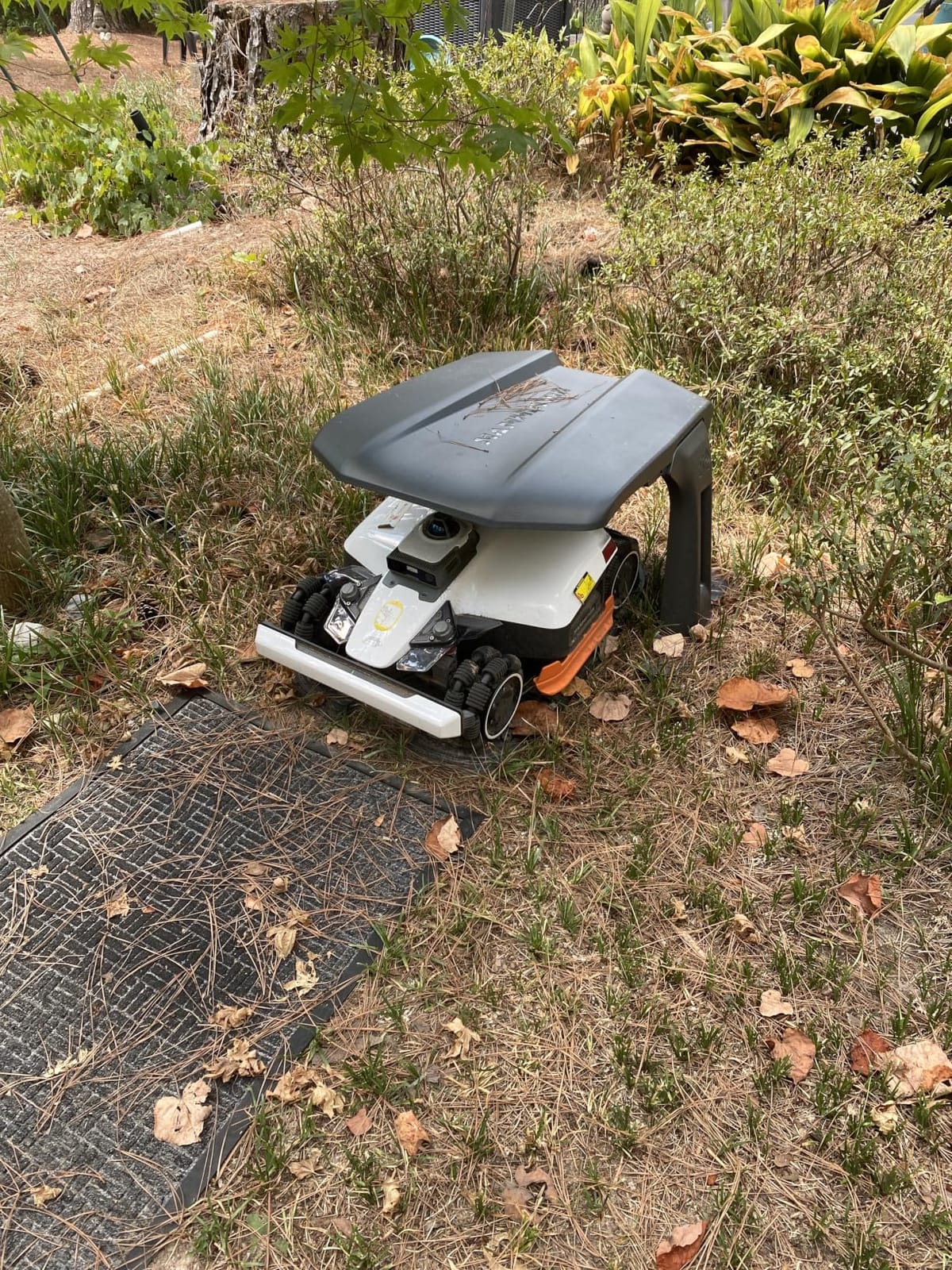
Throughput is the useful number here, and it is one of the few in this group the manufacturer states directly. Two 165 W motors with 6-blade discs and a battery up to 12Ah give 175 minutes per charge and coverage of 500 sqm per hour. That is a real figure rather than an acreage promise, and it is the metric to compare against anything else you are considering.
Path planning is thorough. Perimeter-only, zigzag, checkerboard and adaptive zigzag patterns are all available, across up to 30 mowing zones plus no-go areas. Owners running complex properties call the zone flexibility the standout of this generation. The box includes an extra blade set, charging station, accessories and a guide.
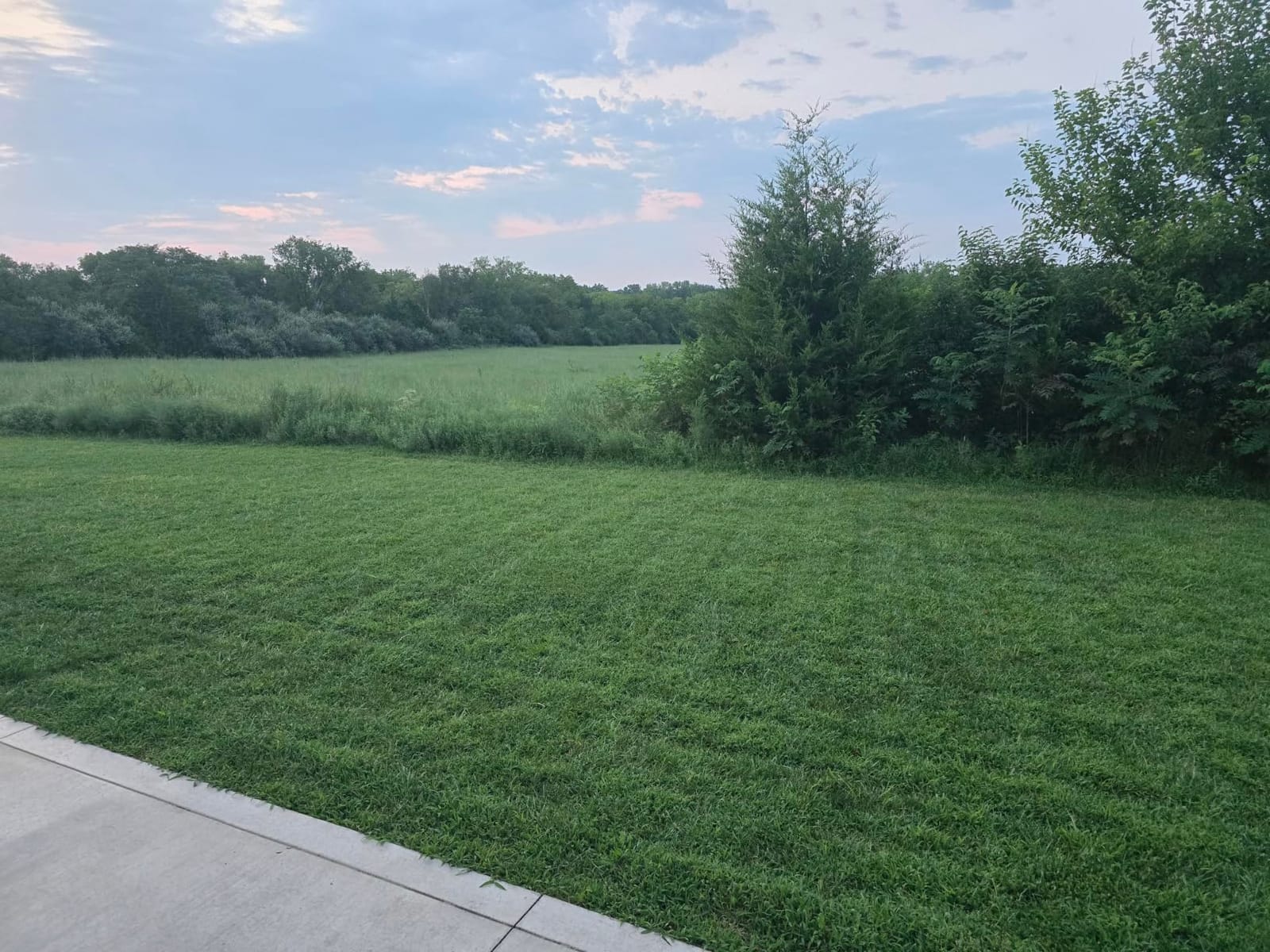
Why Tri-Fusion matters more than any single sensor
RTK mowers suffer badly under foliage because satellite signals scatter. One owner summarised it as not good for small yards with canopy or other things that block satellite connection, and that problem grows rather than shrinks as you add trees to a property.
A LiDAR dome keeps working regardless of what is overhead, so having both means the machine always has one reference it can trust. The dual cameras add object recognition, with the upgraded AI processor identifying more than 300 obstacle types and calculating a safe path in real time.
The cut-height ceiling problem
Here is the catch. The maximum cutting height is 2.7 inches, lower than most rivals in this group, so if you mow tall warm-season grass through summer this is the wrong machine. Cool-season lawns at 2.5 to 3 inches are its natural range.
Setup is the other friction point. Boundary mapping requires careful work before reliable mowing begins, and the feedback loop is consistent across both Mammotion machines here. Budget a full weekend for mapping and fine-tuning, not an hour.
4. ECOVACS GOAT A3000 LiDAR PRO – Best for Edge Cut on Three-Quarter Acre
ECOVACS Goat A3000 LiDAR PRO Robotic Lawn Mower, Dual LiDAR Navigation
0.75 acre
64.5 lbs
2 cm Dual-LiDAR accuracy
1.2-3.6 inch height
70 minute recharge
Pros
- Dual LiDAR holds accuracy under trees and fences
- No boundary wire or RTK antenna
- Built-in TruEdge trimmer reduces string trimming
- 32V platform cuts dense Bermuda and Zoysia
- About 70 minute full recharge
Cons
- 3.6 average rating signals uneven reliability
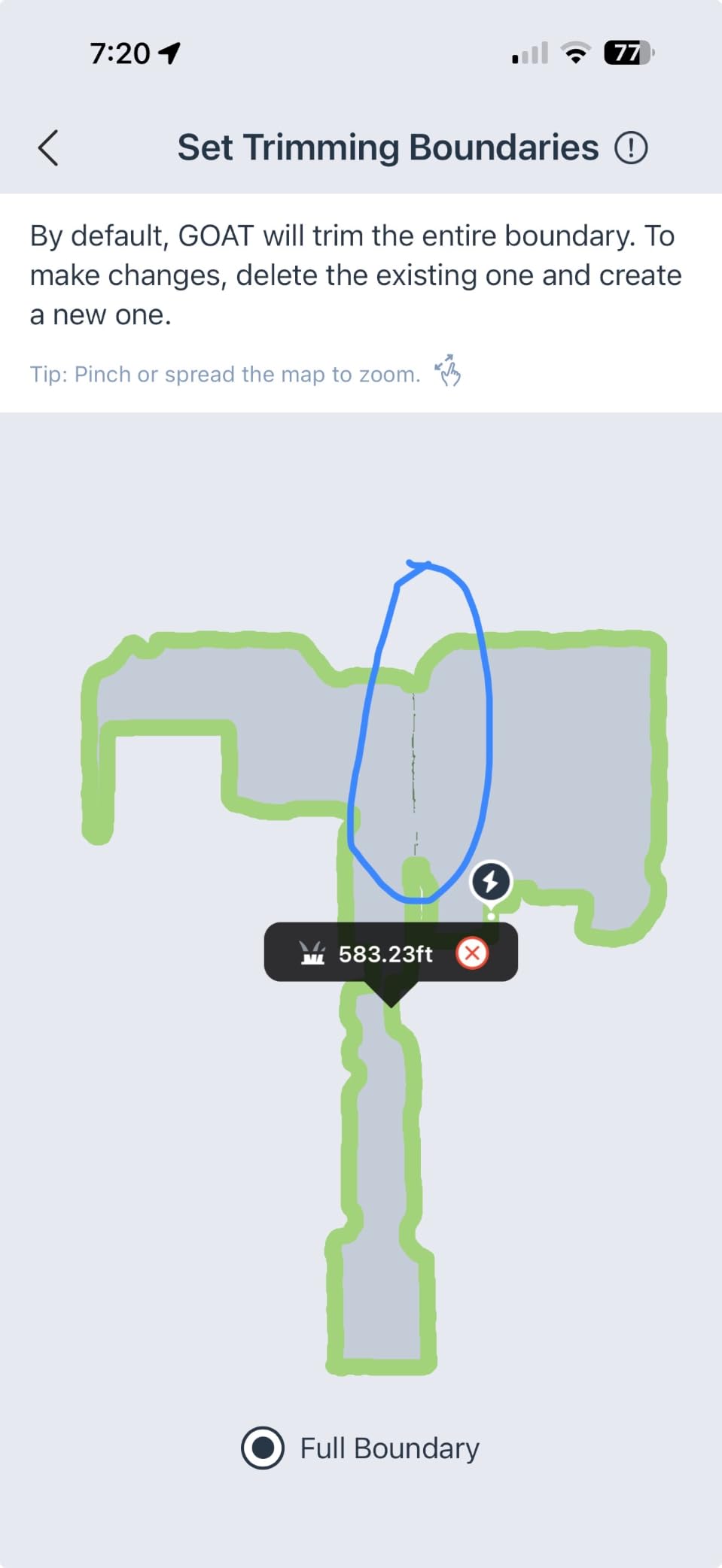
- App mapping and boundary setup are less intuitive
- Reports of drifting outside mapped zones
- Heaviest machine here at 64.5 pounds
The GOAT A3000 LiDAR PRO is the pick if string trimming after every mow is the thing you most want to stop doing. The built-in TruEdge integrated trimmer is a real mechanical solution rather than a software promise, and it handles sidewalks, driveways, fences and flower beds.
Navigation is the HoloScope 360-degree Dual-LiDAR system with 2 cm positioning accuracy, and it needs no perimeter wire and no RTK antenna. At 3.6 stars across 111 reviews it is not the highest-rated machine here, but the cut hardware is the most complete.
The 32V platform with a dual-blade disc handles thick turf that stalls weaker decks, and reviewers name Bermuda, Zoysia, Fescue and St. Augustine as grasses it cuts through. The 7500 mAh battery with 189W fast charging recharges fully in about 70 minutes, and coverage reaches 400 sqm per hour.
App control covers map editing, mowing zones, no-go areas, cutting height across five positions from 1.2 to 3.6 inches, speed and travel paths. The split opinion is stark: 52% of buyers give five stars for wire-free accuracy and edge work, while 19% describe zone drift, missed patches and app friction.
What TruEdge actually saves you
Be realistic about it. A robot grass cutter rarely eliminates trimming everywhere, and a few of these machines leave an inch or two of edge. The ECOVACS is the one here where that gap is handled by hardware, so hard edges along paving get genuinely tight.
On irregular property lines with beds and trees, the practical saving is fewer passes with a string trimmer rather than zero passes. Owners who bought it for the edge feature report it delivers, and the dual-LiDAR keeps it accurate right up against fences and in shade.
Zone drift is the real risk here
The weakness is consistency, not capability. Some machines drift outside mapped zones or need frequent restarts, and app mapping is less intuitive than competing brands. On a large lawn that tolerance matters more than on a small one.
At 64.5 pounds this is also the heaviest machine in the roundup, so if you expect to move it by hand for repairs or seasonal storage, check that you can. Recharging is quick, but the 70 minute figure assumes the dock has a solid power supply.
5. ECOVACS GOAT A2500 RTK – Best for Raw Mowing Throughput
ECOVACS Goat A2500 RTK Robot Lawn Mower, Lidar-Enhanced RTK+Vision Navigation, Auto-Mapping, Dual Blades, Edge Precision Mowing, Perimeter Wire-Free, Suitable for 5/8 Acres Lawn, 50% Slope Capability
0.625 acre
50% slope
57.9 lbs
4305 sq ft per hour
1.2-3.6 inch height
Pros
- RTK holds lock on lots with heavy tree cover
- Covers a little over half an acre per charge
- Returns to base and resumes on its own
- App shows location and battery level
- Support shipped a fast warranty replacement
Cons
- Lowest average rating in this group at 3.2
- Phone app makes boundary setup awkward
- Reports of drifting into neighbouring lawns
- RTK base power supply is inadequate
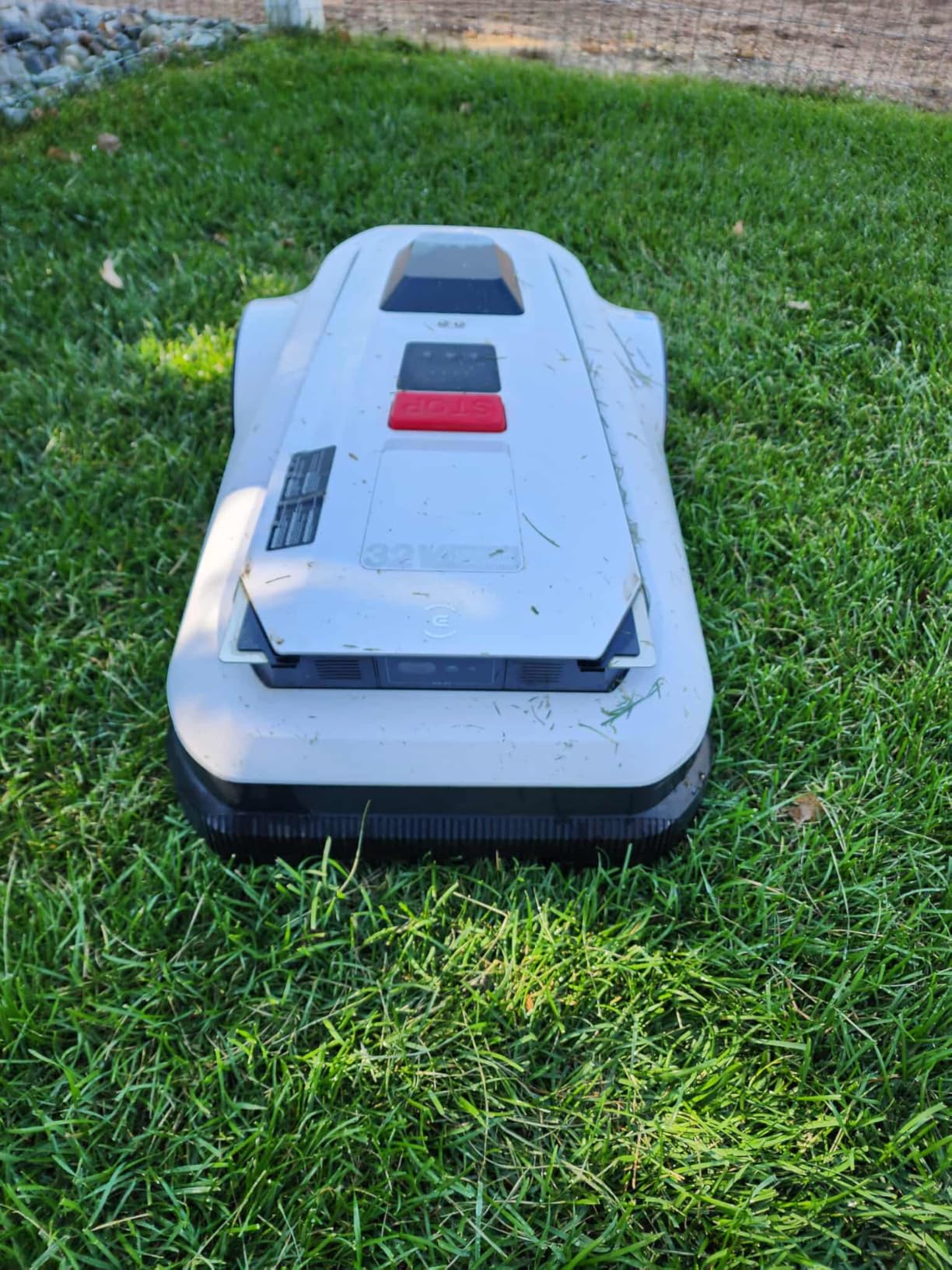
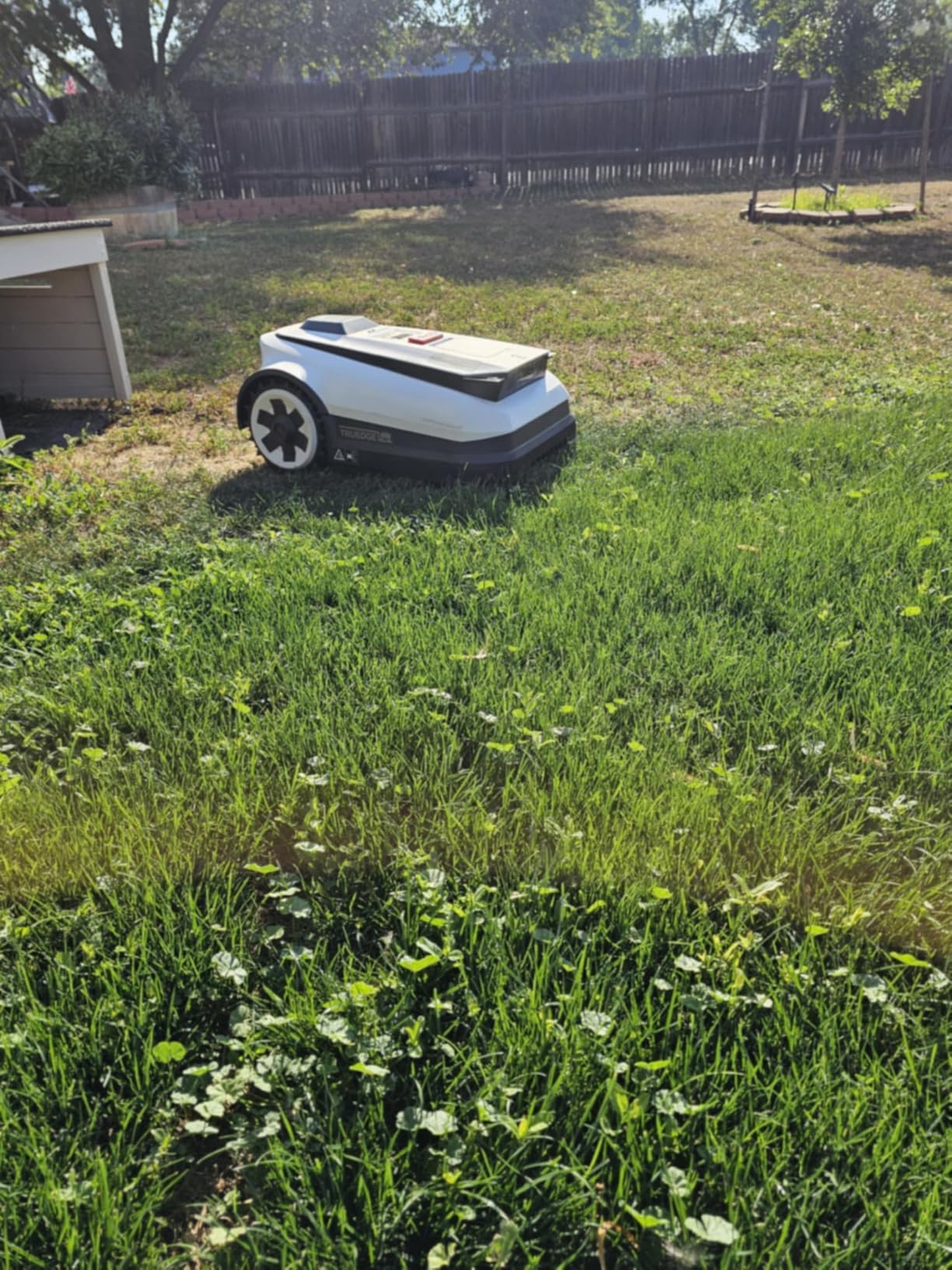
If you are chasing square feet per hour, the GOAT A2500 RTK posts the highest throughput figure in this group. The 32V Energetic Platform with a dual blade-disc covers up to 4305 sq ft per hour at 2.3 ft/s, and the 5Ah battery recharges in 45 minutes while mowing up to 5382 sq ft per charge.
Navigation is LELS RTK plus 3D-ToF LiDAR with 2 cm positioning accuracy and more than 40 satellite connections, backed by an AIVI 3D AI camera. TruEdge gets the blade-to-edge distance down to about 5 cm, and the mower handles 50% slopes without a boundary wire.
The reason this is not higher is the rating. At 3.2 across 103 reviews it is the weakest-rated machine here, with 30% of buyers giving one star. That is too large a block to design around, and the complaints behind it are consistent rather than isolated.
Positive themes are genuine: RTK holding lock on lots with heavy tree cover, clean even cuts on a little over half an acre per charge, and full auto-recharge and resume. One owner reports ECOVACS support shipping a fast warranty replacement after a first unit failed, which is worth something.
Why the throughput number is real but misleading
4305 sq ft per hour is a peak figure measured on open, level, short grass. Real large-lawn conditions are the opposite: slopes slow it down, narrow passages force perimeter work, and charging cycles interrupt the pattern. Expect the effective rate to be well below the headline.
The 5Ah battery is also small by the standards of this group, so a half-acre lawn takes multiple charge cycles and the 45 minute recharge becomes part of your daily schedule. If your lawn is three-quarters of an acre or more, the size ceiling is the deciding factor.
Boundary drift needs a watchful eye
The one-star reviews describe the mower drifting into neighbouring lawns, map boundaries shifting after reboots, and no-go zones being entered while transiting between mowing areas. Phone-app boundary setup also makes it hard to guide the machine in a straight line, which leaves uncut strips.
Two practical notes. The included RTK base power supply is inadequate, so owners treat the bonus adapter as effectively required. And the unit runs on a 110V US power supply only, which is a real problem outside North America.
6. YARBO Robot Lawn Mower Pro – Best for Multi-Acre Estates
YARBO Y40 Core Robot Lawn Mower Pro, Wire-Free, 6-Acres, Four-Season Care
Up to 6 acres
70% slope (35 degrees)
215 lbs
20 inch cut
0.8-4.0 inch height
Pros
- Only unit rated for true large properties
- Cut quality comparable to a riding mower
- Modular platform accepts a snow blower and cart
- Deep control over maps and mowing patterns
- All-steel chassis built for heavy use
Cons
- Setup takes hours to days on tree-covered property
- GPS dropouts stop it mid-lawn
- Map drift needs reconfiguration
- Non-LiFePO4 battery is shorter-lived
The YARBO Pro is in a different class from everything else here. It is rated for lawns up to 6 acres, carries a 20 inch cutting width, and weighs 215 pounds on an all-steel chassis. If you are past three acres, the rest of this list is undersized for you.
Owners on multi-acre sites report cut quality comparable to a zero-turn riding mower with clean adjustable stripes. The modular platform supports straight blades as well as razor blades, plus a snow blower and cart attachment, which turns it into a four-season machine rather than a summer purchase.
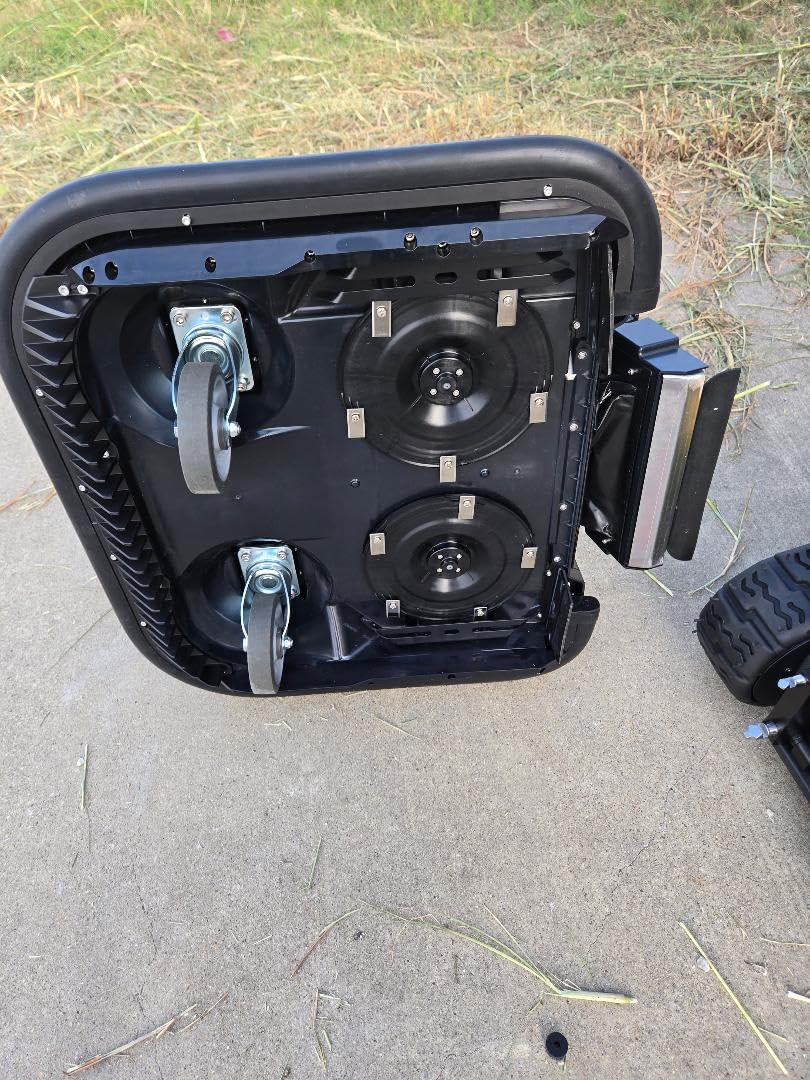
Navigation is triple-fusion: RTK-GPS, binocular vision and a multi-sensor PPVS array, with ultrasonic detection for suspended obstacles. Patented multi-terrain tracks with all-steel skid shoes manage a 70% climbing gradient, and IPX6 rating covers the weather exposure that comes with mowing at dawn.
Control is deep. Owners cite detailed mapping, mowing areas, pathways, cut patterns and boundary settings, and the in-app camera feed lets you watch the machine or drive it manually from off the property. Cutting height runs from 0.8 to 4.0 inches, and the 300W dual-motor disc ejects grass efficiently to reduce clogging. With 86 reviews at 4.3 and 71% five-star, the enthusiasm is real.
Setup time and sky view requirements
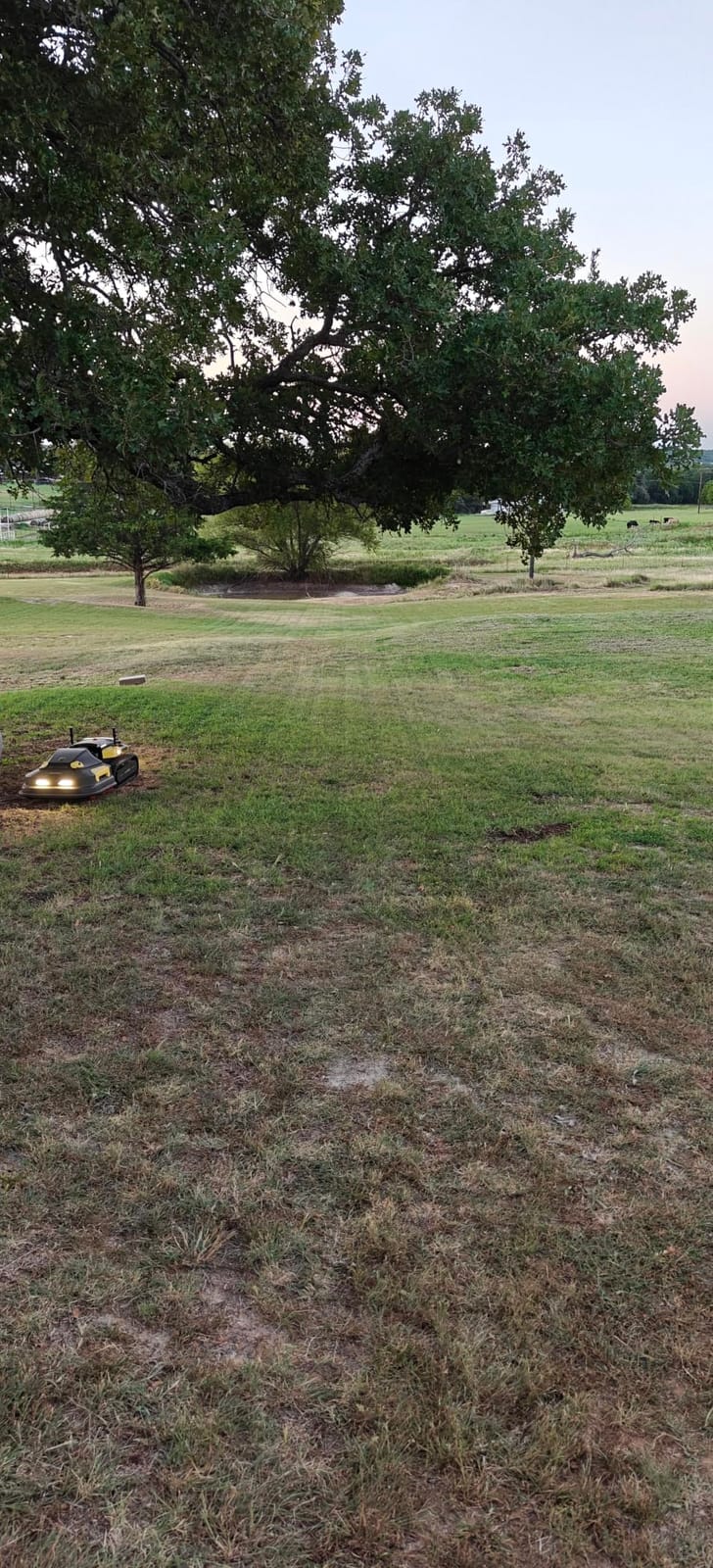
Plan properly here. Mapping is a multi-hour to multi-day project, more so on tree-covered properties, and the Data Center Set needs a 120-degree unobstructed sky view. If your property has heavy canopy, find that view before you order, not after.
The machine arrives in four boxes at about 210 pounds and two adults are recommended for assembly. Once configured, owners running 3 to 6 acres report long-term uptime, and Yarbo support has replaced two modules outright for one owner.
Drifting maps and the recovery routine
The consistent criticism is navigation reliability. GPS dropouts stop the unit mid-lawn and need manual recovery, and map drift recurs and needs reconfiguration during mowing. On a large property, walking out to a mower across three acres is a real cost in time.
Two more cautions. The battery is a cobalt pack rather than LiFePO4, which means higher replacement cost and a shorter service life, and support tickets have been reported sitting for days behind a backlog. Ground clearance is low and the data centre mount is unstable in wind, so site selection matters.
7. Husqvarna 410iQ – Best for Dealer Support and a Long Warranty
Husqvarna 410iQ ½ Acre Wire-Free, 45% Slope, app Based, Robot Lawn Mower
0.5 acre
45% slope
59 lbs
9.4 inch cut
1-4 inch height
Pros
- EPOS gives centimetre-accurate location data
- Wire-free app mapping avoids trenching
- Widest cut height range here at 1 to 4 inches
- Larger wheels handle paths and driveways
- 4-year warranty with GPS theft tracking
Cons
- 9.4 inch cutting width means long mow cycles
- 24% one-star reviews on reliability and support
- Rated for only up to half an acre
- App boundary mapping needed before it runs
The 410iQ is the pick when support access matters as much as features. Husqvarna runs a dealer network, and this machine carries a 4-year warranty, which is the longest in this group. For a buyer with no local expertise and a large property, that is a meaningful difference.
EPOS positioning delivers centimetre-accurate location data with onboard radar obstacle detection, and installation is wire-free through the app with a virtual map, mowing areas and stay-out zones. No boundary wire to trench, and no antenna to site for clear sky view.
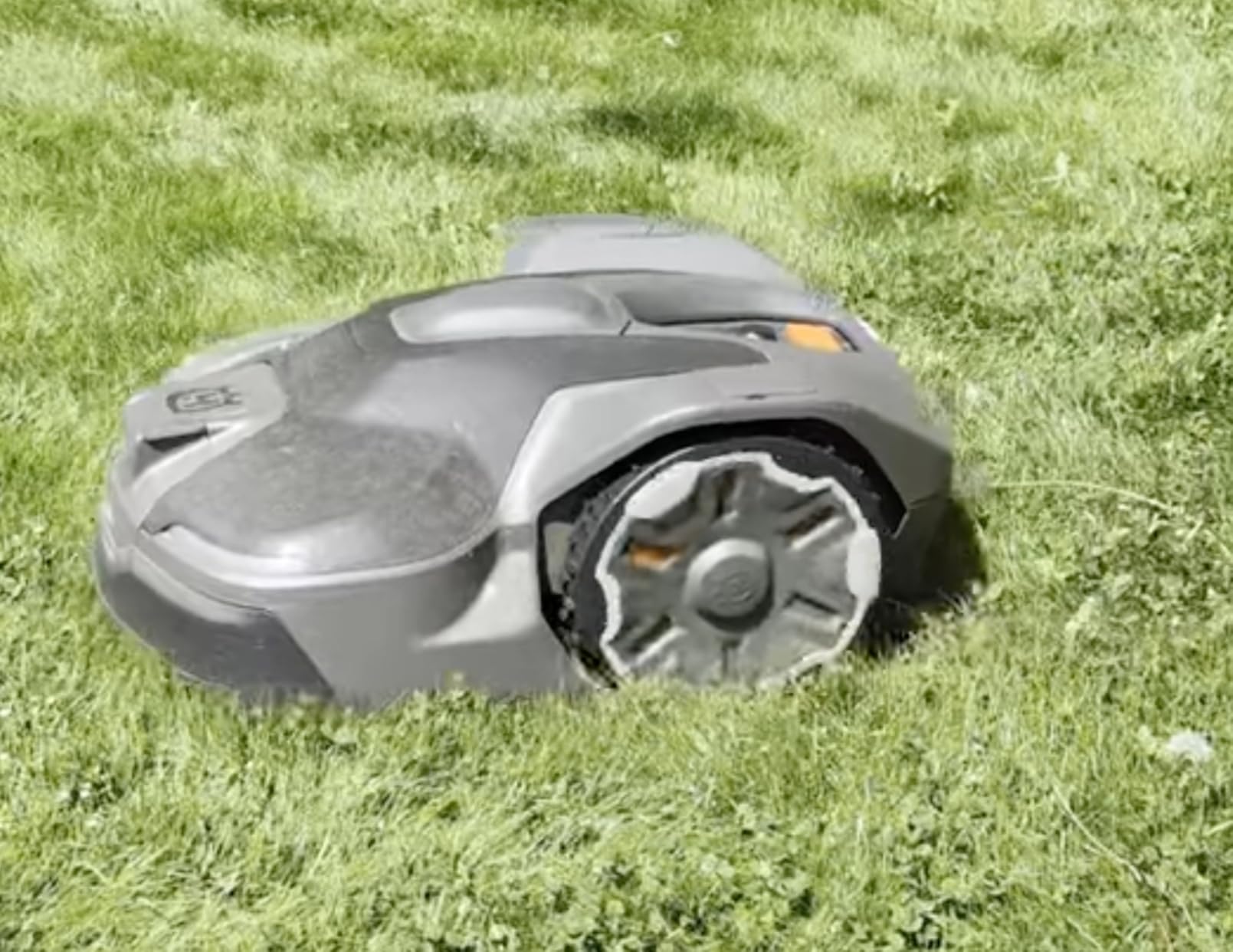
Cutting height runs from 1 to 4 inches, the widest adjustable range in this group, which matters if you alternate between cool-season and warm-season settings across the year. Larger wheels and a durable bumper carry it over paths and driveways, and the whole machine is hose-washable.
Anti-theft is handled with an alarm plus GPS tracking through the Husqvarna Connect app. The kit includes one year of free replacement cutting blades, and 55% of the 76 buyers give five stars for EPOS accuracy and slope handling. A 24% one-star block is the reason it sits here rather than higher.
What a dealer network actually buys you
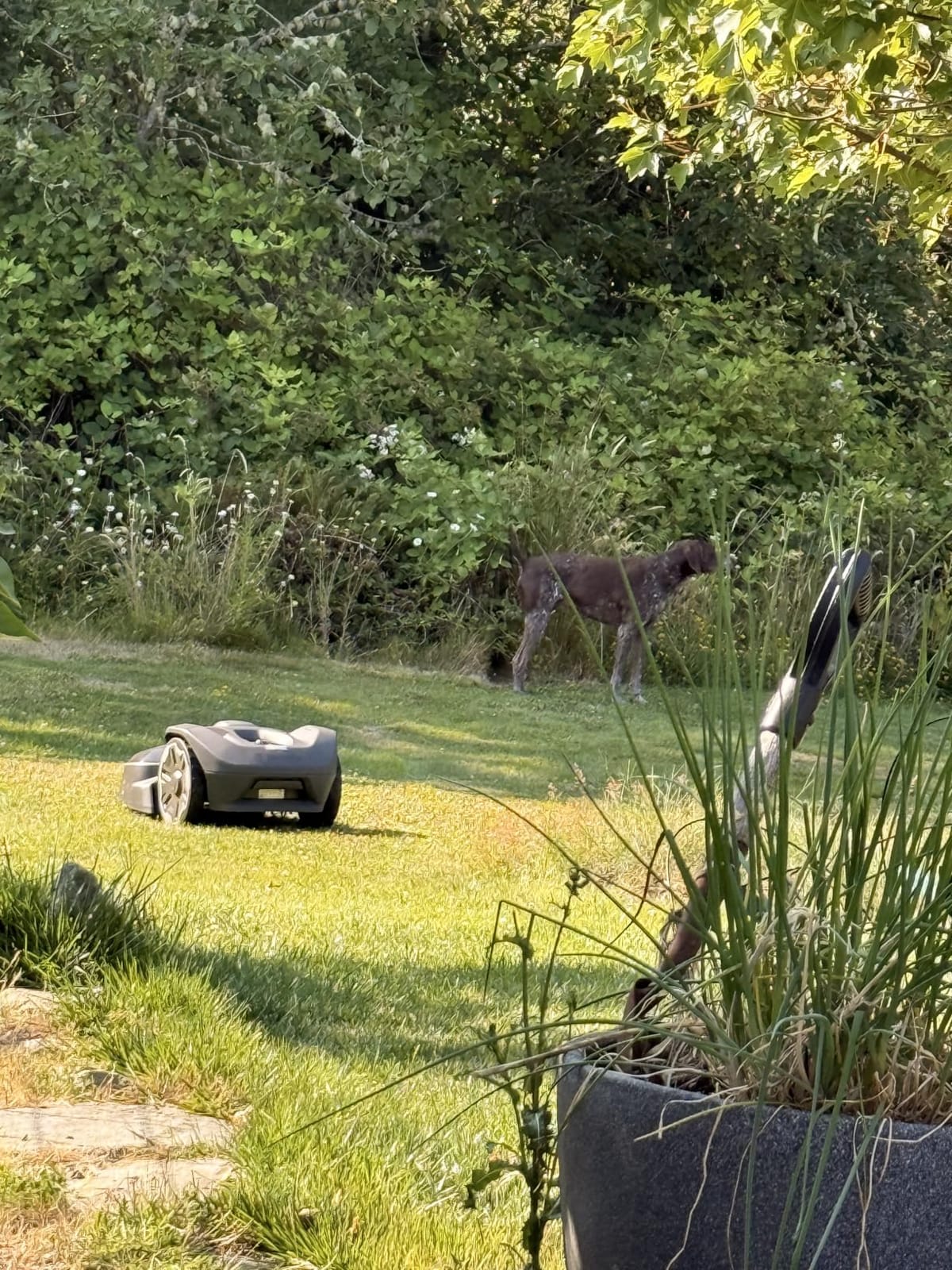
For direct-to-consumer brands, support means a ticket queue. For Husqvarna, it means a person who can diagnose a machine in your region. On mower reviews with hundreds of reviews, that difference shows up repeatedly in the complaints about slow or scripted responses.
The dealer advantage is strongest if you are not confident setting up zones and virtual boundaries yourself, and weakest if you are. A 4-year warranty also means you are less likely to be arguing about a battery replacement in year five.
A 9.4 inch deck on a half acre
Here is the honest limit. This is the smallest capacity in the roundup at half an acre, and a 9.4 inch cutting width means multiple charge cycles even to finish that. Husqvarna rates it for up to half an acre, so treat that as a ceiling, not a target.
Require app boundary mapping before it will run unattended, which is a real time investment. If your mowable grass is over half an acre, or you have 30 degree banks, step up to one of the larger machines instead of stretching this one past its rating.
8. Sunseeker X5 AWD – Best for Half-Acre Yards With Hills
Sunseeker X5 AWD Robot Lawn Mower, RTK, Vision AI, 0.5 Acre, Wire-Free
0.5 acre (21780 sq ft)
30 degree / 60% slope
26 lbs
8.7 inch floating deck
60 dB
Pros
- RTK plus vision holds course under trees and shade
- All-wheel drive far less likely to stall
- Very quiet at 60 dB
- Produces straight stripes and can mow patterns
- Lightest at 26 pounds and easy to move
Cons
- 8.7 inch deck means frequent charge sends
- Obstacle avoidance treats tall grass as an obstacle
- Can get stuck on small humps at lawn edges
- May need WiFi extenders on larger properties
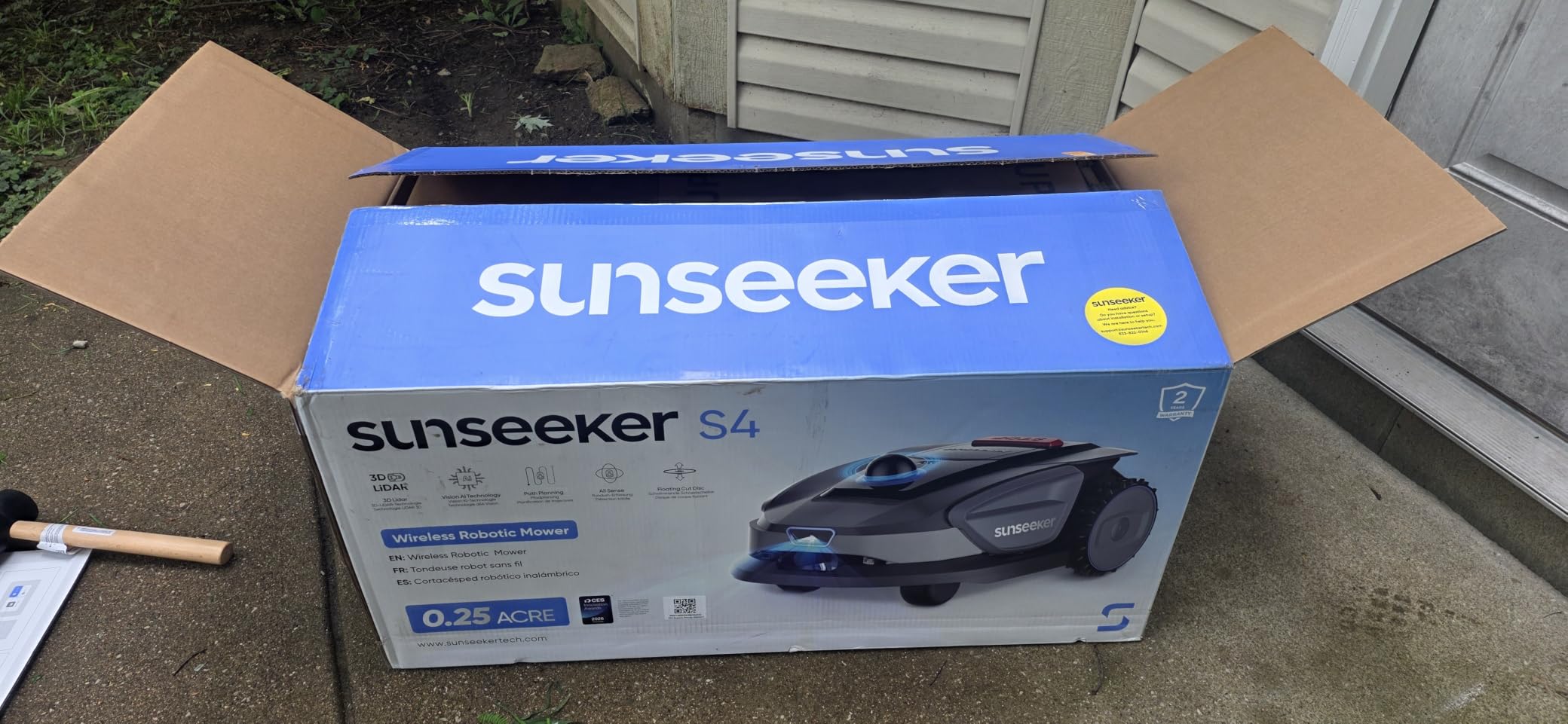
The Sunseeker X5 AWD covers yards up to 21780 sq ft, which is the lower end of what this guide treats as a large lawn. It earns a place because of what it does with that ground rather than how much ground it covers.
RTK, VSLAM and Vision AI navigation keep it working under trees, in shade and in weak RTK areas, day or night. All-terrain all-wheel drive with rugged tyres and independent front suspension handles slopes up to 30 degrees, and at 26 pounds it is the easiest machine here to reposition by hand.
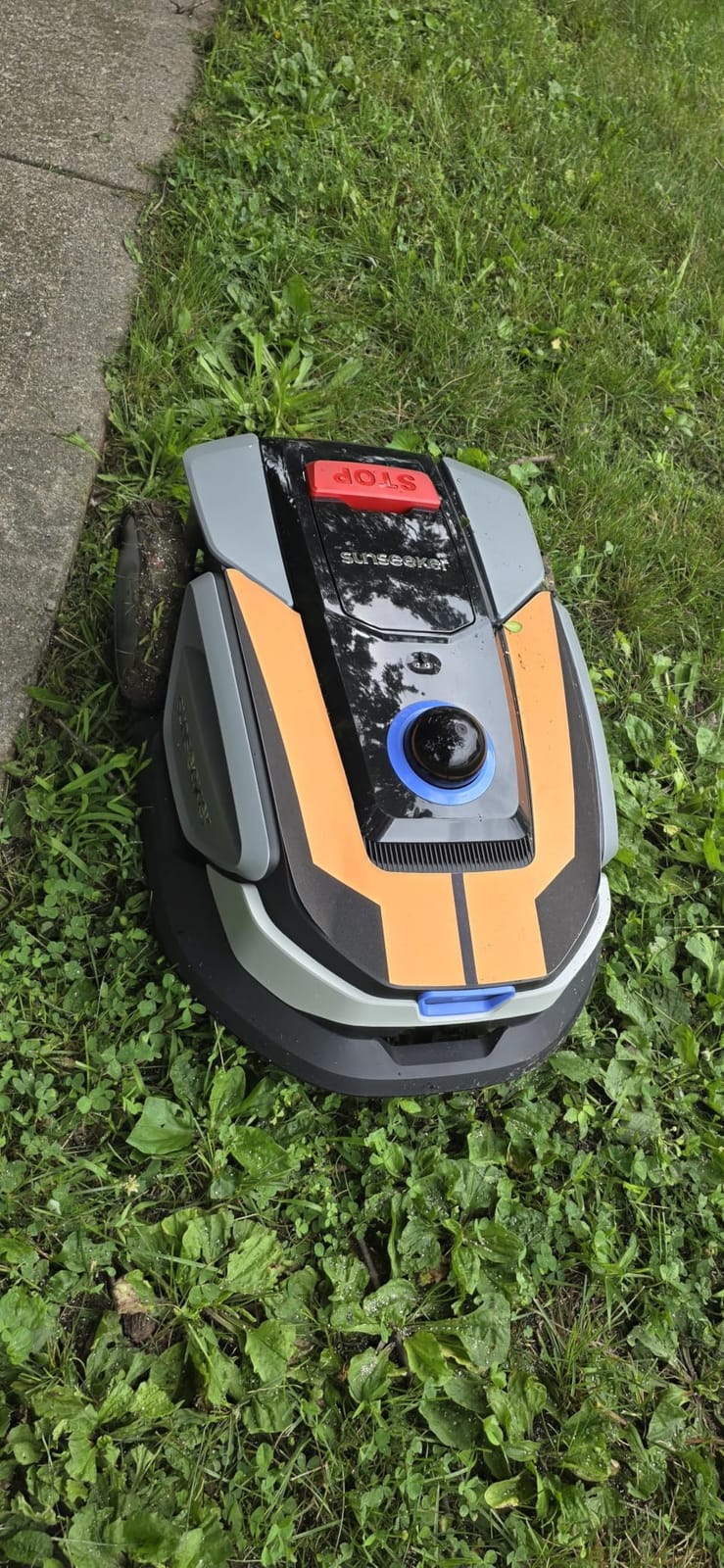
The finish quality is the standout. Owners report perfectly straight stripes and the ability to mow preloaded patterns such as numbers and symbols, which is a small thing that tells you a lot about path planning consistency. Operation is quiet at 60 dB, with plastic body creak the loudest sound reported.
It manages passages as narrow as 31.5 inches, and the 8.7 inch floating deck adjusts from 1.6 to 3.2 inches. Up to 5 maps, smart zones and no-go areas work without trenching. A 2-year warranty with US-based support backs it, and 67% of 29 reviews are five-star with only 3% one-star.
Why 26 pounds changes how you own a mower
Machines in this guide weigh from 26 pounds at the light end to 64.5 pounds for the heaviest wheeled unit, and the YARBO is 215. Owners repeatedly complain that large mowers are too heavy to reposition manually, whether for a blockage, a repair or storage in a shed.
At 26 pounds the X5 moves like a carry-on suitcase. That matters more than it sounds for a mower that lives outside, because every rescue trip is a trip you will take dozens of times a season.
Pre-cut the grass first
The one behaviour to plan around is obstacle detection treating tall grass as an obstacle. Owners recommend cutting the lawn before handing it over, which is a bit strange for a machine meant to do the mowing, but it prevents constant avoidance behaviour in long grass.
Boundaries also need setting well back from lawn edges, which leaves extra weed trimming, and larger properties may need WiFi extenders to reach the corners. If either of those compromises is going to bother you, choose a different machine.
9. Lymow One Plus – Best for Steep Hills and Wet Ground
Lymow One Plus Robot Lawn Mower, Wire-Free RTK+Vision Navigation, 1.73 Acres Daily Coverage, 100% Slope (45°) Climbing, 1.2″-4″ Cut Height, AWD All-Terrain Automatic Robotic Mower, App Control
1.73 acres daily
45 degree / 100% slope
16 inch cut
15000mAh LiFePO4
1.2-4 inch height
Pros
- Track drive handles 45 degree slopes and marshy ground
- Real steel blades cut like a zero-turn
- 15000mAh LiFePO4 rated 2000+ cycles
- 1.73 acres of daily coverage
- Self-lifting deck keeps clippings on the lawn
Cons
- RTK communication reported spotty in some locations
- Not a set-and-forget machine
- Heat-related failures reported
- Map editing in the app is unintuitive
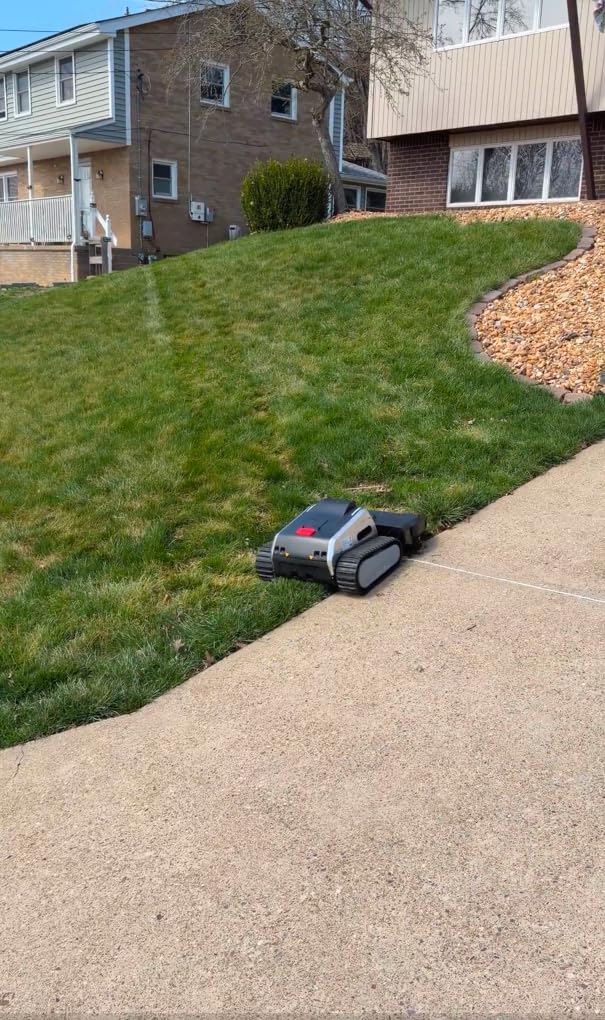
No other machine in this group handles ground like the Lymow One Plus. The Terrain Master track drive manages 45 degree slopes, which is 100 percent, plus 2.8 inch obstacle crossing, and owners on one to three-acre properties describe it as among the most capable mowers available.
Tracked drive also means it works in marshy ground without leaving the ruts a heavy riding mower would. On a property with soft spring soil, wet low spots or steep banks, that is the single most valuable trait on this list.
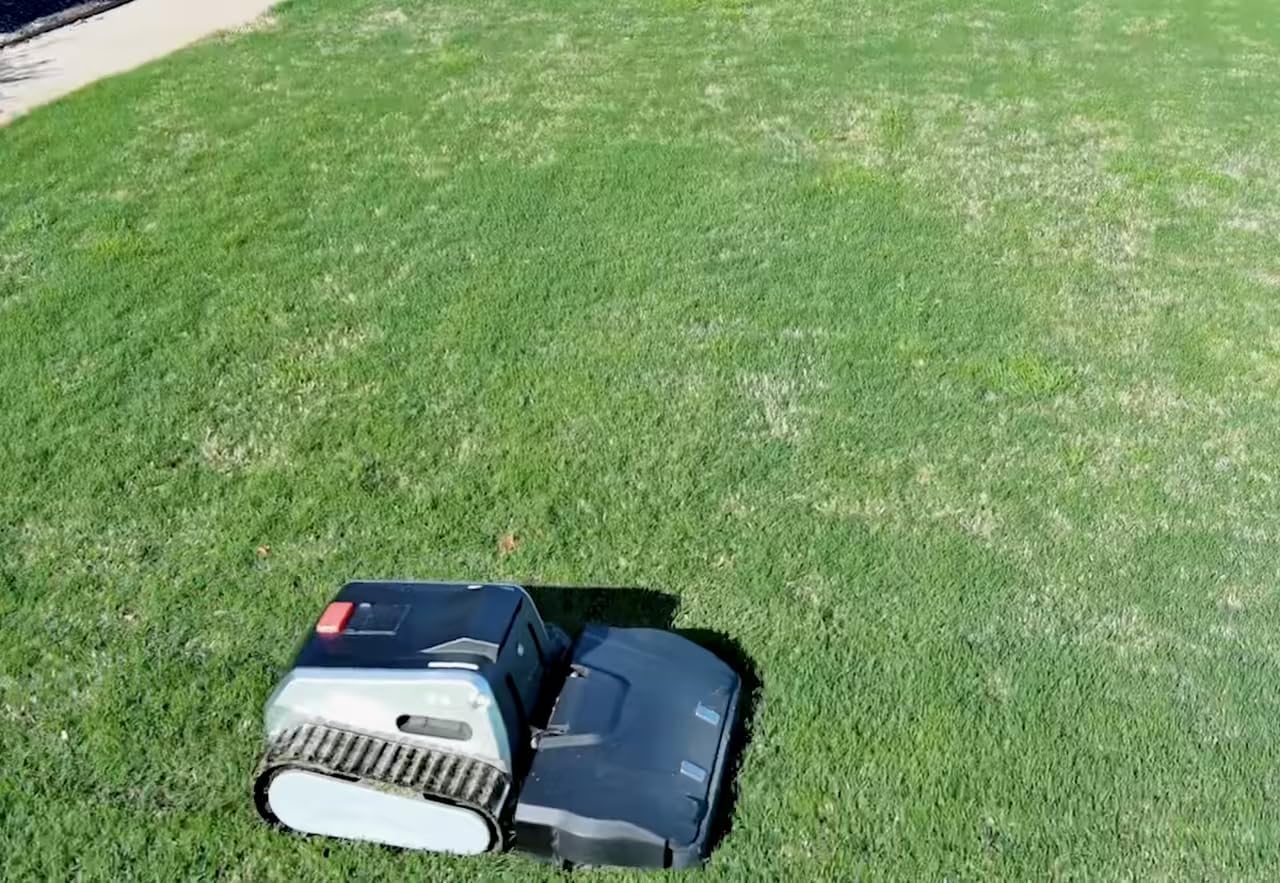
The cutting hardware is genuinely different. The Lycut System 2.0 uses dual SK5 tool steel blades at 50 HRC driven by a 1785W peak motor to 6000 RPM across a 16 inch dual rotary deck, and cyclone airflow lifts flattened grass and mulches leaves into fine particles. Several owners compare the result favourably to a zero-turn.
Coverage is the strongest claim here in practical terms: 15000mAh LiFePO4 battery rated for 2000+ cycles, a 3-hour charge mowing 0.57 acres, and up to 3 cycles a day for 1.73 acres of daily coverage. RTK combines with VSLAM visual mapping, and AI vision plus ultrasonic detection covers pets, toys and decorations.
Track drive on 45 degree ground
Normalise the slope numbers before comparing. Manufacturers quote percentages and degrees inconsistently, and 45 degrees is roughly 100 percent. This machine quotes both, which is why it sits alone at the top of the slope figures in this roundup.
On a large lawn with one steep bank rather than a uniformly steep site, tracks give you the ability to mow that bank at all. Two-wheel-drive machines and wheeled AWD machines alike tend to stall in a rut and stop there, and a stranded mower three acres from your house is a bad weekend.
Battery chemistry and heat behaviour
The LiFePO4 pack is the best-specified battery in the group at 15000mAh and 2000+ cycles, which matters for anyone storing the mower seasonally. Critics on the other hand report heat-related failures, with blades stopping mid-run and batteries refusing to charge when hot.
It is also not a set-and-forget machine. Zones, channels and blade settings need real tuning, RTK communication is reported spotty in some locations with limited manufacturer support, and the app reports a zone complete while leaving uncut patches at higher blade speeds. The chassis is A380 automotive-grade aluminium with IPX6 waterproofing, and there are up to 80 zones with no-go areas.
10. Husqvarna Automower 430X – Best With a Physical Boundary Wire
Husqvarna Automower 430X Robotic Lawn Mower with GPS Assisted Navigation, Automatic Lawn Mower with Self Installation and Ultra-Quiet Smart Mowing Tech for Medium to Large Yards (0.8 Acre), 967852845
0.8 acre
45 degree slope
29 lbs
9.45 inch cut
0.8-2.4 inch height
Pros
- Boundary wire stays reliable under heavy tree cover
- Very quiet for early morning mowing
- Handles narrow passages between beds and paths
- Established brand with US support
- Smart home integration with Alexa and Home
Cons
- Requires installing a boundary wire by trenching or laying cable
- 9.45 inch cut width means long mow times
- Rated for up to 0.8 acre only
- 15% one-star reviews on install and reliability
The Automower 430X is the one to consider if you want to rule out GPS problems entirely. A physical boundary wire and guide wire give a signal that does not care how many trees are overhead, which is the failure mode that frustrates RTK owners most.
Owners with heavily shaded, tree-covered yards report the wired signal simply works where GPS mowers stall. It handles narrow passages, weather and 45 degree slopes, and outputs 1430 sq ft per hour across a 9.45 inch cutting width for lawns up to 0.8 acre.
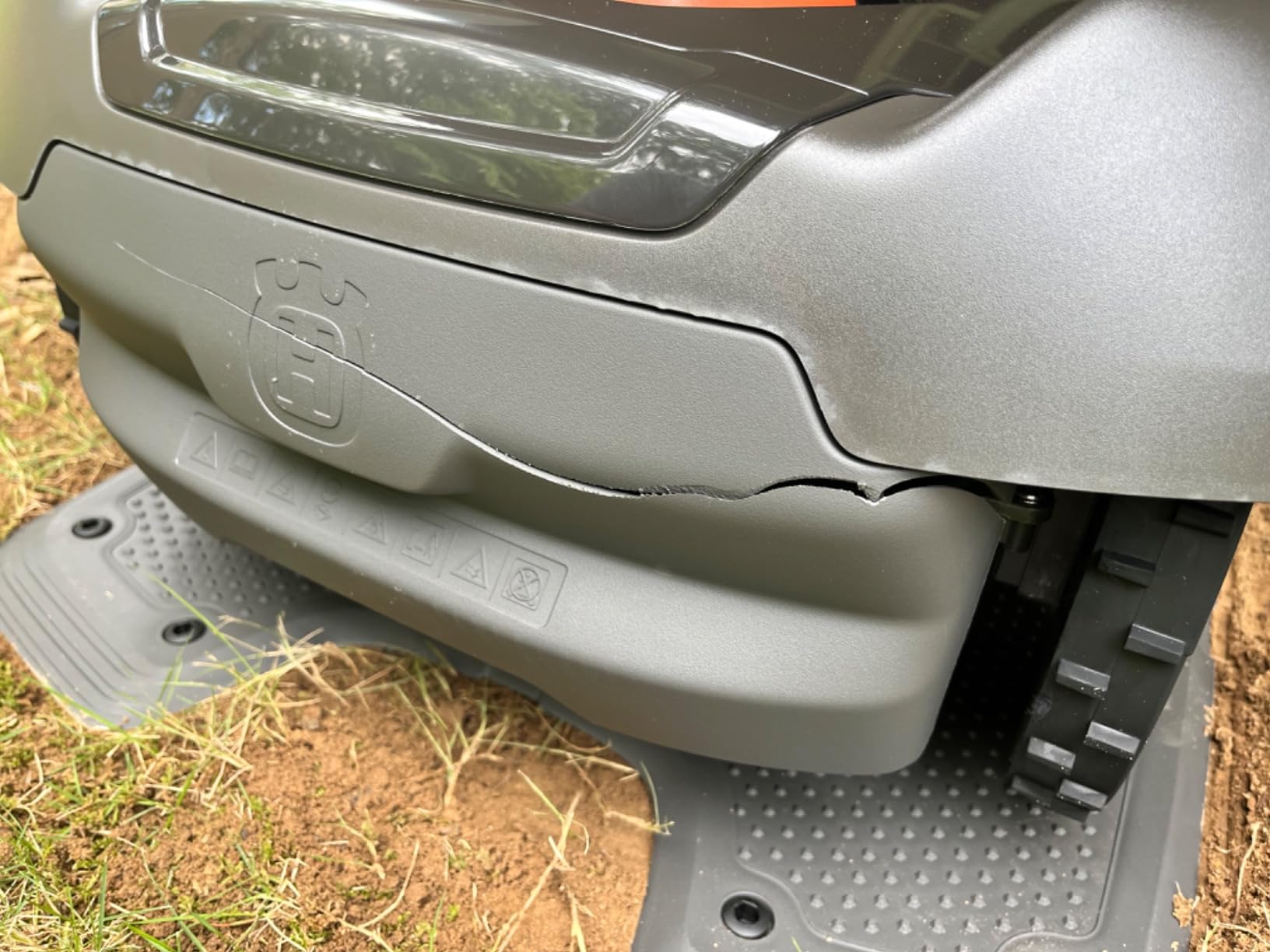
At 29 pounds it is light, and it is quiet enough to run early in the morning without upsetting a household. Theft protection is thorough: GPS tracking, a built-in alarm and a PIN code lock, all through the Automower Connect app, which also handles scheduling, settings and mowing status.
Smart home integration with Amazon Alexa and Google Home is a genuine convenience, and a self-installation kit is included with a 2-year warranty. Across 29 reviews, 58% are five-star and the complaints cluster around one thing rather than the machine itself.
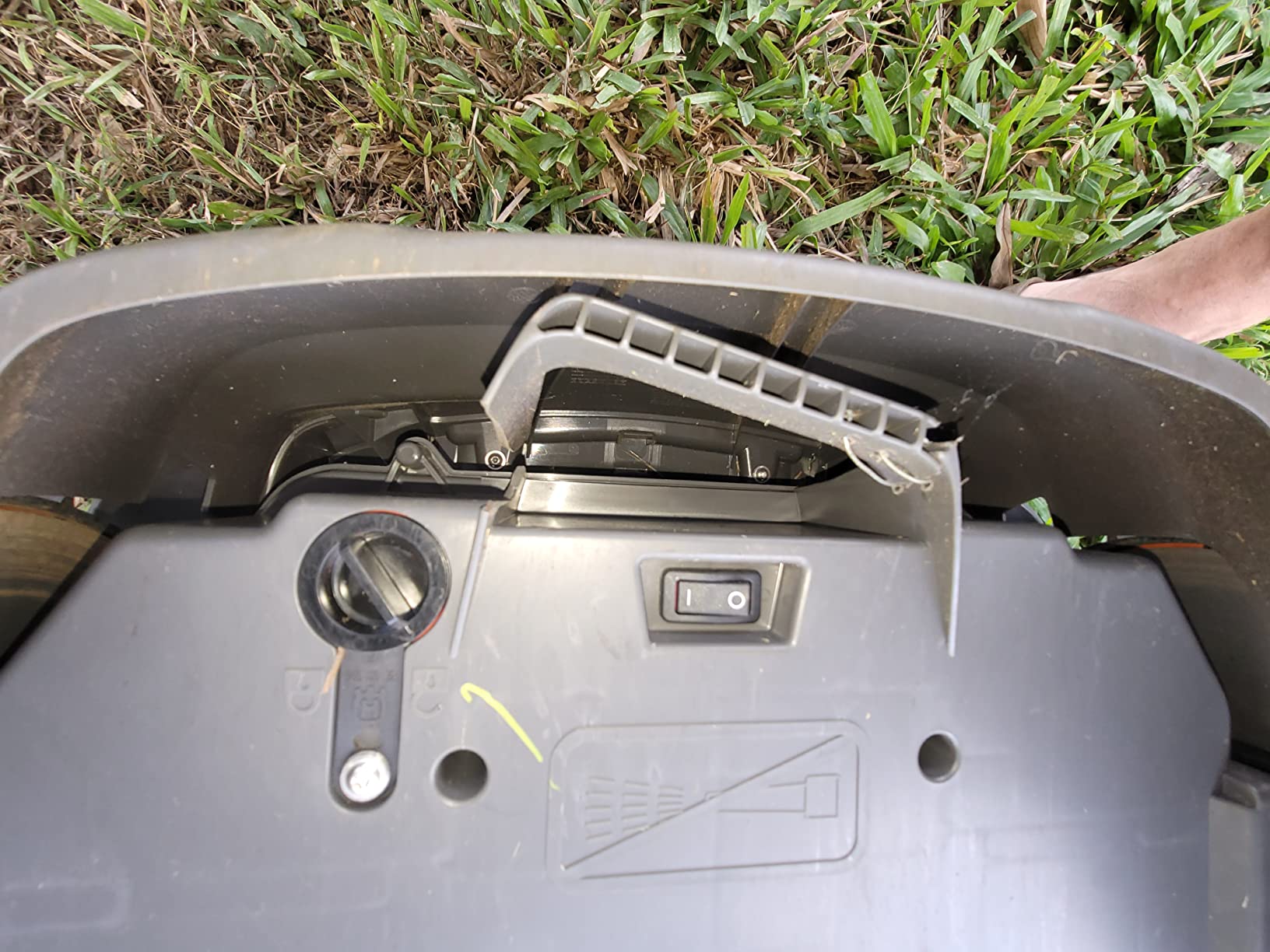
The boundary wire question
Owners note a hard limit of roughly 30 to 35 meters from the wire, which constrains layout on large irregular properties. For an open half acre with a simple shape, that is not a problem. For a property with several disconnected lawn areas, it becomes one.
The installation is the real trade-off. Laying or trenching cable around a large property is a multi-day, error-prone job, and getting the guide wire right matters. If you are starting from scratch, that is a weekend of work the wire-free machines do not ask of you.
Quiet nights and narrow passages
Where the wired approach wins beyond reliability is the working week. Mowers with a 9.45 inch deck take longer, and a longer run is more likely to overlap with early morning hours when noise becomes a neighbour issue.
It also navigates narrow passages between beds and paths, which helps on a property where the grass is not one clean rectangle. If your lawn is under an acre and heavily wooded, this remains the most predictable machine here, and users of the 430X report two years of reliable use.
How to Size Your Lawn Before You Buy
Measure the grass, not the lot. Walk the property and mark out what a mower can actually enter: not the house footprint, not the driveway, not the bed you never mow. The number that matters is the lawn area in square feet, and one acre is 43560 sq ft.
Count the mowable square footage for each separate area, then add them. A front lawn of 6000 sq ft and a back lawn of 12000 sq ft is 18000 sq ft total, not two separate purchases, unless the areas are genuinely disconnected with no path between them.
Then measure the steepest slope. Manufacturers quote slope inconsistently, with some using percentages and some degrees, and 45 degrees is roughly 100 percent. If your worst bank is over 50 percent, a wheeled machine will struggle there even if the average lawn is flat.
Finally, note your narrowest passage. Bodies here are 16 to 30 inches wide, so a mower needs more clearance than the body width alone, and 31.5 inches is about the realistic minimum for a comfortable daily route. Path widths, not lawn area, decide whether two zones work.
RTK vs LiDAR vs Vision: What Happens Under Heavy Tree Cover
RTK is centimetre-level satellite positioning that needs a clear view of the sky, either from a base station or NetRTK corrections delivered over cellular. It is precise and cheap to run, and it is the technology most likely to fail exactly where large lawns tend to be complicated.
LiDAR is laser-based 360-degree mapping that works with no satellite signal and no antenna at all. Experienced owners on r/roboticLawnmowers consistently prefer the spinning dome because it just works, and RTK often does not when foliage is overhead. That is a real counterweight to the marketing emphasis on RTK accuracy.
Vision and VSLAM use cameras to build and hold a map. They are inexpensive and effective in daylight with good texture, and they are the sensible pairing for a lawn without a base station or a big upfront sensor.
Hybrid is the answer most large-lawn buyers end up with. The LUBA 3 combines 360-degree LiDAR, NetRTK and dual-camera vision and switches between them, and the Sunseeker X5 runs RTK, VSLAM and Vision AI together. When one signal degrades, another carries the map.
That is why the tree-covered pick in this roundup is a hybrid rather than a pure RTK machine. A physical boundary wire is the old solution to the same problem and still works, at the cost of a weekend of installation.
Slope, Terrain, and the Numbers Manufacturers Mix Up
Slope ratings assume a specific test condition: a smooth, short, dry incline with no load and no turning. Real banks have tussocks, buried roots, irrigation heads and soft shoulders, and a machine that clears 80 percent on paper can still bog down on a rutted 40 percent slope after rain.
Drive system is the second variable. Tracked machines such as the Lymow One Plus and the YARBO spread weight and keep contact on soft ground. All-wheel drive with independent suspension, as on the LUBA 3 and the Sunseeker X5, is the next best thing and far less likely to stall on a small hump.
Two-wheel drive is the one to avoid on hills. The ECOVACS GOAT A3000 reports front wheels sliding downhill on slanted passes and tearing turf lines, and the Husqvarna machines here are rated to 45 percent with narrower bodies built for flatter ground.
Floatation matters as much as grip. A floating cutting deck, which pivots to follow the ground plane, is what prevents scalping high spots and missing hollows. Check for it explicitly, because not every deck in this roundup has it.
Real Mow Time and Daily Throughput on Large Lawns
Manufacturer acreage ratings are calculated under ideal conditions and are effectively a ceiling. The honest measure is mow throughput in square feet per hour, and only a few machines in this roundup publish it: the LUBA 3 at 500 sqm per hour, the ECOVACS A3000 at 400 sqm per hour, and the GOAT A2500 at up to 4305 sq ft per hour.
Run the arithmetic on that. At 500 sqm per hour, one acre of 4047 sqm is roughly eight hours of actual cutting before you account for charging, perimeter passes, obstacles, narrowed passages and the strip each machine leaves along edges. Treat that as a full day per mow, and most large lawns need either daily mowing or every other day.
Users running half an acre on a WORX Landroid report scheduling it 17 hours a day, from 7am to midnight, to keep up. That is not user error. It is what a narrow deck and a large lawn actually require, and it is why deck width matters as much as coverage rating.
The machines that cut the time down are the wide-deck ones: the YARBO at 20 inches, the Lymow One Plus at 16 inches, the Mammotion and MOVA units at roughly 15.7 and 15.8 inches, and the ECOVACS A2500 platform behind its 4305 sq ft per hour figure. The 8.7 and 9.4 inch decks here are the slowest.
Obstacle Avoidance, Pets, and the Edge-Cutting Reality
Obstacle systems have two layers. LiDAR and 3D ToF detect physical objects by shape and distance, and AI vision adds object classification, with counts ranging from 200 types on the Mammotion LUBA 2 and the ECOVACS A2500 to more than 300 on the LUBA 3, the MOVA and the YARBO.
All of that helps with toys, garden ornaments and small animals. It is not a guarantee for a dog at a dead run, and none of these machines is a substitute for keeping a pet inside during the first weeks while you learn its routes. Lift sensors and bump-stop behaviour vary, so test before you trust it.
Edge cutting is where marketing runs furthest ahead of reality. A robot grass cutter rarely eliminates trimming everywhere, and the figures in this roundup range from about 1.2 inches uncut on the MOVA UltraTrim 2.0 to roughly 5 cm blade-to-edge on the ECOVACS A2500 and a larger gap on machines with no dedicated edge hardware.
The ECOVACS GOAT A3000 is the only one here with a built-in mechanical trimmer, and that is why it earns the edge badge. If your lawn is bounded mainly by paving or flush paths, that machine will save real time. If it is bounded by fences and beds, plan on a string trimmer regardless.
Multi-Zone Lawns, Disconnected Grass, and One Mower or Two
Large properties rarely have one lawn. Zone counts in this roundup range from 5 on the Sunseeker X5, through 30 on the LUBA 3 and 50 on the LUBA 2, to 80 on the Lymow One Plus, and more zones means more realistic scheduling for a property with a front yard, a side corridor and a back garden.
Ask one question: is the coverage rating per zone or total across all zones? Owners raise this confusion repeatedly. The safer assumption is that the headline acreage is total mapped area, and that a machine near its rating will be slower per zone because of transit time.
For truly disconnected grass with no path between areas, you have three options: carry the machine, install a second base station, or run two smaller mowers. The MOVA explicitly has no gate automation, so a fenced-off front lawn there means manual relocation or a second base.
For a split property, two smaller units usually beat one large one. They work in parallel, a failure in one does not stop the other, and each stays inside a coverage rating it can actually finish. The exception is a narrow corridor: if the passage is under the width of the mower, no amount of zoning solves it.
Ownership Costs, Anti-Theft, and Winter Storage
Blades are the running cost nobody quotes. Razor blades need replacing far more often than the ones in a conventional deck, and owners of the Mammotion units call it out directly. A full year on a large lawn with a 15.8 inch disc will go through more than a small yard would.
Cellular is the other recurring line. The MOVA includes three years of 4G, the YARBO and Mammotion units use app connectivity for their features, and the GOAT A2500 runs on a 110V US power supply only, which matters if you are outside North America. Budget for a battery replacement during the life of the machine regardless of brand.
Anti-theft matters more when a machine this capable lives outside overnight. PIN lock plus GPS tracking plus a lost mode appears on the Mammotion LUBA 2, the MOVA with TrueGuard, the Husqvarna pair with alarms and GPS, and the YARBO. A mower that only sends a notification is worth less than one that refuses to start.
Winter storage is a battery question more than a mower question. The Lymow One Plus has the best-documented pack here at 15000mAh LiFePO4 rated for 2000+ cycles, and the YARBO uses a cobalt pack that is costlier and shorter-lived. Store charged, dry and off the ground, and check it monthly rather than letting it sit flat for six months.
If you are planning the rest of your grounds setup, our guides to sprinkler systems for lawns and tow-behind spreaders for large lawns cover the watering and feeding side of the same acreage.
When a Robot Mower Is Not Worth It
Tiny irregular lots with a lot of edges and very little interior are the clearest case against. If your mowable grass is under a quarter acre, a 4WD push mower will finish the job before a robot has mapped the boundary, and our reel mower picks cover that side.
Disconnected lawn zones with no path between them are the second case, unless you are willing to move the machine or install a second base. And a property with heavy tree cover plus steep banks plus mud is the hardest combination: it pushes you toward the most expensive machines with the most demanding setups.
Finally, be honest about how you will respond when it gets stuck. Owners describe building a rescue routine for family members on some models, and a machine that saves no time because it stops halfway across the lawn has cost you money and patience. If nobody in the household will go and fetch it, buy the one with the best obstacle handling and the highest rating, not the biggest acreage number.
Frequently Asked Questions
Are there robotic mowers that can mow large areas?
Yes. Wire-free robotic mowers are rated from about half an acre up to several acres. In this roundup the Sunseeker X5 AWD covers 21780 sq ft, the Mammotion LUBA 2 AWD 5000HX is rated for 1.25 acres with a 1.48 acre maximum, the Lymow One Plus claims 1.73 acres of daily coverage, and the YARBO Pro is rated for lawns up to 6 acres. Coverage ratings are ceilings measured under ideal conditions, so allow extra capacity for slopes, passages and obstacles.
Which robot lawn mower is best for large acreage?
For most large residential lawns, the Mammotion LUBA 2 AWD 5000HX is the strongest all-round choice, covering 1.25 acres with 80% slope capability and the deepest review history here. For a tree-covered property, the Mammotion LUBA 3 AWD 3000 uses LiDAR, NetRTK and AI vision together so it keeps working when the satellite signal fades. Past three acres, the YARBO Pro is the only machine here rated for genuine multi-acre ground.
What is the largest robotic lawn mower available?
Among consumer machines, the YARBO Robot Lawn Mower Pro is rated for lawns up to 6 acres. It has a 20 inch cutting width, a 300W dual-motor disc, patented multi-terrain tracks and a 70% (35 degree) climbing gradient, and the modular platform accepts straight blades, a snow blower and cart attachments. It weighs 215 pounds, needs a 120 degree clear sky view for its Data Center Set, and arrives as four heavy boxes.
What are the negatives of robotic lawn mowers?
The most common complaints are RTK signal loss under heavy tree canopy, mowers stalling or failing to finish a large property, needing manual rescue, unreliable edge cutting that still requires string trimming, complex app-based boundary setup, dependence on WiFi or cellular connectivity, and units too heavy to move by hand. Manufacturer acreage claims are also widely seen as optimistic, and no robot mower is maintenance-free since blades need seasonal replacement.
What robotic mower is suitable for a 1 acre lawn?
A machine rated for 1.25 acres or more gives you room for slower real-world conditions. The Mammotion LUBA 2 AWD 5000HX and the Lymow One Plus both fit, the latter with 1.73 acres of daily coverage and track drive for 45 degree slopes. A half-acre machine such as the Husqvarna 410iQ or the Sunseeker X5 AWD will technically cover an acre over repeated cycles, but it will spend most of its time mowing.
What is the average lifespan of a robot lawn mower?
Expect roughly five to ten years depending on battery chemistry and how it is stored. The best-documented pack in this roundup is the Lymow One Plus with a 15000mAh LiFePO4 battery rated for 2000+ cycles, while cobalt packs such as the one in the YARBO are costlier to replace and shorter-lived. Blades are the most frequent consumable, and storing the machine charged, dry and off the ground over winter extends its life.
How long does it take a robot mower to mow 1 acre?
One acre is 43560 sq ft. A machine rated at 500 sqm per hour covers roughly eight hours of actual cutting, and adding charging, perimeter passes, obstacles and passages pushes that to a full day. Narrow decks of 8.7 or 9.4 inches take much longer, which is why users on half an acre report scheduling their machines 17 hours a day to keep up.
What size mower is best for 1 acre?
For a full acre of open, gently sloping grass, a wide-deck machine in the 15.7 to 20 inch cutting width range keeps the time down. The YARBO at 20 inches, the Lymow One Plus at 16 inches and the Mammotion and MOVA units near 15.8 inches are the practical picks. If your acre includes steep banks or dense tree cover, prioritise all-wheel drive or tracks and a LiDAR-based navigation system over deck width.
Final Verdict: Match the Mower to Your Acres and Your Steepest Slope
Two numbers decide this purchase: mowable square footage and steepest slope. Get both, then read across the picks. Under three-quarters of an acre with moderate hills, the Sunseeker X5 AWD or the Husqvarna 410iQ fit the bill, and the 410iQ wins if a dealer and a long warranty matter.
Between a half acre and a full acre, the field opens up. The Mammotion LUBA 3 AWD 3000 is the one for tree cover, the ECOVACS GOAT A3000 LiDAR PRO for hard edges, and the Mammotion LUBA 2 AWD 5000HX as the balanced all-round answer. Past an acre with banks, add the Lymow One Plus for slope capability and the YARBO Pro past three acres.
Whatever you choose, budget a full weekend for mapping and boundary setup. That is the part everyone underestimates, and it is the part that decides whether a robot mower actually saves you time. For the small end of the market our robotic pool cleaner guide covers the other thing on your property that runs itself.