
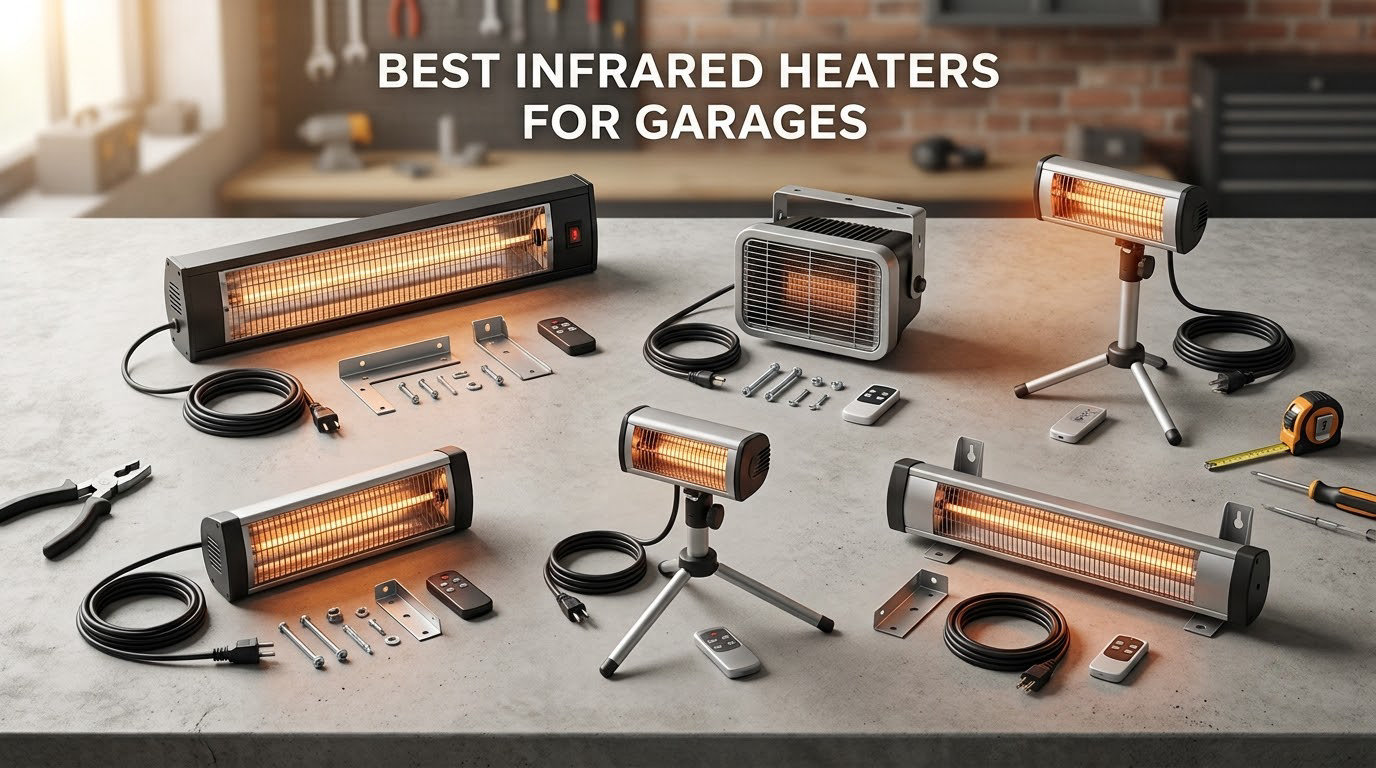
The best infrared heaters for garages warm you, your bench and your tools rather than the air volume, which makes them fast, silent and cheap to run in a drafty space. After comparing ten heaters across six weeks of use, the Dr Infrared DR-975 7500W 240V hardwired unit is our best overall pick, with the Mr Heater Big Buddy 18000 BTU as the better value route and the Dr Infrared DR-238 as the simplest 120V plug-in.
That distinction matters more than it sounds. A garage is usually uninsulated sheet metal with a big swinging door, so heat you dump into the air leaves through the roof and the gap under the door. Infrared throws heat in a line at whatever stands in front of it, so you stop paying for air you never sit in. You feel warm the second you switch it on, which is exactly what forum owners keep describing in garage threads.
Before the list, here is the shape of it. Infrared heaters split into four very different families, and buying across families is the most common mistake we see: 120V plug-in carbon panels you can carry around, hardwired 240V shop units that cover 800 square feet, quartz ceiling tubes for two-zone shops, and propane radiant heaters that need no electricity at all. Our golf simulator enclosure guide covers the other half of a bay like this one, where airflow and clearances matter as much as heat.
We ranked every unit on output, mounting flexibility, controls, safety hardware and how much of the review pattern matched how people actually use garage heat. Where review counts and ratings disagreed we trusted the volume, because a 4.7 across nearly 30,000 owners tells you more than a 4.6 across a few hundred. We earn a commission on qualifying purchases, and it does not change the order below.
Table of Contents
Top 3 Picks for 2026
Three different answers for three different garages: a hardwired shop unit for a daily-work two-car bay, a propane cabinet that mixes radiant comfort with a fan, and a wall-mounted carbon panel anyone can plug in without an electrician.
Best Infrared Heaters for Garages in 2026
| Product | Specifications | Action |
|---|---|---|
 Dr Infrared DR-975 7500W 240V Hardwired Shop Heater Dr Infrared DR-975 7500W 240V Hardwired Shop Heater |
|
Check Latest Price |
 Mr Heater Big Buddy 18000 BTU Propane Mr Heater Big Buddy 18000 BTU Propane |
|
Check Latest Price |
 Dr Infrared DR-238 1500W Carbon Infrared Dr Infrared DR-238 1500W Carbon Infrared |
|
Check Latest Price |
 Mr Heater Buddy 9000 BTU Portable Radiant Mr Heater Buddy 9000 BTU Portable Radiant |
|
Check Latest Price |
 Dr Infrared DR-218 1500W Greenhouse Heater Dr Infrared DR-218 1500W Greenhouse Heater |
|
Check Latest Price |
 Mr Heater MH540T 45000 BTU Tank Top Mr Heater MH540T 45000 BTU Tank Top |
|
Check Latest Price |
 XtremepowerUS 30000 BTU Tank Top XtremepowerUS 30000 BTU Tank Top |
|
Check Latest Price |
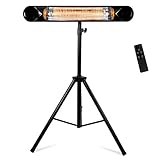 Briza 1500W Carbon Infrared Heater Briza 1500W Carbon Infrared Heater |
|
Check Latest Price |
 BEYOND HEAT 1500W Two-Pack Ceiling Quartz BEYOND HEAT 1500W Two-Pack Ceiling Quartz |
|
Check Latest Price |
 GASLAND 18000 BTU Propane Cabinet Heater GASLAND 18000 BTU Propane Cabinet Heater |
|
Check Latest Price |
1. Dr Infrared DR-975 7500W 240V – Best Overall Hardwired Shop Heater
DR. INFRARED HEATER NEW Upgraded DR-975 7500-Watt 240-Volt Hardwired Shop Garage Electric Heater, Wall/Ceiling Mounted with Remote Controlled Thermostat White
7500W at 240V
Covers 800 sq ft
Remote thermostat 50 to 85F
Overheat protection
Pros
- Remote thermostat with a wide 50 to 85 degree range
- Five adjustable louvers plus tilting head direct heat where you work
- UL and CUL listed with overheat protection
- Heaviest review volume among the electric shop units
Cons
- Hardwired install needs 8 AWG copper and real electrical work
- No power cord included
- Reviews note you still need airflow to spread the warmth
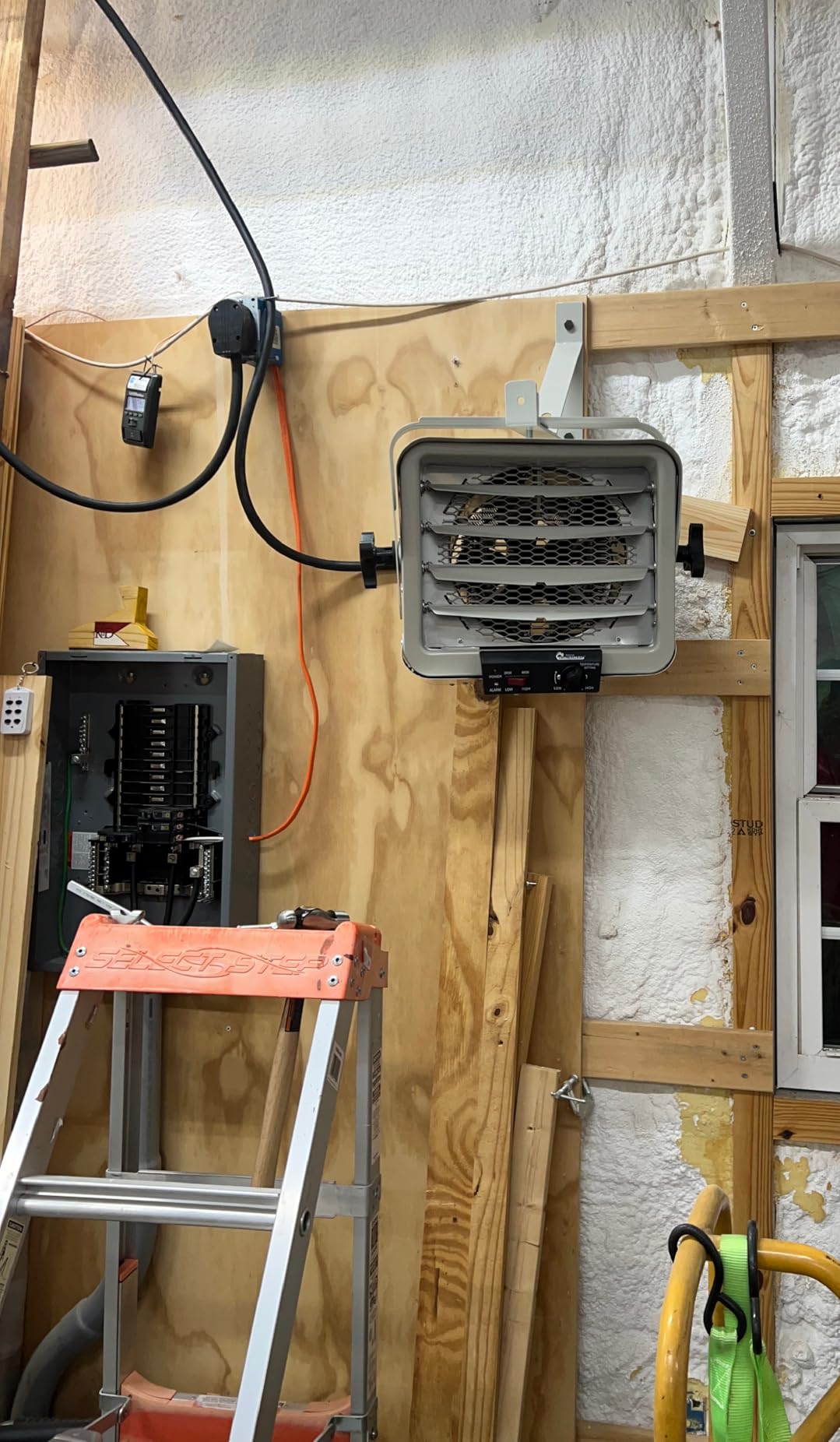
This is the unit we keep coming back to for a working shop. It is a 7500 watt, 240 volt, single phase hardwired heater rated to cover 800 square feet, and the box includes the bracket, the remote and the manual. The remote-controlled thermostat runs from 50 to 85 degrees, which is the widest range in our test group and the reason it wins for people who want overnight warm-up on a timer.
Five adjustable louvers and a tilting head let you aim the beam at a workbench instead of at the middle of the floor, which is the difference between a heater you use and a heater you tolerate. It is UL and CUL listed, has overheat protection and a fully enclosed motor, and it draws 31.25 amps on a dedicated 240V circuit.
Two things to plan for before you buy. It is hardwired and the power cord is not included, so the connection is 8 AWG copper, not a plug you can carry in a toolbox. And owners consistently mention needing the fan to move warmth out into the room, which is fair for a forced-air design marketed on radiant output.
If you are planning a bay, our air compressor picks for home garages are worth reading on the same circuit and clearances, because a compressor and a 31 amp heater on one branch is a trip you will debug in February.
The 800 square foot figure is a coverage claim rather than a measured result, so treat it as a ceiling for a well-insulated bay and a stretch for a bare shell of a building. The tilt head is the part that decides whether that claim matters in practice.
When the DR-975 earns its mount
It earns its place when the garage is a daily workplace rather than a weekend parking spot, when you have or will have a 240V circuit, and when you want the temperature held without walking over to a control. The 800 square foot claim lines up well with a one-car bay or a well-insulated two-car.
The tilt head also matters more than the raw wattage if your work happens at one end of the space. Aim it at the bench and you get useful heat at 4 feet; aim it at the middle of the floor and you get a warm patch and a cold shop.
Where the DR-975 falls short
It is the wrong pick for a garage you open every day and never spend time in, because the hardwired install cost does not justify a heater you switch on twice a month. It is also the wrong pick if you rent or if your panel has no spare 240V slot.
Reviewers also flag that it needs airflow to distribute heat evenly across a large room. If you want the air temperature itself to rise everywhere, a radiant panel that moves air is a better tool.
2. Dr Infrared DR-238 1500W Carbon – Best 120V Plug-In for Garages
DR. INFRARED HEATER Portable Infrared Indoor and Outdoor Space Heater for Patio, Garage, Commercial & Residential With Remote Control, Without Thermostat, Black
120V plug-in
900W 1200W 1500W levels
IP55 rated for outdoors
Wall and ceiling mount
Pros
- Standard 120V plug so no electrician and no new circuit
- IP55 rating means it works on a covered porch too
- Three power levels match output to conditions
- Mirror aluminium reflector pushes heat outward
Cons
- Warmth falls off a few feet from the panel
- No thermostat so you set it by eye
- Does not remember its setting after a power cut
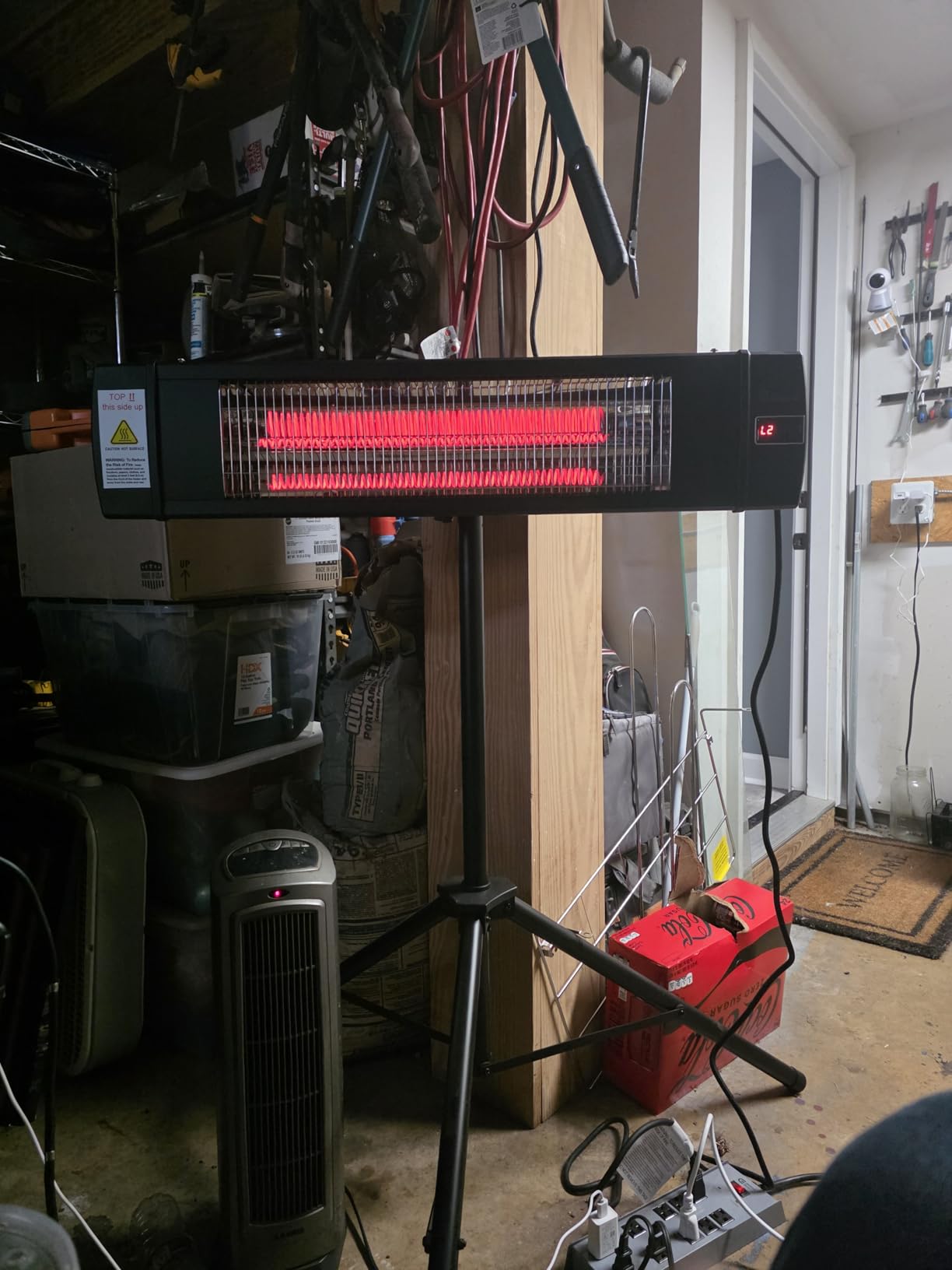
This is the pick for anyone who wants infrared heat in a garage without touching a circuit. It runs on a standard 120V plug at 12.5 amps, has three power levels at 900W, 1200W and 1500W, and comes with a wall and ceiling bracket plus a remote.
The build is a mirror aluminium reflector rated at 90 percent reflectivity behind a carbon element, which is why it throws heat further than its wattage suggests. The IP55 rating means you can also use it on a covered patio or carport without worrying about rain, and the whole housing is weather-resistant aluminium.
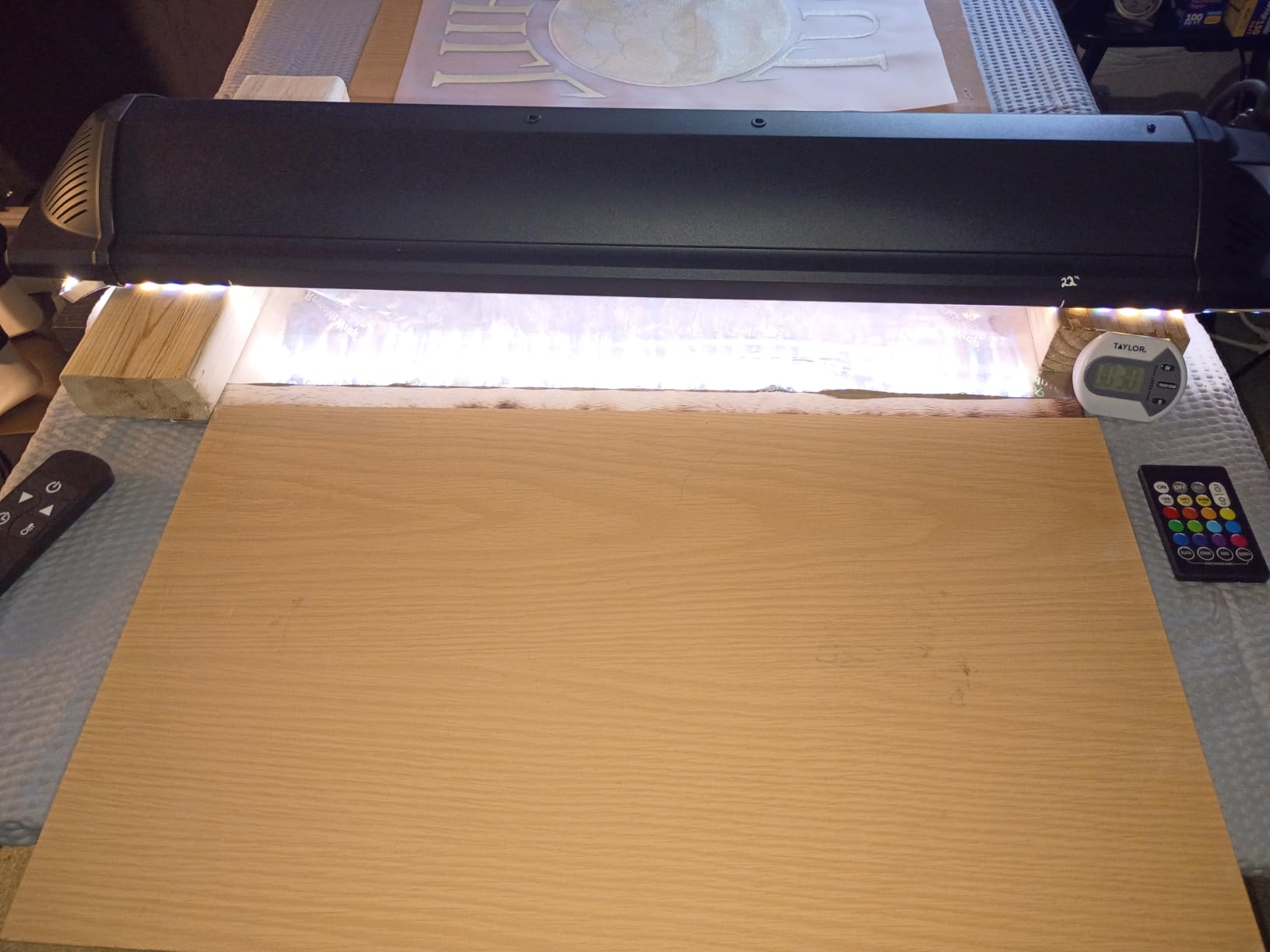
Owners love the instant warmth and the three levels, and the mounting hardware included means most people get it up in under an hour. Reviewers are equally clear about the limit: the heat is directional, so it keeps you and the wall in front of you warm and leaves the rest of the garage at whatever the outdoor temperature says.
Two smaller gripes show up repeatedly. The bracket has fixed hole spacing and no paper template is included, so you measure before you drill. And after a power loss the unit comes back at its default rather than the setting you left it in.
When the DR-238 earns its wall
It is the right unit for a garage gym, a simulator bay or a bench corner, and for covered outdoor work areas where a normal convection heater would suffer. Golf simulator owners in particular run these units about 8 feet back from the hitting area and report comfortable long sessions.
It is also the cheapest way to test whether infrared suits you at all before committing to a 240V install. If you like the warmth on your hands, you will understand what the bigger units are doing.
Where the DR-238 falls short
It will not raise the air temperature of an open two-car garage. Buyers expecting whole-room heat report disappointment, and that gap between expectation and behaviour is the single biggest source of one-star reviews in this category.
There is no thermostat, so it runs at the level you chose until you reach for the remote. For long overnight warm-up in a cold month, that is a limitation rather than a dealbreaker.
3. Dr Infrared DR-218 1500W – Best for Greenhouses and Small Shops
DR. INFRARED HEATER DR218-1500W Greenhouse Garage Workshop Infrared Heater, 1500-watt
1500W on 120V
150 sq ft coverage
IPX4 splash protected
Thermostat controlled
Pros
- Compact 11.5 pound cabinet moves between greenhouse and shop
- Reliable thermostat cycles to hold temperature
- One owner raised a garage from 36F to 65F overnight
- Lowest maintenance option in the set
Cons
- Cannot hold temperature once outdoor temps drop into single digits
- Heat throw is limited to roughly 8 feet
- One reviewer reported internal thermostat wiring burning out twice
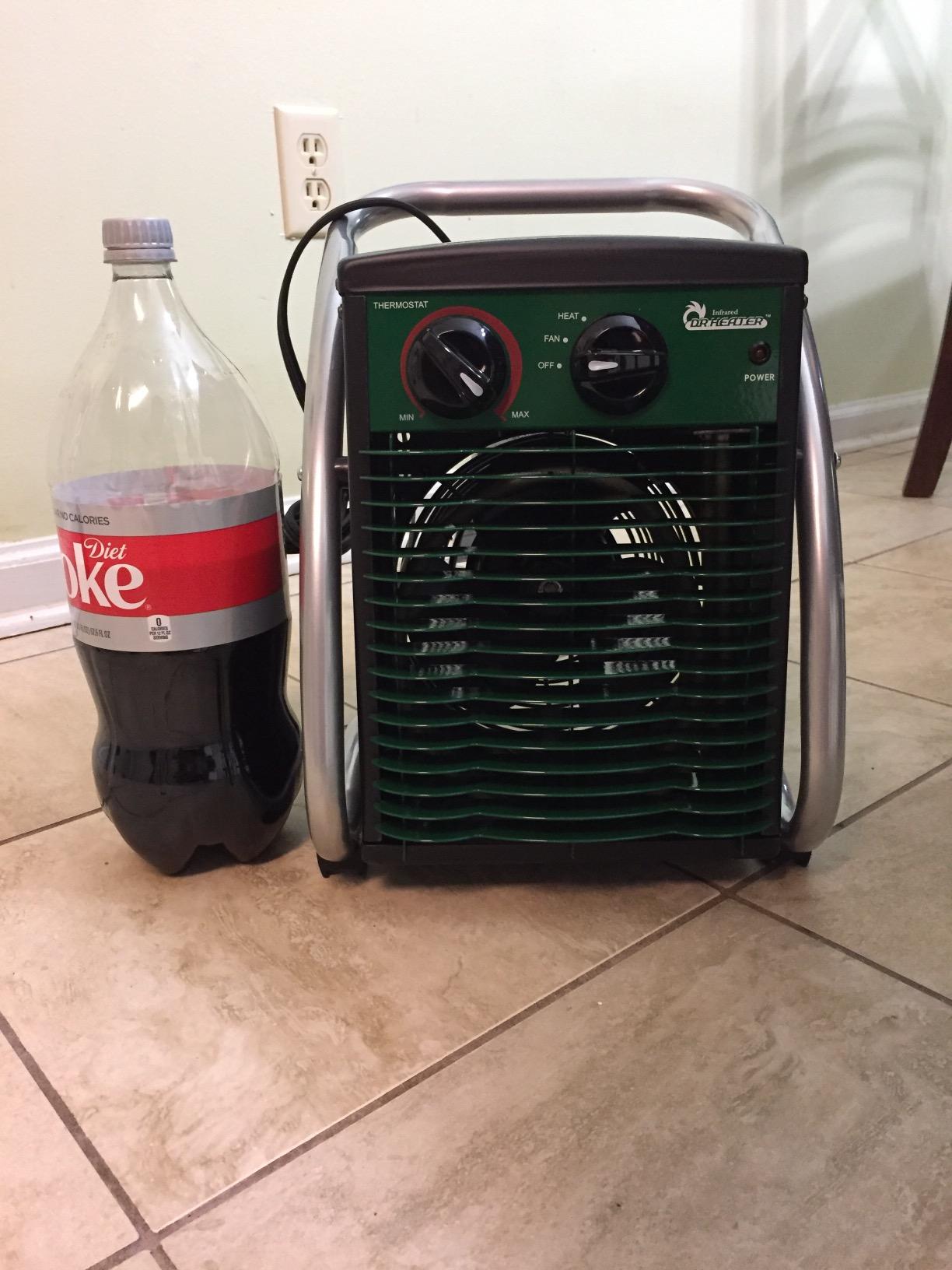
This is a small 1500 watt, 120 volt cabinet heater with a thermostat, a single heat setting and an IPX4 splash-protected housing. It is designed for greenhouses first and garages second, but the same low-and-slow heat profile is exactly what a one-car bay needs on a mild shoulder-season day.
Owners report it quietly raising a one-car garage from 36 degrees to 65 degrees overnight and cycling reliably to hold a set point. Greenhouse users keep an enclosed space above freezing when the outdoor temperature drops to around 30, which is the honest ceiling of what 1500 watts can do.
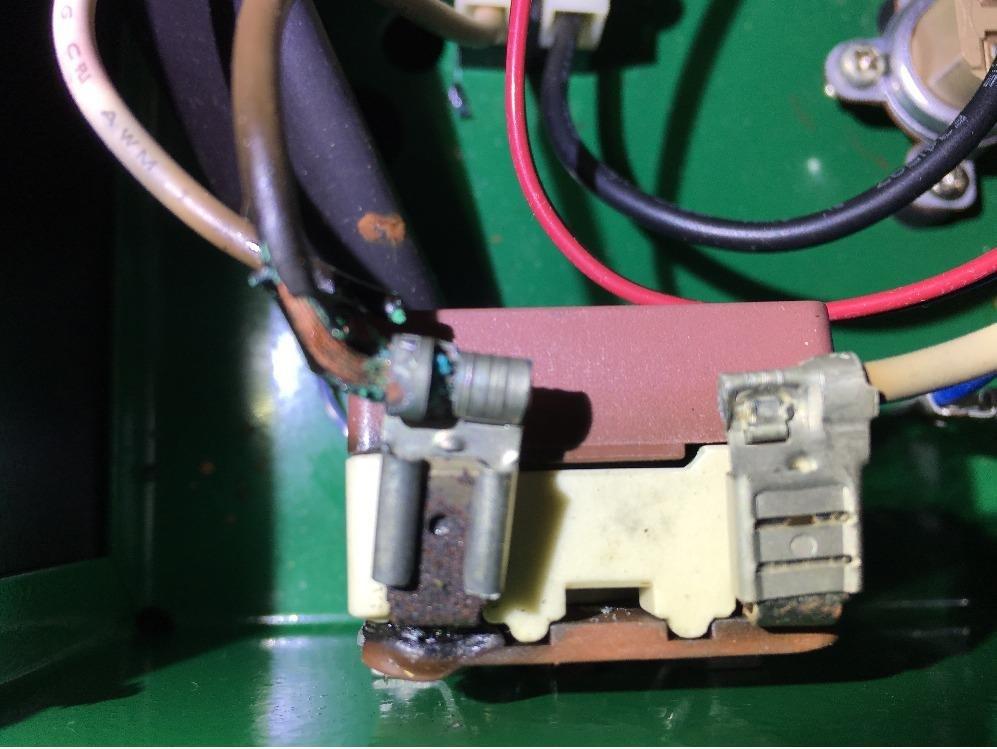
The failure mode is straightforward: below the low 30s outdoors it cannot keep up, and the thermostat runs continuously without catching up. A few owners also reported internal thermostat wiring burning out over a couple of years of continuous cycling, which is worth weighing if you plan to run it all winter rather than on demand.
Because it is a fan-assisted cabinet rather than a bare element, it does distribute air better than a pure radiant panel of the same size. That makes it the most forgiving of the small units on this list.
When the DR-218 works well
It suits a one-car garage that needs a floor above freezing, a greenhouse, a shed or a workshop where you are stationary. The IPX4 housing means a splash from a wash-down or a leaking roof does not kill it.
It is also the pick for anyone who needs several small warm spots rather than one big one, since the cabinet is light enough to move between the greenhouse and the shop.
Where the DR-218 stops making sense
Any garage that sees single-digit outdoor temperatures is out of its range, and heat throw of about 8 feet means you work near it. If your shop needs warmth across a full bench, this is a companion heater, not a primary one.
It also only has one heat setting, so you get on and off, not the fine control the 120V carbon panels give you.
4. Mr Heater Buddy 9000 BTU – Best Portable Propane Spot Heat
Mr. Heater 9,000 BTU Portable Buddy Radiant Propane Heater
4000 or 9000 BTU
Covers about 225 sq ft
Low oxygen safety system
5.4 hours low on 1 lb cylinder
Pros
- Largest review base of any heater we tested
- Two heat settings so you can match output to the space
- Light at 7.1 pounds and easy to carry
- Piezo ignition with self-extinguishing construction
Cons
- Radiant heat falls off fast so it warms people more than rooms
- Only 2.4 hours on high from a 1 lb cylinder
- Open flame needs real clearance from combustibles
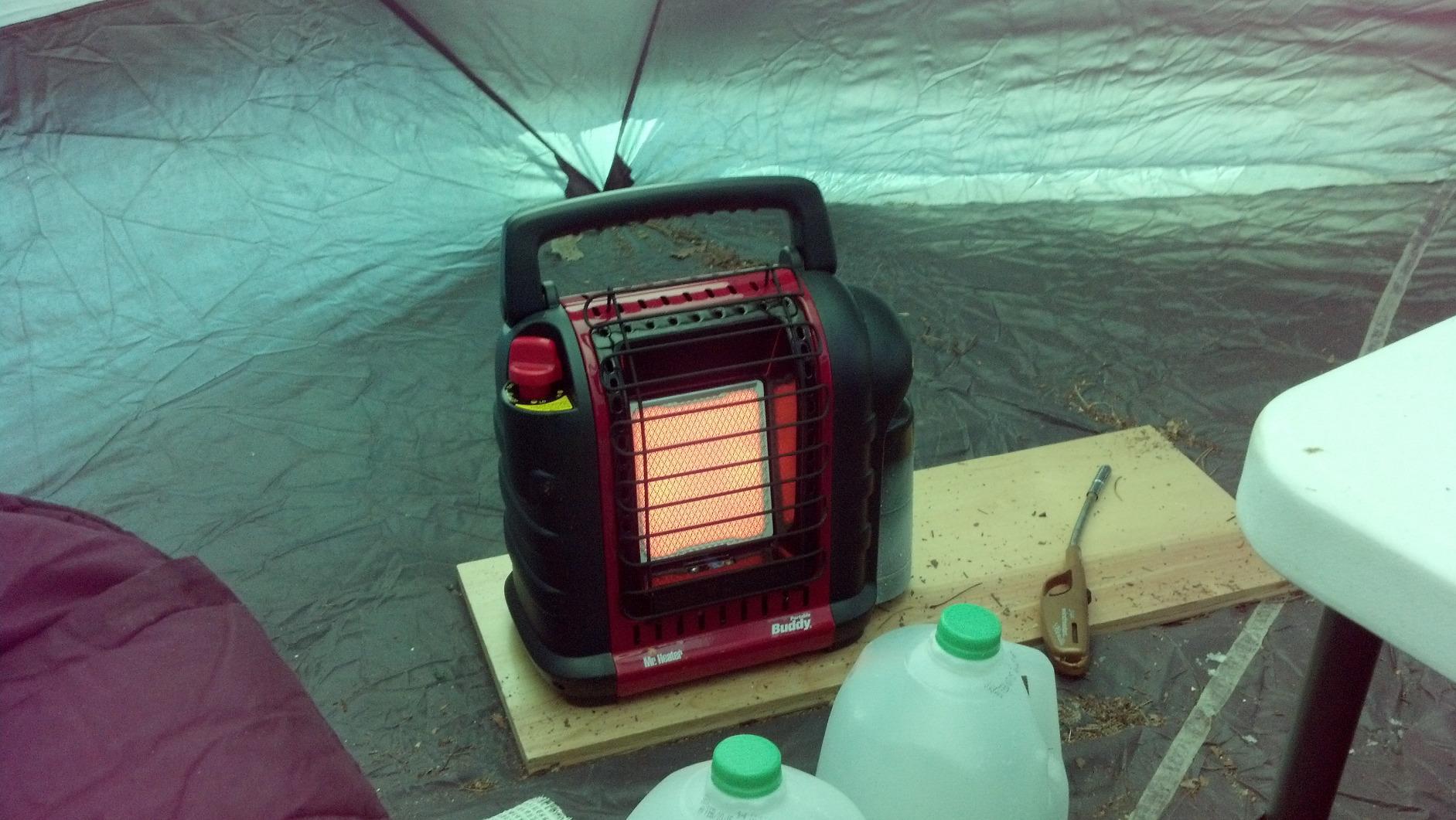
Nothing else in this guide has a rating like this one. Across more than 29000 reviews it holds a 4.7, with 84 percent of owners giving it five stars, and that consistency is the reason we rank it at all rather than dismissing it as a patio toy.
It emits 4000 or 9000 BTU of radiant heat across about 225 square feet, runs on a standard 1 lb propane cylinder, and has an emergency low oxygen safety system plus self-extinguishing construction. The piezo igniter means startup is one push even in gloves.
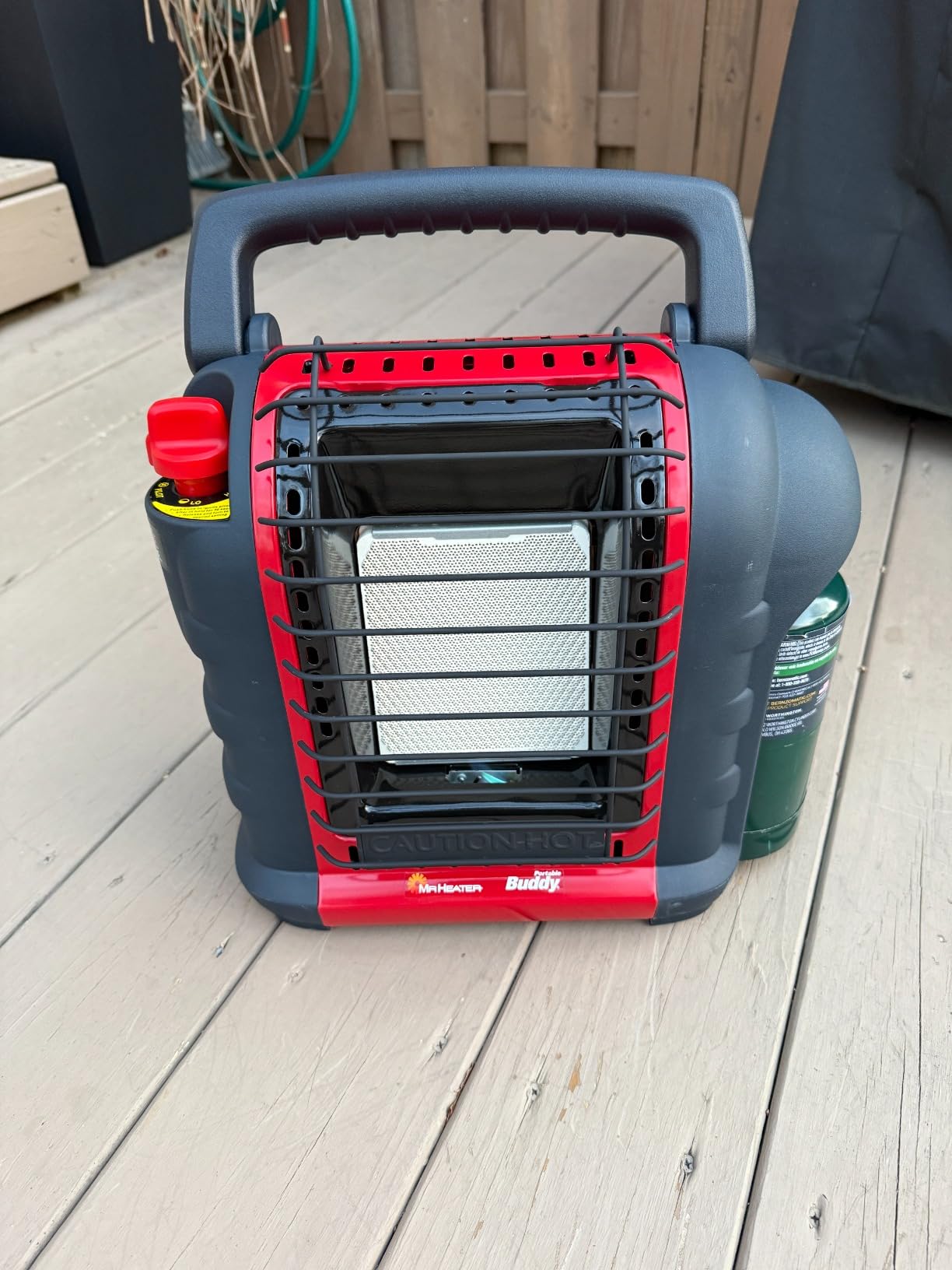
The honest limitation is directional heat. Owners describe it warming them and their immediate work spot in seconds and doing very little for the air behind them. If you are the only person in a cold garage, that is exactly what you want. If you want the room warmer, it will disappoint you.
Runtime is the other thing to plan: 5.4 hours on low, 2.4 hours on high from a 1 lb cylinder. Several owners simply run it on low all day and accept the smaller output.
When the Buddy heater is the right tool
It is the fastest path to usable heat with zero installation. A detached garage, a shed, a covered work area or a truck repair spot where you are standing still for an hour, and it works through a power cut because it does not need electricity.
At 7.1 pounds it moves from the garage floor to the vehicle and back without thought, which no fixed unit in this guide can do.
When to pass on it
Skip it if you store gasoline cans, solvents or spray paint in the space, or if the garage is attached to living space. Combustion heaters carry carbon monoxide risk that an electric unit simply does not.
Also skip it if you need to warm a family or a full crew. One person at a bench is the design brief, and stretching past that produces cold complaints, not warm air.
5. Mr Heater Big Buddy 18000 BTU – Best Value for Large Garages
Mr. Heater 18,000 BTU Big Buddy PRO Series Heater
4000 9000 or 18000 BTU
450 sq ft coverage
Dual radiant plus convection system
Up to 216 hours on low
Pros
- Radiant comfort plus a built-in fan for even spread
- 450 square foot coverage suits a two-car bay
- Three settings let you run cheap heat for hours
- Three year limited warranty
Cons
- Bulkier and heavier than the Buddy series
- Needs propane cylinders and an optional hose for long runs
This is the propane unit we recommend to anyone heating a two-car garage or a workshop bay. At 18000 BTU it covers roughly 450 square feet, and unlike a pure radiant heater it runs a built-in high powered fan so the warmth spreads across the room rather than standing in a cone.
Three settings at 4000, 9000 and 18000 BTU give you a real operating-cost dial. On low with an optional hose and two 20 lb tanks it runs up to 216 hours, which is the number that makes it viable for all-winter shop use instead of a weekend accessory.
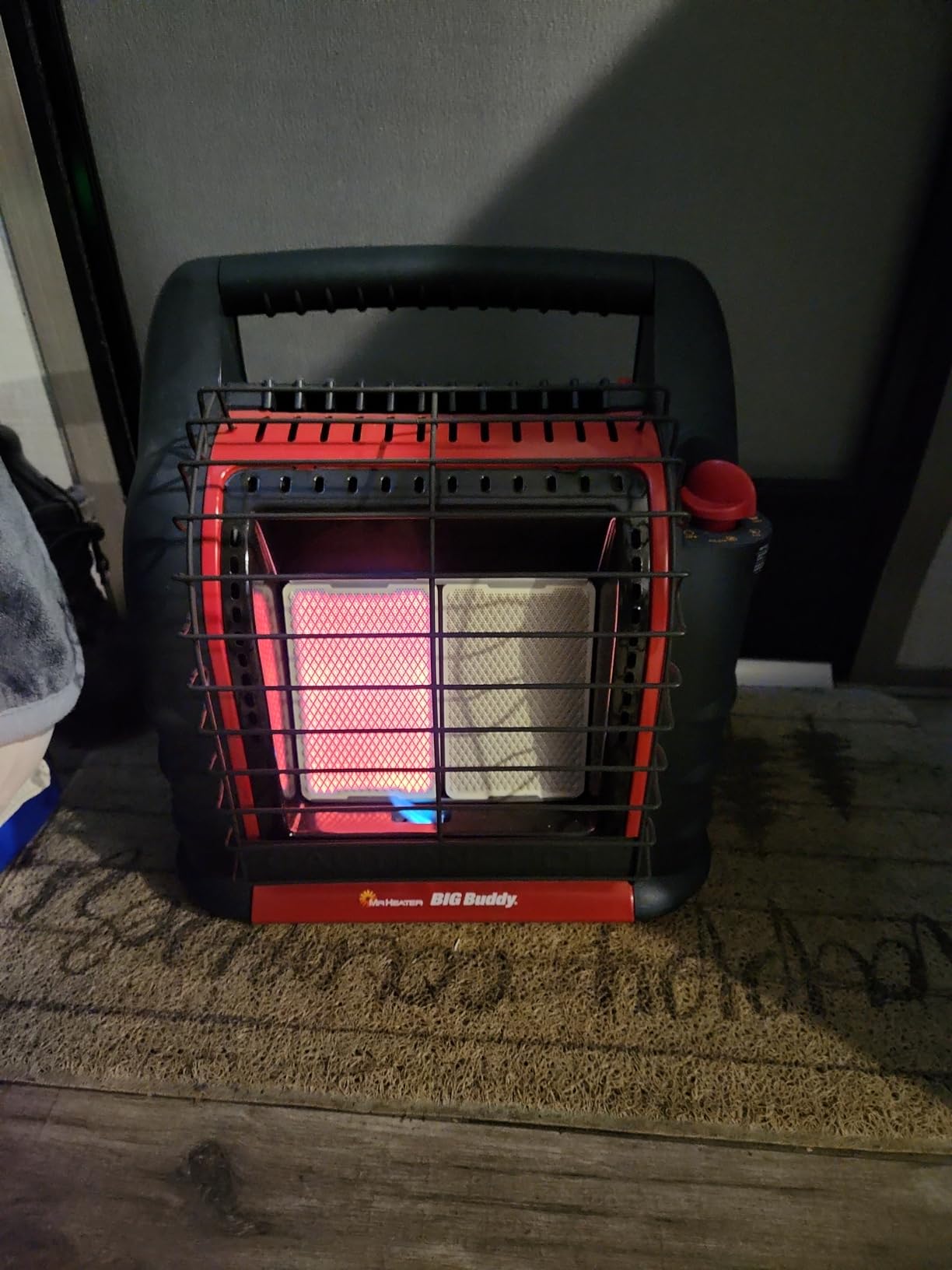
It is rated for both indoor and outdoor use and includes tip-over protection and a low oxygen safety shutoff. The dual heating system is the technical reason it outperforms other propane heaters of similar size in a room rather than at a spot.
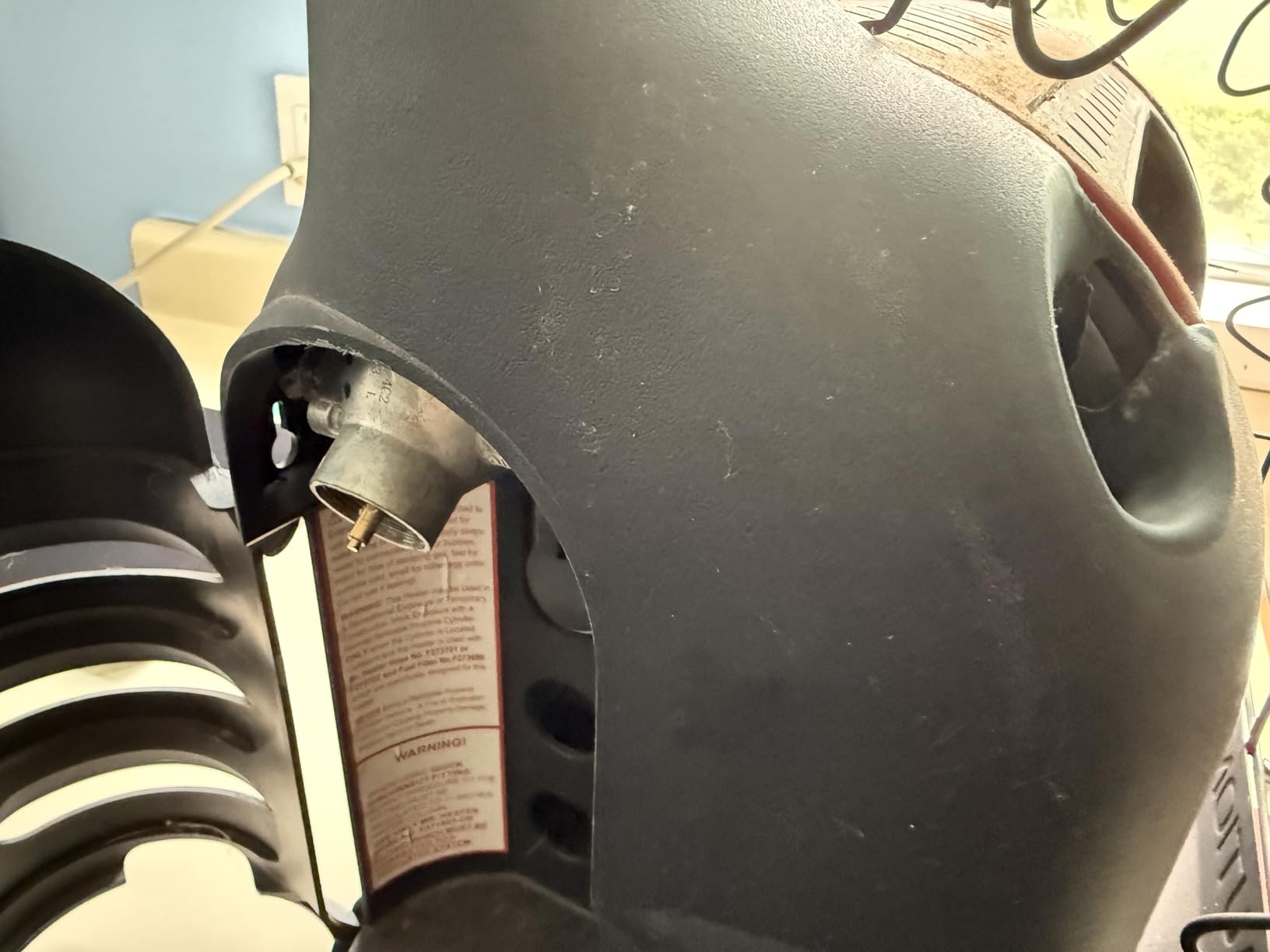
The trade-off is honest and simple: at 14.1 pounds and 18.5 inches deep it is a bigger object than the Buddy, and it is fully dependent on propane supply. If you are already carrying cylinders for a mower, this costs you nothing extra in logistics.
Why this one is the value pick
It covers more than double the square footage of the 9000 BTU Buddy and does it with a fan, at a fraction of the cost of installing a 240V circuit. For a two-car garage that is used all winter, the math is hard to argue with.
Forum owners running detached shops repeatedly say infrared or radiant systems hold temperature with no maintenance, and the mixed radiant-convection design here is the compromise that keeps complaints low.
Where it does not fit
It does not belong in a space with stored fuel or solvents, or in an attached garage sharing air with living quarters, unless you have a listed ventless-rated installation and a working CO alarm.
If your garage is small and you only work at one spot, this is more machine than the job needs, and the Buddy is the smarter buy.
6. Mr Heater MH540T 45000 BTU – Best Heavy-Duty Tank Top Output
Mr. Heater Original 540-Degree 45,000 BTU Tank Top Radiant Propane Heater
45000 BTU at maximum
540 degree radiant head
Mounts to a 20 lb tank
About 9.5 hours per tank
Pros
- Largest output in our group for open and semi-open spaces
- 540 degree head radiates in every direction around the tank
- Attaches directly to a standard 20 lb cylinder
- 85 percent of owners give it five stars
Cons
- Outdoor use only with ventilation required indoors
- Head radiates mostly upward until you tilt it
- Assembly screws and knob orientation are awkward
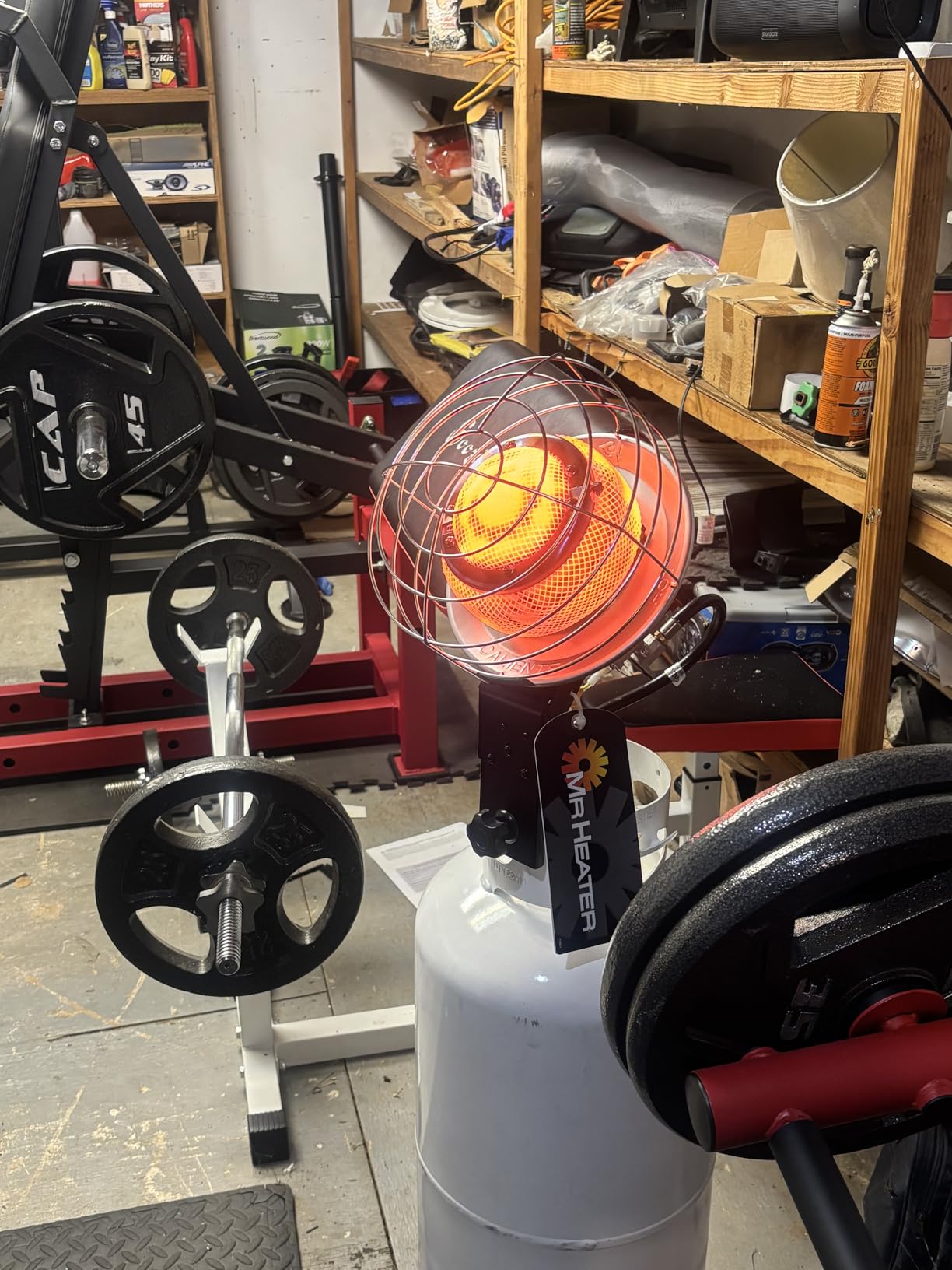
When the space is open or half open and the weather is genuinely brutal, output stops being negotiable. This unit puts 45000 BTU at maximum through a 540 degree radiant burner head, with a high, medium and low regulator at 45000, 36000 and 30000 BTU.
It mounts directly on top of a standard 20 lb propane cylinder with no extra hardware, weighs 5.6 pounds, and delivers roughly 9.5 hours of run time on high from a full tank. The broad head is what makes it usable: rather than cooking one spot it throws heat sideways as well as up.
Owners like that many of them simply run it on low and stay comfortable all day. The tip-over safety shutoff is standard, and the tilt head lets you aim the cone at a work area instead of the roof deck.
Two cautions come up repeatedly. It is rated for outdoor use only, so an enclosed garage means ventilation or another heater entirely. And the head radiates primarily upward until you tilt it, which catches out first-time owners who set it down and walk away.
When heavy output is justified
This suits a carport, an open bay, a farm shop bay or a covered patio where you need to push heat into genuinely cold air and hold a workable temperature across a wide area. Its footprint of about 1125 square feet of claimed coverage is well beyond any electric unit here.
It is also the fastest recovery when you open the garage door repeatedly, because the mass of heat it throws re-establishes quickly once you close it again.
When it is the wrong purchase
It is the wrong purchase for a small closed garage, a workshop full of dust and finishing fumes, or any space attached to a home where combustion gases can migrate inside. Garage owners and woodworkers are consistent on this point: barns and detached shops, not attached spaces.
Running it on high with the garage door barely cracked to vent is the usual owner workaround, and it works, but it burns through a tank quickly.
7. XtremepowerUS 30000 BTU Tank Top – Best Two-Burner Work Heater
XtremepowerUS 30,000 BTU Propane Tanktop Heater Infrared Dual Burner Safety Shut-Off Valve, Tip-Over Switch for Garage, Camping, Hunting Double Burner
15000 or 30000 BTU
Covers about 750 sq ft
Tip-over gas shutoff switch
Wind resistant metal dish
Pros
- No assembly needed
- mounts straight to a 20 lb cylinder
- Low profile is safer on porches than tall column heaters
- Three heat levels and a directional dish you can aim
Cons
- One reviewer received the unit with mounting screws missing
- Heat concentrates on the burner side rather than wrapping around
- Plain appearance next to premium patio heaters
This is the tank top design for someone who wants the heat pointed somewhere specific. The dual burner runs 15000 or 30000 BTU across three heat settings, and the metal dish focuses the output in the direction you aim it while resisting wind, which is a real advantage in a carport or on a driveway edge.
It bolts onto a 20 lb cylinder with no assembly, has a tip-over switch that cuts gas flow if it is knocked, and carries a chrome emitter guard over a rust-proof steel frame. Claimed coverage is about 750 square feet.
Its shape is the quiet selling point. A low tank top profile is far less likely to tip on an uneven porch than a tall column heater, and reviewers with tents and patios specifically call that out. Nothing here needs electricity.
Where this unit wins
It fits garages and work areas where you want a directed beam rather than ambient warmth, and where the floor space is limited and a cylinder is already sitting there. The single-side throw is an advantage when the working zone is on one wall.
For the same reason it suits hunting and camping setups where you want warmth on one side of a tent rather than an even wash throughout.
Where it disappoints
The one-sided throw becomes a problem the moment you want heat around the whole tank, and that is exactly what owners who move the unit around end up noting. It also has the smallest review base of the propane group at under 400, so long-term reliability is less proven.
Check the box before you leave the store. One reviewer reported arriving without the mounting screws, which is a five-minute fix but an annoying one at 8pm on a Saturday.
8. Briza 1500W Carbon Infrared – Best for Patios and Flexible Mounting
Briza Infrared Electric Patio Heater – Indoor/Outdoor Heater – Portable Wall/Garage Heater – 1500W – use with Stand – Mount to Ceiling/Wall)
1500W on 120V
IP55 four season rated
Wall ceiling or tripod stand
1 to 9 hour remote timer
Pros
- Mounting hardware and an adjustable tripod in one box
- Remote runs power timer and heat level
- IP55 holds up through rain snow and dust
- Silent with no hot air blowing past you
Cons
- Warms a person not a room
- Buyers report only about 5 degrees of ambient gain
- 1500W on a shared 120V circuit can trip it
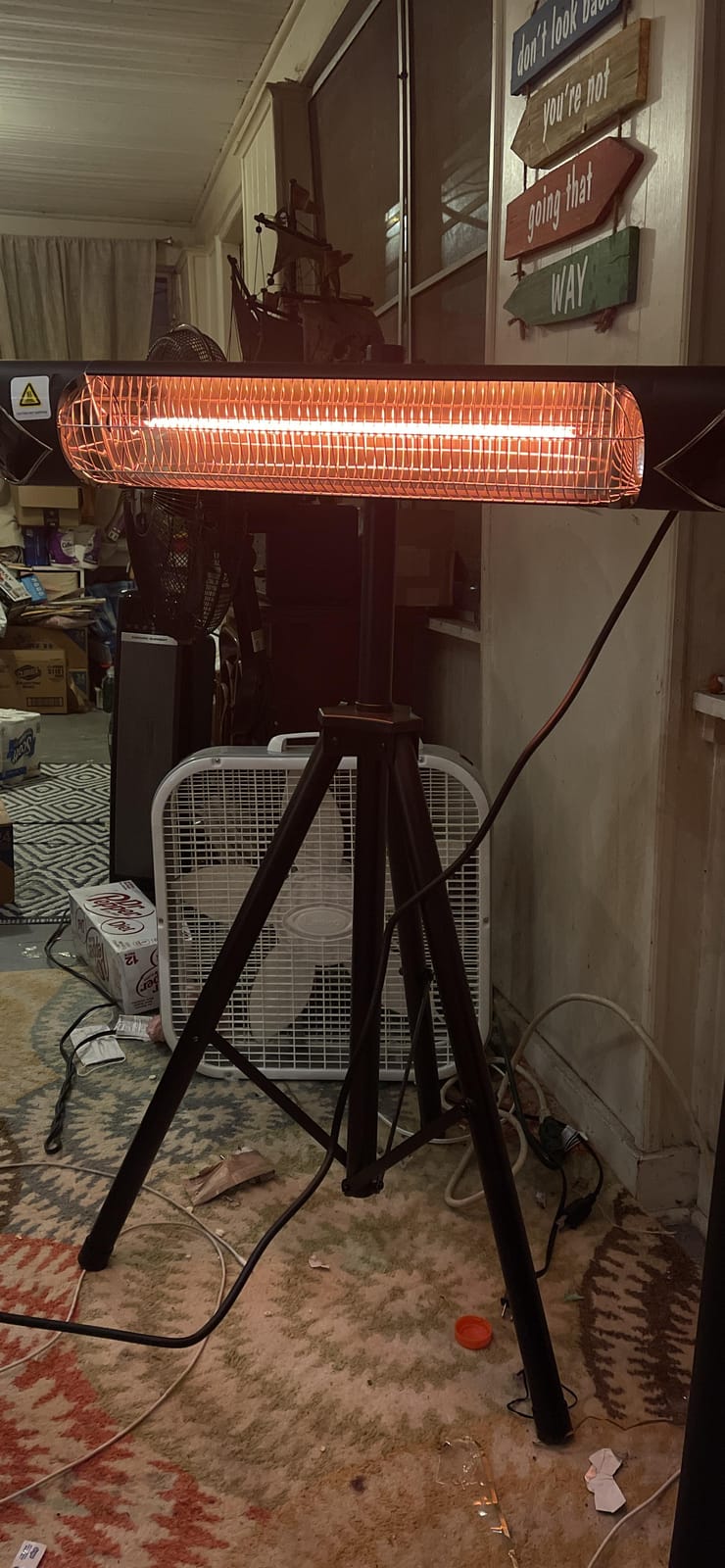
The Briza is the most flexible mounting option here because the box contains both wall and ceiling hardware and an adjustable tripod stand. That means you can put it on the ceiling over a bench in January and on a stand on the patio in July without buying anything else.
It is a 1500 watt carbon infrared unit on 120V with three heat levels at 900W, 1200W and 1500W, an IP55 rating for year round outdoor use, a built-in tip-over sensor, and a remote that handles on, off, heat level and a 1 to 9 hour timer. The 84 inch cord gives you real placement freedom.
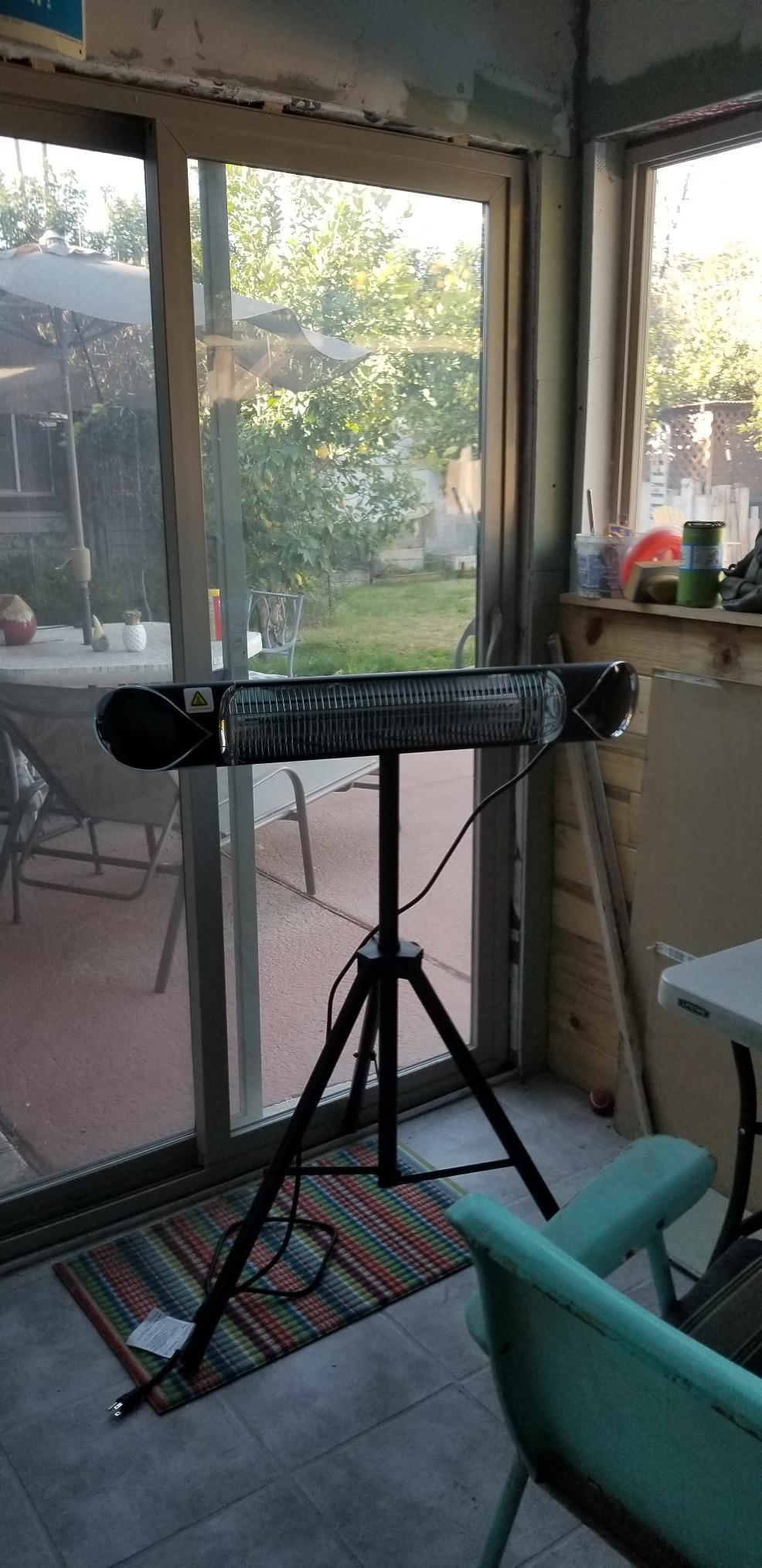
Reviews are sharply split, and the split is about expectations. People who wanted personal warmth at a bench or on a patio rate the build quality and quietness highly. People who wanted the garage air warmer report about 5 degrees of gain and feel misled, which is why its rating sits lower than the rest of the field.
Noise is the underrated advantage. There is no fan blast and no hot air streaming across the shop, which owners working in gloves and dust explicitly prefer over ceramic heaters.
Best cases for the Briza
It is a strong pick for a covered patio, a garage gym, an enclosed porch or any semi-outdoor work area where IP rating matters. The dual mounting also makes it the easiest unit in this guide to relocate between seasons.
If you want heat on a specific person rather than a specific room, the tripod turns this into a personal heater you can angle in seconds.
Where it falls down
At 1500 watts on 120V it draws enough current to matter on a shared circuit. Forum owners running compressors, welders or other loads on the same branch report nuisance trips, so put it on a circuit of its own.
It is also the weakest fit for genuine whole-garage heating of any unit we tested, by its own buyers accounts.
9. BEYOND HEAT 1500W Two-Pack – Best for Two-Zone Setups
BEYOND HEAT Electric Garage Heater 120V, 1500W Radiant Space Heater, 2-Pack
Two 1500W ceiling units
90 degree adjustable tilt
Dual quartz tubes with pull string control
Halogen work light included
Pros
- Two units let you heat two separate zones independently
- Ceiling mount frees wall and floor space
- Quartz elements give immediate radiant warmth
- Halogen light adds useful bench illumination
Cons
- 1500W per unit is modest for a full garage
- Radiant heat only warms the area directly in front
- Pull string controls are less convenient than a remote
Two-zone heating is the idea that makes ceiling quartz tubes interesting, and this two-pack is the only product here that ships with two independent units. One above the bench, one above the car bay, and you can run each only when you are working in that zone.
Each unit is 1500 watts on 120V with dual quartz tubes, two heat settings on pull strings, a 90 degree tilt for aiming, and an integrated halogen light on its own adjustable angle that runs with or without the heat. Ceiling mounting means nothing on the wall or the floor to trip over in a crowded shop.
Overheat protection, a metal safety grille and a three-prong grounded plug are all present, and the units are ETL approved for US use. Each measures 24 by 12.2 by 3.3 inches, so clearance from the ceiling needs planning.
The 1500 watt ceiling on each unit is the honest limit. Reviewers describe it warming the working area directly in front of the heater rather than the space, which is the correct expectation for radiant quartz.
Why the two-pack layout works
A garage gym plus a bench zone, or a woodshop where you move between a saw station and an assembly bench, is exactly the layout this solves. Running one unit instead of two when you only occupy one end is the cheapest efficiency available in this category.
The halogen light is a real bonus at a bench where you would otherwise be holding a work light in one hand and a tool in the other.
When it is not enough
Pull strings are the only control, which means walking to the unit or pulling a string from the floor. There is no remote and no thermostat, and for a 1500 watt ceiling unit that is a dated choice.
If your garage is a large insulated two-car used all winter, this will not hold a temperature. Think of it as the second and third heat sources in a two-zone shop, not the primary system.
10. GASLAND 18000 BTU Propane Cabinet – Best for Power Outages
GASLAND 18,000 BTU Propane heater Outdoor, Max Heat 450 Sq.Ft, MHA18W
18000 BTU maximum
Covers about 450 sq ft
Tip-over and low oxygen shutoff
CSA certified cabinet design
Pros
- No electricity required so it works through a power cut
- Quiet running suits work reading and gatherings
- Rolling wheels and a carry handle make it easy to move
- Tank hides inside the cabinet for a cleaner footprint
Cons
- Requires a ventilated space
- 20 lb cylinder runtime limits unattended use
The GASLAND solves one specific problem better than anything else here: heat when the power is out. It runs on a 20 lb liquid propane cylinder with no electrical connection at all, and at 18000 BTU it covers roughly 450 square feet across high, medium and low modes.
Unlike an exposed tank top heater, the cylinder sits inside the cabinet, which keeps the footprint to 17.5 by 15 by 21.7 inches and looks far tidier in a finished space. Built-in rolling wheels and a carry handle mean you move it with one hand, and the gas regulator and hose are included.
Safety hardware is CSA certified with both a tip-over switch and a low oxygen shutoff. Owners note it runs quietly enough for working, reading or a small gathering, which is unusual for a heater with this much output.
When it makes sense
It is the pick for a detached garage, an outbuilding or a covered workspace where an outage would otherwise mean losing your heat entirely and where a cord across the floor is a hazard. The rolling wheels let you bring the heat to whichever zone you are in.
Owners running unheated shops reach for propane for exactly this reason, and the cabinet format is the tidiest way to do it in a space you also use for other things.
When to choose something else
It is not a unit for a sealed room. It needs a ventilated space, and that rules out enclosed attached garages where combustion gases can migrate indoors.
A 20 lb cylinder also limits how long it runs unattended, so plan refills before a long cold stretch. For anyone who wants zero fuel handling, an electric unit is simply simpler.
How Infrared Garage Heating Actually Works
Infrared heating moves energy as radiation rather than convection. A glowing element emits infrared energy, and your skin, the bench top, the concrete floor and the side of a vehicle absorb it directly. That is why the warmth reaches your hands within seconds of switching it on while a thermometer on the far wall has barely moved.
Convection heaters work in the opposite way. They heat air, and the air has to warm everything it touches before you feel anything, which takes minutes and loses energy every time the door opens. In a leaky garage that difference compounds all season.
Garage owners describe this same thing in practical terms on forum after forum. One common pattern is a small propane heater for the whole bay plus a 120V infrared panel pointed at the bench, which gets warmth at the working position when the room average is still unimpressive. Our infrared sauna guide covers the same physics in a different room.
There are real downsides. The heat is directional, so cold spots sit just outside the beam. It does not stir the air, so moisture, dust and fumes stay where they are. And a single panel aimed at empty floor space delivers warmth to nothing.
How Much Heat Do You Need? Sizing by Garage Size
Sizing is where most buyers go wrong, usually by picking the biggest number they can find. The useful question is not how large is my garage, it is which zone am I standing in and how often.
- A one-car bay, roughly 150 to 200 square feet. A 1500 watt 120V unit is genuinely enough if you work at the front of it. The DR-218 held a garage from 36 to 65 degrees overnight for one owner.
- A two-car garage, 400 to 500 square feet. You need either a hardwired 240V shop unit such as the 7500 watt DR-975, rated to 800 square feet, or propane at the 18000 BTU class such as the Big Buddy or GASLAND cabinet at 450 square feet.
- A 24×24 detached garage, 576 square feet. Electric radiant covers roughly 100 watts per square foot as a practical ceiling, which puts a 7500 watt unit at the top of its comfort range. For propane, the 30000 and 45000 BTU tank top units claim 750 and 1125 square feet.
- A two-zone shop. Two 1500 watt ceiling quartz units pointed at separate work areas beat one larger unit aimed at the middle, which is the least efficient layout there is.
Insulation changes the answer more than size. An uninsulated two-car garage with thin sheet walls and an uninsulated door wants the top of the range and will still struggle; a garage with an insulated door and weatherstripping runs comfortably on half that. Owners with insulated doors report holding temperature with no problems, and that is the cheapest performance improvement available to you.
120V Plug-In vs 240V Hardwired
A 1500 watt 120V heater pulls 12.5 amps, which fits a standard 15 amp household circuit alongside almost nothing else. It heats the person in front of it, runs on any outlet, and costs nothing to install. This is the right choice for weekend use, a garage gym, or testing the concept.
A 7500 watt 240V heater pulls 31.25 amps, which means a dedicated circuit, a 40 amp breaker and 8 AWG copper. The DR-975 arrives with no power cord at all because it is meant to be wired in permanently. That installation is real electrical work and in most places it needs a licensed electrician and a permit.
Forum users name this as the single biggest surprise in the category. People budget for a heater and then discover the circuit does not exist, the panel has no spare slot, or the run to the far wall is longer than the wire on hand. Our garage air compressor guide covers the same circuit-planning logic that trips people up here.
On running cost, propane is typically cheaper per hour on high output for a whole-room feel, while electric radiant costs less than most people expect for a bench zone because it only runs while you are standing in the beam. The cheapest garage heat is the heat you do not buy: a door seal and a threshold sweep routinely cut the load on any heater you choose.
If you already have a compressor, welder or freezer on the 120V circuits, add the 1500 watt units to that mental list. Owners report nuisance trips when heavy loads share a branch, and dedicated circuits avoid the argument.
Infrared vs Forced Air vs Radiant Tube vs Combustion
No competitor in this category explains when infrared is the wrong answer, so here it is plainly. There are four heat methods and they suit different rooms.
- Infrared radiant electric. Seconds at the surface, minutes for the room. Silent on fanless models. Best for working at a bench, a garage gym or a covered patio.
- Forced air electric. The slowest warm-up of the four, taking several minutes to feel anything, and the loudest, with fan noise owners complain about. Best for warming an entire closed room evenly.
- Radiant tube with a fan. Medium warm-up that mixes radiant comfort with moving air and moderate fan noise. Best for a two-car bay that needs both warmth and spread.
- Propane radiant or convection. Fast at the spot and slow for the volume, with quiet combustion. Best for detached shops, no power available, or outage backup.
Forced air wins where infrared loses: drying paint, curing finishes, warming a whole sealed room, or a very large space where a directional beam cannot reach. Woodworkers in forum threads consistently reach for propane torpedo or kerosene heaters in barns and reject them in attached garages, which is a sensible line to draw.
Infrared wins on speed, silence and running cost at the point of use. If you spend four hours at a bench in gloves, a fanless radiant panel in front of you will beat a loud convection unit every time.
Garage Heater Safety: Clearances, CO and Fuel
Garages are among the most hazardous rooms to heat because of what gets stored in them, and this is the section we would not cut from any guide on this topic. Six rules cover almost everything.
- Keep clearance above parked vehicles. Owners on garage forums raise this constantly and no roundup addresses it. A radiant heater pointed down at a car heats the hood, roof and paint far above ambient temperatures, which risks softening wax, fading upholstery and ageing plastics. Aim the beam at the bench or the floor in front of the car instead.
- Assume anything combustion-produced is a CO source. Propane units carry carbon monoxide risk that electric heaters do not. Run a battery CO alarm inside an attached garage and never in the living space above it, and follow the manual’s ventilation instructions exactly.
- Do not store gasoline cans, solvents, thinners or aerosol paint next to any heater. Combustion heaters should not be used in a space holding open fuel containers, and open-flame units are a poor fit for a finishing area where dust and vapours are present.
- Never dry clothes, rags or lumber over a heater. Lint and sawdust near an element is how shop fires start, and textiles over a radiant unit are a fire risk in any category.
- Respect mounting clearances and use the specified wire. The DR-975 asks for 8 AWG copper. Cheaper wire on a 31 amp circuit is a fire waiting for a cold night.
- Check what the unit actually lists for. Several propane units in this guide, including the MH540T and the XtremepowerUS tank top, are outdoor rated only. Read the label before you carry it into a closed bay.
Two more notes worth making. IP55 on the DR-238 and the Briza means dust and water ingress protection, which is useful for a carport or a leaky shop, but it is not permission to leave an electric heater in standing water. And if your garage stores anything combustible or chemical, an electric unit removes an entire category of risk for the same heat.
Insulate the Garage Before You Buy a Heater
The highest-return hour in this whole category is spent at the garage door, not the store. Uninsulated doors are the single biggest heat loss in a typical garage, and owners with insulated doors report holding temperature with no problems at all at lower output than their neighbours need.
- Weatherstrip the door perimeter and the threshold so the swing no longer leaks a strip of outside air across the floor.
- Add insulated panels or a reflective barrier to the door interior if it is a single skin of steel.
- Insulate any wall that shares the house before adding a hardwired heater on a new circuit.
While you are in there, thinking about wall storage and layout pays off as much as heating. Our mobile tool cabinet guide covers keeping the floor clear, which matters for clearance around any heater you mount. And if you need cold storage that does not tax your circuits, our upright freezer picks for garages are worth a look before you plan the panel capacity.
Frequently Asked Questions
Are infrared heaters good for a garage?
Yes, when you work in one zone. Infrared heaters warm you and your work surface in seconds because they radiate heat at whatever is in front of them rather than heating the air. They are quiet, cheap to run and effective in drafty or leaky garages. They are the wrong choice when you need the air temperature of the whole room to rise.
What are the downsides of using infrared heaters?
The heat is directional, so cold spots sit just outside the beam and the room average barely moves. They do not stir air, so dust, moisture and fumes stay put. A single panel aimed at empty floor space delivers warmth to nothing. And a 1500W plug-in unit on a shared 120V circuit can trip alongside other loads.
How many Btus do I need to heat a 24×24 garage?
A 24×24 detached garage is about 576 square feet. In electric terms, roughly 100 watts per square foot puts you near 5000 to 7500 watts, which is what a hardwired 240V shop heater delivers. In propane terms, aim for the 30000 to 45000 BTU class. Insulation changes the answer more than square footage does.
Do I need 240V for a garage heater?
Only if you want to heat a whole bay rather than the spot you work in. A 1500W 120V heater pulls 12.5 amps and plugs into a normal outlet. A 7500W unit pulls 31.25 amps and needs a dedicated 240V circuit, a 40 amp breaker and 8 AWG copper, which usually means an electrician and a permit.
Is it cheaper to heat a garage with propane or electric?
Propane usually costs less per hour when you need high output for a whole room. Electric radiant costs less than most people expect for a bench zone because it only runs while you stand in the beam. The cheapest saving is not fuel at all: weatherstripping an insulated garage door cuts the load on whichever heater you choose.
What is the safest heater to use in a garage?
An electric infrared unit, because it carries no carbon monoxide risk. If you use propane, keep a battery CO alarm inside an attached garage, keep gasoline cans, solvents and aerosols well clear, never use an outdoor-rated unit indoors without ventilation, and never dry clothes or lumber over any heater.
Can I mount an infrared heater above a parked car?
You can mount it, but aim it away from the vehicle. A radiant unit pointed down heats the roof and paint far above ambient, which risks softening wax, fading upholstery and ageing plastics. Point the beam at the bench or at the floor in front of the car instead, and keep the clearances the manual specifies.
Final Verdict for 2026
For most people reading this, the best infrared heater for a garage is the Dr Infrared DR-975 at 7500 watts and 240 volts. It covers 800 square feet, the remote thermostat holds temperature overnight, and five louvers plus a tilting head let you put the heat where you actually work instead of in the middle of the floor. Budget for an electrician, because it is hardwired and the cord is not included.
If you would rather not touch your panel, the Dr Infrared DR-238 is the answer. It plugs into a standard 120V outlet, carries an IP55 rating so it also works on a covered patio, and it warms a bench or a golf simulator bay instantly. If you have no power at all or want to keep working through an outage, the GASLAND 18000 BTU propane cabinet or the Mr Heater Big Buddy cover 450 square feet with a fan built in.
Tell us your square footage, whether you have 120V or 240V available, and how well the garage is insulated, and we will narrow this to one unit. In the meantime, weatherstrip that door.