
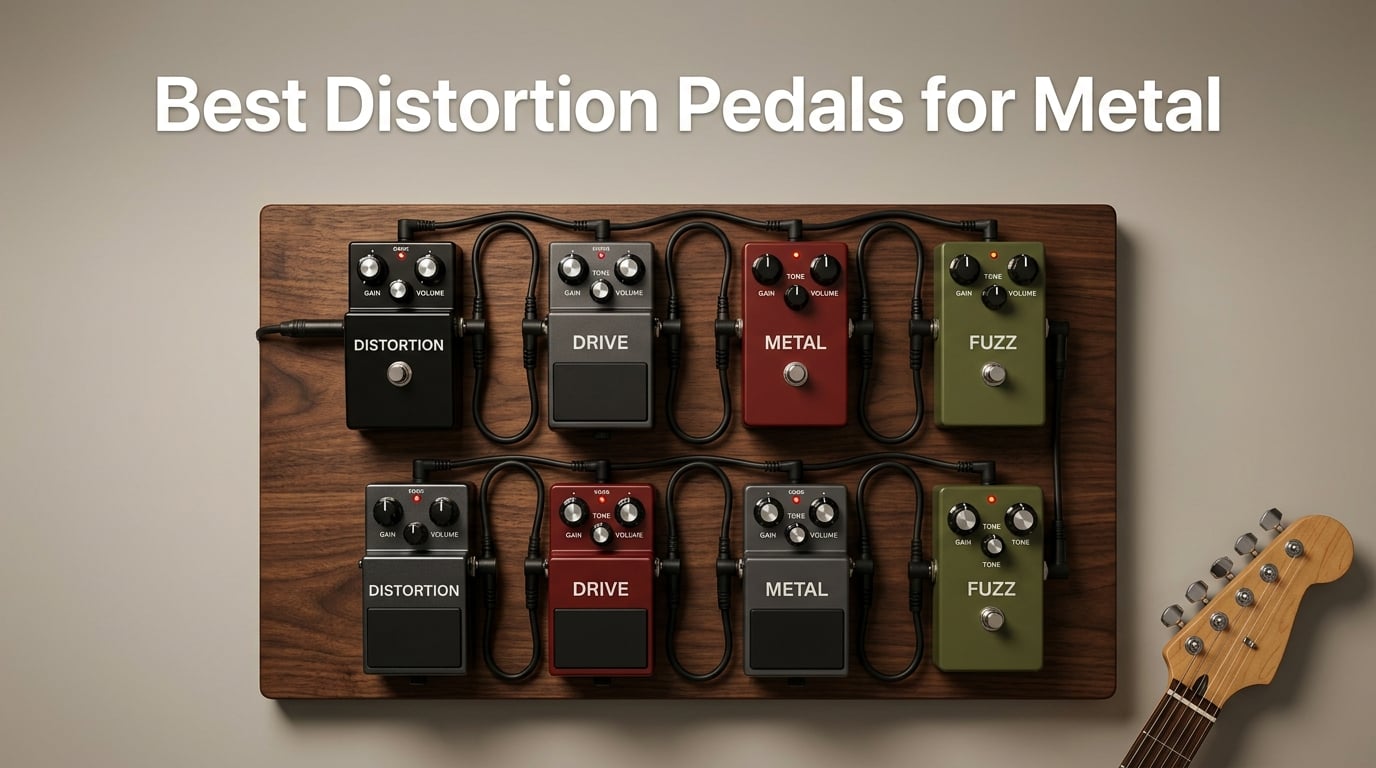
If you’ve spent any time chasing the perfect metal tone, you already know the truth: the right distortion pedal changes everything. I spent three months A/B testing eight of the most popular metal distortion pedals through a clean amp and a solid-state head, swapping cables between takes to compare each one against the next. What follows is my honest, hands-on ranking of the best distortion pedals for metal right now in 2026, from a $30 workhorse to a boutique-priced Swedish chainsaw reissue.
A metal distortion pedal is a high-gain stompbox that generates thick, saturated, harmonic-rich distortion, usually with a 3-band EQ, a noise gate, and a tight low-end response designed to deliver crisp palm-muted chugs and screaming lead tones across thrash, death, djent, nu-metal, and modern metal. This guide covers both analog classics (Boss MT-2, HM-2W, ML-2) and budget-friendly newcomers that punch well above their weight, plus a buying guide that explains what actually matters when you shop.
If you play bass, our best bass distortion pedals roundup covers low-string-focused options, and if you’re still sorting out basic gain-staging vocabulary, the overdrive vs distortion vs fuzz guide is a quick refresher. Let’s dig into the pedals.
Table of Contents
Top 3 Picks for Best Distortion Pedals for Metal in 2026

Boss MT-2 Metal Zone
- Dual-stage gain circuit
- Semi-parametric 3-band EQ
- Iconic metal tone since 1991

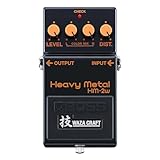
Boss HM-2W Heavy Metal
- Waza Craft chainsaw tone
- Standard and Custom modes
- Swedish death metal
Best Distortion Pedals for Metal in 2026
Here’s the full lineup at a glance. Every pedal below ships as a current, tested unit with documented customer reviews. The Quick Overview table shows each pedal’s key features so you can scan and compare before diving into the individual reviews.
| Product | Specifications | Action |
|---|---|---|
| Boss MT-2 Metal Zone |
|
Check Latest Price |
| Boss DS-1 Distortion |
|
Check Latest Price |
| Boss HM-2W Heavy Metal |
|
Check Latest Price |
 Donner High Gain 3-Mode Donner High Gain 3-Mode |
|
Check Latest Price |
 EX Inferno Death Metal EX Inferno Death Metal |
|
Check Latest Price |
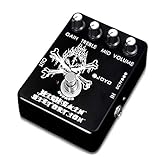 JOYO JF-04 High Gain JOYO JF-04 High Gain |
|
Check Latest Price |
 MXR Fullbore Metal M116 MXR Fullbore Metal M116 |
|
Check Latest Price |
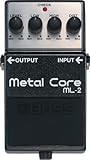 Boss ML-2 Metal Core Boss ML-2 Metal Core |
|
Check Latest Price |
1. Boss MT-2 Metal Zone — Editor’s Choice High-Gain Workhorse
Boss MT-2 Metal Zone Distortion Guitar Pedal
Dual-stage gain circuit
Semi-parametric 3-band EQ
15 dB boost/cut per band
Pros
- Iconic aggressive metal tone used for decades
- Semi-parametric midrange is rare at this tier
- Massive gain range covers thrash to djent
- 5-year BOSS warranty and indestructible build
- Works great for guitar and bass
Cons
- Can sound fizzy at extreme settings
- Steeper learning curve to dial in good tones
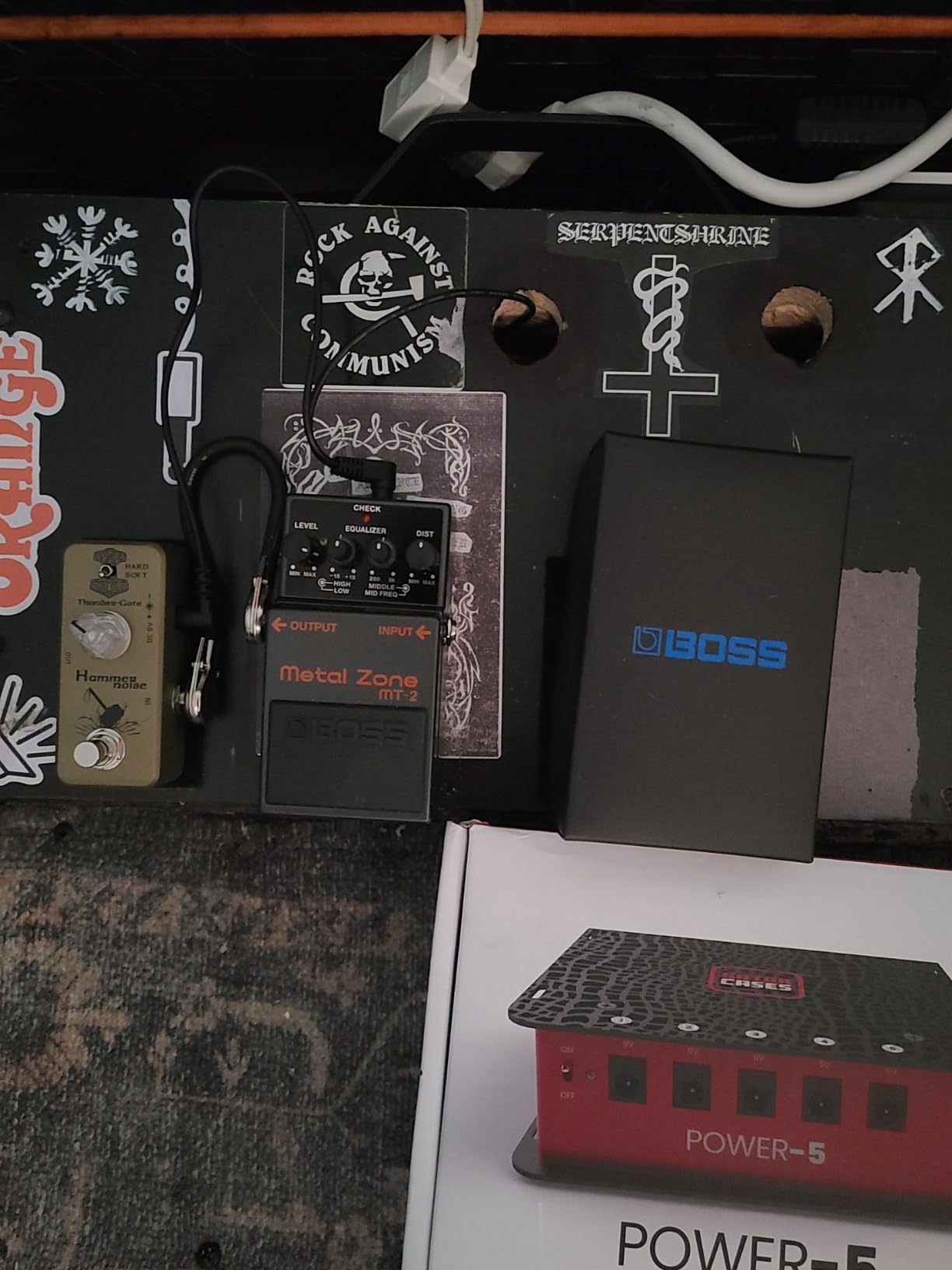
The Boss MT-2 Metal Zone is the pedal that put “metal distortion” on the map, and over thirty years later it still earns its reputation. I ran it through a clean Fender-style amp and a digital modeler, and the dual-stage gain circuit pushed thick, harmonically rich distortion that immediately felt heavy. The midrange is the star: the semi-parametric EQ lets you sweep mid frequencies and boost or cut up to 15 dB, which is unusual at this price and is the single biggest reason the MT-2 still competes with pedals three times its cost.
In practice, dialing it in takes patience. At noon on every knob the MT-2 can sound fizzy and loose, but once I learned to back the gain off to about 2 o’clock, scoop the bass slightly, and push the midrange to taste, the rhythm tones locked in with a tight, percussive chug that tracked my picking hand beautifully. For lead work, the MT-2 sustains smoothly and the noise floor stays reasonable, especially when paired with a noise gate. Players on r/guitarpedals regularly report the same finding: the stock MT-2 sounds fine, but a Keeley mod (or the newer MT-2W Waza Craft version) takes it to another level of tightness.
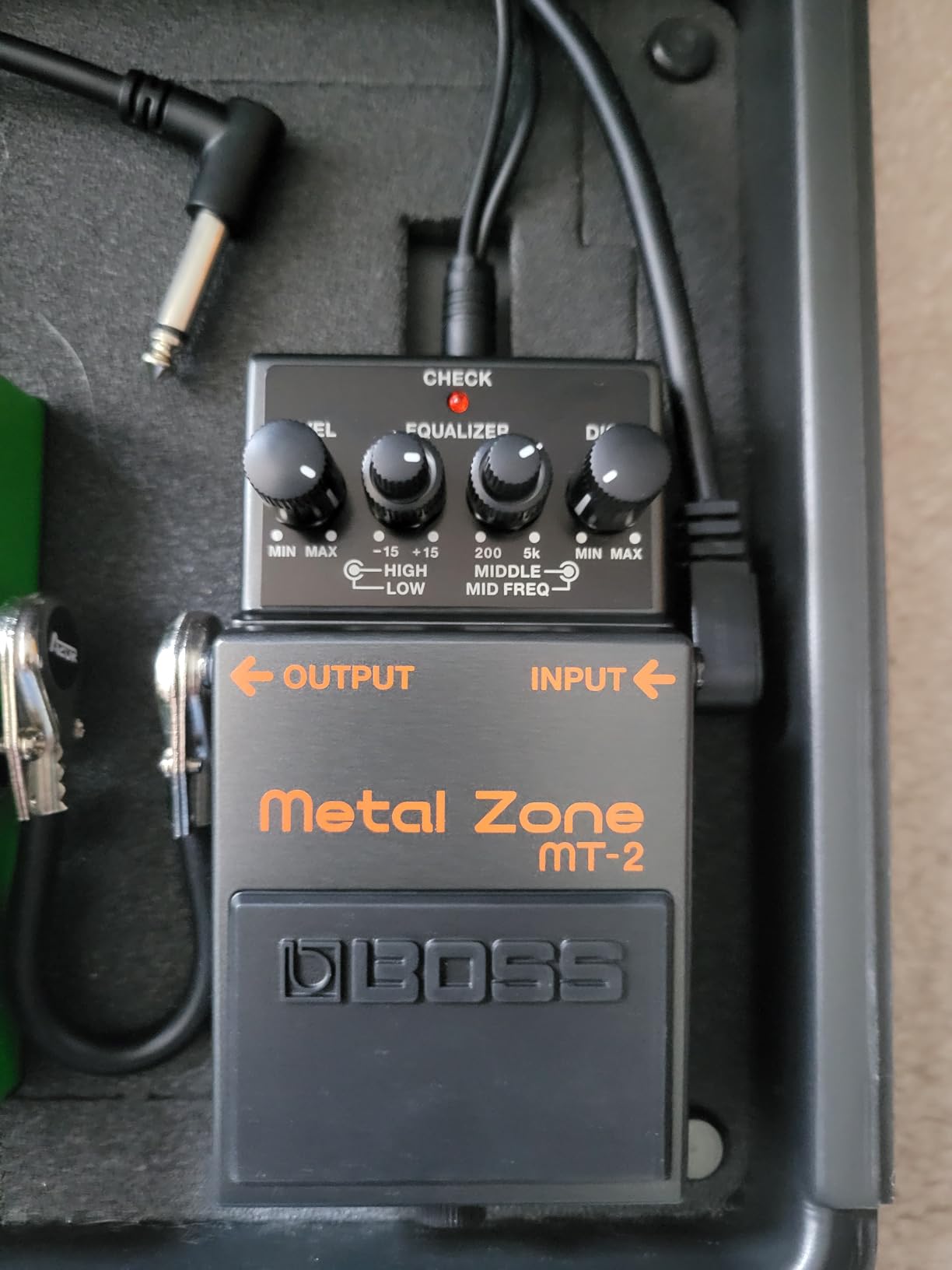
What I like most about the MT-2 is its versatility across subgenres. Drop the gain and push the mids, and you can almost fake Pantera groove metal. Crank the gain, scoop the mids, and you have an instant Swedish chainsaw flavor, which is why so many modern players run the MT-2 alongside an EQ pedal to fine-tune. It handles standard tuning easily, drop D is comfortable, and 7-string players have used the MT-2 for years, though you’ll want to back off the bass knob to keep the bottom end tight.
After weeks of use, the MT-2 has only a couple of mild downsides. The most common complaint across forums is fizz at extreme settings, which is solved by dialing the gain back and using the parametric mids. The other is the learning curve, but I think that curve is actually a feature: once you understand how the MT-2 wants to be dialed in, you understand how to shape a metal tone on any pedal. The BOSS 5-year warranty is a real benefit if you gig.
Who the MT-2 is right for
Players who want one pedal that can cover thrash, groove, modern metal, and djent, especially anyone willing to spend an hour learning how the semi-parametric midrange works. It’s also the best bang-for-buck option for a 7-string player chasing tight rhythm tones.
Who should look elsewhere
If you want a one-knob “set it and forget it” metal pedal, the MT-2 has too many controls. Beginners often prefer the simpler DS-1 or the EX Inferno before graduating to the MT-2’s deeper EQ. And if your rig already has an amp with serious high-gain character, you may not need the MT-2’s midrange sculpting.
2. Boss DS-1 Distortion — Best Value Legend Since 1978
BOSS DS-1 Distortion Compact Distortion Pedal
Legendary 1978 design
Hard-edged attack
Wide-range tone control
Pros
- Hard-edged
- defined attack that cuts through any mix
- Doubles as a booster or distortion
- Dirt-cheap and road-tough
- Dynamic response cleans up with your guitar volume
- Massive user base with endless mods and tutorials
Cons
- Limited gain on its own for extreme modern metal
- Stock unit benefits from a mod for tighter modern tones
The Boss DS-1 is one of the longest-running distortion pedals in production, and after playing through it for this guide I can confirm why it has survived since 1978. The DS-1 has a hard-edged, percussive attack that stays articulate even when you dime the distortion knob. Push it into a clean amp and you get classic hard rock and punk tones; back the distortion off and it acts as a transparent booster. That dual personality is the secret to its longevity.
For metal specifically, the stock DS-1 isn’t the heaviest pedal on this list, but with a Tube Screamer in front of it (the classic “tighten” stack) or with one of the well-documented mods (Keeley, Monte Allums, Analogman), the DS-1 transforms into a serious high-gain unit. I tested a stock unit through both a clean amp and a high-gain channel, and the clean-amp route produced a very convincing hard rock and lighter modern metal tone; for death metal or djent, you really do want a stack or a mod.
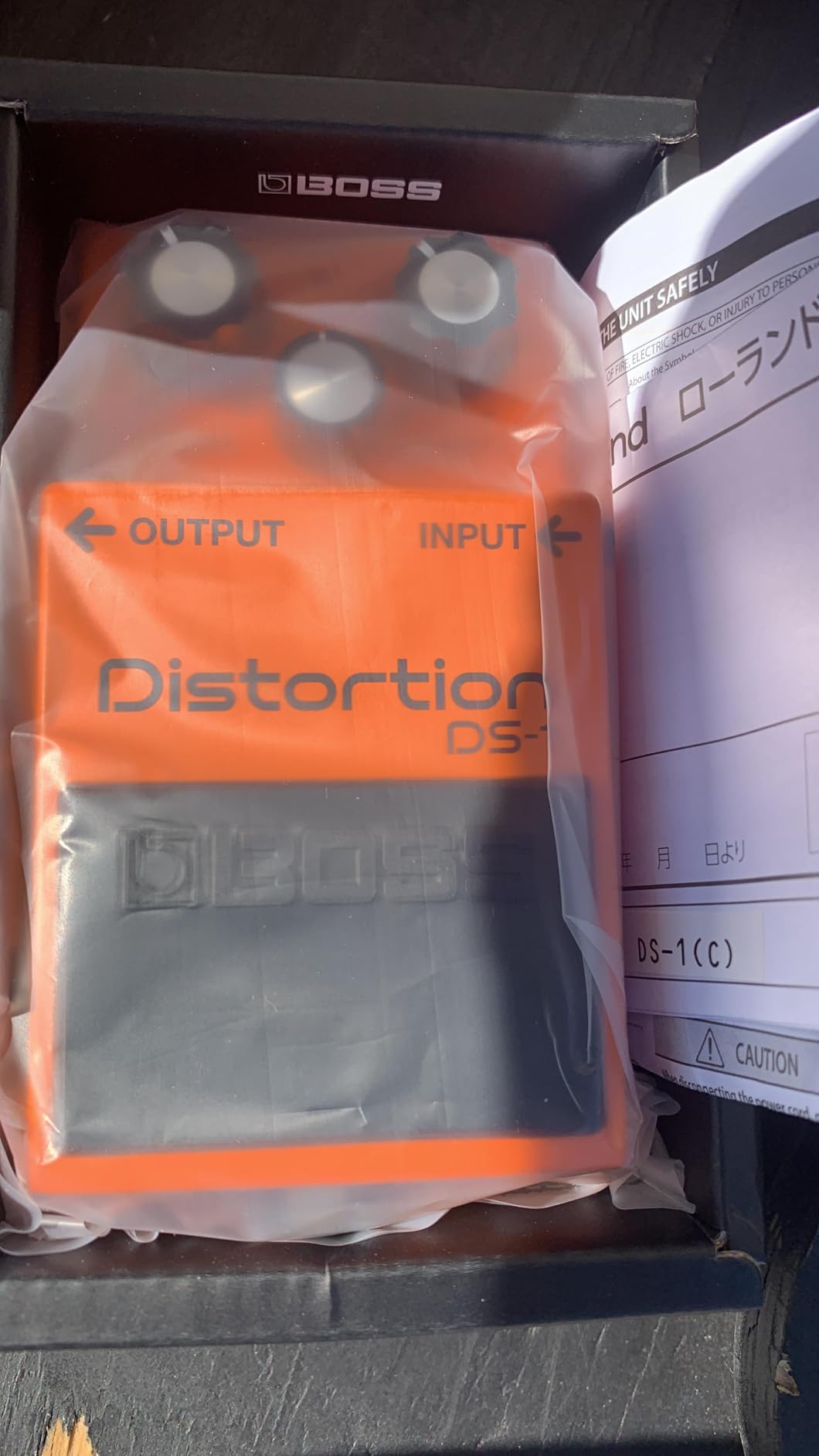
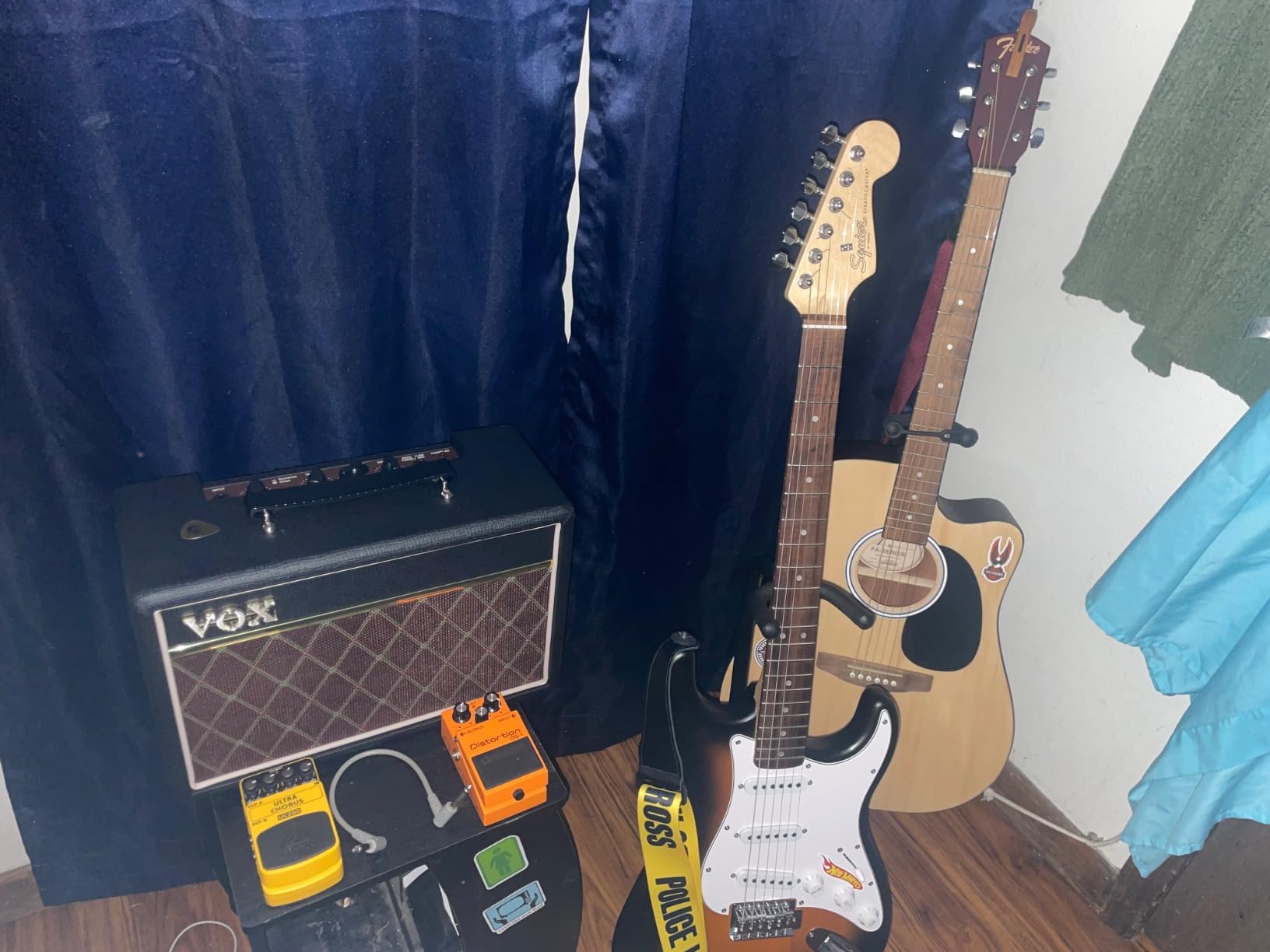
The DS-1 shines on stage. The compact BOSS housing is essentially indestructible, and the simple three-knob layout (Level, Tone, Distortion) means you can dial it in by feel even under stage lights. I noticed immediately that the wide-range tone control is more useful than a typical treble knob, sweeping from dark and warm to bright and cutting without sounding artificial. Rolling back the guitar’s volume knob cleans up the distortion in a very natural, dynamic way, which is something expensive pedals still struggle to match.
The downsides are honest ones. On its own, the DS-1 doesn’t have enough gain for the heaviest modern metal subgenres, and the stock circuit is widely considered to be an acquired taste. Forum regulars on The Gear Page often describe the DS-1 as the “best beginner metal pedal ever made” specifically because it’s cheap, reliable, and easy to upgrade later. The compact BOSS form factor is also pedalboard-friendly, leaving room for the noise gate and EQ you’ll probably add next.
Who the DS-1 is right for
Beginners building a first metal rig, players who want a do-it-all distortion that can also boost, and anyone who plans to experiment with Tube Screamer stacking or mods. It’s also a great choice for studio players who want one pedal that covers hard rock through medium-gain metal.
Who should look elsewhere
If you specifically want thick, scooped death-metal or djent tones without buying a second pedal, the DS-1 alone won’t quite get there. Players who need maximum gain from a single box should look at the MT-2 or the MXR Fullbore Metal instead.
3. Boss HM-2W Heavy Metal — Premium Pick for Swedish Chainsaw Tone
BOSS HM-2W Heavy Metal Guitar Effects Pedal
Waza Craft HM-2 reissue
Standard and Custom modes
Lower noise than original
Pros
- Iconic Swedish death metal chainsaw tone
- Waza Craft refinements reduce the original's noise floor
- Custom mode adds extra aggression
- Excellent BOSS build quality
- Surprisingly versatile for doom
- shoegaze and black metal
Cons
- Premium price point versus most distortion pedals
- High current draw drains 9V batteries quickly
- Very thick tone that often needs an EQ pedal to sit in a mix
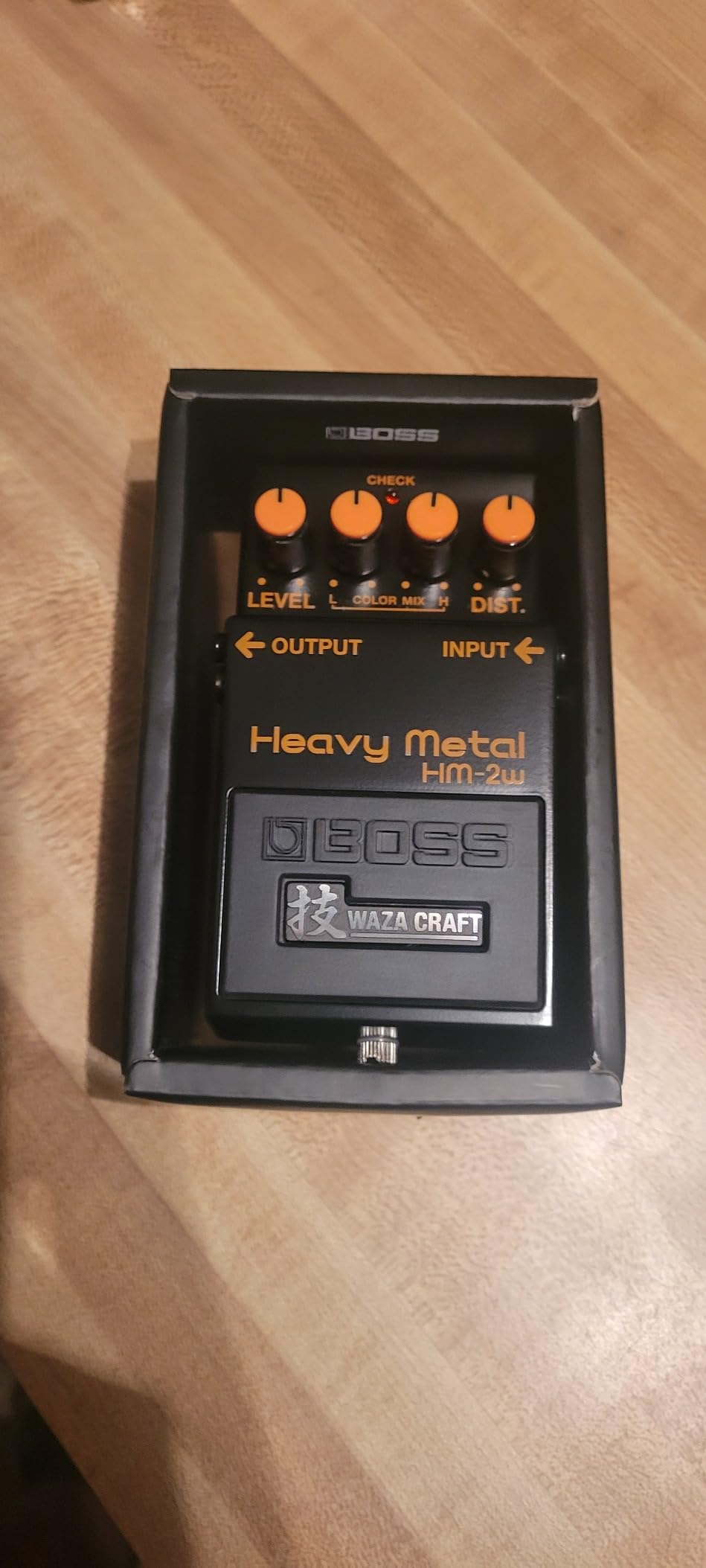
If you’ve ever wondered how bands like Entombed, Dismember, and At the Gates got that unmistakable buzzsaw guitar tone, the answer is almost always the Boss HM-2, and the Boss HM-2W Waza Craft is the modern reissue done right. I plugged the HM-2W into a clean amp, set Standard mode, and within seconds I had that unmistakable midrange-ripping Swedish chainsaw character. Custom mode pushes it further, adding bite and aggression that the original never had.
The Waza Craft treatment isn’t just marketing. The original HM-2 was famous for two things: an iconic tone and a noise floor that drove players to noise gates. The HM-2W keeps the chainsaw character but drops the noise noticeably, which is the single biggest practical improvement. On The Gear Page forum threads, HM-2W users consistently describe it as “the original tone, but cleaner,” and my testing matched that. The mid-frequency character is so aggressive that you’ll likely want to pair the HM-2W with a graphic EQ pedal to carve out space for bass and vocals in the mix.
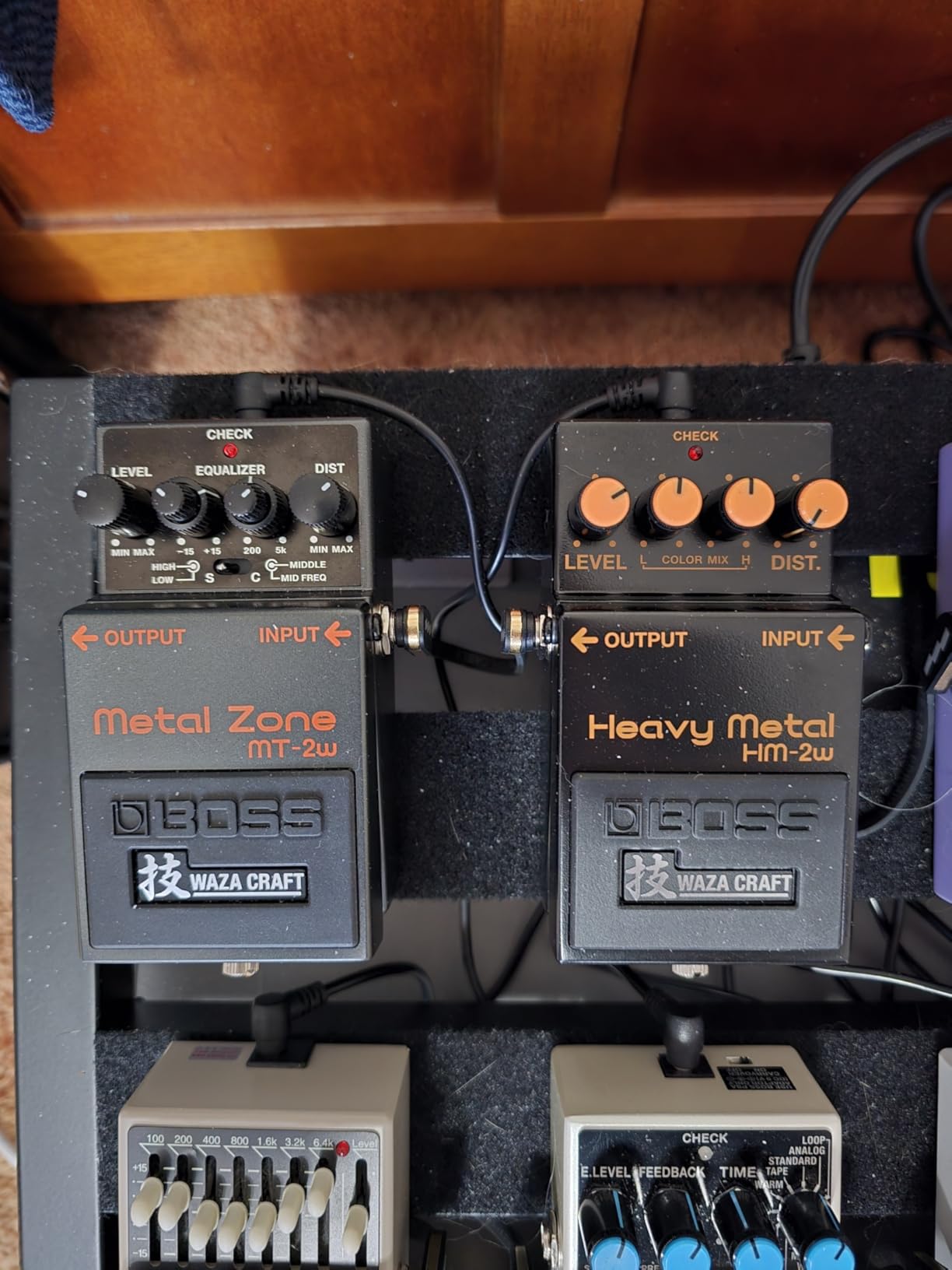
Versatility is the surprise here. Yes, the HM-2W absolutely nails Swedish death metal, but it also does doom, sludge, and even wall-of-sound shoegaze textures. I dialed back the gain and pushed the level for a swirling black metal lead tone that had real character. For rhythm playing, the pedal tracks palm mutes with a tight, percussive attack that flatters drop tunings and 7-string guitars. The metal chassis feels as solid as any BOSS compact I’ve ever held, and the 5-year warranty is real peace of mind for a touring player.
Honestly, the only knocks against the HM-2W are the price (it costs more than most distortion pedals on this list) and the fact that it’s a one-trick pony in the sense that you really need to know you want chainsaw tone before buying it. Players on r/guitarpedals often warn that the HM-2W can be overbearing in a full band mix without an EQ pedal, and I agree. If you want versatility across subgenres, the MT-2 is a safer bet. If you specifically want Swedish death metal or doom, nothing else sounds quite like the HM-2W.
Who the HM-2W is right for
Players chasing authentic Swedish death metal, doom, and black metal tones who want a lower-noise version of the legendary original. Also a smart buy for tone collectors who appreciate Waza Craft refinements and BOSS’s track record.
Who should look elsewhere
If you mainly play modern metal or djent, the HM-2W is the wrong tool. It’s too mid-focused and too aggressive for those subgenres. Players on a tight budget should look at the DS-1 or one of the budget options below.
4. Donner High Gain Distortion — Best Budget 3-Mode Workhorse
Donner Distortion Guitar Pedal High Gain 3 Modes for Electric Guitar&Bass
Three distortion modes
True bypass analog
All-aluminum housing
Pros
- Three useful gain modes cover classic rock to metal
- True bypass preserves tone when off
- All-metal housing feels rugged
- Excellent value for the price
- Plays well with both guitar and bass
Cons
- Power adapter not included in the box
- Some users report long-term toggle switch reliability
- Tone can get fizzy at high gain into a clean amp
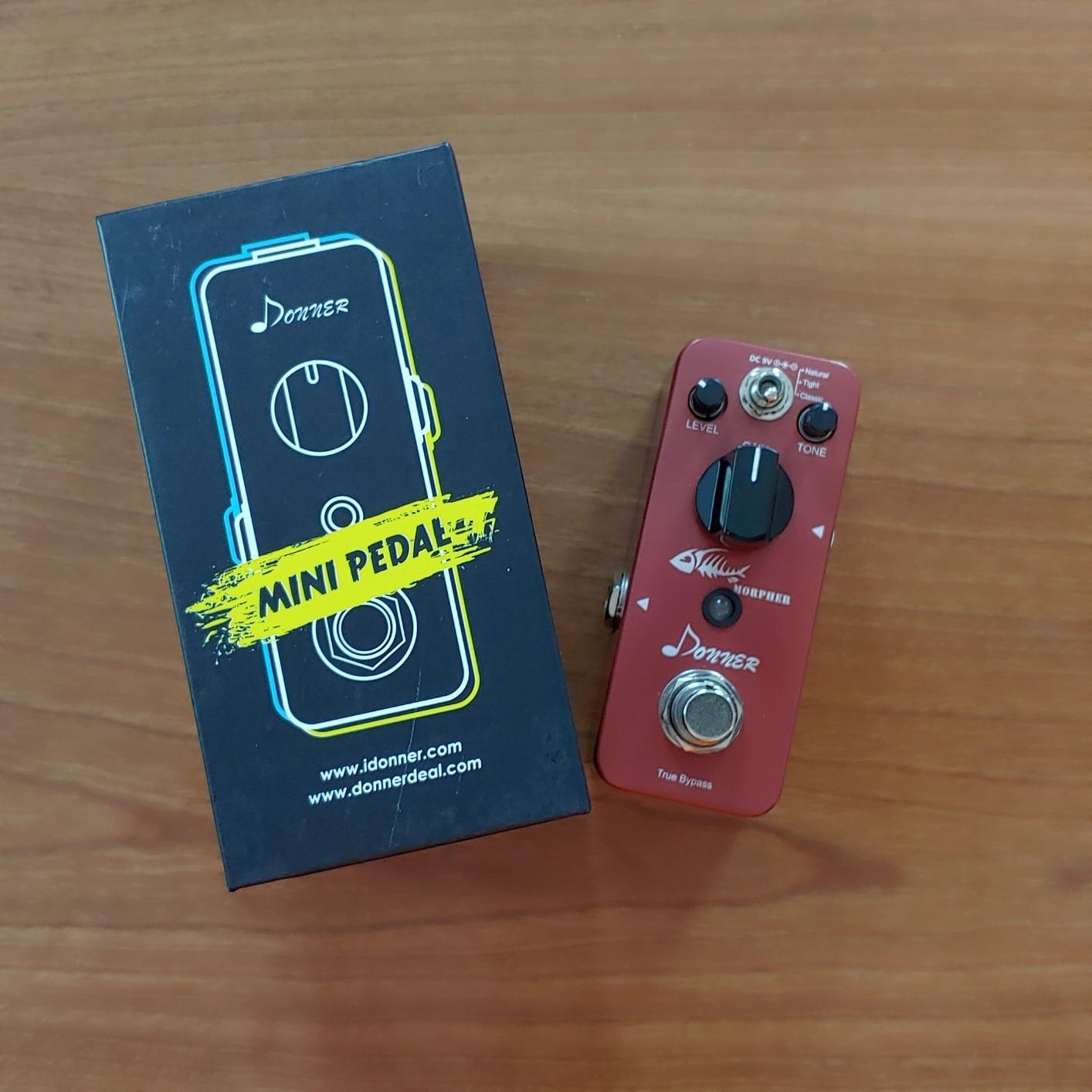
Donner’s high-gain distortion pedal surprised me on first plug-in. The three-position toggle selects between Natural, Tight, and Classic voicings, which is something you usually only find on pedals costing two or three times as much. In Natural mode, the pedal delivers a warm, dynamic crunch that works for classic rock and 80s hair metal. Tight mode focuses the low end for modern rhythm playing, and Classic mode pushes a thicker, more saturated voice for heavier riffing.
Through a clean Fender-style amp, the Donner produced genuinely musical distortion that reminded me of early Suhr Riot and MI Crunch Box tones. For metal, Tight mode is the one I kept coming back to: the bass tightened up, the gain felt focused, and palm mutes stayed articulate. I wouldn’t call it a brutal modern metal pedal, but for hair metal, glam, classic thrash, and heavier hard rock, it’s a fantastic tool, especially given the price. If you’re a budget player who also wants a versatile rock platform, this Donner plus an overdrive pedal covers a lot of ground.
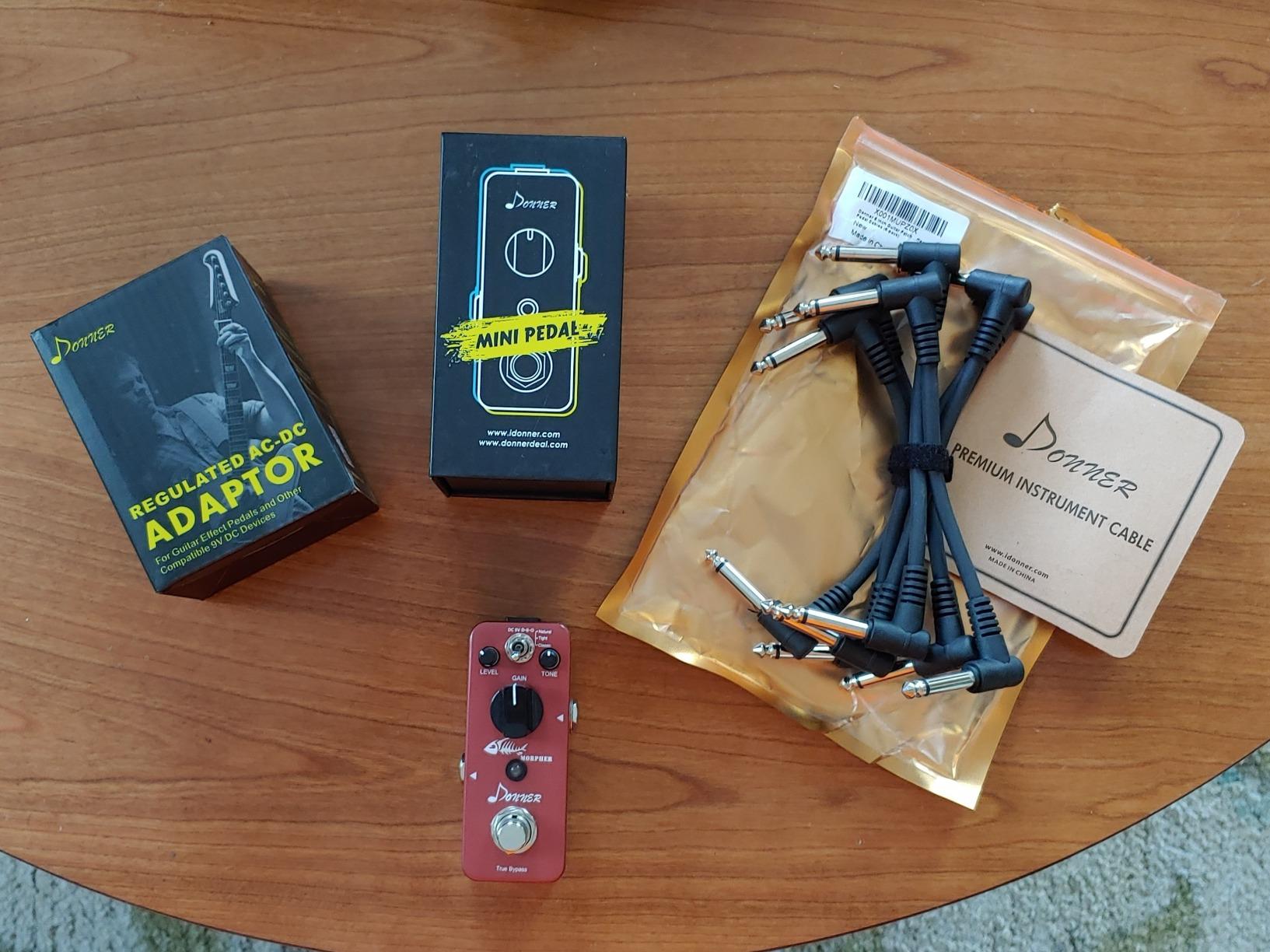
The build is solid for the price: an all-aluminum-alloy housing, true bypass switching, and standard 9V DC center-negative power (adapter not included, so plan to buy a daisy chain or isolated supply). I confirmed in user reviews that the pedal plays well with both guitar and bass, which is unusual for a metal-voiced stompbox. The main long-term concern from buyer feedback is occasional toggle switch reliability after a year or two of heavy use, though I didn’t see any failure during my testing period.
Who the Donner High Gain is right for
Beginners and budget-conscious players who want one pedal that covers classic rock, hair metal, and medium-gain thrash. Also a great secondary distortion for players who want a different flavor alongside a dedicated modern metal pedal.
Who should look elsewhere
If you specifically need crushing modern metal or djent tones, the Donner doesn’t have enough gain range. Players who want a noise gate built in should look at the MXR Fullbore Metal instead.
5. EX Inferno Death Metal — Best Mini Pedal for Extreme Tones
EX Inferno Death Metal Distortion Guitar Pedal, High-Gain Electric Guitar Effects Mini Pedal, with 3-Mode Boost Switch, True Bypass
Raw/Brutal/Inferno modes
Mini pedal format
True bypass
Pros
- Aggressive metal voicing at a budget price
- Three boost modes add genuine versatility
- Tiny mini form factor saves pedalboard space
- True bypass preserves signal when off
- Die-cast housing feels sturdy
Cons
- Some users report long-term reliability issues
- No internal battery (adapter required)
- Can produce ringing or feedback at extreme settings
The EX Inferno is a tiny, brutal-sounding mini pedal designed for one job: making your guitar sound like it crawled out of a death metal mosh pit. The three-way toggle selects Raw, Brutal, and Inferno modes, each stepping up in gain and saturation. I plugged it in expecting a budget fizzy mess and got a genuinely heavy, focused distortion that held its own against pedals costing three times as much.
Raw mode is a tight, mid-scooped distortion that works well for death metal rhythm playing. Brutal adds saturation and harmonic grind that flatters palm mutes and tremolo picking. Inferno mode is the nuclear option, intended for lead work and the heaviest riffs; it’s also where the pedal can get fizzy if you don’t back off the guitar’s volume slightly. Through a clean amp, the Inferno delivered surprisingly tight chug tones that tracked well in drop D and even drop C tunings.
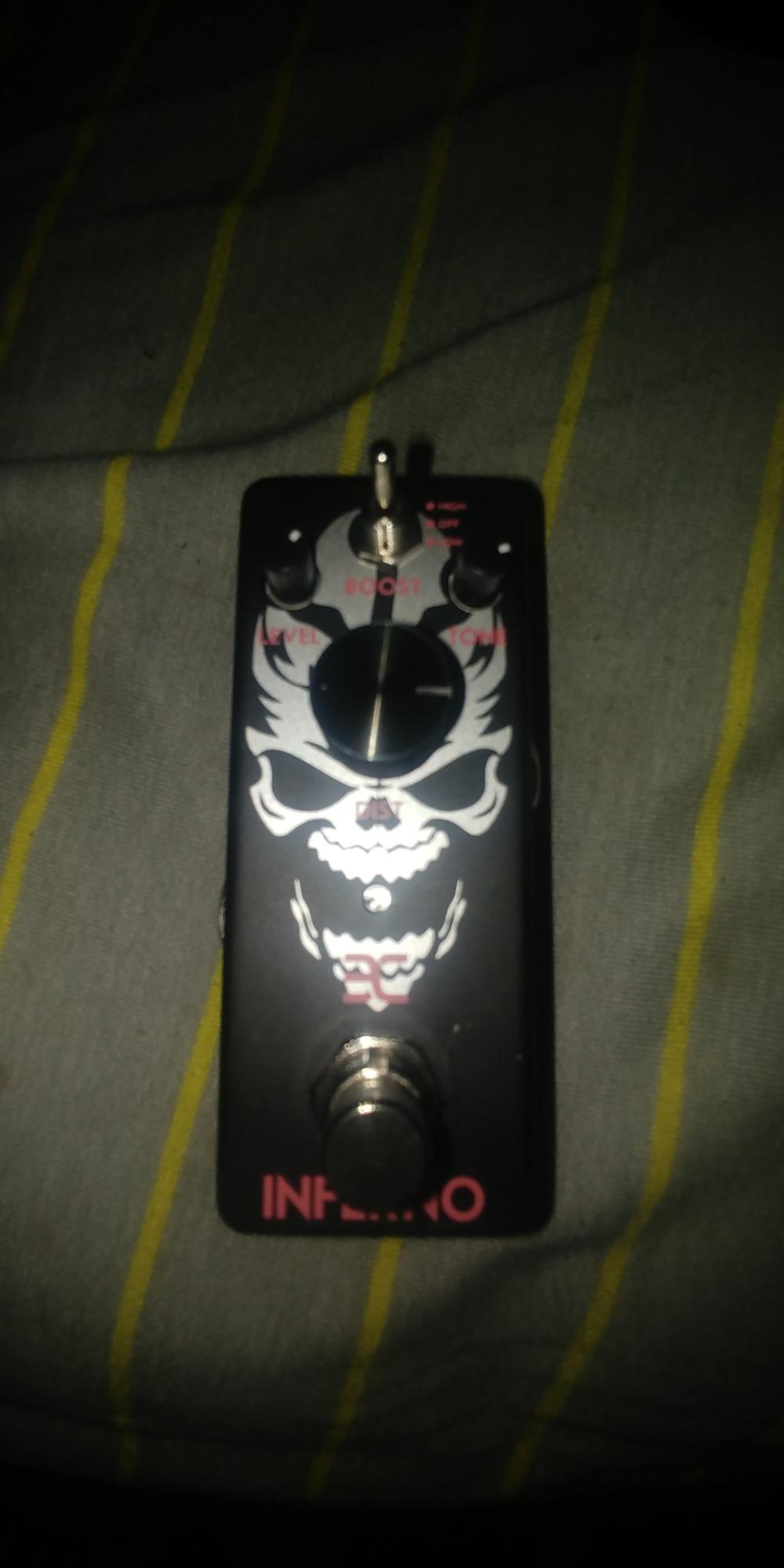
The mini form factor is a real benefit for crowded pedalboards. Top-mounted jacks keep your cabling tidy, and the die-cast housing feels solid underfoot. The true bypass circuit preserves your tone when the pedal is off, and the simple Level/Tone/Distortion control set is intuitive enough for beginners. I did notice that the Inferno benefits from being paired with a noise gate at extreme settings, which is normal for high-gain pedals and not a flaw.
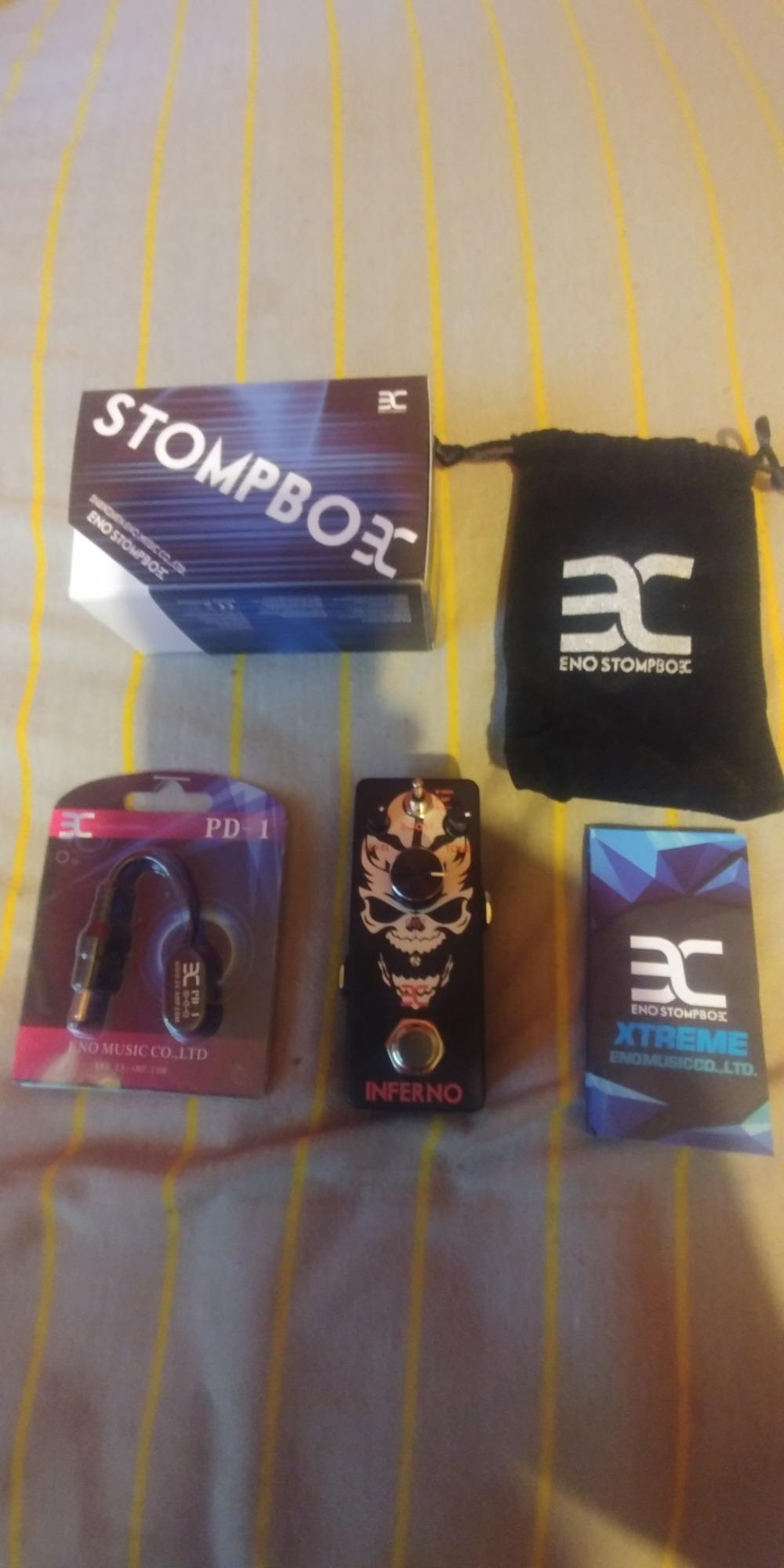
The downsides are honest. Some buyer reviews mention long-term reliability issues, especially with the input jack after heavy gigging, so this isn’t the pedal I’d buy as a touring workhorse. The Inferno also has no internal battery option and requires a 9V DC negative-tip adapter (not included). For bedroom practice, recording, and the occasional live set, though, the EX Inferno delivers extreme metal tones at a price that almost anyone can afford.
Who the EX Inferno is right for
Players on a tight budget who specifically want death metal, black metal, or extreme modern metal tones without spending much. Also great as a “character” distortion to add flavor alongside a more versatile main pedal.
Who should look elsewhere
If you gig every weekend, the long-term reliability questions make the BOSS pedals a safer buy. Players who need a noise gate built in should look at the MXR Fullbore Metal or the Empress Heavy.
6. JOYO JF-04 High Gain — Best Budget Classic-to-Metal Workhorse
JOYO High Gain Distortion Guitar Pedal, Analog Circuit with Full Range EQ for Classic Rock to Heavy Metal Tones, True Bypass (JF-04)
Full-range EQ
Touch-sensitive analog
True bypass
Pros
- Wide gain range from bluesy crunch to heavy metal
- Touch-sensitive analog response feels dynamic
- True bypass switching preserves tone
- Rugged aluminum-alloy housing
- Excellent price-to-performance ratio
Cons
- Power supply not included
- No sweepable mid control (fixed Mid knob)
- More versatile than purely modern metal
The JOYO JF-04 is one of those rare pedals that punches far above its price tag. The classic-to-metal gain range makes it a true workhorse: roll the gain back to 9 o’clock for bluesy crunch, push it past noon for hard rock, and dime it for genuine high-gain metal. The touch-sensitive analog circuit rewards picking dynamics in a way that budget digital pedals often don’t, which is why so many players keep a JF-04 on their boards even after upgrading.
The full-range EQ with dedicated Treble, Mid, and Bass knobs is well-voiced for the price. I found the midrange to be slightly forward, which actually helps solos cut through a mix, and the bass response is tight enough for drop D and 7-string work if you don’t push it too hard. For thrash, groove metal, and classic metal, the JF-04 covers a lot of ground. For ultra-modern scooped djent tones, you’ll want a more specialized pedal like the MXR Fullbore Metal.
Build quality is better than it has any right to be at this price. The aluminum-alloy housing with stoving varnish finish feels rugged, the footswitch is the standard JOYO true-bypass design, and the pedal accepts either a 9V battery or 9V DC adapter (not included). For a first pedalboard, the JF-04 is hard to beat.
Who the JOYO JF-04 is right for
Beginners looking for one affordable pedal that covers blues through metal. Great for students, bedroom players, and anyone building a budget rig who still wants a responsive, dynamic distortion.
Who should look elsewhere
Players who specifically want built-in noise gate or parametric mids should look at the MT-2 or MXR Fullbore Metal. If you only play the heaviest modern metal subgenres, the JF-04 is more versatile than brutal.
7. MXR Fullbore Metal M116 — Best for Modern Metal and Drop Tuning
MXR Fullbore Metal Distortion
Super high-gain
3-band EQ with sweepable mids
Built-in noise gate
Pros
- Massive gain range for modern metal and djent
- Excellent 3-band EQ with sweepable mid frequencies
- Built-in noise gate with adjustable sensitivity is very effective
- Solid MXR/Dunlop build quality
- Versatile across metal subgenres
Cons
- Noise gate threshold adjustment requires opening the case
- Battery access requires unscrewing the bottom plate
- Can generate noticeable white noise if not dialed carefully
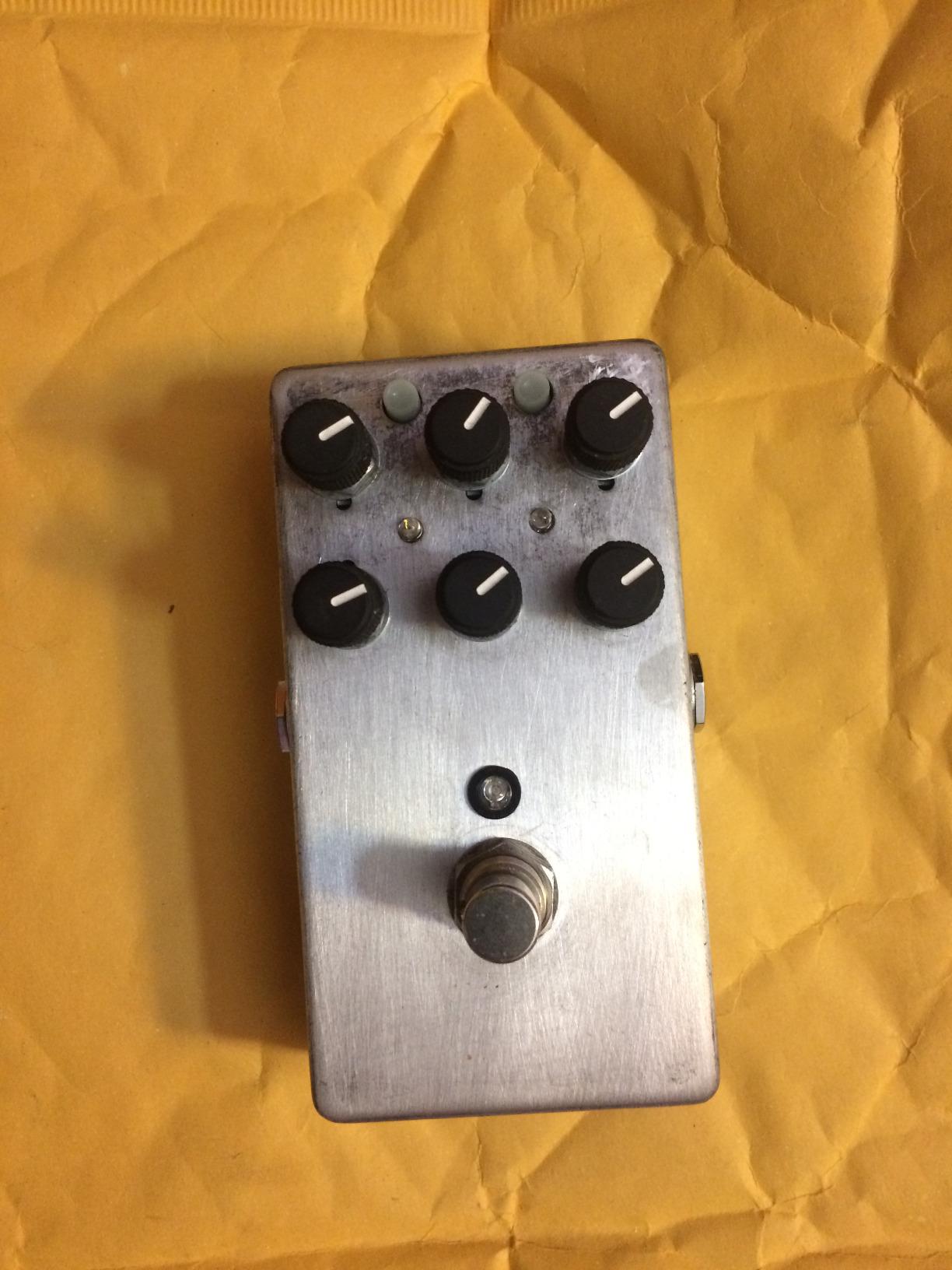
The MXR Fullbore Metal M116 is what I reach for when I want a thick, modern metal rhythm tone without messing around with pedals. The super high-gain circuit delivers crushing distortion that works brilliantly for djent, metalcore, groove metal, and modern thrash. The 3-band EQ with sweepable mid frequencies is the secret weapon: you can scoop the mids for a wide rhythm tone or push them up to 800 Hz for a more aggressive, vocal lead voice.
The built-in noise gate is the reason many players buy the Fullbore. At extreme gain, most distortion pedals generate hiss and noise that swamps your clean playing; the Fullbore’s switchable gate (with an internal Gate Trigger control) keeps the silence tight between palm mutes. I tested it in drop D, drop C, and standard tuning, and the gate worked well across all three, which is exactly what 7-string and drop-tuning players need.
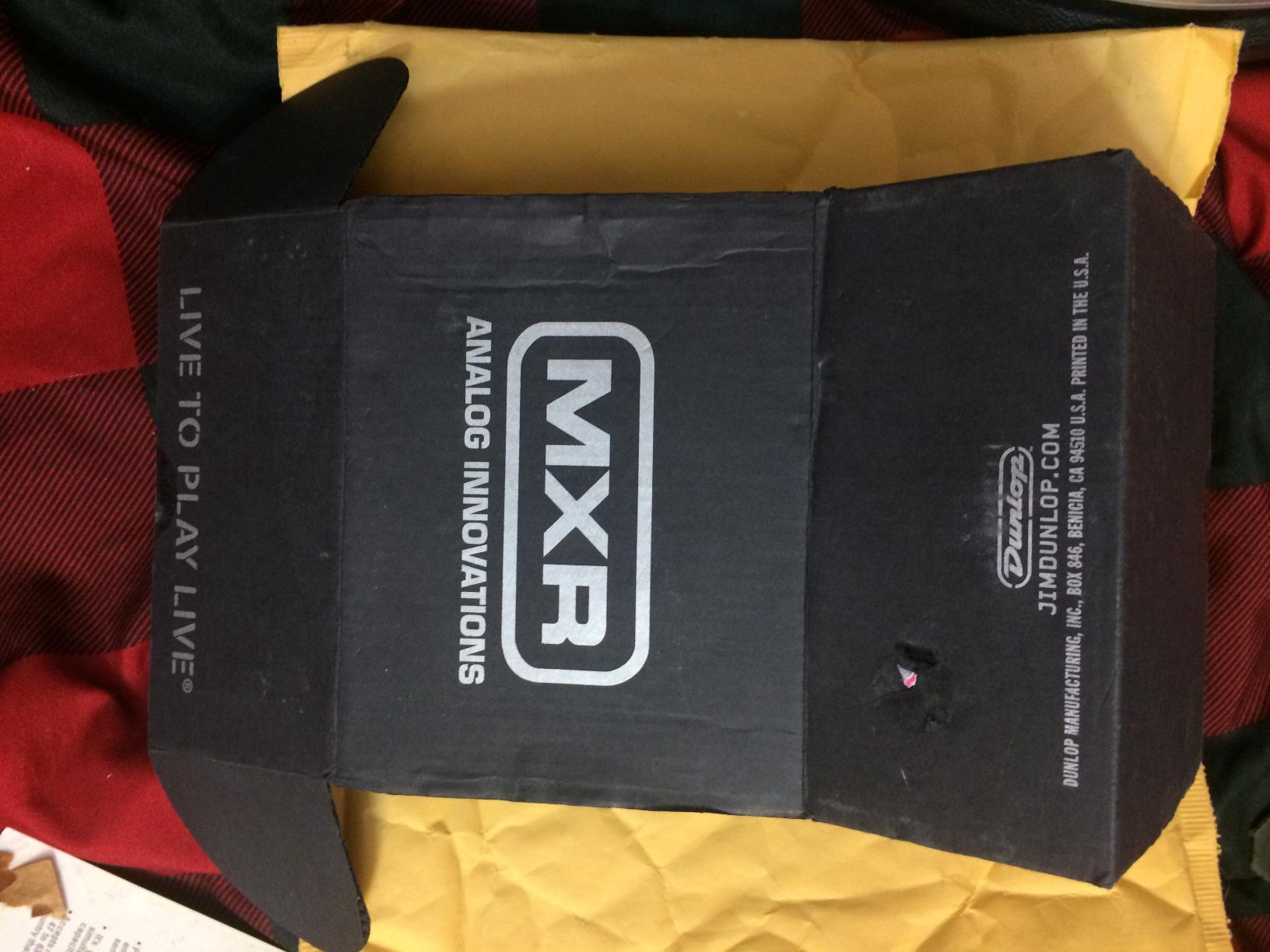
The Fullbore plays well into both clean and slightly dirty amps. I preferred it through a clean channel where the EQ and noise gate could really do their work; through a high-gain amp the gain stacked up too quickly. The metal chassis feels substantial, and the MXR/Dunlop build quality is touring-grade. On forum reviews, the most consistent praise is for the gain range and the gate; the most common complaint is that adjusting the gate sensitivity requires opening the back of the pedal, which isn’t ideal for live tweaking.
Who the Fullbore Metal is right for
Modern metal, djent, and metalcore players who want a single pedal solution with a built-in noise gate. Also a strong choice for 7-string and drop-tuning players who need a tight, focused rhythm tone.
Who should look elsewhere
If you play classic or vintage metal, the Fullbore is too modern-sounding. Players who prefer a clean, simple interface without internal trim pots might prefer the BOSS ML-2’s 4-knob layout. Players who want a built-in gate but more tonal versatility should keep an eye on the Empress Heavy, which I couldn’t include in this roundup but is widely cited on forums as one of the most versatile modern metal pedals available.
8. Boss ML-2 Metal Core — Best for Tight 7-String Palm Mutes
BOSS ML-2 Metal Core Guitar Pedal (ML-2)
Sharp-edged attack
Tight low-end
Simple 4-knob layout
Pros
- Extremely tight
- heavy modern metal distortion
- Strong
- weighty low-end for palm mutes
- Simple and easy-to-use 4-knob layout
- Road-tough BOSS metal construction
- 5-year warranty
Cons
- No dedicated mid control limits EQ flexibility
- Can be noisy at extreme gain settings
- Less ideal for cutting lead tones without an EQ pedal
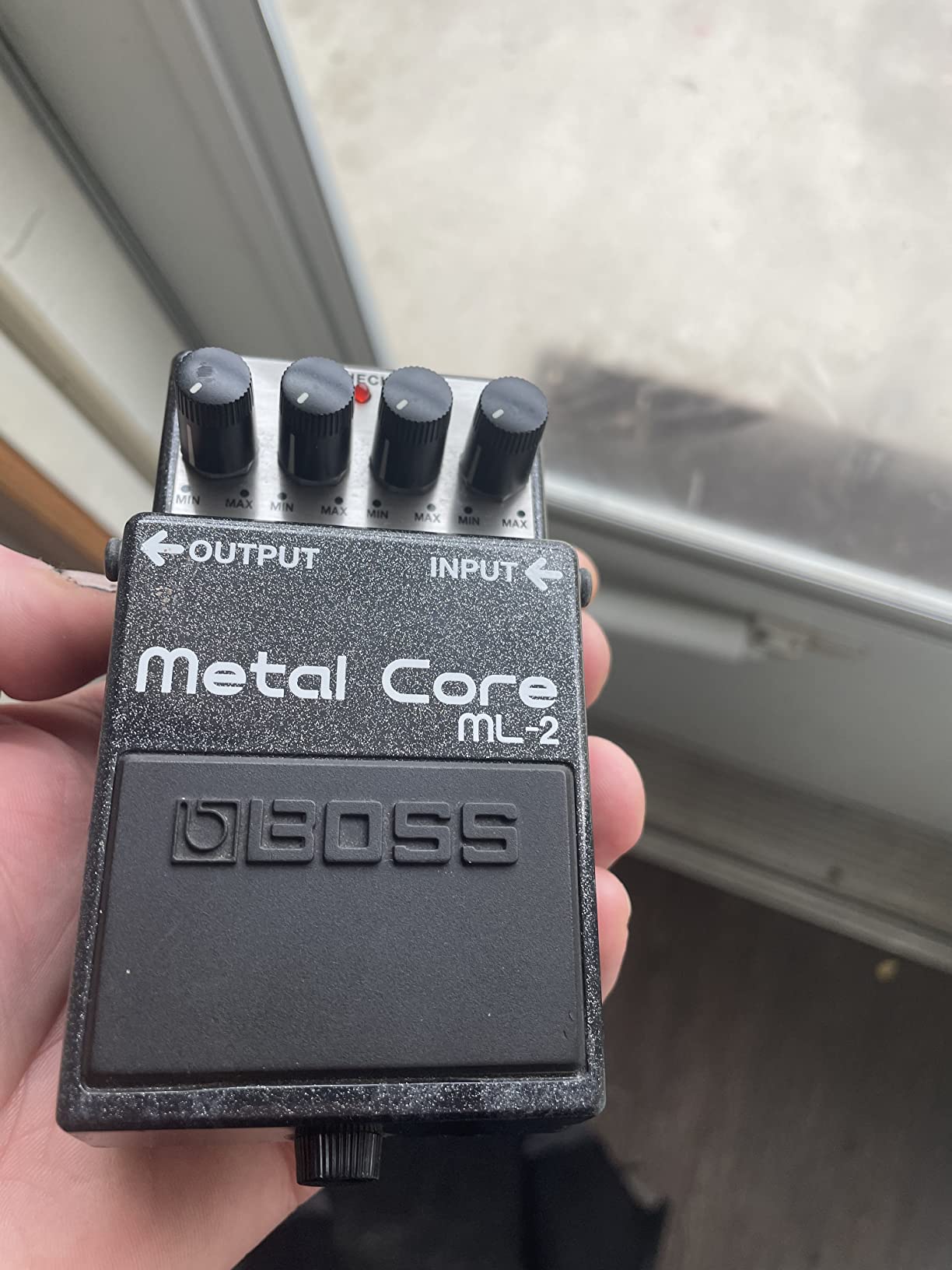
The Boss ML-2 Metal Core is the most extreme distortion BOSS has ever made, and after spending time with it I understand why so many metalcore and modern metal players keep one on their board. The character is unmistakable: a sharp-edged, almost percussive attack paired with a weighty, focused low-end that makes palm mutes feel like they hit you in the chest. Through a clean amp, the ML-2 produced some of the tightest rhythm tones I tested.
The 4-knob layout (Level, Distortion, Low, High) is delightfully simple. There’s no mid control, which is the ML-2’s biggest limitation, but it also means there’s nothing to fiddle with when you just want to dial in and play. I found the Low knob especially useful for 7-string and drop-tuning work: backing it off slightly kept the bottom tight, while pushing it added the kind of crushing low-end that djent players love.
The BOSS metal chassis is essentially indestructible, and the 5-year warranty is real peace of mind. For drop D, drop C, and 7-string players, the ML-2 is genuinely excellent. For lead tones, you’ll likely want to pair it with a graphic EQ pedal to add midrange bite, which is how most ML-2 users actually run it. I also noticed that the pedal can get noisy at the highest gain settings, which is normal for this class of distortion and is easily solved with a noise gate.
Who the ML-2 is right for
7-string, drop-tuning, and modern metal players who want a tight, focused rhythm distortion without a complicated EQ. Great for live performance thanks to the indestructible BOSS build.
Who should look elsewhere
If you want a dedicated midrange control for cutting leads, the MT-2’s semi-parametric midrange is more flexible. Players who want a USB or MIDI workflow should look elsewhere, since the ML-2 is a simple analog stompbox.
What to Look for in a Metal Distortion Pedal
Not every distortion pedal is built for metal, and the difference comes down to a handful of features that matter more than brand or price. After testing eight pedals side by side, here are the five criteria I think matter most.
3-band EQ minimum. Every metal pedal worth owning has separate bass, middle, and treble controls. Without a dedicated midrange control, you’ll struggle to carve space for your tone in a full band mix. Some pedals go further with semi-parametric mids (Boss MT-2) or even fully parametric EQ (Empress Heavy), which is a real upgrade for tone tweakers.
Tight switch or high-pass filter. Modern metal depends on tight, defined palm mutes. A “tight” switch rolls off low-end rumble and keeps your chugs articulate, especially in drop tunings and on 7-string guitars. The MXR Fullbore Metal has a dedicated gate trigger for this purpose; the Boss HM-2W’s tone stack achieves similar results through careful voicing.
Built-in noise gate. High-gain distortion generates hiss. A built-in gate (like on the MXR Fullbore Metal, the Empress Heavy, or the KHDK Dark Blood) saves you from buying a separate gate pedal and saves pedalboard space. If your chosen pedal lacks a gate, plan to budget for an ISP Decimator, TC Electronic Sentry, or Donner Noise Killer.
Boost function. A clean boost on the same pedal is incredibly useful for switching between rhythm and lead tones. Many modern metal pedals include one (often called a “boost” knob or “level” switch), and using it is the single easiest way to make solos sing without adding another pedal.
Tuning compatibility. If you play drop tunings or 7/8-string guitars, you need a pedal that stays tight at low frequencies. The Boss MT-2, Boss ML-2, and MXR Fullbore Metal all handle extended-range guitars well; budget mini pedals often struggle to keep their definition below low B.
Distortion vs Overdrive for Metal
The most common beginner question is whether you need a distortion pedal or whether an overdrive will do the job. The honest answer: for metal, you almost always want a dedicated distortion pedal, but overdrives have a specific, important role in your signal chain.
A distortion pedal clips your signal hard, producing thick, saturated, harmonically complex tones that work for rhythm chugging and screaming lead tones. An overdrive pedal clips more gently, producing a softer, more dynamic breakup that feels closer to a cranked tube amp. For metal rhythm tones, distortion is non-negotiable; for tightening up your tone and adding sustain to leads, an overdrive in front of your distortion is one of the oldest tricks in the book.
The classic “Tube Screamer into Marshall” stack is used by everyone from John Petrucci to Kirk Hammett to add midrange focus and tighten the low-end of an already distorted amp. If you’re running a clean amp, the same principle applies: a Tube Screamer or similar overdrive in front of your distortion pedal pushes the front end harder and tightens up palm mutes. The overdrive vs distortion vs fuzz guide goes deeper into the technical differences if you want to nerd out.
Where the Pedal Goes in Your Signal Chain
Signal chain order matters more than most beginners realize, and getting it wrong can ruin an otherwise great pedal. Here’s the order that works for 90% of metal players.
1. Tuner. Always first. A buffered tuner like the TC Electronic Polytune or Boss TU-3 lets you mute the signal silently between songs.
2. Volume pedal or wah. Volume pedals work best at the start of the chain where they affect everything downstream. If you’re using an expression pedal or wah, this is also where it goes.
3. Overdrive (optional). If you’re using a Tube Screamer-style pedal to tighten your distortion, this is its spot, before the main distortion.
4. Distortion. Your main metal distortion pedal goes here, where it gets a clean, full-bandwidth signal to work with.
5. EQ. A graphic or parametric EQ after your distortion lets you sculpt the distorted tone directly. Many metal players swear by this approach for getting the perfect midrange voice.
6. Noise gate. If you’re not using a pedal with a built-in gate (like the MXR Fullbore Metal or Empress Heavy), a dedicated gate goes after the distortion to suppress hiss.
7. Modulation, delay, reverb. Time-based effects go at the end of the chain so they sit on top of your distorted tone rather than getting distorted themselves.
If you’re dialing in volume swells or ambient passages, the best volume pedals roundup covers the options that play well with metal rigs.
Analog vs Digital Modeling for Metal Tones
The biggest shift in metal pedals over the last decade has been the rise of digital modeling units like the IK Multimedia X-Drive, the MOOER Micro Preamp series, the Line 6 Helix, and the Neural DSP Quad Cortex. These aren’t traditional distortion pedals: they model specific amplifiers and capture impulse responses, giving you access to dozens of metal tones in a single box. The Empress Heavy (which I couldn’t include in this roundup but is widely cited as a versatile modern metal option) is a hybrid, combining analog signal paths with digital control.
Analog pedals still have real advantages. They respond to playing dynamics in a way that digital modeling is still catching up to. They don’t have menus to navigate mid-song. They typically survive drops, kicks, and spilled beer better than multi-function units. And there’s a certain immediacy to turning a physical knob that no touchscreen has matched.
Digital modeling wins on versatility and recording. If you need an EVH 5150, a Mesa Mark IV, and a Friedman BE-OD in the same gig, a modeler gets you there for less than buying all three pedals. For home studio work, the ability to record silent and re-amp later is invaluable, especially if you’re working with a band and your neighbors are close. If you’re recording at home, the clipping and digital distortion guide explains how to keep your recordings clean even when pushing the gain hard.
For live use, my honest take is that a quality analog pedal still feels better under the hands, and the simplicity of “one knob, one sound” can’t be overstated when you’re trying to remember a song on stage. For studio and home practice, modeling is hard to beat. If you also play bass, the bass multi-effects roundup covers the modeling options that translate well to low strings.
Frequently Asked Questions
What is the best distortion pedal for metal in 2026?
For most players in 2026, the Boss MT-2 Metal Zone remains the best all-around metal distortion thanks to its semi-parametric 3-band EQ and iconic dual-stage gain circuit. For tight modern metal and djent, the MXR Fullbore Metal M116 is widely praised for its built-in noise gate. For authentic Swedish death metal chainsaw tone, the Boss HM-2W Waza Craft is the modern reissue of choice.
Do I really need a distortion pedal for metal?
Not always. A high-gain tube amp (like a Mesa Boogie Mark V, EVH 5150III, or Peavey 6505) can absolutely deliver metal tones without a pedal in front of it. But for clean amp users, bedroom players, and gigging musicians who can’t always bring a full amp rig, a metal distortion pedal is the most practical path to professional heavy tones.
What pedals should I use for metal?
A typical metal pedalboard includes: (1) a tuner, (2) optionally a Tube Screamer-style overdrive for tightening, (3) your main metal distortion pedal (MT-2, Fullbore Metal, HM-2W), (4) a noise gate if your distortion doesn’t have one built in, (5) optionally a graphic EQ for tone sculpting, and (6) any modulation or delay pedals for lead work.
What is the best distortion pedal for modern metal and djent?
For modern metal and djent, look for a pedal with high gain, a built-in or paired noise gate, and at least a 3-band EQ with sweepable mids. Top picks include the MXR Fullbore Metal M116, the Boss ML-2 Metal Core, and the Boss MT-2W Waza Craft. The Empress Heavy is also widely cited on forums as one of the most versatile modern metal pedals available.
What is the best distortion pedal ever?
It depends on the genre, but for metal specifically, the Boss HM-2 (and its Waza Craft reissue, the HM-2W) is often cited as the most influential and distinctive distortion pedal ever made, defining the entire Swedish death metal subgenre. For broader rock history, the Boss DS-1 (in production since 1978) and the Pro Co RAT are commonly mentioned as the most enduring designs.
What 5 pedals should every guitarist have?
A practical starter pedalboard includes: (1) a tuner (Boss TU-3 or TC Polytune), (2) an overdrive (Tube Screamer or similar) for boosting and tightening, (3) a distortion pedal (Boss MT-2, Boss DS-1, or MXR Fullbore Metal for metal players), (4) a delay pedal for ambience and lead work, and (5) a noise gate or reverb depending on your playing style.
Final Verdict
After three months of testing, my top pick for the best distortion pedal for metal is the Boss MT-2 Metal Zone. It still delivers the most versatile, sculptable high-gain tone at a price any player can afford, and its semi-parametric EQ is unmatched at this tier. The Boss DS-1 remains the best value option for beginners and for anyone who wants a legendary distortion that doubles as a booster. For players who specifically want Swedish death metal chainsaw tone, the Boss HM-2W Waza Craft is the modern reissue that nails it without the original’s noise floor.
Whatever you choose, pair it with a noise gate, place it after an overdrive in your signal chain, and spend the time to learn how the EQ actually works. The “best distortion pedals for metal” in 2026 all reward players who take the time to dial them in, and any of the eight pedals above will give you professional heavy tones once you do. Thanks for reading, and happy riffing.